
NEW
Font size
 Worksheets
Mock 4 - FE - PHY
Total questions: 60
Worksheet time: 30mins
500 kts equals to:
926 km/hr
926 mph
1852 km/hr
None of the answers is correct.
If a constant force is applied, how does mass affect acceleration?
Acceleration is directly proportional to mass
Acceleration is inversely proportional to mass
Mass and acceleration are independent
None of the above
What is the unit of momentum in the International System of Units (SI)?
Kg.m/s
g.m/s²
Kg.m/s²
None of the answers is correct.
When two forces act in opposite directions on the same object, what determines the net force?
The force with the greater magnitude will determine the net force direction.
The force with the lesser magnitude will determine the net force direction.
The net force is always zero regardless of the magnitudes.
All forces cancel each other out completely.
How long does it take for an object to fall freely from a height of 320 meters? (Assume no air resistance and gravity acceleration is 10 m/s²).
8 seconds
16 seconds
32 seconds
None of the answers is correct.
When a falling object reaches terminal velocity, which of the following is true?
The object continues to accelerate.
The net force acting on the object is zero.
The object stops moving.
Air resistance becomes negligible.
Convert 2750L into m³.
2.75 cubic meter
27.5 cubic meter
0.275 cubic meter
None of the answers is correct.
Identify the correct interaction between electric charges.
Like charges attract each other.
Unlike charges repel each other.
Like charges repel each other.
None of the above.
When a plastic rod is rubbed with wool, the charges developed on wool and the rod respectively:
Positive, Positive
Negative, Positive
Positive, Negative
Negative, Negative
The kinetic energy of molecules in a substance is primarily influenced by:
Density
Pressure
Specific heat
Temperature
Which of the following statements about conduction is true?
Conduction can occur in a vacuum.
Conduction requires a medium to transfer heat.
Conduction is the primary mode of heat transfer in space.
Conduction only occurs in liquids.
Which of the following statements about heat transfer by radiation is true?
It can only occur in a vacuum.
It requires direct contact between objects.
It can occur without any medium between the objects.
It is the slowest form of heat transfer.
Which of the following components is characterized by having low electrical resistance?
Insulator.
Good conductor
None of the answers are correct.
Bad conductor
Why do you sometimes experience a small electric shock when you walk across a carpet and then touch a metal object?
Magnetic electricity
Conservation of charge
Static electricity
Thermal electricity
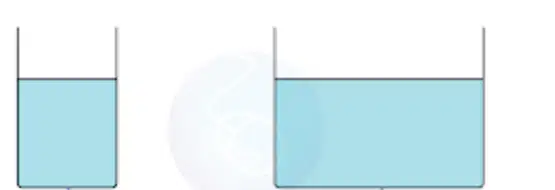
Consider two containers filled with water as shown in the figure. Which of the following statements is true about the pressure at the bottom of the containers?
The pressure at the bottom of both containers is equal
The pressure at the bottom of the first container is higher
The pressure at the bottom of the second container is higher
Pressure is independent of the height of the water column
What type of electricity is generated when two different materials are rubbed together?
Dynamic electricity
None of these
Static electricity
Frictional electricity
When water at 0°C is heated to 4°C, its density:
None of these
Decreases
Remains the same
Increases
According to Bernoulli's Principle, if the speed of air flowing under the airplane wings decreases, the pressure under the wings will:
Remain the same
Decrease if the temperature increases
Decrease
Increase
If an aircraft is loaded with cold fuel, its range will:
Increase
Decrease initially
Decrease
Range is unaffected by fuel temperature
Hydraulic machines are:
Distance multipliers
Use hydraulic fluid because it is compressible
All are correct
Force multipliers
Liquid pressure is:
Directly proportional to the depth of a liquid column
Inversely proportional to the density and depth of a liquid column
Inversely proportional to the depth of a liquid column
Directly proportional to the density and depth of a liquid column
What factors influence the location of the center of gravity in an object?
Only the shape
Only the mass
The shape and material
The shape, size, and mass distribution
In inelastic collisions:
All options are correct.
Kinetic energy is always conserved.
The colliding bodies stick together after impact.
Momentum is not conserved.
Which of the following materials is a poor thermal conductor?
Silver
Wool
Aluminium
Iron
What is the work done in moving a charge of 5 C across two points with a potential difference of 4 V?
20 J
15 J
10 J
25 J
Heat is defined as:
The stored energy in a hot body
Energy in transit
Change in temperature
None of these
In the SI system, the unit of measurement for electric charge is the:
Ampere
Coulomb
Volt
Ohm
The difference in electric pressure is called:
Volt difference
Charge difference
Electric difference
Potential difference
Direction of conventional current is from
Negative terminal to positive terminal
In both the directions
In any direction
Positive terminal to negative terminal
Calculate the work done in moving a charge of 3C across two points with a potential difference of 30V
90J
60J
120J
30J
Power is the rate of doing work. It is measured in
Watt*Seconds
Watt/Seconds
Joules/Seconds
Joules*Seconds
Molecules of matter are in constant motion. The amount of vibration or motion is dependent on
Volume
Pressure
Latent heat
Temperature
Heat transfer by conduction
Is not possible from human beings to their environment.
Does not occur from light bulbs - they are too bright.
None of these
Requires some sort of material to facilitate the heat transfer.
Which of the following is not a circuit element?
Switch
Electric current
Bulb
Wire
A sample of gas at a temperature of 20°C has a volume of 40 cm³ at a pressure of 2 x 10⁵ Pa. If the pressure is increased to 6 x 10⁵ Pa while the temperature is raised to 30°C, what will the new volume be?
13.4 cm³
13.8 cm³
10 cm³
13.5 cm³
Molecules are in continuous motion at:
Temperatures above 0 C only
Temperatures at or above 0 C only
Temperatures above 0 K only
Temperatures at or above 0 K only
The equation of continuity states that:
When a fluid flows through a pipe, its mass flow must remain constant, since mass can neither be created nor destroyed (conservation of mass).
When a fluid flows through a pipe, its velocity flow must remain constant, since velocity can neither be created nor destroyed (conservation of velocity).
When a fluid flows through a pipe, its volume flow must remain constant, since volume can neither be created nor destroyed (conservation of volume).
None of the answers is correct
If 8 seconds elapse between seeing a lightning flash and hearing the thunder, how far away is the storm? (Speed of sound = 330 m/s.)
2640 m
2500 m
2800 m
None of the above.
Calculate the kinetic energy of a cyclist with a mass of 70 kg moving at a velocity of 1.2 m/s.
50.4 J
42 J
58.8 J
None of the above.
Charles' Law gives the relationship between ______ and temperature, if pressure and mass are held constant.
Number of molecules
Density
Volume
Weight
Aircraft movement about the vertical axis is known as:
Yaw
Roll
Pitch
None of the above
A gas occupies a volume of 8 cubic meters at a temperature of 20 °C. What will be its volume when the temperature is increased to 120 °C, assuming the pressure remains constant?
10.7
12.5
10.4
None of the above
What are the two types of motion possible with balanced forces?
Not moving or moving with acceleration
Not moving or moving in curved paths
None of the other answers
Not moving or moving with constant speed in a straight line
A force of 12 N is applied to push a box across the floor. If 7.2 J of work is done, how far has the box been moved?
0.5m
0.6m
0.7m
0.8m
A heater is supplied with 5000 J of electrical energy and produces 1500 J of thermal energy. What is the efficiency of the heater?
30%
25%
None of the answers is correct
35%
The larger the power, the faster the ________ done in a unit time.
Force
None of the answers is correct
Energy lost
Work or energy transfer
Work done equals
Energy transferred
Energy lost
Energy saved
None of the answers is correct
Batteries are a source of ____________ energy which when used will be transferred into ____________ energy.
Chemical – Electrical
Electrical – chemical
Chemical – food
Nuclear – kinetic
Mechanical – thermal
An object with a momentum C was forced by an extra force to change its momentum to equal D within t seconds. Then the extra force will equal:
C - D
C + D
(C + D)/t
(D - C)/t
If a mercury barometer is taken to the top of a mountain, how would you expect the height of the mercury column to change?
It will increase
It will reduce
None of the options is correct.
It will remain the same
A box of mass 30 kg is dropped from a height of 2 meters and rebounds to a height of 0.8 meters. Calculate the energy lost due to sound, heat, etc., during the bounce:
Cannot be determined
360 J
240 J
120 J
A gas occupies a volume of 15 liters at a pressure of 3 atm and a temperature of 310 K. If the temperature is increased to 400 K and the pressure is decreased to 1.5 atm, what will be the new volume of the gas?
41.2L
10.5L
38.7L
29.4L
How much work is done in lifting a 1500 kg object to a height of 50 meters? (Assume g=10 m/s²)
750 KJ
600 KJ
7500 J
75 KJ
A constant retarding force of 40N is applied to a body of mass 10 kg moving initially with a speed of 20m/s. How long does the body take to stop?
5s
4s
6s
8s
A 3 kg object moves a distance of 45 meters in 5 seconds. What is its kinetic energy?
243J
405J
121.5J
810J
A car of mass 1500 kg is moving at a speed of 25 m/s. The driver takes 0.7 seconds to react before applying a braking force of 8000N. Calculate the thinking distance, braking distance, and stopping distance:
17.5m, 58.6m and 76.1m
none of the answers is correct
17.5m, 59.1m and 76.7m
20m, 70m and 90m
Braking distance is a function of the following variables:
brake force only
none of the answers is correct
slope, friction, initial velocity, mass and brakes force
initial velocity only
Usually, the lost energy is often converted into non useful _________ energy.
Electrical
Chemical
Heat
Mechanical
A heater is supplied with 5000 J of electrical energy and produces 1500 J of heat energy. What is the efficiency of the heater?
30%
25%
none of the answers is correct
35%
The larger the power the faster the _________ done in a unit time.
Force
none of the answers is correct
energy lost
work or energy transfer

