
Font size
 Worksheets
Countdown to the Civil War
Total questions: 20
Worksheet time: 12mins
Stimulus: "The Mexican-American War marked a significant expansion of the United States under the doctrine of Moving Westward under God. This was where U.S. forces clashed with Mexican troops over territorial disputes. President James K. Polk championed the cause, asserting that the U.S. was destined to expand across the continent. The Treaty of Guadalupe Hidalgo concluded the war, leading to the cession of a vast region, including present-day California, Arizona, and New Mexico, altering the cultural and political landscape of North America."
Based on the stimulus provided, which of the following would most likely be the title of a book that
includes this passage?
"The Dawn of the American Frontier: Exploring Unclaimed Lands"
"Manifest Destiny Fulfilled: The Expansion of the United States"
"American Independence: From Revolution to Recognition"
"Conflicts of the Americas: The Rise of U.S. Isolationism"

John Gast's painting American Progress (1872) depicts the figure of Columbia, personifying the United States, as she moves westward bringing light, technology, and settlers, symbolizing Manifest Destiny and the expansion of civilization across the American frontier.
Which of the statements would most likely come from the figures shown in the bottom left corner?
"We must move further west as our land and way of life are threatened."
"The settlers are bringing useful tools and technology that we can quickly adopt to strengthen our communities."
"This land has always been ours, and we’re pleased to share it with these travelers."
"These newcomers bring progress, and we look forward to joining their way of life."
"Slavery is a benevolent institution that provides structure and care for an inferior race, essential for maintaining the prosperity and stability of our society."
Who would most likely be responsible for making this statement in the antebellum South?
William Lloyd Garrison: Owner of the Liberator Magazine, a Bostonian Publication
Frederick Douglass: Abolitionist, former enslaved person, orator, writer, and statesmen
Joe Davis: Brother of Jefferson Davis and owner of Hurricane Planation in Mississippi
Hinton Rowan Helper: the owner of a small farm in North Carolina worked by his family.
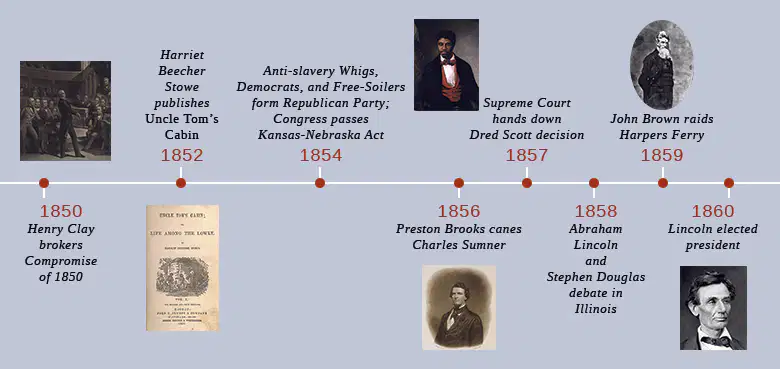
Which of the following would be the BEST title for this timeline?
"Path to Freedom: Reconstruction and the Fight for Civil Rights"
"Manifest Destiny: The Expansion of U.S. Borders in the Mid-19th Century"
"The Sectional Divide: Evolving Tensions in Antebellum America"
"The Civil War: The Pinnacle of Racism in the United States"
Stimulus: "The Compromise of 1850 was a series of legislative measures aimed at diffusing the tensions between Northern and Southern states over the issue of slavery in newly acquired territories. Crafted by Senator Henry Clay, the compromise included provisions such as the admission of California as a free state, the establishment of territorial governments in Utah and New Mexico with popular sovereignty on slavery, and a stricter Fugitive Slave Law.
While the compromise briefly alleviated sectional discord, it brought to light the growing ideological divide, particularly with the North’s resistance to the Fugitive Slave Act and the South’s increasing dependence on slavery for economic stability."
Based on the passage, which of the following would the author most likely argue about the long-term impact of the Compromise of 1850?
The Compromise of 1850 weakened both Northern and Southern economies by limiting expansion and development in the territories.
The Compromise permanently solidified popular sovereignty as the solution to determining slavery’s legality in the U.S. territories.
The Compromise successfully resolved the sectional conflicts between North and South, leading to a period of lasting peace.
The Compromise temporarily eased tensions but ultimately highlighted the irreconcilable differences between North and South over slavery.
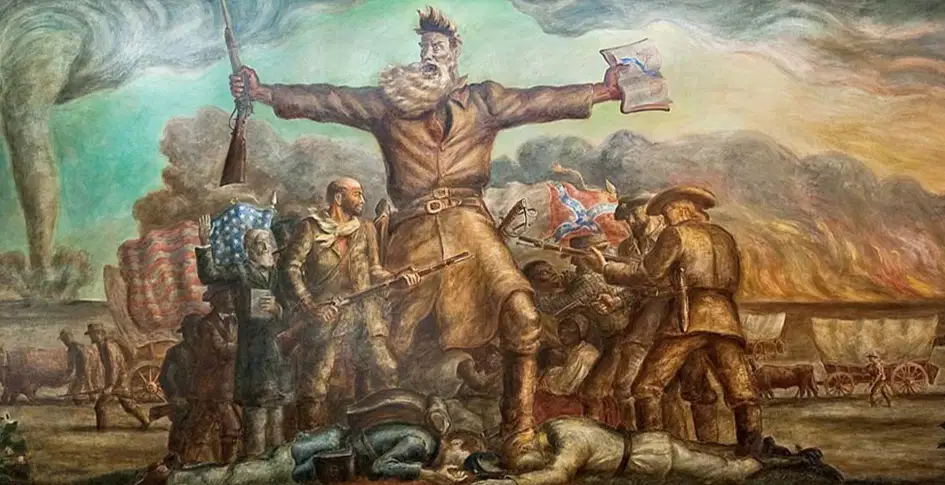
The image portrays John Brown, a radical abolitionist, who led violent attacks in Kansas in the 1850s as part of the "Bleeding Kansas" conflict over whether Kansas would enter the Union as a free or slave state. Brown’s actions, including the Pottawatomie Massacre, and later his raid on Harpers Ferry, made him a polarizing figure, viewed by some as a martyr for the abolitionist cause and by others as a violent fanatic.
Based on the symbolism in the image, which of the following best describes how John Brown is depicted in relation to his role in the abolitionist movement?
John Brown is depicted as a visionary leader, peacefully guiding others toward emancipation.
John Brown is shown as a political diplomat, negotiating a compromise between pro-slavery and anti-slavery forces.
The image portrays John Brown as a violent crusader, embodying the fierce and turbulent struggle over slavery.
The image suggests that John Brown’s influence was insignificant, with little prominence or intensity.
"The Kansas-Nebraska Act of 1854, introduced by Senator Stephen A. Douglas, allowed the territories of Kansas and Nebraska to decide the issue of slavery based on popular sovereignty. By effectively repealing the Missouri Compromise, which had previously maintained a balance between free and slave states, the act opened new territories to the possibility of slavery. This led to violent confrontations between pro-slavery and anti-slavery settlers in Kansas.
Which of the following historical events would MOST likely proceed this piece of legislation?
Bleeding Kansas
The MO Compromise
49ers and the Gold Rush
The Writing of Uncle Tom's Cabin
"There was a groan of mortal agony, and the eyes of the dying man opened; it was for a moment, but in that moment he saw the slave dealer, the man-stealer, the trafficker in human hearts, and flesh, and souls, and his last breath passed in a shuddering cry of despair."
Based on what you've read, this passage would MOST likely appear in which of the following primary sources?
Kansas Nebraska Act, written in 1854
Diary of John Sutter, a 49er
Memoir of Roger B. Taney, Justice in Dred Scott case
Uncle Tom's Cabin, fictional book written by Harriet Beech Stowe
"‘I’m in the Lord’s hands,’ said Tom; ‘nothin’ can go no furder than he lets it;—and thar’s one thing I can thank Him for. It’s me that’s sold and going down, and not you nur the chil’en. Here you’re safe;—what comes will come only on me; and the Lord, He’ll help me,—I know He will.’"
— Uncle Tom's Cabin by Harriet Beecher Stowe, 1852
Based on the excerpt, what does the character of Uncle Tom most likely symbolize within the context of the abolitionist movement?
The inferiority of the enslaved and the economic need for slavery.
The resilience of the enslaved and the moral failings of the institution of slavery.
The reality of treatment of blacks and the moral justification of slavery
The economic commitment of the Southern economy to maintain its values
The 1857 Supreme Court decision in Dred Scott v. Sandford, Chief Justice of the Supreme Court Roger B. Taney said the following:
"They (enslaved blacks) had for more than a century before been regarded as beings of an inferior order and altogether unfit to associate with the white race, either in social or political relations; and so far inferior that they had no rights which the white man was bound to respect; and that the Negro might justly and lawfully be reduced to slavery for his benefit."
Which of the following best explains the impact of this ruling on sectional tensions in the years leading up to the Civil War?
The decision called for legal philosophies like popular sovereignty which allowed Americans to use Democratic means to determine slavery's future.
The decision reduced sectional tensions by establishing a compromise on the expansion of slavery that both Northern and Southern states accepted.
The decision encouraged Northern states to secede from the Union in protest of the federal government’s support of slavery.
The decision escalated sectional tensions by suggesting that Congress had no authority rather legal or moral to restrict slavery.
Arrange the following in the sequence in which they came to be...
MO Compromise
Compromise of 1850
Kansas Nebraska act
Dred Scott Decision
Election of Lincoln
Match the Freedoms to the Amendment
This eliminated the Institution of slavery except for people duly convicted of a crime
13th Amendment
This provided citizenship rights and civil protections for newly freed Americans
14th Amendment
This granted Black men the ability to vote.
15th Amendment
This labeled enslaved people as property of the Government
Emancipation Proclamation
This divided the South into 5 Military Districts
Reconstruction Act of 1867
An excerpt from a Southern Black Code (1865) states: "No negro or freedman shall be allowed to come within the limits of the town of Opelousas without special permission from his employer."
Which of the following best explains the main purpose of such a regulation in post-Civil War Southern society?
To promote economic independence for formerly enslaved individuals
To ensure fair treatment in employment for newly freed African Americans
To reinforce white supremacy in a post-civil war society
To protect freed people’s rights to congregate in Southern towns
Excerpt from the 14th Amendment: "All persons born or naturalized in the United States…are citizens of the United States and of the state wherein they reside."
Example of a Mississippi Vagrancy Law: African Americans who were unemployed or did not have proof of employment could be arrested, fined, and forced into unpaid labor.
How did Black Codes challenge the protections intended by the 14th Amendment for newly freed African Americans?
They undermined the spirit of the amendment by allowing states to pass discriminatory laws.
They reinforced voting rights by allowing African Americans to participate in elections
They directly inhibited black citizens ability to vote freely.
They aligned state laws with federal protections under the amendment
“The Freedmen’s Bureau opened hospitals throughout the South to provide medical care to African Americans, treating thousands in the aftermath of the war.”
What does the establishment of hospitals by the Freedmen’s Bureau indicate about the Bureau’s role in post-war Southern society?
It prioritized economic assistance over social services for freed people.
It aimed to address the urgent health and welfare needs of formerly enslaved people.
It was unsuccessful in providing any lasting support for health care.
It primarily focused on serving the medical needs of Confederate veterans.
Excerpt from a letter by Frederick Douglass, 1877:
“...The abandonment of the freedmen to the mercies of their former oppressors is an act which will bring dishonor to the government. These men, who had hoped to secure their freedom and civil rights through the protection of the federal government, now find themselves betrayed by those in power.”
Based on Douglass’s perspective in this letter, what was his main criticism of the Compromise of 1877?
It ensured that Southern African Americans would maintain equal rights.
It provided a pathway for African Americans to hold political office across the South.
It promoted federal policies that expanded Reconstruction in the South.
It betrayed African Americans by withdrawing federal protection, leaving them vulnerable to racial violence and discrimination.
Two fictional newspapers publish editorials about slavery in 1850:
- The Western Homesteader argues that slavery should not spread because it threatens the independence and economic opportunity of white farmers.
- The Moral Guardian argues that slavery is a sin and must be ended everywhere in the country.
Which of the following BEST identifies which movement each newspaper reflects?
The Western Homesteader: Abolitionist Movement; The Moral Guardian: Pro-Slavery Movement
Stimulus: “A geographical line has been drawn across the Union, and all the States north of that line have united in the election of a man to the high office of President of the United States, whose opinions and purposes are hostile to slavery; and upon this ground . . . the non-slaveholding States have assumed a power inconsistent with the letter and spirit of the Constitution.” -South Carolina Articles or Reasons for Secession
Which of the following events BEST represents a motivating factor for the secession of South Carolina?
Which of the following words is MOST analogous to the term “secession” as used to describe Southern actions in 1860–1861?
Stimulus: As Sherman’s troops moved across Georgia in 1864, they tore up railroad tracks, burned factories that supplied Confederate troops, and destroyed barns, crops, and bridges. His goal was not only to weaken the Confederate Army directly but also to break the South’s ability to support the war by targeting the economic and civilian resources that sustained it.
Which of the following military strategies is BEST demonstrated by the actions described in the passage?
Anaconda Plan

