
 Worksheets
Periodic Table and Elements
Total questions: 35
Worksheet time: 20mins
The identity of an element on the periodic table is determined by the number of _______.
protons
neutrons
electrons
ions
The columns in the periodic table are called
a metal
a nonmetal
a group/family
a period
The chemical properties of an element are determined by the number of
energy levels
valance electrons
isotopes
ions

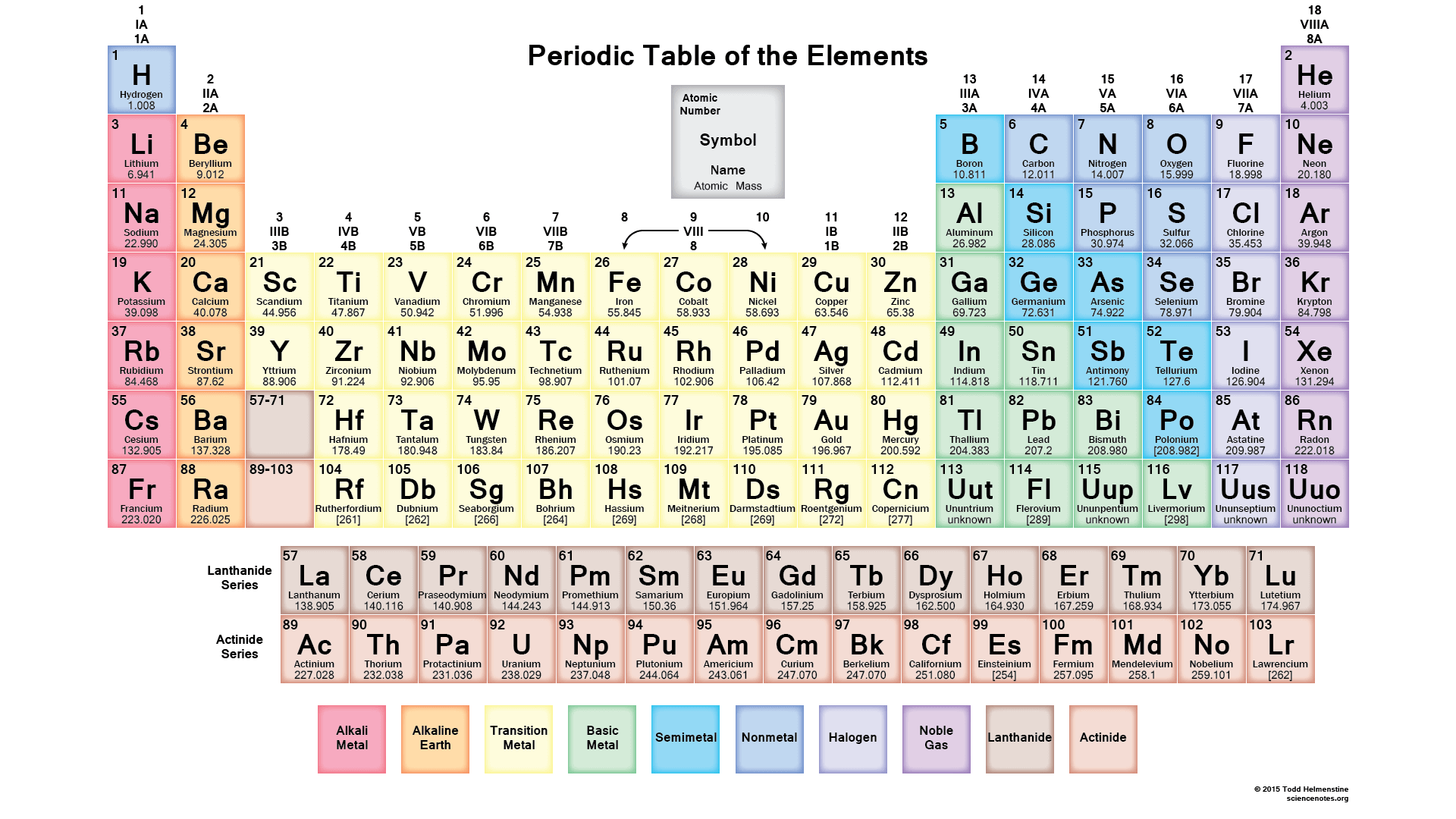
Which element has properties similar to Calcium (Ca)?
Sodium
Magnesium
Potassium

How many neutrons can be found in an atom of Na (Sodium)?
12
11
22.99
23

How many protons does Potassium (K) have?
39
19
20
39.10

What is the atomic mass of Calcium (Ca)?
40.08
20
The atomic number of an element increases from left to right across the periodic table.
True
False
When an atom gives away an electron it becomes
an isotope
a negative ion.
a positive ion.
sad.
What subatomic particle is positive and found in the nucleus?
electron
proton
neutron
quark
Every element has an unique number of _______________.
protons
neutrons
electrons
symbols

What are the red elements (those on the left)?
metals
nonmetals
metalloids

What are the blue elements (those on the right)?
metals
nonmetals
metalloids

What are the yellow "stair-step" elements?
metals
nonmetals
metalloids
What subatomic particle is found in the nucleus and is neutral?
proton
neutron
electron
What subatomic particle is negative and found outside the nucleus?
proton
neutron
electron

12
30
65
4

8
4
26
56

Vertical columns of elements that DO share chemical properties (react the same) because they have the similar ELECTRONS in their shells.
Groups
Periods

Horizontal rows of elements that DO NOT share chemical properties.
Groups
Periods

The periodic table is arranged by increasing ______ ______, which is equal to the number of protons.
atomic mass
atomic number

As you go down the Periodic Table the size and mass of the atoms _________.
increases
decreases
cannot be determined
Which element(s) is not a metal?
Which of these is a metalloid?
Na (#11)
As (#33)
O (#8)

