
NEW
Font size
 Worksheets
ka be er nov
Total questions: 15
Worksheet time: 11mins
What examination finding separates postoperative capsular block syndrome from aqueous misdirection?
elevated intraocular pressure (IOP)
peripheral choroidal detachment
space between IOL and posterior capsule
uniformly shallow anterior chamber
severe pain
After cataract surgery a patient needs an unexpectedly large myopic overrefraction. The cornea is clear, the anterior chamber is shallow and there is a large space between the IOL and the posterior capsule. IOP is 14mmHg. What appears to be the etiology of this refractive surprise?
Incorrect IOL power for target refraction
inverted IOL
Capsular bag distension syndrome
IOL in sulcus instead of the capsular bag
IOL decenteration
A 42-year-old man with adult-onset diabetes mellitus reports worsening vision at distance over the past 6 months. He has not worn eyeglasses or contact lenses but ask about possibility of LASIK to correct his vision. He says that his blood glucose levels have ranged between 175 and 350 mg/dL (9.642—19.284 mmoVL) during the past 2 years, and his most recent HbAlc was 8.5. Corrected distance visual acuity is 20/15 in each eye (right eye, 2.50 sphere; left eye, 2.00 sphere), and findings from the ophthalmologic evaluation are other-wise normal. What is the most appropriate initial management?
glucose control prior to evaluation
contact lens fitting
eyeglass correction
LASIK surgery
RLE
What is the best preferrable intraocular lens for patient with history of uveitis?
Placing a acrylic lens in the ciliary sulcus if lens cannot inserted on the capsular bag
Acrylic PCIOLs placed in the capsular bag
Placing a lens in the anterior chamber if lens cannot inserted on the capsular bag
Silicone lens implanted in the capsular bag
Silicone lens in the ciliary sulcus with optic capture
What finding is confirmatory for post cataract cystoid macular edema?
Is tipically symptomatic and permanent
Petaloid hyperfluorescent pattern on fluorescein angiography
Response to corticosteroids and prostaglandin inhibitor eyedrops
Hyporeflective cystic spaces in outer plexiform layer by OCT
heals itself overtime
An eye with extreme increased axial length may be susceptible to what intraoperative issue?
Higher risk of iris prolapse
Lens iris diaphragm retropulsion syndrome
IFIS
Higher risk of endothelial damage
Higher risk of PCR due to trampoline effect
What technique to prevent posterior chamber rupture in patient with Posterior Polar Cataract?
Always do complete hydrodissection to release the posterior cataract
Maintain the AC depth with OVD and high bottle of irrigation
Perform gentle hydrodelineation,leaving a generous amount of epinuclear bowl
Deliver excessive of fluid around the cortex up and cross
Avoid do hydrodelineation due to posterior capsule adhesions
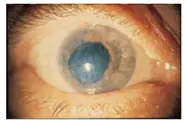
An 82-year-old woman underwent uncomplicated intracapsular cataract surgery 20 years ago. No intraocular lens implant was inserted. Her aphakic vision was good up until several years ago, when a gradual loss of vision developed. Her vision has now dropped to 20/100. The slit-lamp appearance of the eye is shown in the figure. Important details in her history and physical exam whould not include which of the following?
High intraocular pressure due to secondary closed angle glaucoma
Vitreous touching the endothelium
Intact hyaloid face but DMD
Amount of corneal endothelial cell count
exposure keratopathy due to lagophthalmos
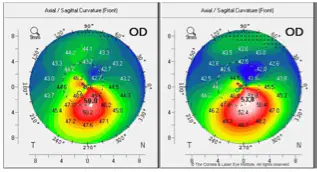
Following cataract surgery with implantation of toric-IOL, the patient is very unhappy with the postoperative best-corrected vision. Given the preoperative topography shown (K1 53,8; K2 50,9), what preferred management would you suggest?
Soft contact lens fitting
PKP
Rigid gas permeable contact lens fitting
Piggy back IOL
IOL exchange
A 65-year-old man that had an uneventful phacoemulsification one day before, came for 1 day follow-up. visual acuity was 6/12, there is minimal corneal oedema with a positive Seidel test. anterior chamber depth was Van Herrick grade II, with a round , central, regular pupil, and IOL (+) in-the-bag. what is the best management for this case?
Reform the anterior chamber immediately
Observation, ask the patient to come again in one week
Suture the wound immediately
Cycloplegic eye drop and closed monitoring
Bandage contact lens
The following are true about the crystalline lens:
Potassium (K+) levels are low (≈10 mmol/L), and sodium (Na+) levels are high (≈120 mmol/L)
Contributes more power than the cornea towards the refraction of the eye
If extracted without implant can correct myopia who needs spectacle correction of minus 15.00 D
Proteins constitute 33% of the weight of the lens, which is 2–3 times higher than other tissues in the body
Has an uniform refractive index
Secondary to the rapid compression of the eye on the anterior-posterior axis and the expansion that immediately follows, the Wiegert ligament causes the lens capsule to tear. The following statement regarding the ligaments is correct..
Attachment of the vitreous to the posterior capsule of the lens
Attachment to the anterior lens capsule beyond the zonule of zinn
Attachment of the superior oblique tendon muscle
Associated with the ciliary body and Burger space
Associated with the choroid and Burger space
An Intra Ocular lens ( IOL ) placed in the capsular bag following cataract extraction , has moved toward the cornea over 6 weeks after surgery. What is the refractive change that would be expected from this anterior movement?
Hyperopic shift
no effect
myopic shift
slight astigmatism
not determinable
Cataract surgery can increases the risk of worsening retinopathy in patients with diabetes melitus. This risk can best be reduced by which one of the following?
Treating preexisting proliferative diabetic retinopathy with panretinal photocoagulation
Implanting an acrylic or polymethylmethacrylate intraocular lens
Focal photocoagulation prior to development of diabetic macular edema
It is more advisable to perform small incision manual cataract surgery rather than phacoemulsification
It is more advisable to perform extracapsular cataract extraction rather than phacoemulsification

What is true about the image of slitlamp biomicroscopy examination of A 41-year-old man with liver cirrhosis of unknown aetiology for 6 years below are..
Narrow iridocorneal angle, snowflake cataract
Kayser-Fleischer ring in central kornea, posterior subcapsular cataract
Kayser-Fleischer ring in peripheral kornea, stelate cataract
Kayser-Fleischer ring in peripheral kornea, sunflower cataract
Fleischer ring, keratoconus, posterior polar cataract

