Wayground logo

Free Printable Worksheets

Font size

S
M
L
XL
Worksheets

Geologic Time Scale: Learning Check

Total questions: 30

Worksheet time: 2hrs 39mins

Name
Class
Date
1.
What is the purpose of the geologic time scale?
a)
To identify when events occurred in Earth's history
b)
To explain the formation of Earth
c)
To study the composition of rocks
d)
To predict future events in Earth's history
2.
What is the significance of fossils in dating Earth's history?
a)
They provide evidence of future events in Earth's history
b)
They provide evidence of organisms that existed during a previous time in Earth's history
c)
They provide evidence of the formation of rocks
d)
They provide evidence of the composition of rocks
3.
What is the significance of rock layers in dating Earth's history?
a)
They provide evidence of future events in Earth's history
b)
They provide evidence of the formation of rocks
c)
They provide evidence of when rocks existed
d)
They provide evidence of the composition of rocks
4.
Which period are we currently in?
a)
Quaternary
b)
Holocene
c)
Jurassic
d)
Tertiary
5.
Paleontologists infer that the earth is approximately how many years old?
a)
4.5 million years
b)
450 million years
c)
450 billion years
d)
4.5 billion years
6.
The era that dinosaurs ruled the Earth's land, air and oceans.
a)
Cenozoic
b)
Paleozoic
c)
Precambrian
d)
Mesozoic
7.

What type of event usually marks the end of an Era

a)

A Mass Extinction

b)

A Quinceanera

c)

An earthquake

d)

A Volcanic Eruption

8.

What are the four eras in order from OLDEST to NEWEST?

a)

Pre-Cambrian, Paleozoic, Mesozoic, Cenozoic

b)

Pre-Cambrian, Mesozoic, Paleozoic, Cenozoic

c)

Cenozoic, Mesozoic, Paleozoic, Pre-Cambrian

d)

Mesozoic, Pre-Cambrian, Cenozoic, Paleozoic

9.

Index fossils represent __________ that existed on earth for short periods of time.

a)

books

b)

molecules

c)

minerals

d)

species

10.

_____________ is the sequencing of events based on the order in which they occurred.

a)

Relative Dating

b)

Absolute Dating

c)

Geologic Time

d)

Fossils

11.

_____________ is determining the exact age, in years, of a rock or fossil through radiometric dating.

a)

Relative Dating

b)

Absolute Dating

c)

Geologic Time

d)

Fossils

12.

A __________is the amount of time it takes for a parent isotope to decay to half of its original value

a)

Law of Original Horizontality.

b)

Daughter Isotope

c)

Parent Isotope

d)

Half life

13.

Examine the image here. Which organism appeared first?

a)

Gastropod

b)

Trilobite

c)

Crinoid

d)

Coral

e)

Ammonite

14.

Examine the image here. Which organism appeared last?

a)

Gastropod

b)

Trilobite

c)

Crinoid

d)

Fern

e)

Ammonite

15.
To be considered an index fossil, it had to have lived for a relatively short period of time.
a)
True
b)
False
16.
The Law of Superposition helps scientists to determine what?
a)
The absolute age of rock layers
b)
The age of fossils
c)
The relative age of rock layers
d)
the super powers of rocks
17.
An organism that no longer exists on Earth is called
a)
Decayed
b)
Evolved
c)
Extinct
d)
Preserved
18.

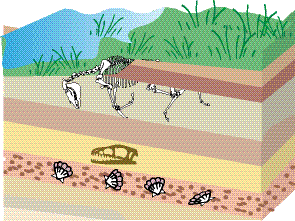
According to the law of superposition, the youngest fossils are found 

a)
At the top of the rock layers
b)
Near the bottom of the rock layers
c)
In the middle of the rock layers
d)
Somewhat near the surface
19.
The best index fossils have which two traits?
a)
widespread geographically, long lifespan
b)
widespread geographically, short lifespan
c)
specific place, long lifespan
d)
specific place, short lifespan
20.

Layer B on side #1 (left) is a match to which layer on side #2 (right)?

a)

z

b)

y

c)

w

d)

there is no match

21.

Examine the image here. Ferns appeared on Earth ____________ coral.

a)

before

b)

after

22.

Examine the image here. Gastropods appeared on Earth ____________ ammonites.

a)

before

b)

after

23.
Fossils of species that existed for  short periods and were widespread 
a)
trace fossils 
b)
index fossils 
c)
original remains 
24.
What is an example of an index fossil?
a)
t-rex fossils
b)
insect in amber
c)
trilobites or ammonites
d)
woolly mammoth fossils
25.
According to the law of superposition, the oldest fossils are found 
a)
At the top of the rock layers
b)
Near the bottom of the rock layers
c)
In the middle of the rock layers
d)
Somewhat near the surface
26.
Which rock layer in the diagram seems to be the oldest?
a)
F
b)
E
c)
B
d)
A
27.
Which Rock layer or intrusion is the youngest?
a)
A
b)
B
c)
C
d)
D
e)

E

28.

Which Rock layer or intrusion is the oldest?

a)
A
b)
B
c)
C
d)
D
e)

E

29.

What is the best reason that fossil #4 is NOT a good index fossil?

a)

It is not widespread

b)

it is not short-lived (in numerous layers)

c)

It is in half of the outcrops

30.

Why are there more animal fossils than plant fossils?

a)

Animals are smaller than plants.

b)

Plants have harder bodies than animals.

c)

Plants have softer bodies than animals.

d)

Animals eat plants.