
 Worksheets
Database Management baby
Total questions: 61
Worksheet time: 31mins
Data are known ___
Information
Facts
Decision
Tables
Data can be represented in ___
Alphabets and special characters
Only digits
Only alphabets and digits
Alphabets, digits and special characters
File is a collection of related data stored in secondary memory. All the following are disadvantages of the file organization approach except
Data is related
Difficulty in accessing data
Data isolation
Integrity Problems
What is the full form of DBMS?
Data of Binary Management System
Database Management System
Database Management Service
Data Backup Management System
What is a database?
Organized collection of information that cannot be accessed, updated, and managed
Collection of data or information without organizing
Organized collection of data or information that can be accessed, updated and managed
Organized collection of data that cannot be updated
Which of the following is a feature of the database?
No-backup for the data stored
User interface provided
Lack of Authentication
Store data in multiple locations
Which of the following is not a function of the database?
Managing stored data
Manipulating data
Security for stored data
Analysing code
Which of the following is a function of the DBMS?
Storing data
Providing multi-users access control
Data Integrity
All of the above
What does an RDBMS consist of?
Collection of Records
Collection of Keys
Collection of Tables
Collection of Fields
Entity is a thing or object in the ___
Entity relationship diagram
Real world
Enhanced entity relation diagram
Database
In a given ERD scenario, entities are mostly identified using ___
Noun
Their cardinality
Their relationship type
Proper noun
Logical data refers to the data for the table created by the user in the ____
Primary memory
Secondary memory
All of the above
None of the above
Physical data refers to the data for the table created by the user in the ____
Primary memory
Secondary memory
All of the above
None of the above
The three level of architecture in the DBMS are
ERD, EER, SQL
Entity, attribute, cardinality
External, conceptual, internal
DBA, DA, DBMS
Application programmers and online users are example of database users. Another example of database user is ___ user
MySQL
Naïve
ERD
Entity
All the following are database language except ___
Data definition language
Data manipulation language
Data control language
Database administrator language
Data definition language enable users to __
Create tables in the database
Manipulate table records in the database
Specify user authorization to the table data
None of the above
Data control language enable users to __
Create tables in the database
Manipulate table records in the database
Specify user authorization to the table data
None of the above
Data manipulation language enable users to __
Create tables in the database
Manipulate table records in the database
Specify user authorization to the table data
None of the above
Data control language enable users to __
Create tables in the database
Manipulate table records in the database
Specify user authorization to the table data
None of the above
Data manipulation language enable users to __
Create tables in the database
Manipulate table records in the database
Specify user authorization to the table data
None of the above
Which of the following gives a logical structure of the database graphically?
Entity-relationship diagram
Entity diagram
Database diagram
Architectural representation
The entity relationship set is represented in E-R diagram as
Double diamonds
Undivided rectangles
Dashed lines
Diamond
An entity set that cannot exist without the existence of another entity is termed as a __________
Strong entity set
Variant set
Weak entity set
Variable set
Which of the following gives a logical structure of the database graphically?
Entity-relationship diagram
Entity diagram
Database diagram
Architectural representation
The entity relationship set is represented in E-R diagram as
Double diamonds
Undivided rectangles
Dashed lines
Diamond
An entity set that cannot exist without the existence of another entity is termed as a __________
Strong entity set
Variant set
Weak entity set
Variable set
Weak entity set is represented as ___
Underline
Double line
Double diamond
Double rectangle

The relationship between Customer and Order is ___
Many-to-Many
Zero-to-Many
Zero-to-One-to-Many
One-to-Many

The maximum cardinality is ___ for Customer and __ for Order
Many and One
One and Many
Zero and Many
Many and Many

The minimum cardinality for both entities is ____
Many
Optional
Optional or One
one
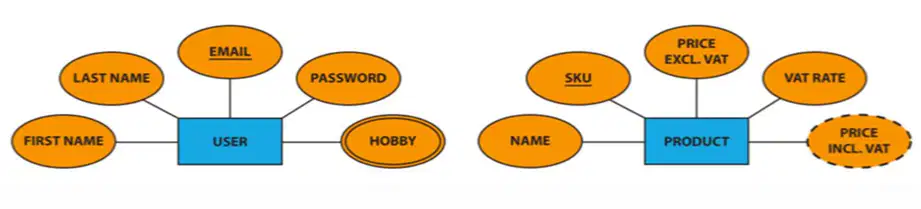
The ___ attribute is a multivalued attribute
Hobby
Price
SKU
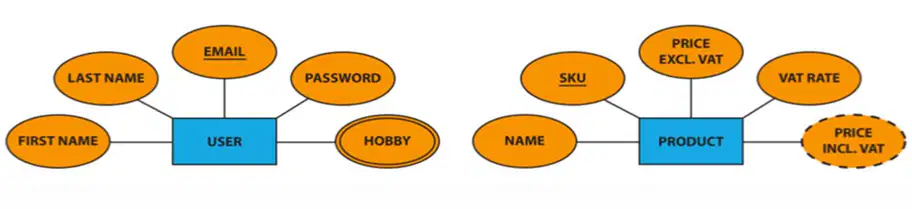
The ___ attribute is a derived attribute
Hobby
Price
SKU
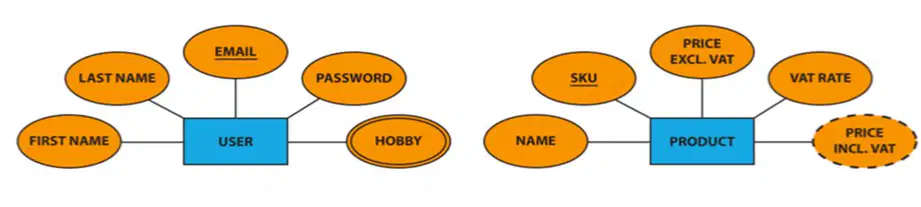
The possible attribute in the Product entity that could be used as foreign key in the User entity is __________
Hobby
Price
SKU
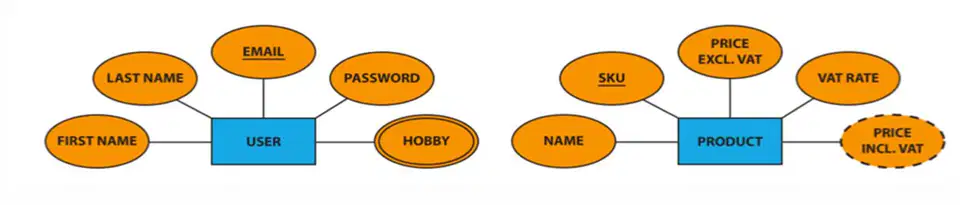
The possible attribute in the User entity that could be used as foreign key in the Product entity is __________
Hobby
Price
SKU
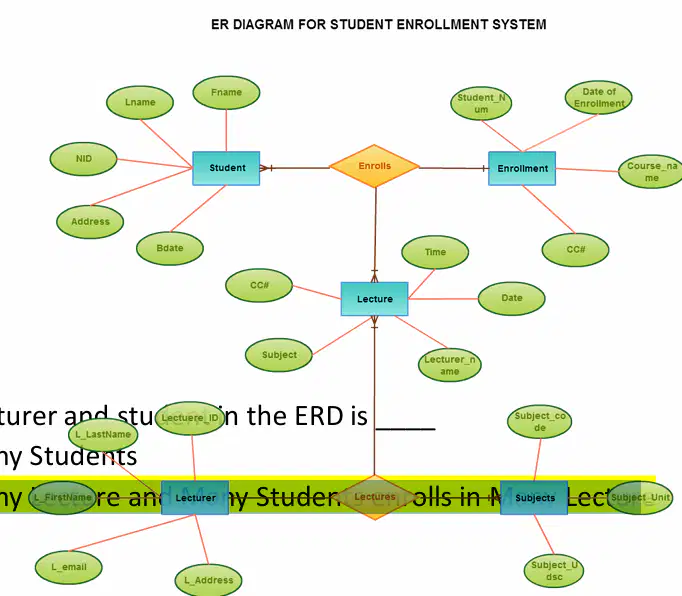
The relationship between Lecturer and student in the ERD is ____
One Lecturer lectures Many Students
One Lecturer lectures Many Lecture and Many Students enrolls in Many Lecture
Only A
Only B
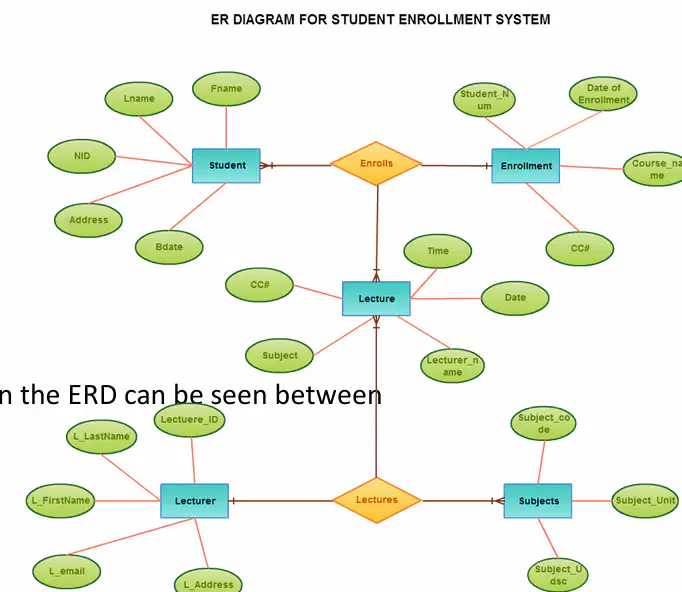
The Many-to-Many relationship in the ERD can be seen between
Subjects and Lecture
Student and Lecture
Only A
A and B
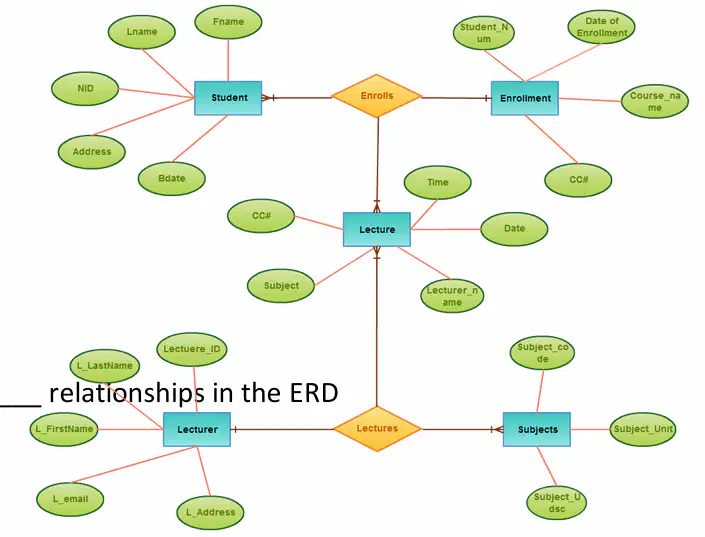
There are 5 entities and ___ relationships in the ERD
1
2
3
4
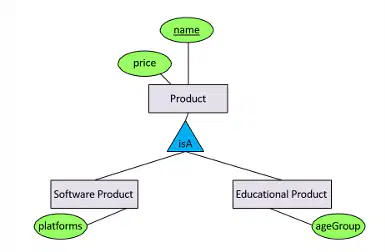
Which of the following is not true about the model
Software product is a subclass of product
Product “is a” software product
Educational product is a child of product
Product is a generalized superclass
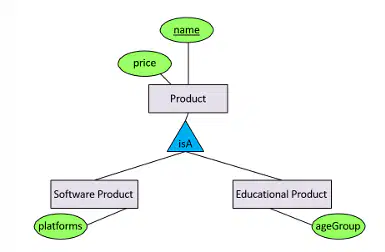
The software product entity has the following attributes
Name, price, and ageGroup
Price, name, platforms, and ageGroup
Price, name, and platforms
Product, software product, educational product
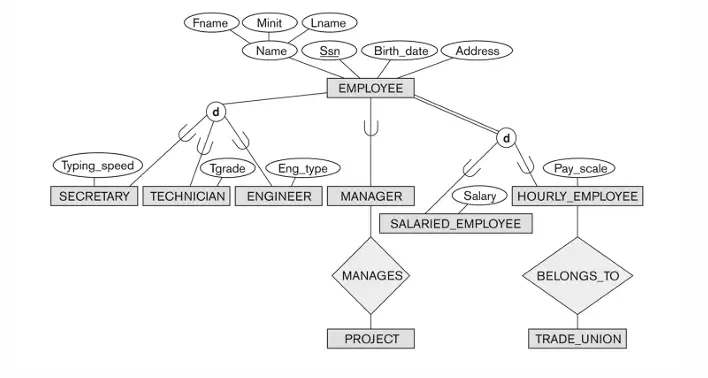
How many specialization of Employee are shown in the EERD
4
5
7
2
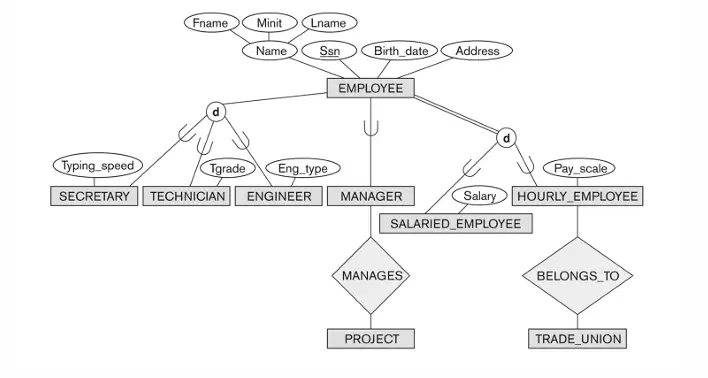
___ is not a specialization of Employee
Secretary
Manager
Engineer
Project
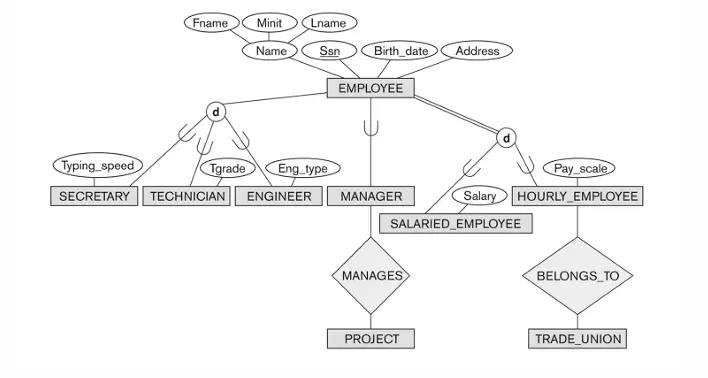
Without counting any subclass entity, how many entities are shown in the EERD?
4
5
3
2
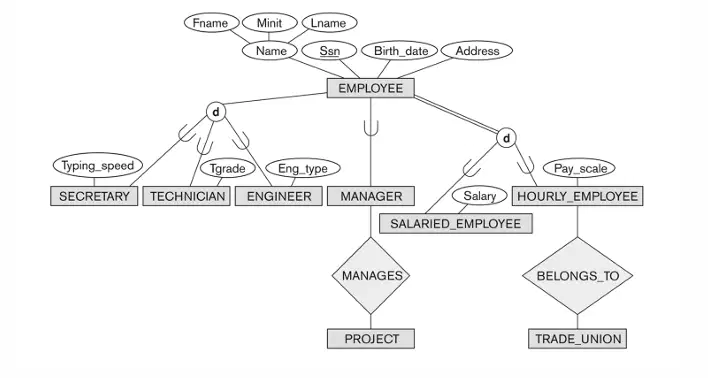
The following are local attributes belonging to the Employee subclasses
Typing_speed, Tgrade, and Eng_type
Salary, Pay_scale, and Employee
Employee, Project, and Trade_union
Employee, Manager, and Project
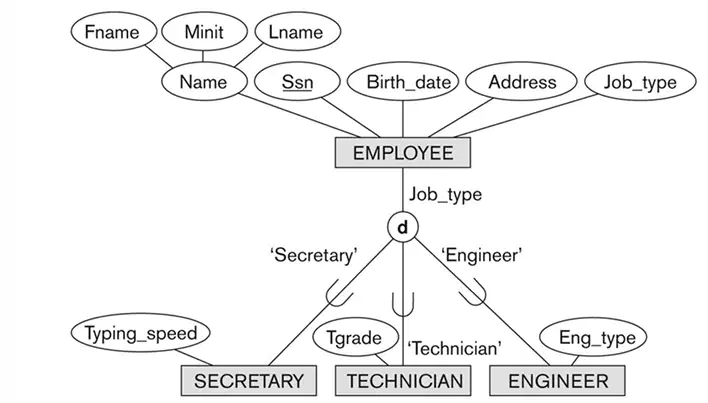
The 3 subclasses of Employee are all attribute defined specialization based on the ___ attribute
Ssn
Name
Job_type
disjoint
The basic constraints that can apply to specialization/generalization are
Disjoint, IS-A, and Overlapping
Total and Partial
Specialization and Generalization
Disjointness, Overlapping, and Completeness
If the subclasses are disjoint, then an entity occurrence can be a member of ___
Only one of the subclasses
Many subclasses
All of the above
None of the above
___ applies when an entity occurrence may be a member of more than one subclass
Overlapping constraint
Disjoint constraint
Total constraint
Partial constraint
Which of the following is a disjoint constraint
{mandatory}
{or}
{and}
{optional}
Which of the following is an overlapping constraint
{mandatory}
{or}
{and}
{optional}
Which of the following is a completeness total constraint
{mandatory}
{or}
{and}
{optional}
A subclass with more than one superclass is called a ___
Tree subclass
Specialized subclass
Shared subclass
Generalized subclass
In a lattice or hierarchy, a subclass inherits attributes not only of its direct superclass, but also of all its predecessor
Subclasses
Superclasses
All of the above
None of the above
What will be the output of the following MySQL command? SELECT * FROM employee WHERE title=’HEAD TELLER’;
All columns and rows belong to table employee
All columns but only those rows which contain ‘HEAD TELLER’ as a “title”
All columns don’t belong to table employee
None of the mentioned
What will be the output of the following MySQL command? SELECT * FROM employee WHERE (title=’HEAD TELLER’) AND (start_date=2013-01-24);
All columns and rows belong to table employee
All columns but only those rows which contain ‘HEAD TELLER’ as a “title” and 2013-01-24 as a “start_date”
All rows belong to table employee
None of the mentioned
What will be the output of the following MySQL command? SELECT emp_id, fname, lname FROM employee WHERE title=’HEAD TELLER’ AND start_date=2008-11-24;
All columns
Only those columns which are mention with “SELECT” clause
Columns mention with “SELECT” clause and only those rows which contain ‘HEAD TELLER’ as a “title” and start_date as 2008-11-24
None of the mentioned
What will be the output of the following MySQL command? CREATE table PERSON(ID int(10), Name varchar(20), Phone varchar(10), Address varchar(100));
A table within database with new name will be created
New table named person without attributes will be created
A Person table with four attributes will be created
None of the above
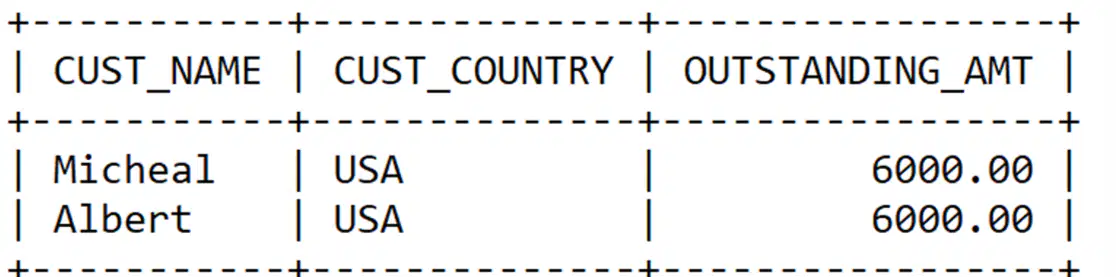
What MySQL query will generate the following table?
select CUST_NAME, CUST_COUNTRY, OUTSTANDING_AMT FROM customer WHERE CUST_COUNTRY = 'USA' AND OUTSTANDING_AMT > 3000;
select CUST_NAME, CUST_COUNTRY, OUTSTANDING_AMT FROM customer WHERE CUST_COUNTRY = 'USA' AND OUTSTANDING_AMT >= 3000;
A and B
None of the above
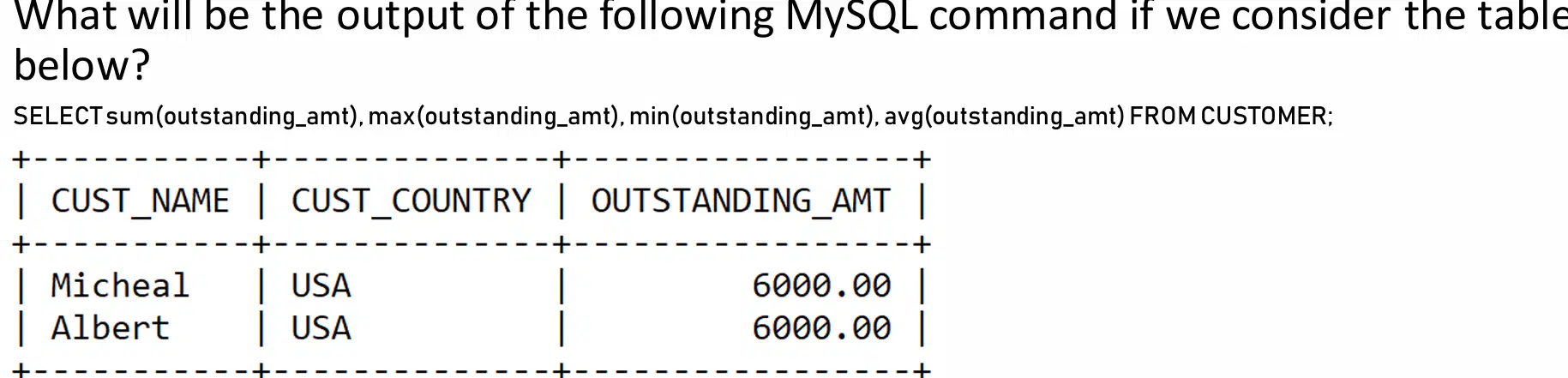
What will be the output of the following MySQL command if we consider the table below? SELECT sum(outstanding_amt), max(outstanding_amt), min(outstanding_amt), avg(outstanding_amt) FROM CUSTOMER;
600, 6000, 12000, and 600
6000, 12000, 6000, and 9000
12000, 6000, 6000, and 6000
3000, 6000, 12000, and 600
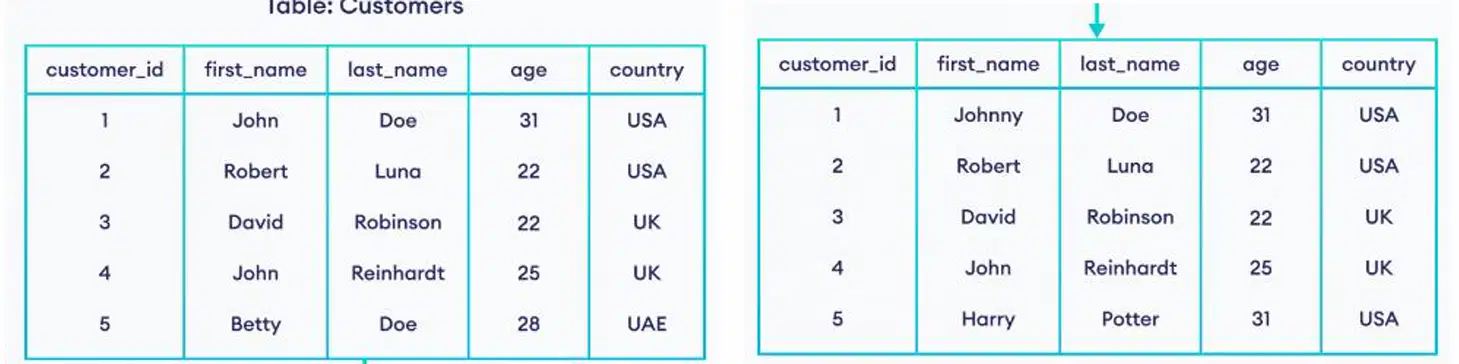
The following query will add the Harry Potter record to the table on the right-hand side.
Alter table customer add customer_id= 5, first_name= Harry, last_name= Potter, age = 31, and country = ‘USA’;
Insert into customer values(5, ‘Harry’, ‘Potter;, 31, ‘USA’);
Insert into customer values(5, ‘Harry’, ‘Potter’, 31, ‘USA’);
Insert into customer value(5, ‘Harry’, ‘Potter’, 31, ‘USA’);
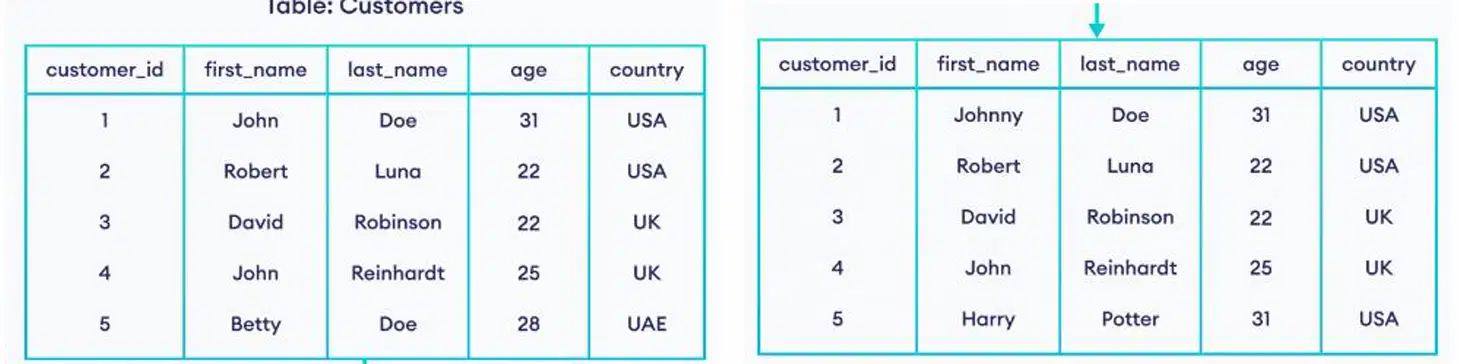
The following query will change John from the left-hand table to Johnny as in the right-hand table
Alter table customer change first_name= ‘Johnny’ where first_name= ‘John’;
Update from customer first_name= ‘Johnny’ where customer_id= 1;
Alter table customer update first_name= ‘Johnny’ where customer_id= 1;
Update customer set first_name= ‘Johnny’ where customer_id= 1;

