
 Worksheets
Exponential & Logarithmic Quest Practice Problems
Total questions: 270
Worksheet time: 16hrs 44mins
log381
log525
log416
log41

1/2
√2
2
-2
log81
0
1
2
8
log5125
0
1
2
3
log749
0
1
2
3
log6216
0
1
2
3
log3 271
0
-1
-3
3
log2 321
5
-5
6
-6
log 10
0
1
-1
2
log 100
0
1
-2
2

100
2
10
1

2
-2
-1/2
1/2
1/2
√2
2
-2

0
1
8
1/8

-3
1/3
3
-25
Evaluate Log 1001
2
3
101
-2
Evaluate log3 (31)
1
-1
31
3.33
Rewrite logx95 = 2.3
x2.3 = 95
952.3 = x
2.395 = x
x95 = 2.3
Rewrite 1.6(x+2) = 14.1
log1.614.1 = x+2
log1.6(x+2) = 14.1
log14.1(x+2) = 1.6
log(x+2)1.6 = 14.1
Without a calculator, evaluate log41
1/4
0
-1
not possible
List the following in order, least to greatest:
A) log5 30
B) log0.25 32
C) log7 49
D) log8 40
A,B,C,D
A,B,D,C
B,D,C,A
B,D,A,C
Evaluate log125 25
2/3
3/2
1/6
1/5
Evaluate log28
(a)
Evaluate log864
(a)
Evaluate log77
(a)
Evaluate log381
(a)
Evaluate log101000
(a)
Evaluate log61
(a)
Evaluate log881
(a)
Evaluate log7491
(a)
Evaluate log55
(a)
Evaluate log93
(a)
logx1000=3
1
10
30
3
log8(4x+4)=2
15
12
10
3
f(x)=-(1/3)x+4 ?
f(x)=5x-6-3 ?
f(x)=13(0.5)x-6 ?
f(x)=-2(3)x+4-8 ?
f(x)=-19-x
f(x)=4/5(.8)x-9
f(x)=-3(1.75)x-4+6


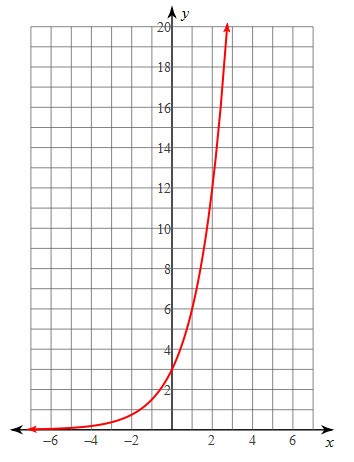
Is the pictured graph exponential growth, exponential decay, or linear or none?
Exponential Growth
Exponential Decay
Linear
None
Which is the best graph for f(x)=2(3x) ?


Which graph represents y=21⋅4x


Does the function represent exponential growth or decay?
Decay
Growth
Identify the y-intercept of the graph of the exponential function:
y=3(21)x(3,0)
(1/2, 0)
(0,0)
(0,3)

What is the intercept of the exponential function?
(0, 3)
(3, 0)
(6, 0)
(0, 6)

Which definition defines growth?
B is greater than 1
B is less then 1
B is less than 0
B is in greater than 0 but less than 1
Which definition defines decay
B is less then 1
B is greater than 1
B is greater then 0 but less then 1
B is less then 0
Growth or Decay?
Growth
Decay

In the following decreasing exponential graph
the base is greater than one
the base is between 0 and 1
the base is zero
the base is a negative value
This is the horizontal line which the values of the function cannot fall below :
Asymptote
Growth Factor
Axis of symmetry
Curve
Which graph represents y=21⋅4x
Which is the best graph for f(x)=−3x ?


Which is the best graph for f(x)=2(3x) ?

Use the graph to help!
Range: y>0
Range: y>1
Range: y>0
Range: y>0


Select all the transformations that apply.
y = -2 log 1/2 x
Vertical stretch by 2
Vertical shrink by 1/2
Reflection across the y-axis
Reflection across the x-axis
Find the corresponding graph of
−log4(x+1)+2


R: all real numbers
R: y ≥ 0
R: y ≥ 3
R: y ≤ 3

Which equation is the inverse of the equation above?


Which graph best represents the following logarithmic function?
y=log4x


Which graph best represents the following logarithmic function?
y=log2x
Which graph best represents the following logarithmic function?
y=log4x
Which graph best represents the following logarithmic function?
y=log2x
Which function has a horizontal asymptote?
exponential
logarithm
both
neither
Which function has a vertical asymptote?
exponential
logarithm
both
neither

Classify the following graph.
Exponential Growth
Exponential Decay
Logarithmic
Rational


What is the domain of log(x)?
(-∞, ∞)
[0, ∞)
(0, ∞)
(∞, -∞)

What is the range of log(x)?
(-2, 4)
(-∞, ∞)
(-∞, 0)
(∞, -∞)

What is the x-intercept of log7(x)?
(2, 0)
(-1, 0)
(0, 1)
(1, 0)
When creating a graph for f(x)=log7(x), what should be typed into the graphing calculator?
y1 = log(7)x
y1= log(7x)
y1= log(x) / log(7)
y1= log(7) / log(x)
Rewrite in log form: 63=216
log3216=6
log2166=3
log63=216
log6216=3
Rewrite in exponential form: log525=2
25=25
525=2
52=25
252=5
Which the following graphs shows an exponential decay equation?


Which function best describes the following graph?
Logarithmic
Exponential
Rewrite in log form: 25=32
log232=5
log25=32
log532=2
log325=2
Rewrite in exponential form: log23 1=0
231=0
230=1
023=1
123=0
What is the domain and range of the exponential function y=2x ?
D: (0, ∞)
R: (−∞, ∞)
D: (−∞, ∞)
R: (0, ∞)

Which graph is representative of the equation?


Which equation is representative of the graph?
y=2(3)x
y=3(1/2)x
y=-2(3)x

Which equation is representative of the graph?
y=4(1/2)x
y=1/2(4)x
y=4(2)x
y=-8(1/2)x
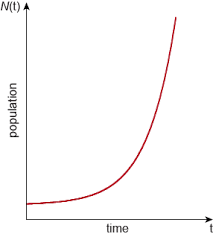
Is the pictured graph exponential growth, exponential decay, or logarithmic?
Logarithmic
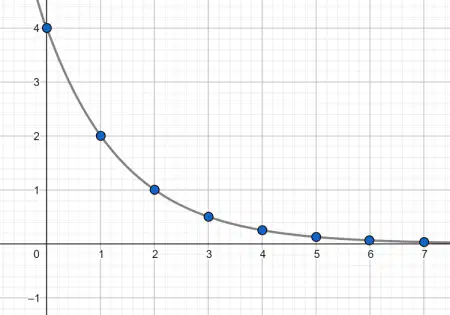
Is the pictured graph exponential growth, exponential decay, or logarithmic?
Logarithmic
Classify the following graph.
Exponential Growth
Exponential Decay
Logarithmic
What is the domain of log(x)?
(-∞, ∞)
(-∞, 0)
(0, ∞)
(0, 8)
What is the range of log(x)?
(-2, 4)
(-∞, ∞)
(-∞, 0)
(0, ∞)

What is the asymptote of the exponential function?
y = 0
y = -3
x = 0
x = -3
What is the asymptote of the logarithmic?

Identify the asymptote of the transformed graph log2(x+3) shown in red in the graph
x=−3
x=3
y=3
y=−3

What is the asymptote of y = 2x - 3
y = 0
y = -3
x = 0
x = -3

What is the range of the function graphed?
(-∞, ∞)
(-∞, 2] and [2, ∞)
[2, ∞)
(-∞, 2]
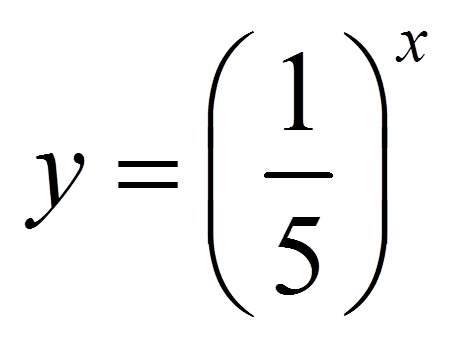
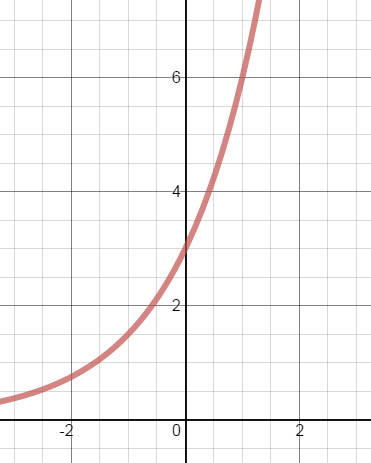
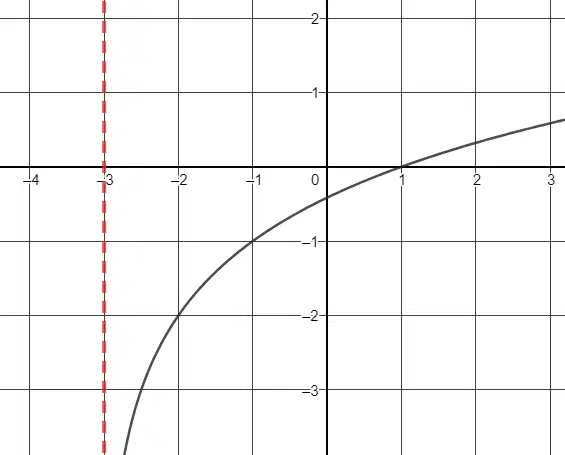
Select the correct function for the graph.
f(x)=log2(x+3)−2
f(x)=log2(x−3)−2
f(x)=2(x+3)−2
f(x)=2(x−3)−2

Select the correct function for the graph.
f(x)=log2(x+3)−2
f(x)=log2(x−3)−2
f(x)=2(x+3)−2
f(x)=2(x−3)−2

Select the correct function for the graph.
f(x)=log2(x+3)−2
f(x)=log2(x−3)−2
f(x)=2(x+3)−2
f(x)=2(x−3)−2

Select the correct function for the graph.
f(x)=log2(x+3)−2
f(x)=log2(x−3)−2
f(x)=2(x+3)−2
f(x)=2(x−3)−2

Select the correct function for the graph.
f(x)=(21)x+3
f(x)=(21)(x+3)
f(x)=log21(x+3)
f(x)=log21x+3

Select the correct function for the graph.
f(x)=(21)x+3
f(x)=(21)(x+3)
f(x)=log21(x+3)
f(x)=log21x+3

Select the correct function for the graph.
f(x)=(21)x+3
f(x)=(21)(x+3)
f(x)=log21(x+3)
f(x)=log21x+3

Select the correct function for the graph.
f(x)=(21)x+3
f(x)=(21)(x+3)
f(x)=log21(x+3)
f(x)=log21x+3
y=log2x−4
Which statement is true?
This functions shifts down 4
This function shifts up 4
This functions shifts right 4
The asymptote is horizontal
Using the parent function y=2x what would the graph of y=2x + 1 look like?
Horizontal Shift to the right 1 unit
Horizontal shift to the left one unit
Vertical shift one unit up
Vertical shift one unit down
What are the transformations of this graph?
f(x)=log2(x−1)+5
Right 1 Up 5
Right 1 Down 5
Left 1 Up 5
Left 1 Down 5
f(x)=log2(x+3)+5
Describe the asymptote of this function.
vertical
horizontal
there is both a horzontal and vertcal asymptote
Which function has a horizontal asymptote?
exponential
logarithm
both
neither
Which function has a vertical asymptote?
exponential
logarithm
both
neither
Which graph is exponential decay


y=(21)x−5+3
Describe the asymptote of this function.
horizontal
vertical
not enough information
What is the Domain?
What is the Range?
Determine the horizontal asymptote for the function
f(x) = 3(2)x-4 + 5
x=4
y=4
x=5
y=5
What is the transformation?
y=4(x+5)
Left 5
Right 5
Up 5
Down 5
Domain of y=log6(x) ?
(−∞, ∞)
(0, ∞)
(−∞, 0)
[0, ∞)
Write the equation of the function f(x)=log3x after the following transformations:
Translate 6 units left and 4 units up.
g(x)=log3(x+6)+4
g(x)=log3(x+4)-6
g(x)=log3(x-6)+4
g(x)=3log(x+6)+4
f(x) = log 3 (x + 1)?
Find the asymptote for the following.
y=log3(x+1)+5
x = -1
x = 1
y = 5
y = -5
List the range for the following.
y=log3(x+1)+5
(-∞,∞)
(-1, ∞)
(5,∞)
(1, ∞)
Find the corresponding graph of
log3(x−1)+4


Which graph matches the equation?


Which graph matches this equation?


Which graph matches this equation?


Mrs. W is raising bunnies for Easter. She currently has 5 bunnies and expects the number of bunnies to increase 55% each year. What equation below represents this scenario?
f(x) = 5(155)t
f(x) = 5(1.55)t
f(x) = 5(0.155)t
f(x) = 5(15.5)t
Mrs. W is raising bunnies for Easter. She currently has 5 bunnies and expects the number of bunnies to increase 55% each year. Approximately how many bunnies would Mrs. W have after 1 year has passed? ( Round to the nearest bunny)
7
17
8
55
Mrs. W is raising bunnies for Easter. She currently has 5 bunnies and expects the number of bunnies to increase 55% each year. Approximately how many bunnies would Mrs. W have after 5 years have passed? ( Round to the nearest bunny)
(a)
Last year, there were 1,500 people who attended the homecoming football game at a local high school. This year, there is expected to be a 16% increase in attendance. What equation represents this scenario?
f(x) = 1,500(11.6)t
f(x) = 1,500(0.116)t
f(x) = 1,500(116)t
f(x) = 1,500(1.16)t
Last year, there were 1,500 people who attended the homecoming football game at a local high school. This year, there is expected to be a 16% increase in attendance. Based on the equation, approximately how many people will attend homecoming next year? (Round to the nearest person)
1470
1740
240
420
Last year, there were 1,500 people who attended the homecoming football game at a local high school. This year, there is expected to be a 16% increase in attendance. If this trend continues, approximately how many people will attend homecoming in 5 years? (Round to the nearest person)
(a)
More and more people are purchasing food from farmers' markets. As a consequence, a market researcher predicts that the number of farmers' markets will increase by 15% each year. If there are 6,200 farmers' markets this year, how many will there be in 10 years? (Round to the nearest whole number if necessary).
25,082
12,937
62,000
43,511
Jenny has $20 in a savings account. The interest rate is 5%, compounded annually. To the nearest cent, how much interest will she earn in 2 years?
$2.05
$45.79
$1.99
$7.51
y=10,000*1.26x
y=10,000*(0.76)x

y = 7(1.2)x
Write an equation that models the following situation:
Samantha's hair was known to grow very rapidly. It began at a length of 6 in and grew at a rate of 14% a week.
(HINT: Write out the equation on a separate piece of paper and hen simplify inside the parenthesis)
y=6(0.14)x
y=6(1+14)x
y=6(1.14)x
y=6(0.86)x
Daniel’s Print Shop purchased a new printer for $35,000. Each year it depreciates (loses value) at a rate of 5%.
What is the initial value?
$35,000
0.05
1.05
0.95
y = 7(1.2)x
Samantha's hair was known to grow very rapidly. It began at a length of 6 in and grew at a rate of 14% a week.
f(x) = 3(1/3)x


An adult takes 400 mg of ibuprofen. Each hour, the amount of ibuprofen in the person’s system decreases by about 29%.
What would go in the parenthesis for this problem? BEFORE SIMPLIFYING
(1 + 0.29)
(1 - 0.29)
(1 - 0.71)
(1 + 0.71)
You have inherited land that was purchased for $30,000 in 1960. The value of the land increased by approximately 5% per year. What is the approximate value of the land in the year 2011?
$361,223.09
$15,000.00
$31,500.29
$280,500.86
Which of the following functions shows an initial amount of $15 and an increase of 35% each year?
y = 15(35)x
y = 15(0.35)x
y = 15(1.35)x
y = 35(1.15)x

Is this exponential growth or decay?
Growth because a=1
Growth because there is no a
Decay because b=0.5
Neither because a=0

Is this exponential growth or decay?
Growth, because of 7
Growth because of 1.2
Decay, because of 1.2
Decay because of 7
The value of a car is $15,000 and depreciates at a rate of 8% per year. What is the exponential equation?
y=8(15,000)x
y=15,000(0.92)x
y=15,000(1.08)x
y=15,000(0.08)x
Suppose a culture of bacteria begins with 5000 cells and dies by 30% each year. Write an equation that represents this situation.
y=5000(0.7)x
y=5000(1.3)x
y=30(5000)x
y=5000xx
The population of Boringtown decreased annually by 1.8% between the year 2015-2018. In 2015, there were approximately 200,000 people living in Boringtown. Which function models the city's population since 2015?
f(x) = 200,000(1 + 0.018)3
f(x) = 200,000(1 - 0.18)3
f(x) = 200,000(1 + 0.18)3
f(x) = 200,000(1 - 0.018)3
A population of amoebas in a petri dish will triple in size every 20 minutes. At the start of an experiment the population is 800. Write a function to model this relationship with y representing the total population, and x as the number of 20 minute periods.
y=800(3)x
y=3(800)x
y=800(20)x
y=20(3)x

A sailboat that costs $5,950 decreases in value by 11% per year. How much will the boat be worth after 6 years?
$5,884.00
$5,178.97
$2,992.96
$2,957.04
The equation y = a(1 - r)x is used for:
1/2 life
Interest
Exponential Growth
Exponential Decay
The equation y = a(1 + r)x is used for:
Exponential Growth
Exponential Decay
Half Life
Interest
The Country of Puerto has 3,370,000 people in it and is decreasing at a rate of 4.5%. Estimate the population after 40 years.
534,275
19,601,148
1,350,756
2,521,541
Given the following equation
y=320(21)85
Which is true?
320 is the amount of time it takes for the value to be at half the original amount.
1/2 is the amount of time it takes for the value to be at half the original amount.
5 is the amount of time it takes for the value to be at half the original amount.
8 is the amount of time it takes for the value to be at half the original amount.
Prescription A has an initial value of 1200 mg/L and a half-life 6 hours. Which equation will help us determine the remaining level after 1 day?
y=1200(21)61
y=1200(21)624
y=1200(21)16
y=1200(21)246
The compound interest formula is:
F = P(1 + r)t
What does the F represent?
The amount of interest earned.
The amount of time that has passed.
The total amount of money after a certain amount of time.
The amount required to invest.
The expression (1.016)t/3 represents the interest that a bank pays on a savings account. What is the yearly interest rate?
0.5%
1.05%
1.6%
.04%
You want to save $5,000 for future family vacation. If you assume you can get an interest rate of 4.3% compounded monthly, then how much will you need to invest NOW to reach your vacation goal in 3 years?
$307,042,791
$5,000
$3,250
$4,395.89
Principal: $5000
Interest Rate: 3.75%
Time: 25 years
Compounded Monthly
State the ending account balance.
$12712.31
$12,749.30
$12,657.59
$12550.84
In the compound interest formula A=P(1+r)t what does the P stand for?
The time
The total final amount
The principal amount (original amount)
The interest rate
In the compound interest formula A=P(1+r)t what does the A stand for?
The amount of interest
The total final amount
The interest rate
The time
Emily would like to buy some new furniture for her home. She decides to buy the furniture on credit with 9.5% interest compounded quarterly. If she spent $7,400, how much total will she have paid after 8 years?
$15,415.94
$15,683.28
$15,927.56
$16,109.05
Johnny takes an unknown amount of money and deposits it in a bank at an interest rate of 2%. He leaves the money in the account for 6 years, compounded quarterly. If the Johnny withdraws after 6 years is $455,125, what was the original amount of money he deposited?
$403 780
$404 138
$406 362
$436 870
Treasure won $3,000 from a radio contest. If she puts this money in a bank account that earns 2.9% interest compounded quarterly, how much total will she have in 10 years?
$4915.59
$3933.28
$2979.81
$4005.09
Zach's parents put $1,500 in his bank account for college tuition. At an interest rate of 8.25% compounded semi-annually, what will be the balance after 18 years?
$6,273.50
$6,314.08
$6,385.72
$6,427.94
Heather invested $8,000 in a 4-year Certificate of Deposit (CD) that pays 4.1% interest compounded annually. What is the value of the CD at the end of the 4 years?
$9,394.92
$9,312.00
$1394.00
$1312.00

Olivia would like to buy some new furniture for her home. She decides to buy the furniture on credit with 9.5% interest compounded quarterly. If she spent $7,400, how much total will she have paid after 8 years.
$15,415.94
$15,683.28
$15,927.56
$16,109.05
Write the equation that fits the description:
Investment $1000
Compound Interest Rate 6%
A=1000(1.06)n
A = 100 + 6n
A = 1000 + 60n
A=1000(0.06)n
Growth or Decay?
y=1200(1+0.03)t
Growth
Decay
What is the rate of growth?
y=1200(1+0.03)t
Growth
1200
0.03
Decay
What is the decay rate?
y=55(1−0.02)t
Growth
Decay
55
0.02
Q = 3.1(0.78)t
What is the DECAY rate?
Write as a percent!
CAREFUL!!!
(a)
Q = 3.1(0.78)t
What is the initial quantity?
(a)
North Dakota has recently had the fastest growing population out of all 50 states. On Jan 1, 2013, the population of North Dakota was 700,000 people. North Dakota’s population has been growing by 5% per year. Express North Dakota’s population, N, in terms of years since 2013, t.
Check the BEST answer:
N=700,000(1.05)t
N=700,000(1.5)t
N=700,000(1-0.05)t
N=700,000(0.95)t
An air freshener starts with 30 grams of fluid, and the amount of fluid decreases by 12% per day. Express the amount of grams of freshener, Q, that remains, t, days after it has begun being used.
Check the BEST answer: (HINT: that means simplify what is in the parenthesis)
Q=30(1+0.12)t
Q=30(1-0.12)t
Q=30(0.88)t
Q=12(1.30)t
A population of bees starts out with 10 bees and doubles every day.
y=10(2)x
y=10(2)2x
y=2(10)x
y=10(21)x
A NCAA tournament starts out with 64 teams. Every round half the teams are eliminated.
y=64(2)x
y=64(21)2
y=64(21)x
y=64(2)2x
Bacteria on old cheese starts out with 15 bacteria and triples every 2 hours.
y=15(3)x
y=15(3)x2
y=3(15)2x
y=15(3)2x
The population of carp is cut in half every day. The population starts out with 1500 carp.
y=1500(21)x
y=1500(2)x
y=1500(21)2x
y=21(1500)x
Which equation is an exponential equation?
y=3x+15
y=0.5x+10
y=3(2)x
y=300−10x
A population of ants quadruples every day. Initially, there are 10 ants.
y=4(10)x
y=10(x)4
y=10(4)x
y=10(4x)
A tennis tournament starts out with 128 teams and the teams are eliminated by half each round.
y=128(.5)1x
y=128(2)1x
y=.5(128)1x
y=128(.5)2x
The bacteria on an old pizza starts out with 5 bacteria and doubles every 4 days.
y=4(2)5x
y=5(2)4x
y=2(5)4x
y=5(4)
A wishing well starts out with 40 coins and triples every day.
y=5(40)x
y=40(3)x
y=3(5)40
y=40(3)3x
A type of bacteria doubles every 4 hours. A Petri dish starts out with 16 of these bacteria.
y=2(16)4x
y=16(2)4x
y=16(4)2x
y=16(2)x
Evaluate the function for the given value:
f (x) = 5x for f(4)
20
625
125
25
Evaluate the function for the given value:
h(t) = 3 • 4t for h(-3)
643
192
-36
−643
Evaluate the function for the given value:
y=8⋅0.7x for x = 3
2.744
175,616
16.8
432,8
Evaluate the function for the given value:
f(x)=3x for f(3)
27
9
6
12
Evaluate the function for the given value:
y=(41)x for x = 4 2561
256
161
16
An investment of $8000 in a certain Certificate of Deposit (CD) doubles in value every seven years. The function that models the growth of this investment is f (x) = 8000(2)x, where x is the number of 7 year periods. If the investor does not withdraw any money from this CD, how much money will be available for withdrawal after 28 years?
$128,000
$1,024,000
$2,147,483,648,000
$112,000
A population of amoebas in a petri dish will triple in size every 20 minutes. At the start of an experiment the population is 800. Write a function to model this relationship with y representing the total population, and x as the number of 20 minute periods.
y=800(3)x
y=3(800)x
y=800(20)x
y=20(3)x
A population of amoebas in a petri dish will triple in size every 20 minutes. At the start of an experiment the population is 800. Write a function to model this relationship with y representing the total population, and x as the number of 20 minute periods. How many amoebas are in the petri dish after 3 hours?
15,746,400
216,000
27,894,275,208,000
67.893
A new car costs $15,000 to build in 2010. The company’s financial analysts expect costs to rise by 6% per year for the 10 years they are planning to build the car. The cost to build the car can be modeled by the function f (t) = 15,000 (1.06)t , where t is the number of years after 2010. How much will it cost the company to build the car in 2017?
$22,554.45
$23,907.72
$19,678.32
$45,678.91
Linear, exponential, or neither?
y = 4 + 2x
Linear
Exponential
Neither
Linear, exponential, or neither?
y = 4(3)x
Linear
Exponential
Neither
Linear, exponential, or neither?
Amount increases $10 per year
Linear
Exponential
Neither
Linear, exponential, or neither?
Amount triples each year
Linear
Exponential
Neither

Linear, exponential, or neither?
Linear
Exponential
Neither

Linear, exponential, or neither?
Linear
Exponential
Neither
Linear, Exponential, or Neither?
There are 800 students at Western Middle. The population increases by 3% each year.
Linear
Exponential
Neither
Write a function to represent:
A petri dish contains 35 bacteria. The bacteria triple every hour.
y=35(3)x
y=3(35)x
y=35(31)x
y=35(x)3
Write a function to represent the following function:
A hospital prepares a 100 mg supply of technetium‐99m which has a half‐life of 6 hours.
f(x)=100(21)x
f(x)=99(21)x
f(x)=100(6)x
f(x)=100(99)x
A hospital prepares a 100 mg supply of technetium‐99m which has a half‐life of 6 hours. How many mg are left after one day?
6.25 mg
12 mg
0.00125 mg
3.125 mg
A petri dish contains 35 bacteria. The bacteria triple every hour. How many bacteria are present after 4 hours?
2835 bacteria
945 bacteria
1563 bacteria
3685 bacteria