
 Worksheets
Cell Organelles and Cell Theory
Total questions: 20
Worksheet time: 10mins
What is NOT part of the Cell Theory?
Cells are the basic unit of life
All cells have a nucleus
All cells come from existing cells
All living things are made of cells

Robert Hooke, Anton Van Leeuwenhoek, Theodor Schwann, Rudolf Virchow, and Matthias Schleiden were all responsible for what theory?
The Theory of Gravity
The Theory of Relativity
The Theory of Life
The Cell Theory
What tool would best help you view cells?
Telescope
Microscope
Glasses
Miniscope
All cells come from _______ cells.
Small
Paternal
Pre-existing
Pregnant
What is the basic unit of all living things?
Cells
Atoms
Molecules
Humans
An organism made of one cell is called:
Unicellular
Multicellular
What is one way all living things on Earth are alike?
All living things have hair or fur
All living things can move
All living things are made of cells
All living things have a chloroplast
A plant and an animal are both living organisms. According to the Cell Theory, what can you conclude about these two different organisms?
Plants have cells but animals do not
They are both made of one or more cells
They both come from the same kind of cell
They both come from non-living organisms
Which organelle is responsible for storing DNA?
Nucleus
Mitochondria
Cell Wall
Vacuole

The purpose of the CELL WALL is to:
Convert food into energy for the cell to use
Control the functions of the cell
Provide structure for the cell
Control what goes in and out of the cell
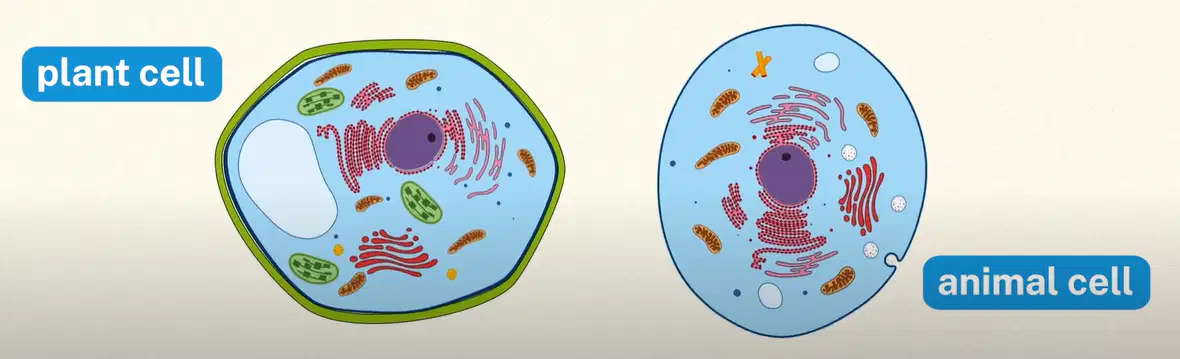
The main reason plant and animal cells have some different organelles is because:
They're completely different animals
They take in energy differently
Animals move and plants don't
Animals are carnivorous and plants aren't

The primary function of the chloroplast is to:
Convert food into energy for the cell
Store water and nutrients
Control the functions of the cell
Perform photosynthesis
Students used a microscope to observe some cells and saw the cells had a cell wall, cell membrane, a nucleus, and many chloroplasts. What kind of cell are they looking at?
A plant cell
An animal cell
A bacteria
A red blood cell

Ms. Penney stored the pig hearts in the refrigerator in the science closet. Which organelle has a function similar to a refrigerator or a closet (storage)?
Chloroplast
Vacuole
Nucleus
Mitochondria
What is the fluid surrounding the organelles in the cell?
Endoplasm
Ectoplasm
Cytoplasm
All-around-plasm
What types of organisms have cells with very large vacuoles because they need to store large amounts of water?
Plants
Animals
Bacteria
Fungi

Why is the mitochondria the POWERHOUSE OF THE CELL?
It converts food into energy for the cell and body to use
It's in charge of all the cells activities
It produces electrical energy for the other cell organelles to use
It grows when you workout just like muscle fibers

What is the different between rough and smooth endoplasmic reticulum?
They both have ribosomes
Neither of them have ribosomes
Rough ER has ribosomes and smooth ER doesn't
Smooth ER has ribosomes and rough ER doesn't
Which organelle is responsible for making proteins?
Nucleus
Ribosomes
Chloroplast
Endoplasmic Reticulum
Which organelle is responsible for packing up and transporting proteins?
Nucleus
Ribosomes
Chloroplast
Endoplasmic Reticulum

