
 Worksheets
Muscular System Review
Total questions: 20
Worksheet time: 10mins
Name
Class
Date
1.
The prime mover for forearm extension.
a)
Tibialis anterior
b)
Triceps brachii
c)
Biceps brachii
d)
Epicranius
2.
The brachioradialis is the synergist to this muscle in flexion.
a)
Tibialis anterior
b)
Triceps brachii
c)
Biceps brachii
d)
Epicranius
3.
The antagonists of the quadriceps, located in the posterior thigh.
a)
Quadriceps femoris
b)
Adductors
c)
Latissimus dorsi
d)
Hamstrings
4.
The prime mover for inhalation.
a)
Rectus abdominus
b)
Diaphragm
c)
External obliques
d)
Latissimus dorsi
5.
The main muscle of the scalp that allows you to raise your eyebrows and wrinkle your forehead.
a)
Orbicularis oculi
b)
Epicranius
c)
Temporalis
d)
Mentalis
6.
The large triangular muscle of the lower back.
a)
Trapezius
b)
Latissimus dorsi
c)
Erector spinae
d)
Platysma
7.
The main muscles of the inner thighs.
a)
Adductors
b)
Sartorius
c)
Gastrocnemius
d)
Quadriceps femoris
8.
This group of four muscles is considered the most powerful in the human body.
a)
Triceps brachii
b)
Biceps brachii
c)
Quadriceps femoris
d)
Biceps femoris
9.
The prime mover in dorsiflexion.
a)
Soleus
b)
Gastrocnemius
c)
Plantaris
d)
Tibialis anterior
10.
The antagonist in forearm flexion.
a)
Triceps brachii
b)
Brachialis
c)
Brachioradialis
d)
Biceps brachii
11.
The prime movers that allow your jaw to close so that you can chew your food are the __________ and the __________ muscles.
a)
masseter, orbicularis oris
b)
temporalis, orbicularis oris
c)
masseter, temporalis
d)
masseter, buccinator
12.
The __________ are a group of muscles that run the length of the vertebral column and keep our backs straight.
a)
Trapezius
b)
Latissimus dorsi
c)
Erector spinae
d)
External obliques
13.
List the following terms related to the structure of skeletal muscle from largest to smallest: Fascicle, Myofibril, Myofilament, Muscle, Muscle Fiber.
a)
myofilament, myofibril, muscle fiber, fascicle, muscle
b)
muscle, fascicle, muscle fiber, myofibril, myofilament
c)
muscle, muscle fiber, myofibril, fascicle, myofilament
d)
muscle, myofibril, muscle fiber, fascicle, myofilament
14.
The tissues that compose most muscles include: (Choose all that apply)
a)
Skeletal muscle tissue
b)
Connective tissues
c)
Blood vessels
d)
Nerve fibers
15.
Common functions of muscles include:
(Choose all that apply)
a)
movement
b)
joint stabilization
c)
generating heat/maintaining constant temperature
d)
posture
16.
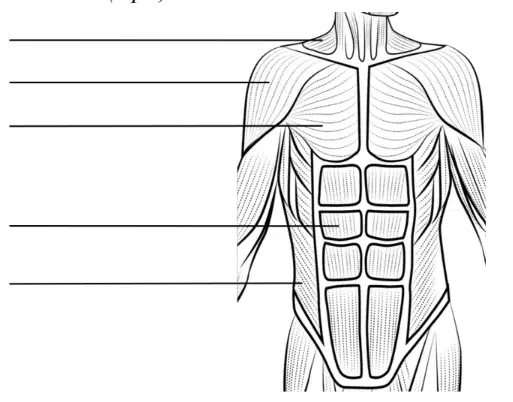
Label the muscle indicated on the first line.
a)
Deltoid
b)
External obliques
c)
Pectoralis major
d)
Rectus abdominus
e)
Trapezius
17.
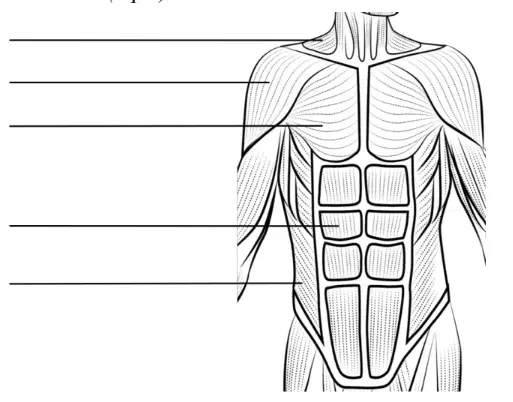
Label the muscle indicated on the second line.
a)
Deltoid
b)
External obliques
c)
Pectoralis major
d)
Rectus abdominus
e)
Trapezius
18.
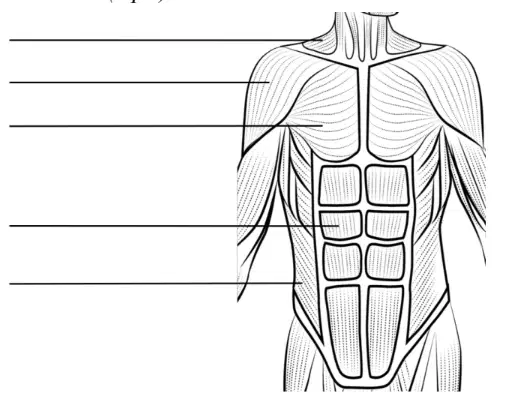
Label the muscle indicated on the third line.
a)
Deltoid
b)
External obliques
c)
Pectoralis major
d)
Rectus abdominus
e)
Trapezius
19.
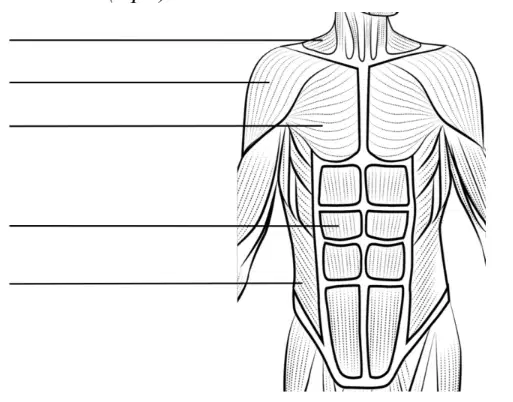
Label the muscle indicated on the fourth line.
a)
Deltoid
b)
External obliques
c)
Rectus abdominus
d)
Pectoralis major
e)
Trapezius
20.
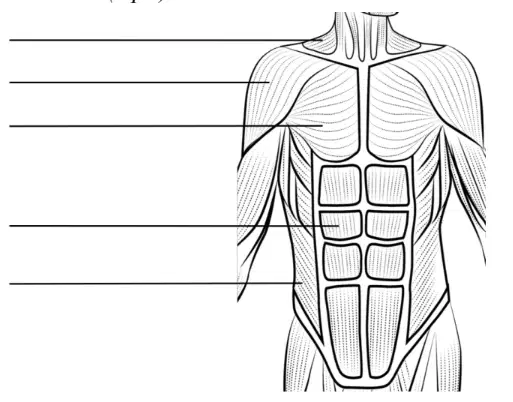
Label the muscle indicated on the fifth line.
a)
Deltoid
b)
External obliques
c)
Pectoralis major
d)
Rectus abdominus
e)
Trapezius
100 %

