wayground logo

Free Printable Worksheets

Font size

S
M
L
XL
Worksheets

Judicial Branch and Checks & Balances

Total questions: 15

Worksheet time: 16mins
Name
Class
Date
1.
Which statement describes the intent of checks and balances?
a)
The government receives revenue (taxes) from the people.
b)
The government receives authority from the people.
c)
No branch of government can become too powerful.
d)
No branch of government can apply concurrent powers.
2.
Which example illustrates the system of checks and balances?
a)
The President vetoes legislation proposed by Congress.
b)
The President confers with the members of the Cabinet.
c)
The Supreme Court interprets the application of a law passed by Congress.
d)
A state sets its own student learning standards while Congress regulates trade between states.
3.
Why are federal judges appointed for life?
a)
to ensure the system of checks and balances.
b)
to strengthen their jurisdiction over state courts
c)
to limit power of the legislative and executive branch
d)
so they can be free from public or political pressures when they hear cases.
4.
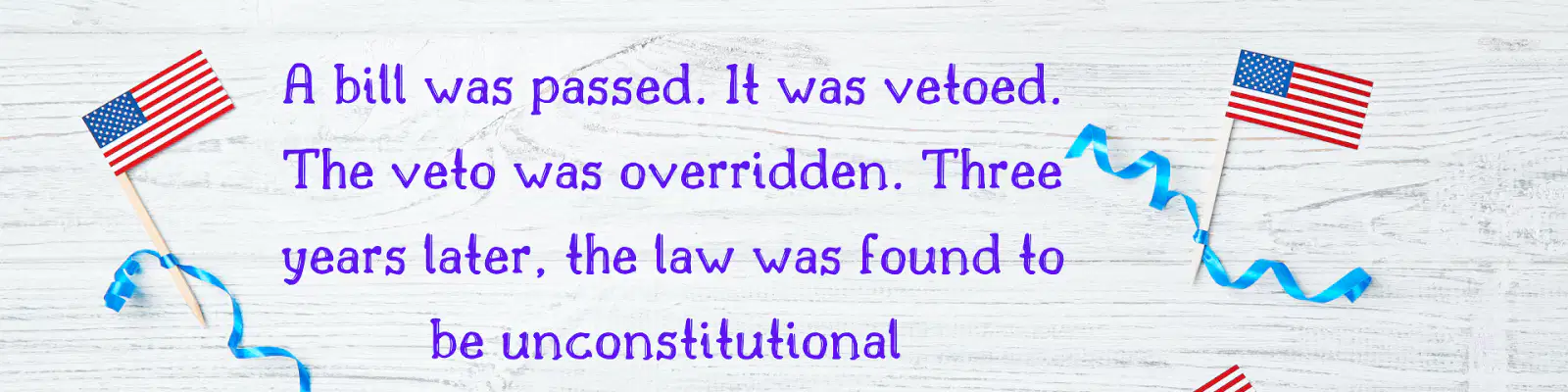
The scenario below describes a government process. According to the scenario in what order did the branches of government exercise their power?
a)
Legislative, executive, judicial, legislative
b)
Legislative, executive, legislative, judicial
c)
Executive, legislative, executive, judicial
d)
Judicial, executive, legislative, judicial.
5.
How does an appellate court differ from a trial court?
a)
An appellate court usually has a jury
b)
An appellate court decides issues of fact.
c)
An appellate court examines more witnesses.
d)
An appellate court reviews another court's decision.
6.
Which are the only federal court to have juries?
a)
U.S. District courts
b)
U.S. Supreme court
c)
U.S. Court of Appeals
d)
U.S. district Courts of Appeals
7.
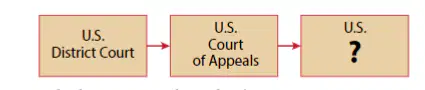
The diagram below provides details about the U.S. court system. Which court completed the diagram?
a)
circuit Court
b)
Supreme Court
c)
Municipal Court
d)
Court of Veterans Appeals
8.
Which of these court decisions is an example of judicial review?
a)
The U.S. Supreme Court strikes down a state law as unconstitutional.
b)
The U.S. Supreme Court decides a dispute in which two states are parties.
c)
A trial court finds a defendant not guilty after barring illegally obtained evidence from the trial.
d)
The U.S. Court of Appeals for the 11th Circuit interprets an ambiguous phrase in the federal law.
9.
Which of the following explain how judges get their jobs?
a)
They are elected by the people.
b)
They are appointed by the President and then after 6 years, are retained (elected) by the people.
c)
They are appointed by the President and confirmed by the Senate.
d)
They are appointed by the President and confirmed by the House of Representatives.
10.
What power was given to the Supreme Court in the court case Marbury v. Madison?
a)
the power to make laws.
b)
the power to execute laws
c)
the power of judicial review
d)
the power to impeach and remove the President
11.

The authority of the Supreme Court to strike down laws or actions that are unconstitutional is known as (a)  

Choose from the below words
Judicial review
embargo
declaration
nullify
12.

Match the description with the Branch of Government

Categorize the following

Includes the House and the Senate

Is led by the President

Is led by the Supreme Court

Interprets the law

Enforces the law

Makes the Law

Members serve for 2 or 6 years

Leader serves for 4 years.

Members serve for life

Legislative Branch
Executive Branch
Judicial Branch
13.

Match the right power to the correct Branch.

Categorize the following

Can over-ride a veto with 2/3 vote

Can Veto legislation

Can declare a law to be unconstitutional.

Legislative Branch
Executive Branch
Judicial Branch
14.

Match the right power to the correct Branch.

Categorize the following

Can approve or reject Presidential appointments

Has the Power to Pardon criminals.

Can declare Presidential actions unconstitutional.

Legislative Branch
Executive Branch
Judicial Branch
15.

Which branch has the power to declare war?

a)

Legislative

b)

Executive

c)

Judicial