
 Worksheets
Fall 2024 Midterm
Total questions: 104
Worksheet time: 1hrs 15mins

Which motive best completes the diagram?
To promote free enterprise
To extend democracy
To expand empires
To found utopian communities
Which statement accurately describes the reasons for establishing Plymouth and Jamestown?
Both colonies were established to bring wealth to stockholders.
Plymouth's founders intended to produce raw materials, while Jamestown's founders expected to discover gold.
Both colonies were established to limit the expansion of other European empires.
Plymouth was founded as a refuge from religious persecution, while Jamestown was founded for
commercial profit.

For what reason did a group of colonists agree to this compact?
To declare independence from all European nations
To form a social contract among themselves
To demonstrate goodwill toward local American Indians
To establish trade relations with other colonies

The factors listed above contributed most to the —
creation of alliances between British settlers and American Indians
election of British colonists to Parliament
growth of representative government in the British colonies
expansion of British trade in the Americas
Which factors encouraged the development of an agricultural economy in the southern colonies?
Mild summers, thin soil, and the region’s proximity to the ocean
A cold climate, rocky soil, and abundant rainfall
A hot climate, rich soil, and a long growing season
Warm summers, cold winters, and little rainfall

Which factor most encouraged the growth of this trade?
The invention of the steam engine
The profitability of cash-crop agriculture in the Plantation system
The development of the factory system
The establishment of protective tariffs
Why did the British Parliament adopt new economic policies after the French and Indian War?
To punish the colonists for their lack of support for the war
to allow the colonies to trade with countries besides Britain
To limit the development of industry in the colonies
To pay off debts incurred in the fighting the war
The Proclamation Line of 1763 led to disagreement between the colonists and the British government because it—
banned colonial trading with the American Indians
surrendered control of the Great Lakes region to Canada
offered all lands west of the Appalachian Mountains to British nobles
prohibited the colonists from settling west of the Appalachian Mountains
The economic system of mercantilism was opposed by later American colonists because it
supported colonial manufacturing
took gold and silver from American mines
prohibited colonists from fishing or trading in furs
prohibited colonists from trading with other foreign countries

The Continental Congress issued this commission to —
Benedict Arnold
Alexander Hamilton
John Hancock
George Washington
Which excerpt from the Declaration of Independence best explains why colonists were unhappy about their lack of
representation in the British parliament?
"He has refused to pass other Laws for the accommodation of large districts of people."
"For imposing Taxes on us without our Consent."
"He has refused his Assent to Laws, the most wholesome and necessary for the public good."
"For transporting us beyond Seas to be tried for pretended offences."

These acts contributed to the start of the Revolutionary War by —
restricting colonial trade with American Indians
imposing regulations on colonial agriculture
angering colonists who believed that their civil liberties had been violated
punishing colonists for resisting the authority of Parliament

This excerpt refers to rights that people —
earn by demonstrating loyalty to their government
receive by becoming citizens of a country
have as a result of being human
are granted after enlistment in the military

All the events listed above occurred during -
the era of westward expansion
the Era of Good Feelings
the Revolutionary era
the Jacksonian era

Which of these completes this graphic organizer?
Parliament repeals the Stamp and Sugar Acts
King George III allows colonists to petition Parliament for tax relief
Parliament passes the Intolerable Acts
King George III appoints colonial representatives to Parliament
The Virginia Company authorized a general assembly known as The Virginia House of Burgesses so that colonists could -
self-govern on a local level
vote in the British Parliament
participate in a free-market economy
express dissatisfaction with British rule
What was the importance of the American victory at the Battle of Saratoga?
It opened up the Mississippi River as a major trade route.
It ended the American Revolution and colonists gained their independence.
The British were weakened by the loss and began withdrawing from the war.
It convinced France to become a colonial ally.
Great Britain recognized the United States as an independent country as a result of-
the signing of the Declaration of Independence
the issuance of the Proclamation of 1763
the signing of the Treaty of Paris
the publication of Common Sense
Which strong feature of the Articles of Confederation created a method for western territories to become states?
The ability to sign peace treaties
Shays' Rebellion
Northwest Ordinance
60,000 Ordinance
Who participated in Shays' Rebellion?
Poor farmers who were Continental Army soldiers
A group of brothers named Shays
Massachusetts militia men
Loyalists

The idea that the people hold the power in the government. They exercise this power by voting.
Popular Sovereignty
Republicanism
Checks and Balances
Individual Rights

People elect representatives to make laws for them.
Individual Rights
Republicanism
Federalism
Checks and Balances

Each branch of the government has a way to limit the powers of the other two branches. Ex= the President can veto
Federalism
Individual Rights
Checks and Balances
Separation of Power

Everyone must follow the law. The government is not all powerful.
Individual Rights
Checks and Balances
Federalism
Limited Government
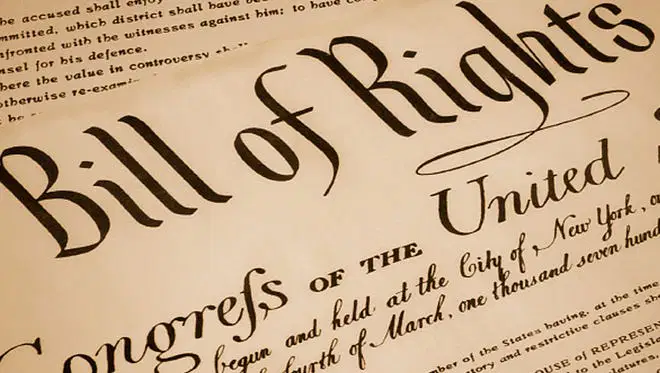
The Bill of Rights, Personal freedoms, and protection under the law.
Federalism
Individual Rights
Popular Sovereignty
Limited Government

The central government is separated into three branches. Each have Different Jobs but equal power. Legislative (Lawmakers)Executive (Enforcers of the Law)Judicial (Judges of the Law)
Separation of Powers
Checks and Balances
Federalism
Republicanism

The Federal and the state governments share power. Each has roles that only they can fulfill. Seen in the 10th Amendment.
Republicanism
Limited Government
Popular Sovereignty
Federalism

The president vetoed a law passed by congress would be an example of which 7 principle?
Checks and Balances
Republicanism
Federalism
Popular Sovereignty

Voting for the people who you want to represent you would be an example of which of the 7 principles?
Republicanism
Federalism
Checks and Balances
Separation of Powers

Why was the Bill of Rights was added to the Constitution?
to put checks and balances into place
to ensure individual rights
to separate powers of our government
to give power to the people
Legislative Branch
Makes the Laws
Executive Branch
Enforces the Laws
Judicial Branch
Interprets the Laws
Our nations First Government System
Articles of Confederation
Each branch has the ability to check the others to keep one branch from becoming too powerful
Check and Balances
The 1st amendment protects which of the following?
Freedom from unreasonable searches and seizures.
Freedom of religion, speech, press assembly and petition.
Right to trial by jury.
No quartering of soldiers.
The 2nd amendment protects which of the following rights?
Right to keep and bear arms.
Rights of accused persons (speedy and public trial).
Powers reserved to the states.
Other rights of the people.
The 3rd amendment protects which of the following rights?
Right of a trial by jury.
Freedom of religion, speech, press, assembly and petition.
No quartering of soldiers.
Right to keep and bear arms.
The 4th amendment protects which of the following rights?
Powers reserved to the states.
Freedom from unreasonable searches and seizures.
Freedom from excessive bail, cruel and unusual punishments.
Right to due process of law, freedom from self-incrimination, and double jeopardy.
The 5th amendment protects which of the following rights?
Right to due process of law, freedom from self-incrimination, and double jeopardy.
Rights of accused persons (speedy and public trial).
Other rights of the people.
Right to keep and bear arms.
The 6th amendment protects which of the following rights?
No quartering of soldiers.
Right to due process of law, freedom from self-incrimination, and double jeopardy.
Powers reserved to the states.
Rights of accused persons (speedy and public trial).
The 7th amendment protects which of the following rights?
Right of trial by jury.
No quartering of soldiers.
Rights of accused person (speedy and public trial).
No quartering of soldiers.
The 8th amendment protects which of the following rights?
No quartering of soldiers.
Powers reserved to the states.
Freedom from unreasonable searches and seizures.
Freedom from excessive bail, cruel and unusual punishments.
The 9th amendment protects which of the following rights?
Right of trial by jury.
No quartering of soldiers.
Freedom from excessive bail, cruel and unusual punishments.
Other rights of the people.
The 10th amendment protracts which of the following rights?
Freedom from excessive bail, cruel and unusual punishments.
Right to due process of law, freedom from self-incrimination, and double jeopardy.
Powers reserved to the states.
Right of trial by jury.
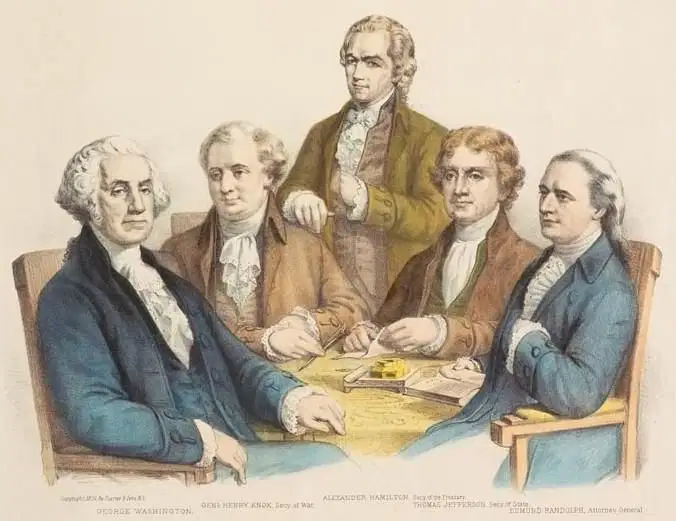
Hamilton, Jefferson, Knox an Randolph made up the Washington advisors, presidential advisors are also called...
the cabinet
the good ol' boys
the judicial branch
the Congress
As part of his financial plan Alexander Hamilton wanted to create a
standing army
Marine Corps
national bank
plan to end slavery
He was the first secretary of the Treasury and one of Washington's most trusted advisors
Thomas Jefferson
Edmund Randolph
Alexander Hamilton
Ben Franklin
A tax on imported goods is called a/an
excise tax
tariff
progressive tax
intermediary tax
They favored a stronger central government that promoted trade and industry and favored strong relations with Britain
Federalists
Antifederalists
Democratic-Republicans
Whigs
Who was the first president of the U.S.?
Abraham Lincoln
Thomas Jefferson
George Washington
Benjamin Franklin
What is a precedent?
A tradition for others to follow
when countries buy or sell goods to each other based on haves and needs
when you do not choose sides in a war or argument between two sides
is when you forbid trade with another nation.


The British Navy became aggressive and kidnapped our sailors, forcing them to fight, this is called....
impressment
forced fighting
french fries
french press

John Adams decided to keep out of the war..not to get involved with England (Britain) or France... this was following the policy of...
George Washington in his farewell address
his mother in law
Mr. Clements and Mr. Mentz
the federalist party
What were the two main political parties involved in the election of 1800?
Federalists and Anti-Federalists
Democrats and Republicans
Federalists and Democratic-Republicans
What was the problem in the election of 1800?
there was a tie
John Adams dropped out of the election
Jefferson rallied up votes illegally
Burr told lies to get votes
What did the French and the British do the caused Thomas Jefferson to push Congress us the Embargo Act of 1807?
They tried to invade Washington DC
They were trying to boycott American goods
They were trying to steal money from the Spanish
They kept attacking U.S. merchant ships
The Supreme Court Case of Marbury V. Madison established the principle of ______________.
(a)3. What does embargo mean?
To steal
To stop trading
To trade more
The Embargo Act of 1807 had a ____________ impact on American business
positive
neutral
negative
Why is Monroe's Presidency called the "Era of Good Feelings?"
War Hawks lived in all regions of the U.S. And wanted war for more money.
Only one political party, Republicans, controlled American politics. Increase in Nationalism and Patriotism
(Sectionalism) the division of the United States into 3 Sections
Monroe declared peace with all European countries and welcome them to the USA

This connected the Great Lakes in the midwest to the Hudson River in New York to make traveling by water and transporting goods easier. Led to New York City becoming the nation's largest city.
National Road
American System
Erie Canal
Panama Canal

This image is stopping European Nations from passing the Atlantic Ocean what document is it depicting?
Monroe Doctrine
The Constitution
How did most Americans view Andrew Jackson's win in the 1828 presidential election?
as a win for the North
A win for Britain
as a victory for manufactures in the North
as a victory for the "common man"
How did President Jackson make use of the spoils system?
He required government employees to join the Democratic Party.
He appointed only National Republicans to the cabinet.
He appointed businessmen to government positions.
He gave government jobs to his political supporters.
How did the 1828 election differ from prior elections?
A majority of the popular vote, not the electoral college, decided the outcome.
Candidates built excitement through slogans, parades, speeches, and mudslinging.
All the candidates came from Washington, D.C.
All the candidates came from western states.
What was the key reason for Andrew Jackson's victory in 1828?
Voting rights had been extended to women.
Voting rights had been extended to African Americans.
Voting rights had been extended to white men without property.
Voting rights had been extended to Native Americans.
What was the Trail of Tears?
the trail Native Americans used to travel to Indian Territory
the forced relocation of all Native Americans to western lands
the forced march of the Cherokee from the Georgia to Indian Territory
a trail American settlers took to reach California
What was the purpose of the Indian Removal Act?
to declare Native Americans as conquered subjects of the United States
to prevent state governments from forcing Native Americans off their land
to give Native Americans British land in Canada
to give the U.S. government control of Native American land
Why did political leaders in South Carolina threaten to secede from the Union?
They disliked the Tariff of 1828
They disliked Andrew Jackson
They wanted to drive Native Americans from the state
They did not want to buy foreign goods
Before becoming President, Andrew Jackson was known as a hero in what famous battle?
World War I
Battle of Yorktown
Lexington and Concord
Battle of New Orleans

This political cartoon from 1833 portrays President Andrew Jackson. Which statement describes a position of the party that agreed with the cartoonist's view of Jackson?
They complained about Jackson's extravagant lifestyle
They opposed Jackson for his efforts to start a war with Great Britain.
They criticized Jackson as a leader with unrestrained powers.
They objected to Jackson's attempt to reduce the number of Supreme Court Justices
What was the primary question surrounding the 1832 Nullification Crisis?
Can the federal government regulate interstate commerce?
Can a state regulate a federal agency?
Can a state overturn a federal law?
Can the federal government levy taxes on states?
Andrew Jackson supported the National Bank
True
False
Go west, young man, go west.
—Horace Greeley, New York Tribune
In the statement above, a newspaper editor’s advice reflected which of the following characteristics of the Age of Jackson?
state's rights
popular sovereignty
manifest destiny
increased immigration
* Belief that the United States should extend from the Atlantic to the Pacific
*Relocation of Native American from eastern territory to present day Oklahoma
* United States purchase of the Louisiana territory
To which of the following eras do these defining characteristics belong?
Westward Expansion
Reconstruction Era
Civil War
Colonial Era

Which of the lines on the map is the location of the Rocky mountains?
A
B
C
D
Before becoming part of the United States, Texas was a part of ______.
Russia
France
Britain
Mexico

Which period in American history does this illustration represent?
Louisiana Purchase
War of 1812
Battle of the Alamo
Manifest Destiny

What is #1 on the map?
Original 13 Colonies
Louisiana Purchase
Texas Annexation
Treaty of Paris 1783
What is #2 on the map?
Gadsden Purchase
Louisiana Purchase
Texas Annexation
Treaty of Paris 1783
What is #3 on the map?
Gadsden Purchase
Louisiana Purchase
Texas Annexation
Treaty of Paris 1783
What is #4 on the map?
Florida (Spanish) Cession
Louisiana Purchase
Texas Annexation
Treaty of Paris 1783
What is #5 on the map?
Mexican Cession
Louisiana Purchase
Texas Annexation
Treaty of Paris 1783
What is #6 on the map?
Mexican Cession
Louisiana Purchase
Texas Annexation
Oregon Country
What is #7 on the map?
Mexican Cession
Louisiana Purchase
Texas Annexation
Oregon Country
What is #8 on the map?
Mexican Cession
Louisiana Purchase
Texas Annexation
Gadsden Purchase
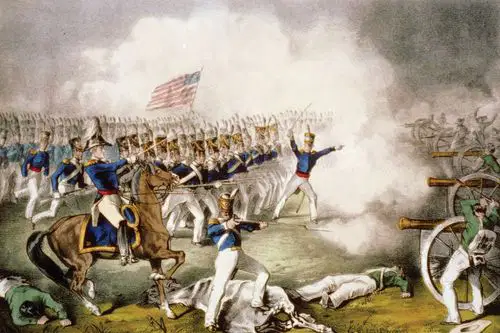
What treaty secured the Mexican Cession for the USA after the Mexican-American War?

