
NEW
Font size
 Worksheets
5.1-5.2 Practice Questions AP Stats
Total questions: 20
Worksheet time: 16mins
State the addition rule of probability.
The addition rule of probability states that the probability of the intersection of two events A and B is equal to the sum of the probability of event A and the probability of event B.
The addition rule of probability states that the probability of the intersection of two events A and B is equal to the product of the probability of event A and the probability of event B.
The addition rule of probability states that the probability of the union of two events A and B is equal to the product of the probability of event A and the probability of event B.
The addition rule of probability states that the probability of the union of two events A and B is equal to the sum of the probability of event A and the probability of event B, minus the probability of the intersection of events A and B.
What is the complementary rule of probability?
1 - P(A)
P(A|B)
P(A)
P(A and B)
If two events are mutually exclusive, what is the probability of both events occurring?
0.25
0
1
0.5
The probability of selecting a person who is born left-handed is 0.11, or about 1 in 9. This means that
For every 9 people, exactly 1 person will be left-handed.
As we sample more and more people, the proportion of them who are left-handed will get closer and closer to 0.11.
A sample of 100 randomly selected people will contain exactly 11 left-handed people.
It is almost impossible to select two people in a row who are both left-handed.
Which of the following statements illustrates the Law of Large Numbers?
We roll a die until it lands on four. The first four occurs on the 6th roll so the probability of rolling a four is 1/6.
A population has 9% blue-eyed people. If we sample 100 people, 9% will have blue eyes.
A population of individuals contains 73% that can curl their tongue. The larger the sample size we select, the closer the percentage of people who can curl their tongue gets to 73%.
In a small number of people, the proportion who have a dog is 15%. As we increase the sample size, the proportion of people who have a dog will increase from 15%.
Flip a fair coin and record if it lands heads up. If the first flip is tails, the next flip will likely be heads to make the probability of heads equal to 1/2.

Carson Cars sells hybrid and non-hybrid Kia, Toyota and Honda cars. All of the cars on the Carson Car lot were classified by make of the vehicle and whether or not it was a hybrid vehicle. The results are summarized in the table.
What is the probability that a randomly selected vehicle is hybrid or a Kia?
20/100
38/100
53/100
71/100
91/100
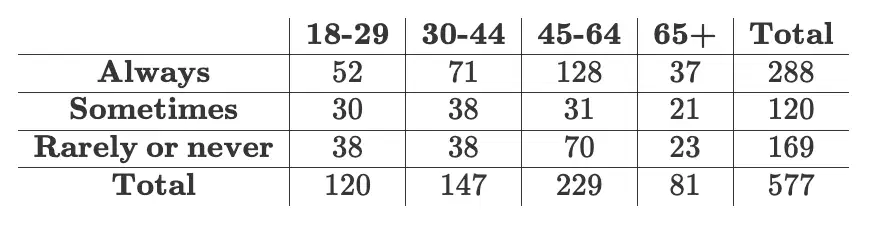
A recent poll asked respondents about their experiences with “hidden fees” associated with tickets to concerts, airlines, and sporting events. One of the questions was “When you are purchasing concert tickets online directly from the provider, how often do you end up paying more than the price you were initially shown as a result of taxes or other fees?” The table shows the set of responses, grouped by the age of the respondents.
If a respondent from this survey is selected at random, what is the probability that the respondent is between 18 and 29 years old or responded “Always” to the question?
0.090
0.208
0.499
0.617
0.707

A recent poll asked respondents about their fears. One of the questions was “Are you afraid of snakes?” The table summarizes the results, categorized by gender.
If a respondent is randomly selected, what is the probability that they are either a male or very afraid of snakes?
90/991
90/474
317/991
474/991
701/991

A grocery store sells many different types of M&M candies. The proportions of the different types are shown in the table.
If a bag of M&M’s is selected from among all the bags the store sells, what is the probability that it is either Milk Chocolate or Peanut?
0.100
0.426
0.320
0.574
0.680

A pet store is doing inventory on the proportion of each type of fish they have in their aquariums. The pet store sells five types of fish, as shown in the table.
If you randomly select a fish from this pet store, what is the probability it is either a goldfish or a betta?
0.0456
0.10
0.19
0.29
0.43
At a large university, 25% of students own a desktop computer, 68% own a laptop computer, and 75% own a desktop computer or a laptop computer. What is the probability that a student chosen at random from this university will own both a desktop and a laptop?
0.07
0.18
0.50
0.75
0.93
At a large university, 13% of students are student-athletes, 28% are business majors, and 35% are student-athletes or business majors. What is the probability that a student from this university chosen at random will be a student-athlete and a business major?
0.06
0.07
0.22
0.35
0.41

Students at Central High School were asked what grade they are in and if they plan to have a summer job. The results are summarized in the table.
What is the probability that a randomly selected student is in 10th grade or plans to have a summer job?
22/260
64/260
140/260
182/260

The table shows data that were collected from people who attended a certain high school basketball game and indicates the team each person rooted for and whether each of these people purchased food during the game. A person who attended the game will be selected at random. Which of the following correctly interprets mutually exclusive events represented by the table?
Rooting for the home team and rooting for the away team
Rooting for the home team and purchasing food during the game
Rooting for the away team and purchasing food during the game
Rooting for the home team and not purchasing food during the game
Not rooting for the home team and not purchasing food during the game
At a sporting event, cheerleaders will throw 50 bundled T-shirts into the crowd. The T-shirt sizes consist of 10 small, 15 medium, and the remainder either large or extra large. Suppose Ana catches a T-shirt. What is the probability that she will catch a T-shirt that is not a size small?
0.10
0.20
0.50
0.67
0.80
A store owner reports that the probability that a customer who purchases a lawn mower will also purchase an extended warranty is 0.68.
Which of the following is the best interpretation of the probability 0.68 ?
For all customers who purchase a lawn mower, 68% will also purchase an extended warranty.
For all customers of the store, 68% will purchase a lawn mower.
For all customers who purchase an extended warranty, 68% will use the warranty.
From the next 25 customers, 17 will purchase an extended warranty.
From the next 25 customers, 17 will purchase a lawn mower.
The probability that a randomly selected visitor to a certain website will be asked to participate in an online survey is 0.40. Avery claims that for the next 5 visitors to the site, 2 will be asked to participate in the survey.
Is Avery interpreting the probability correctly?
Yes, because 2 out of 5 is equal to 40%.
Yes, because participants in the survey are selected at random.
No, because there could be voluntary response bias.
No, because only 40% of all people will visit the site.
No, because 0.40 represents probability in the long run over many visits to the site.

