
Font size
 Worksheets
Unit 5: Western Europe Test Review
Total questions: 35
Worksheet time: 18mins
Which of the following was an original purpose of the European Union?
Increase economic growth of member nations.
Reduce environmental pollution.
Eliminate global terrorism.
Address the problem of international corruption.
In the fall of 2017, the people of Catalonia voted to leave Spain. The Catalonians wanted to separate from Spain for various reasons including economics, nationalism, and cultural preservation. Nationalism in this issue is best described as —
The desire to take over other societies by force
A method of solving the basic economic problems of society
The loyalty of a people to their values, traditions, and a geographic region
The achievement of world peace and global understanding
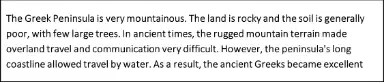
Which of the following developments in ancient Greece was a direct result of the physical geography described above?
Greeks throughout the region gathered to compete in the first Olympic games.
Greeks became a powerful economic trading region
Some Greek city-states united to fight a war against the Persians.
Alexander the Great conquered areas of the Mediterranean region
Europe is a region that can be described by which of the following physical characteristics?
Large peninsula with navigable rivers and harbors
Rainforest with many resources
Vast deserts and tropical plains
Tundra with few resources
Countries in the Northern European region of Scandinavia (Finland, Sweden, etc.) have government-operated schools, universities, and health-care institutions for their people. This is all paid for by very high taxes in the region. These countries also allow their people to own businesses and choose their jobs. What type of economic system does this illustrate?
Mixed socialism and communism
Only free Market
Mixed socialism and free market
Only Socialist
What is the most common reason for acid rain in Germany?
Dumping sewage into river systems
Pollution caused by industrialization
Using uranium to generate electricity.
Using uranium to generate electricity.
The factors that encourage people to leave their place of origin and migrate to another place are called “push” factors. These “push” factors may include…
religious freedom and food and housing shortages
effective advertising, expansive housing markets and political freedom
lack of employment and food, housing shortages, and persecution
economic opportunity and political and religious freedom
Which of the following statements best describes a concern of European countries taking in refugees from Syria?
The national security of their State
The national security of their country.
There are fewer terrorist attacks occurring each year.
The terrorist attackers were all born and lived most of their lives in the Middle East.

Grapes and olives grow best during hot, dry summers. Which region of Europe are grapes and olives most likely found?
United Kingdom
Northern European Plain
Scandinavian Region
Mediterranean Region
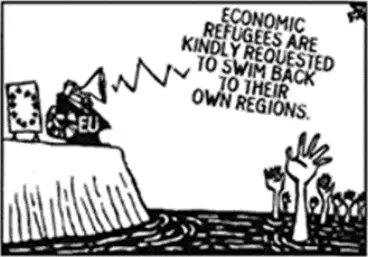
The cartoon above implies which of the following about economic refugees?
They should be able to solve the problems of their regions.
They arrived because of flooding in their countries.
They should seek refuge in the United States and Canada.
They will not be admitted to Europe.
Based on this quotation and your knowledge of social studies, which type of government would Lord Acton most likely support? "Power tends to corrupt; absolute power corrupts absolutely."
Totalitarian state
Absolute monarchy
Dictatorship
Representative democracy
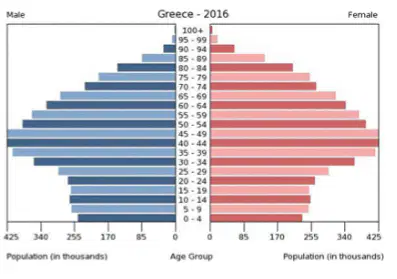
According to the population pyramid above, what government program will Greece need to implement in the future?
Federally funded maternity leave
Mandated vocational training
Healthcare programs for the elderly
Headstart/Pre-k program
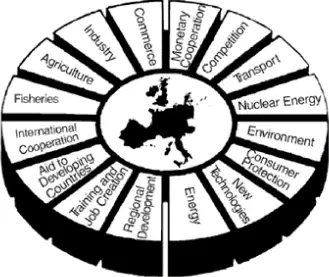
Which of the following organized national groups has chosen cooperation illustrated in the above diagram?
United Nations (UN)
European Union (EU)
North American Free Trade Agreement (NAFTA)
Organization of Petroleum Exporting Countries (OPEC)
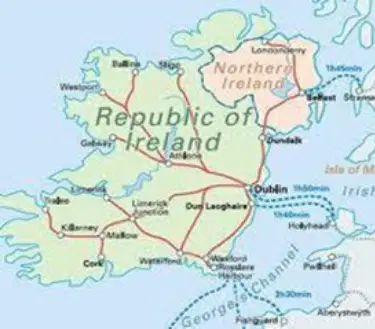
The political division between Northern Ireland and the Republic of Ireland signifies a cultural difference based upon which of the following?
Customs
Traditions
Language
Religion
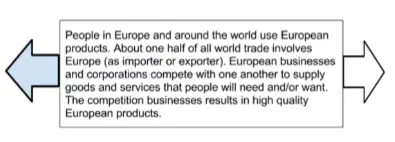
While it is true that nearly all the nations of the world are mixed economies, which end of the economic spectrum are most European nations closest?
Tertiary sector
Market economies
Command economies
Traditional economies
Which statements are true about the physical features of Europe? Select TWO correct answers.
Europe has hundreds of natural harbors.
Europe has a lush rainforest full of natural resources.
Europe has many navigable rivers.
Europe has a vast desert area.
Europe has several countries that are larger than North and South America combined.
Which of the following was an original purpose of the European Union?
Address the problem of international corruption.
Eliminate global terrorism.
Increase economic growth of member nation.
Reduce environmental pollution.
Ireland : _______________ :: Great Britain : _______________
Democracy, Constitutional monarchy
A constitutional monarchy, democracy
Totalitarianism, Democracy
Socialism, democracy
Which are THREE benefits of joining the European Union?
There is a common currency.
It provides political unity.
Taxes are eliminated completely.
Countries agree to wage war together.
The barriers to travel are removed.
Which of the following are reasons that Europe has experienced an influx of African and Southwest Asian immigrants in the 21st century? Select TWO correct answers.
Immigrants are buying their way into select European countries.
Immigrants are seeking a better quality of life.
Europe's declining birth rates mean immigrants are needed for economic reasons.
Europe's religious history allows for immigrants to fit seamlessly into the culture.
Immigrants are willing to denounce their home-country citizenship when entering Europe.
What do the Rocky Mountains in the United States and the rugged mountains of the Scandinavian Peninsula have in common? Select TWO correct answers.
Both are used exclusively for ski resorts.
Both were formed by the movement of plates when they converged.
Both are used exclusively for tourism and trade.
Both were formed by plate tectonics when the plates diverged.
Both were formed over millions of years.
Which of the following defines the role of cultural traits to a group?
a unique assortment of behaviors and beliefs that distinguish a society
a set of behaviors that allows one group to dominate another group
a set of shared beliefs that only one racial group can have
physical traits that pass from one generation to the next
An ethnic group shares a common ancestry that is often handed down from one generation to the next. They share similar characteristics and other common identifiers. What are the common characteristics of an ethnic group? Select TWO correct answers.
language
nationality
citizenship
religion
socioeconomic
Which of the following were ways the Industrial Revolution changed Europe? Select THREE.
There was an increase in nationalism and imperialism.
Urbanization increased as people moved for work.
Religious leaders replaced political leaders.
The creation of the factory system led to specialized labor.
Prices increased due to the expense of new advances.
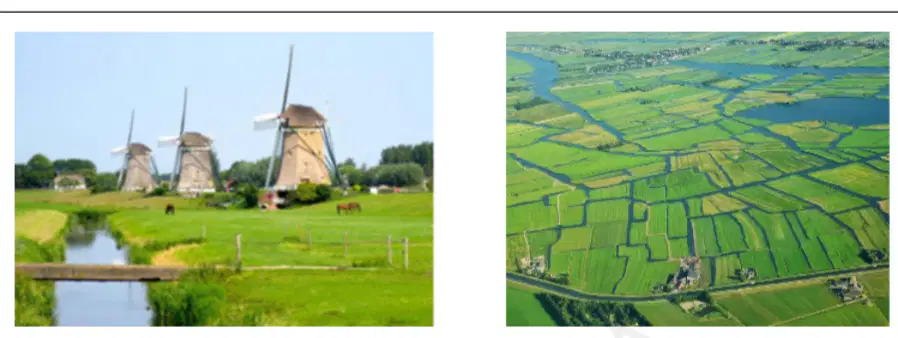
Human modifications and adaptations, such as windmills and polders, are characteristics of what countries’ human-environmental interactions?
Italy
Spain
Denmark
Netherlands

Which letter represents the United Kingdom?
A
B
C
D
Which letter represents FRANCE?
D
B
C
E
Which letter represents GERMANY?
I
B
C
H
Which letter represents SPAIN?
E
D
C
L
Which letter represents ITALY?
E
L
K
D
Which letter represents THE NETHERLANDS?
J
L
K
I
Which letter represents SWITZERLAND?
J
L
K
I
Which letter represents UKRAINE?
F
B
H
I
Which letter represents POLAND?
F
B
H
I
Which letter represents SWEDEN?
F
B
H
I

