
 Worksheets
Plant and Ecosystem Questions
Total questions: 15
Worksheet time: 14mins
How do plants get their food? What do they need to make food?
Through photosynthesis using sunlight, water, and carbon dioxide
By absorbing nutrients from the soil
By consuming other plants
By using stored food reserves
Where does the plant make their food?
What is transpiration?
Which of the following are basic needs of plants?
Water, sunlight, and soil
Water, sunlight, and air
Sunlight, soil, and nutrients
Water, sunlight, air, and nutrients
What is the role of the stem in a plant? What is the role of the roots in a plant?
The stem supports the plant and transports nutrients, while the roots anchor the plant and absorb water and minerals.
The stem absorbs water and minerals, while the roots support the plant and transport nutrients.
The stem produces food through photosynthesis, while the roots store energy.
The stem anchors the plant, while the roots transport nutrients.
What is a consumer?
What are some ways an invasive species can be introduced into an ecosystem?
What is a biotic factor? Name 3 examples of a biotic factor.
A non-living component of an ecosystem, such as sunlight, water, and temperature.
A living component of an ecosystem, such as plants, animals, and bacteria.
A chemical element necessary for the growth of living organisms, such as nitrogen, phosphorus, and potassium.
A physical barrier in an ecosystem, such as mountains, rivers, and oceans.
What is an abiotic factor? Name 3 examples of an abiotic factor.
A living component of an ecosystem; examples include plants, animals, and bacteria.
A non-living component of an ecosystem; examples include sunlight, temperature, and water.
A type of organism that can produce its own food; examples include algae, trees, and shrubs.
A process by which organisms break down food to release energy; examples include digestion, respiration, and fermentation.
Which of the following is an example of a prey and a predator in a grassland ecosystem?
(a)
What is the role of a decomposer in an ecosystem?
To produce energy through photosynthesis
To break down dead organisms and recycle nutrients
To consume primary producers
To compete with herbivores for food
How are fungi different from plants?
What is a niche?
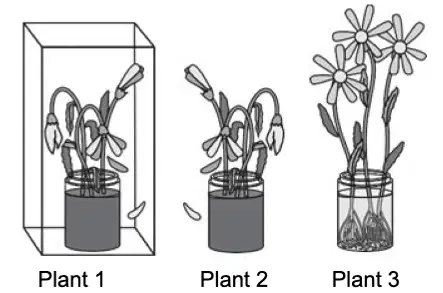
Grace and Linda investigate the effects of three growing conditions on plants. They place each of the three plants that are the same size and type into its own container. The containers are the same shape and size. 1. Plant 1 is given soil and water and put in a clear plastic box where all the air is removed. 2. Plant 2 is given soil and left out in the open, but it does not receive water. 3. Plant 3 is placed in water and left out in the open, but it does not receive soil. The diagram shows what the plants look like after a few days. Explain whether the evidence in the diagram supports or does not support Grace’s claim.
Explain whether the evidence in the diagram supports or does not support Linda’s claim.

