
 Worksheets
APM Unit 6 Lesson
Total questions: 6
Worksheet time: 33mins
6.1 Balance of Payment Accounts
Understanding the Balance of Payments
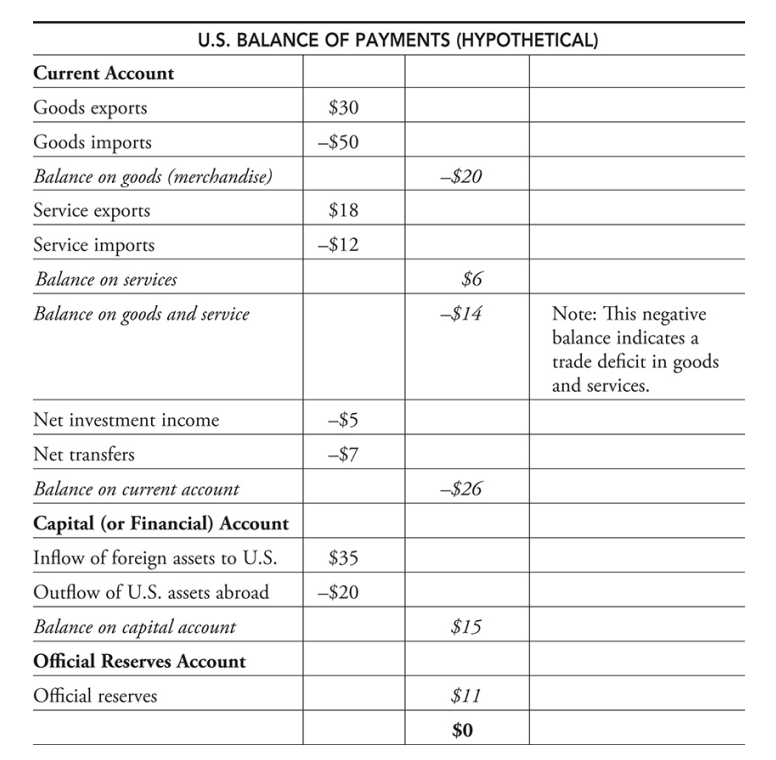
The balance of payments statement is a comprehensive summary of the economic transactions between the United States and other countries. It includes the current account, which records the import and export of goods and services, as well as investment income. For instance, when a Canadian receives dividends from an American corporation, it is recorded as an outflow of dollars from the U.S. A deficit in the current account indicates that more dollars are sent abroad than received.
The capital account, also known as the financial account, tracks the flow of investments in real or financial assets between the U.S. and foreign entities. An example of this is when a Swedish company purchases a manufacturing facility in Idaho, marking an inflow of foreign capital. A surplus in the capital account suggests that foreign investment in the U.S. exceeds American investment abroad. This account is crucial for understanding international investment dynamics.
The official reserves account is managed by the Federal Reserve to adjust any imbalances in the current and capital accounts. When there is a balance of payments deficit, the Fed credits the account by adding foreign currencies to balance it. Conversely, a surplus results in the Fed transferring excess foreign currency into official reserves. This ensures that the balance of payments remains zero.
The concept of a circular flow of dollars is central to the balance of payments. Essentially, the dollars sent abroad by Americans are equal to those received from foreigners. If Americans increase their imports, the current account may show a deficit. However, this is often offset by a surplus in the capital account as foreign investments flow back into the U.S.
Trade balance analysis is a critical component of understanding the balance of payments. It involves examining the difference between the value of exports and imports. A trade deficit occurs when imports exceed exports, while a trade surplus is the opposite. These balances are influenced by various factors, including exchange rates and trade policies.
Foreign exchange reserves play a vital role in maintaining the stability of a country's currency. They are used by the central bank to influence exchange rates and ensure liquidity in the foreign exchange market. The impact of trade policies on these reserves can be significant, as they affect the flow of goods, services, and capital across borders. Understanding these dynamics is essential for comprehending the broader economic picture.
SUMMARY
Balance of Payments Accounts
Balance of payments statement - A summary of the payments received by the United States from foreign countries and the payments sent by the United States to foreign countries.
Current Account
Current account - This account shows current import and export payments of both goods and services and investment income sent to foreign investors of the United States and investment income received by U.S. citizens who invest abroad.
Ex. → If a Canadian is receiving dividends from an American corporation or interest from a U.S. Treasury bill, these dollars would be sent out of the country.
A deficit balance tells us that the United States sent more American dollars abroad than foreign currency received in current transactions.
Capital (or Financial) Account
Capital (or financial) account - This account shows the flow of investment on real or financial assets between a nation and foreigners.
Ex. → If a Swedish firm buys a manufacturing facility in Idaho, or if a Mexican citizen buys a U.S. Treasury bond, it is recorded as an inflow of foreign capital assets into the United States.
A surplus balance tells us that there was more foreign capital investment in the United States than there was U.S. investment abroad.
Official Reserves Account
Official reserves account - The Fed’s adjustment of a deficit or surplus in the current and capital account by the addition or subtraction of foreign currencies so that the balance of payments is zero.
Balance of payments deficit - When the US has sent more dollars out than foreign currency has come in while adding the current and capital account. When this happens, the Fed credits the account to balance it.
Balance of payment surplus - When more foreign currency was coming into the US than American dollars sent abroad. Here, the Fed transfers the surplus currency bank into official reserves.
A Circular Flow of Dollars
The U.S. dollars that Americans send to foreigners are equal to the U.S. dollars that foreigners send to Americans.
If Americans import more goods and services from abroad, the current account will move in the deficit direction but the capital/financial account will move in the surplus direction as those dollars return.
What does the balance of payments statement summarize?
Economic transactions between the U.S. and other countries
The U.S. federal budget
Domestic economic activities
State-level economic transactions
What is recorded in the current account of the balance of payments?
Import and export of goods and services
Flow of investments in real assets
Official reserves
Exchange rates
What indicates a deficit in the current account?
More dollars are sent abroad than received
More dollars are received than sent abroad
Equal dollars are sent and received
No dollars are sent abroad
What does a surplus in the capital account suggest?
Foreign investment in the U.S. exceeds American investment abroad
American investment abroad exceeds foreign investment in the U.S.
Equal foreign and American investments
No foreign investment in the U.S.
How does the Federal Reserve manage a balance of payments deficit?
By adding foreign currencies to the official reserves
By reducing foreign currencies in the official reserves
By increasing domestic currency supply
By decreasing domestic currency supply
What is the trade balance?
The difference between the value of exports and imports
The total value of exports
The total value of imports
The difference between domestic and foreign investments
What role do foreign exchange reserves play?
Maintaining the stability of a country's currency
Increasing domestic production
Decreasing foreign investments
Balancing the federal budget
6.2 Exchange Rates
Understanding Exchange Rates and Currency Markets
Exchange rates represent the price of one currency in terms of another. For example, if two dollars equal one euro, then one dollar equals 0.5 euro. These rates fluctuate due to various external factors. One such factor is consumer tastes, where increased preference for foreign goods can lead to currency depreciation. Conversely, if foreign consumers demand more U.S. goods, the dollar appreciates.
Another determinant of exchange rates is relative incomes. When a country's economy is strong and incomes rise, the demand for both domestic and foreign goods increases. For instance, if Europe experiences economic growth while the U.S. is in a recession, Europeans may buy more U.S. goods. This increased demand for the dollar can lead to its appreciation. Thus, economic conditions in different regions significantly impact currency values.
Speculation also plays a crucial role in currency markets. Investors often trade foreign currencies as assets, aiming to profit from exchange rate fluctuations. If future interest rates in the U.S. are expected to fall compared to Japan, the yen becomes an attractive investment. Speculators might then buy more yen, causing it to appreciate while the dollar depreciates.
Currency conversion methods are essential for international trade and travel. These methods allow individuals and businesses to exchange one currency for another. Understanding these methods is crucial for anyone dealing with foreign transactions. They ensure that the correct amount of currency is exchanged, reflecting the current exchange rate. This process is vital for maintaining economic stability in global markets.
Inflation can significantly impact currency values. When a country experiences high inflation, its currency tends to depreciate. This is because inflation erodes purchasing power, making the currency less attractive to foreign investors. Central banks often intervene to control inflation and stabilize the currency. Their actions can influence exchange rates and affect international trade dynamics.
Central banks play a pivotal role in foreign exchange market operations. They manage national monetary policy and intervene in currency markets to stabilize exchange rates. Different countries adopt various exchange rate systems, such as fixed or floating rates. These systems determine how exchange rates are set and adjusted. Understanding these systems is crucial for comprehending global economic interactions.
SUMMARY
Currency Markets
Exchange rate - The price of one currency in terms of a second currency.
Ex. → If 2 dollars = 1 euro, 1 dollar = 0.5 euro.
Changes in Exchange Rate
Determinants of exchange rates - External factors that increase the price of one currency relative to another.
Consumer tastes - When domestic consumers build a stronger preference for foreign-produced goods and services, the demand for those currencies increases and the dollar depreciates. If foreign consumers increase their demand for U.S.-made goods, the dollar appreciates.
Relative incomes - When a nation’s macroeconomy is strong and incomes are rising, they increase their demand for all goods, including those produced abroad.
Ex. → If Europeans are enjoying economic growth and the United States is in a recession, the relative buying power of European citizens is growing, meaning that the consumption of domestic and U.S.-made goods increases demand for the dollar appreciating its value.
Speculation - Foreign currencies can be traded as assets causing investors to seek to profit from buying currency at a low rate and selling it at a higher rate.
Ex. → If it appears that future interest rates will fall in the United States relative to interest rates in Japan, the yen seems like a good investment. Speculators would then increase their demand for Japanese assets, thus appreciating the yen and depreciating the dollar.
What do exchange rates represent?
The price of one currency in terms of another
The value of goods in a foreign market
The interest rate of a country's central bank
The inflation rate of a country
What can lead to currency depreciation according to the passage?
Increased preference for foreign goods
High inflation rates
Strong economic growth
Central bank intervention
How does speculation affect currency markets?
It can cause currency appreciation or depreciation
It stabilizes exchange rates
It reduces inflation
It increases consumer demand
What happens to a currency when a country experiences high inflation?
The currency tends to depreciate
The currency appreciates
The currency remains stable
The currency becomes more attractive to investors
What role do central banks play in foreign exchange markets?
They manage national monetary policy and stabilize exchange rates
They set consumer tastes and preferences
They determine the value of foreign goods
They control the global supply of currency
What is the impact of a strong economy on exchange rates?
It can lead to currency appreciation
It causes currency depreciation
It has no effect on exchange rates
It reduces the demand for foreign goods
Why is understanding currency conversion methods important?
They ensure the correct amount of currency is exchanged
They increase the value of a currency
They reduce the need for central bank intervention
They stabilize inflation rates
6.3 Foreign Exchange Market
Understanding the Foreign Exchange Market
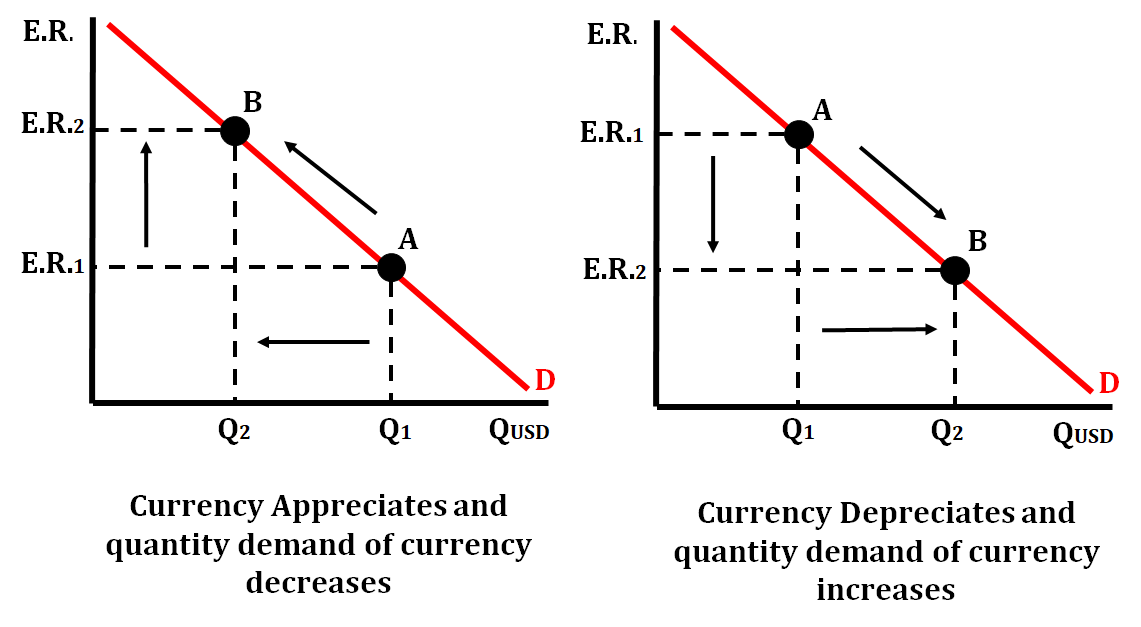
The foreign exchange market, often referred to as the FOREX market, is where international currencies are bought and sold. The demand for a currency is inversely related to its exchange rate. As exchange rates increase, both domestic and foreign consumers tend to purchase less of the currency. Conversely, when exchange rates decrease, the demand for the currency rises as it becomes more affordable.
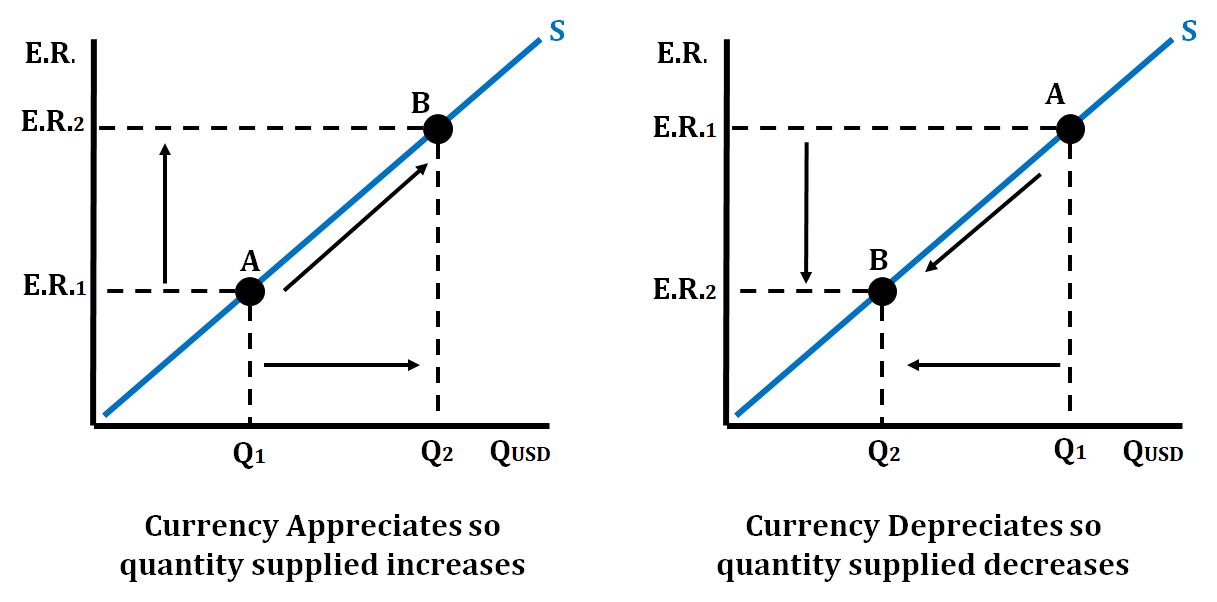
On the supply side, the relationship between exchange rates and the quantity of currency supplied is direct. As exchange rates rise, sellers are more willing to supply the currency. This is because they can receive more value in return. When exchange rates fall, the incentive to supply the currency diminishes, leading to a decrease in the quantity supplied.
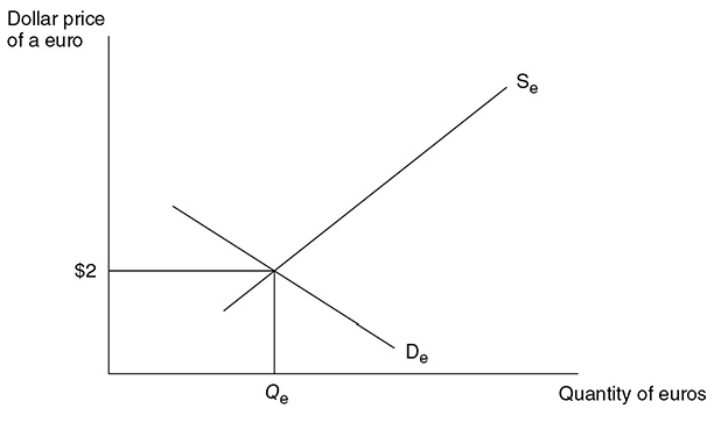
Equilibrium in the FOREX market is achieved when the quantity of currency supplied equals the quantity demanded at a specific exchange rate. This balance is crucial for stable international trade. For example, the equilibrium between the Euro and the U.S. Dollar ensures smooth transactions between the two economies. Disruptions in this balance can lead to economic instability.
Monetary policy plays a significant role in influencing exchange rates. When the Federal Reserve increases the money supply, interest rates on American financial assets fall. This leads to a depreciation of the dollar, making U.S. goods cheaper for foreign consumers. As a result, American net exports increase, boosting aggregate demand.
Conversely, if the Federal Reserve decreases the money supply, interest rates rise, causing the dollar to appreciate. This appreciation makes American goods more expensive for foreign buyers, reducing net exports and shifting aggregate demand to the left. The interplay between interest rates and exchange rates is a critical aspect of economic policy.
Several factors can lead to an increase in demand for the U.S. dollar. These include a strong European preference for American goods, rising European incomes, and a falling U.S. price level. Additionally, speculators betting on a rise in the dollar's value and higher U.S. interest rates can make the U.S. a more attractive destination for financial investments. Understanding these dynamics is essential for navigating the complexities of the foreign exchange market.
SUMMARY
Foreign Exchange Demand
It is the quantity of an international currency that all domestic and foreign currencies are willing and able to purchase at various rates of exchange.
The relationship between exchange rates and the quantity of currency demanded is inverse:
As the exchange rate rises, domestic and foreign consumers will purchase less quantity of the currency.
As the exchange rate falls, domestic and foreign consumers will purchase more quantity of the currency.
Foreign Exchange Supply
It is the quantity of an international currency that all domestic and foreign sellers are willing and able to sell at various rates of exchange.
The relationship between exchange rates and the quantity of currency supplied is positive or direct:
As exchange rates rise, domestic and foreign consumers are willing to sell more.
As exchange rates fall, domestic and foreign consumers are willing to sell less.
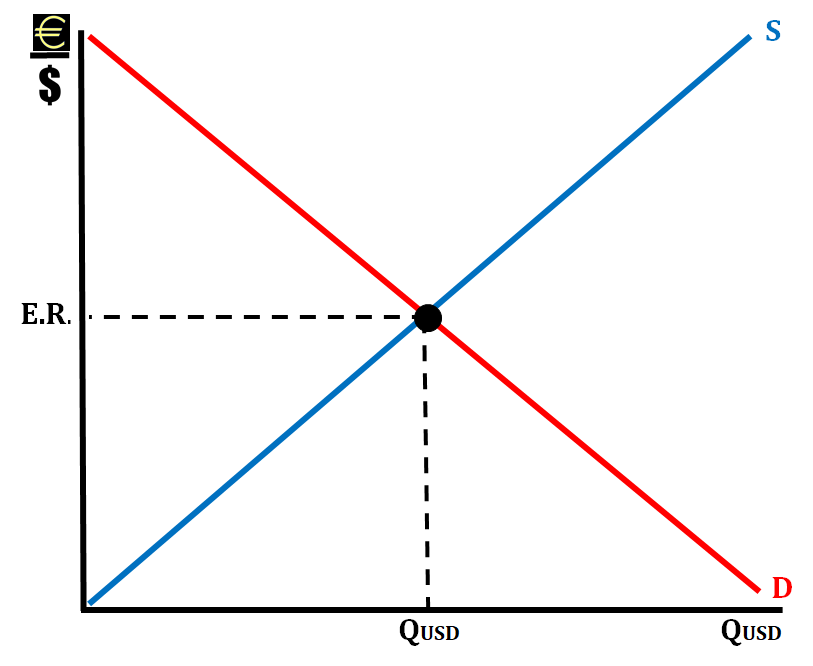
FOREX Market Equilibrium
It is achieved in the FOREX Market (the market in which foreign currency is bought and sold) when the quantity supplied of the currency equals the quantity demanded of the currency at a specific exchange rate.
The FOREX Market in equilibrium for EURO and U.S. Dollar
Connection to Monetary Policy
. When the Fed increases the money supply, the interest rates on American financial assets begin to fall, so the demand for the dollar falls and it depreciates relative to other foreign currencies.
This makes goods in the US less expensive to foreign consumers, so American net exports increase shifting AD to the right.
If the Fed decreases the money supply, American interest rates begin to rise and the dollar appreciates relative to foreign currencies.
This makes American goods more expensive decreasing the net exports which shift AD to the left.
When interest rates rise, capital investments decrease, and financial investments increase.

Demand for the U.S. dollar increases and the dollar appreciates relative to the euro if:
European taste for American-made goods is stronger.
European relative incomes are rising, increasing demand for U.S. goods.
The U.S. relative price level is falling, making U.S. goods relatively less expensive.
Speculators are betting on the dollar to rise in value.
The U.S. relative interest rate is higher, making the United States a relatively more attractive place for financial investments.
What is the relationship between the demand for a currency and its exchange rate in the FOREX market?
Inversely related
Directly related
No relationship
Depends on the currency
What happens to the supply of a currency when exchange rates rise?
Supply increases
Supply decreases
Supply remains constant
Supply fluctuates unpredictably
What is achieved when the quantity of currency supplied equals the quantity demanded at a specific exchange rate?
Equilibrium
Surplus
Deficit
Volatility
How does an increase in the U.S. money supply affect the dollar and net exports?
Dollar depreciates, net exports increase
Dollar appreciates, net exports decrease
Dollar depreciates, net exports decrease
Dollar appreciates, net exports increase
What can cause an increase in demand for the U.S. dollar?
Strong European preference for American goods
Decreasing European incomes
Rising U.S. price level
Low U.S. interest rates
How does a decrease in the U.S. money supply affect interest rates and the dollar?
Interest rates rise, dollar appreciates
Interest rates fall, dollar depreciates
Interest rates rise, dollar depreciates
Interest rates fall, dollar appreciates
What role do speculators play in the foreign exchange market?
Bet on currency value changes
Stabilize exchange rates
Regulate currency supply
Set official exchange rates
6.4 Effect of Changes in Policies & Economic Conditions on the Foreign Exchange Market
Impact of Economic Policies on Foreign Exchange Markets
Changes in economic policies and conditions can significantly impact the foreign exchange market. Four key determinants influence the demand and supply of currency: foreign tastes, trade prices, income levels, and real interest rates. When a government implements expansionary fiscal policy, such as increasing spending or decreasing taxes, it can lead to an increase in aggregate demand, GDP, and prices. Conversely, contractionary fiscal policy, which involves decreasing spending or increasing taxes, can reduce aggregate demand, GDP, and prices.
Monetary policy also plays a crucial role in affecting exchange rates. An expansionary monetary policy, characterized by decreasing the reserve ratio, lowering the discount rate, or buying bonds, can increase the money supply and lower interest rates. This encourages investment spending, which boosts aggregate demand and raises the price level. On the other hand, a contractionary monetary policy, involving increasing the reserve ratio, raising the discount rate, or selling bonds, can decrease the money supply, raise interest rates, and reduce investment spending.
Tariffs are another factor that can influence the foreign exchange market. A revenue tariff is an excise tax on goods not produced domestically, like bananas in the United States, which raises some government revenue without significantly affecting trade. Protective tariffs, however, are levied on domestically produced goods to shield them from foreign competition. For example, a protective tariff on steel can increase domestic production and reduce imports, but it also raises consumer prices and creates inefficiencies.
The economic effects of tariffs include higher consumer prices, reduced consumer surplus, and increased domestic production. While domestic producers benefit from selling more at higher prices, consumers face higher costs and reduced consumption. Tariffs also lead to declining imports and generate revenue for the government, but they promote inefficiency by protecting less efficient domestic industries at the expense of more efficient foreign producers.
Quotas, like tariffs, limit the amount of a good that can be imported, leading to similar economic effects. They result in higher consumer prices and inefficient resource allocation, protecting domestic producers while harming consumers. Unlike tariffs, quotas do not generate revenue for the government, but both measures create deadweight loss and reallocate resources toward less efficient producers.
Overall, government interventions such as tariffs and quotas, along with fiscal and monetary policies, have profound impacts on the foreign exchange market. These measures can alter currency demand and supply, affect interest rates and inflation, and influence global economic conditions. Understanding these dynamics is crucial for comprehending the complexities of the foreign exchange market and its response to policy changes.
SUMMARY
Change in Demand or Supply in Currency
There are four determinants that can change the FOREX Market.
Foreign tastes
Trade prices
Income levels
Real interest rates
Fiscal Policy Impact on Exchange Rates
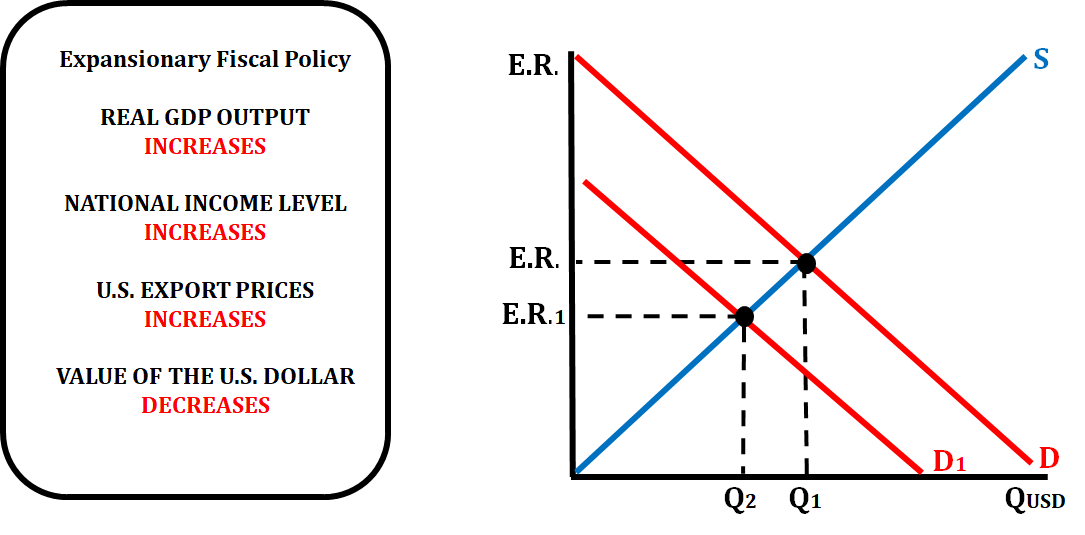
When the government practices an expansionary fiscal policy (increase in spending or decrease in taxes), there is an effect on the exchange rate for that country's currency.
If the government increases spending or decreases taxes, aggregate demand will increase, GDP increase, and price increase.
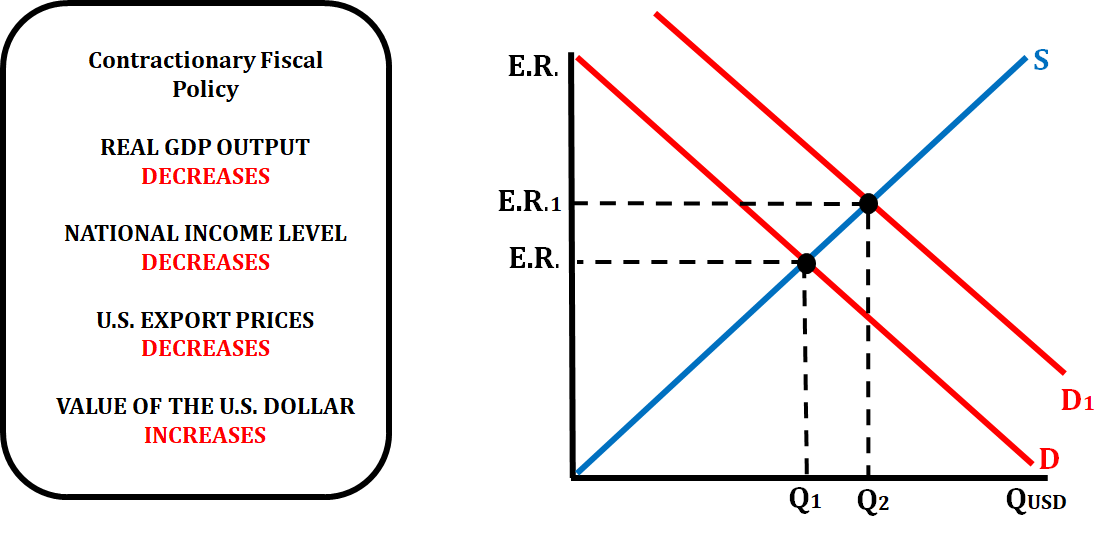
When the government practices a contractionary fiscal policy (decreases spending or increases taxes), there is an effect on the exchange rate of that country's currency
If the government decreases spending or increases taxes, aggregate demand will decrease, GDP decrease, and price decrease.
Monetary Policy Impact on Exchange Rates
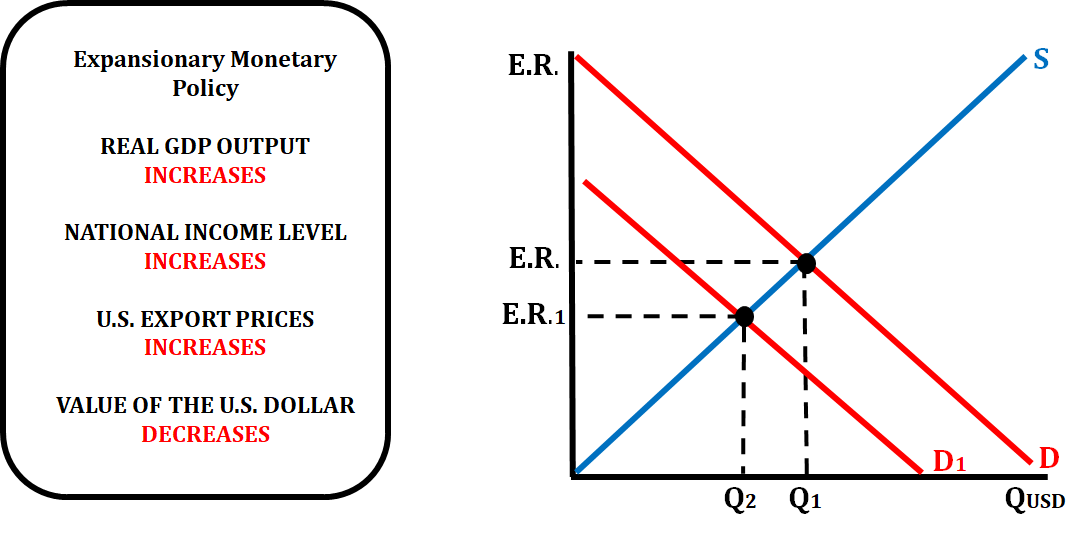
If the central bank of a country is practicing an expansionary monetary policy (decreasing the reserve ratio, decreasing the discount rate, or buying bonds) it will affect the exchange rate as well.
When the FED increases the money supply, that lowers the interest rate which will increase investment spending.
When investment spending increases, aggregate demand increases which raises the price level.
This means that both the national income levels and export prices will increase.
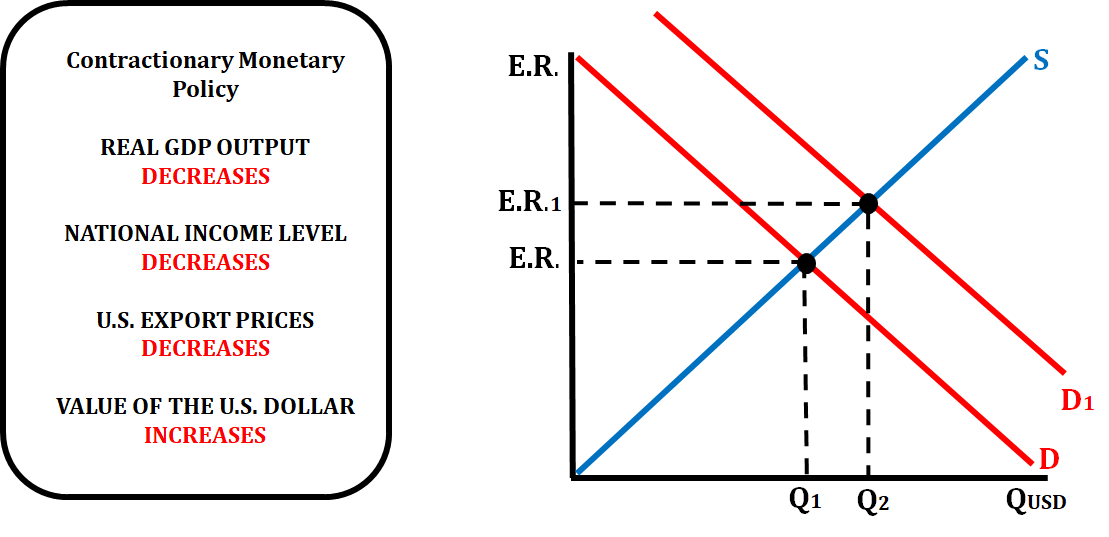
If the central bank of a country is practicing a contractionary monetary policy (increasing the reserve ratio, increasing the discount rate, or selling bonds), it will affect the value of the exchange rate.
When the FED decreases the money supply, that raises the interest rate which will decrease investment spending.
When investment spending decreases, aggregate demand decreases which lower the price level.
This means that both the national income levels and export prices will decrease.
Tariffs
Revenue tariff - An excise tax levied on goods not produced in the domestic market.
Ex. →The United States does not produce bananas. If a revenue tariff were levied on bananas, it would not be a serious impediment to trade, and it would raise a little revenue for the government.
Protective tariff - An excise tax levied on a good that is produced in the domestic market so that it may be protected from foreign competition.
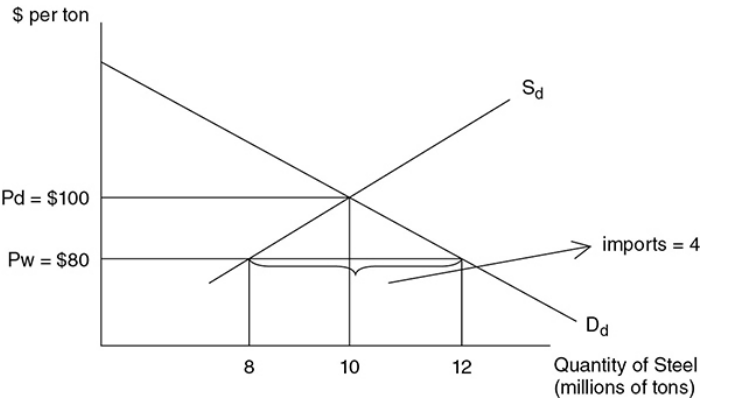
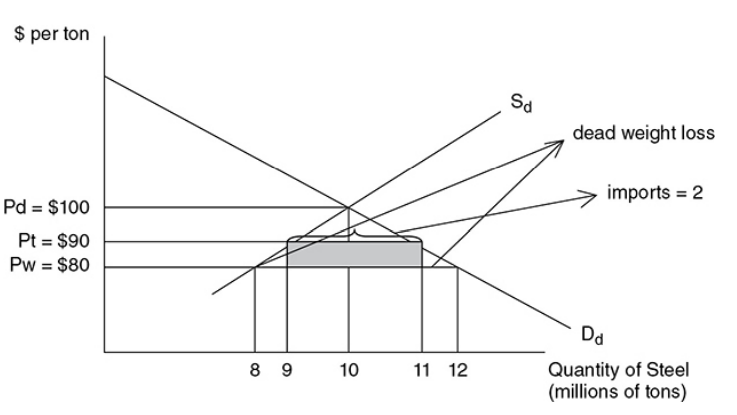
Ex. → Assume the domestic steel price is $100 per ton and the equilibrium quantity of domestic steel is 10 million tons. Since other nations could produce it at a lower cost, in the competitive world market, the price is $80 per ton. At that price, the United States would demand 12 million tons but only produce eight million tons and so four million tons are imported. If the steel industry is successful in getting a protective tariff passed through Congress, the world price rises by $10, increasing the quantity of domestic steel supplied and reducing the amount of steel imported from four million to two million tons.
A higher price and lower consumption reduce the area of consumer surplus and create deadweight loss.
Economic Effects of the Tariff
Consumers pay higher prices and consume less steel
Consumer surplus has been lost
Domestic producers increase output
Domestic steel firms are not subject to the tariff, so they can sell more steel at the price of $90 than they could at $80.
Declining imports
Fewer tons of imported steel arrive in the United States.
Tariff revenue
The government collects $10 × 2 million = $20 million in tariff revenue. This is a transfer from consumers of steel to the government, not an increase in the total well-being of the nation.
Inefficiency
The world price was lower than the domestic price because it was more efficient to produce steel abroad and export it to the United States. By taxing this efficiency, the United States promotes the less efficient domestic industry and stunts the efficient foreign sector. As a result, resources are diverted from the efficient to the inefficient sector.
The deadweight loss now exists
Quotas
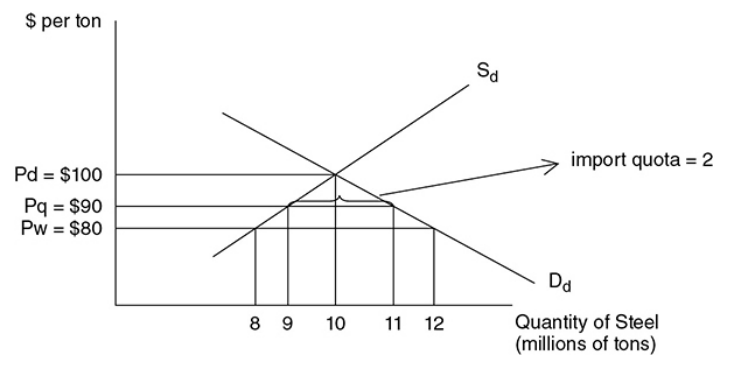
Import quota - A limitation on the amount of a good that can be imported into the domestic market.
With a quota, the government only allows two million tons to be imported. So the impact of the quota, except the revenue, is the same: higher consumer price and inefficient resource allocation.
Tariffs and quotas share some of the same economic effects:
Both hurt consumers with artificially high prices and lower consumer surplus.
Both protect inefficient domestic producers at the expense of efficient foreign firms, creating a deadweight loss.
Both reallocate economic resources toward inefficient producers.
Tariffs collect revenue for the government, while quotas do not.
What are the four key determinants that influence the demand and supply of currency in the foreign exchange market?
Foreign tastes, trade prices, income levels, real interest rates
Government spending, tax rates, inflation, unemployment
Exchange rates, trade deficits, foreign investments, GDP
Interest rates, inflation, government debt, trade balance
What is the effect of an expansionary fiscal policy on aggregate demand and GDP?
Increases aggregate demand and GDP
Decreases aggregate demand and GDP
No effect on aggregate demand and GDP
Only increases GDP but not aggregate demand
Which of the following is a characteristic of contractionary monetary policy?
Increasing the reserve ratio
Decreasing the reserve ratio
Buying bonds
Lowering the discount rate
What is the primary purpose of a protective tariff?
To shield domestic industries from foreign competition
To generate revenue for the government
To increase consumer surplus
To promote free trade
How do tariffs affect consumer prices and domestic production?
Increase consumer prices and domestic production
Decrease consumer prices and domestic production
Have no effect on consumer prices and domestic production
Only increase consumer prices but not domestic production
What is a key difference between tariffs and quotas?
Tariffs generate government revenue, while quotas do not
Quotas generate government revenue, while tariffs do not
Both tariffs and quotas generate government revenue
Neither tariffs nor quotas generate government revenue
How do government interventions like tariffs and quotas impact the foreign exchange market?
They alter currency demand and supply, affect interest rates and inflation
They have no impact on the foreign exchange market
They only affect domestic markets, not foreign exchange
They solely influence global economic conditions without affecting currency
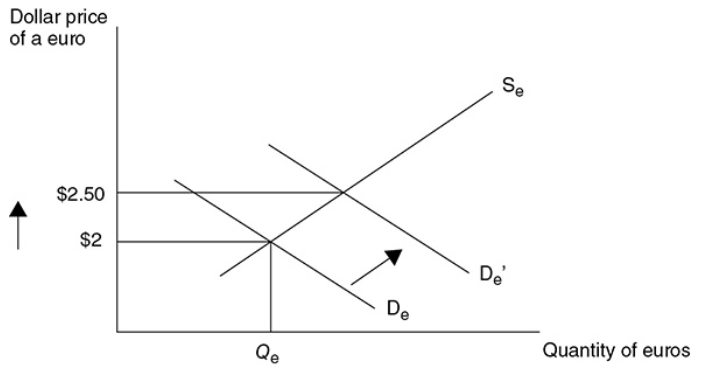
6.5 Changes in the Foreign Exchange Market and Net Exports
Understanding Currency Fluctuations and Their Impact on Net Exports
In the foreign exchange market, currencies can either appreciate or depreciate relative to one another. An appreciating currency means its value is rising compared to another currency, making it stronger. Conversely, a depreciating currency is one whose value is falling, rendering it weaker. These fluctuations are crucial for understanding the dynamics of international trade and economics. Correctly labeling the axes in currency market graphs is essential for accurate analysis.
When a currency appreciates, it can have several effects on a country's economy. A stronger currency makes exports more expensive for foreign buyers, potentially leading to a decrease in net exports. This decrease can result in a reduced aggregate demand, as foreign consumers may seek cheaper alternatives. Consequently, domestic production and employment might suffer due to the lower demand for goods. Overall, an appreciating currency can lead to a decrease in a country's economic output.
On the other hand, a depreciating currency can boost a country's net exports. A weaker currency makes exports cheaper and more attractive to foreign buyers, increasing demand for domestic goods. This rise in demand can lead to higher production levels and more employment opportunities within the country. As a result, the overall economic output may increase, benefiting the domestic economy. Thus, currency depreciation can have positive effects on a nation's trade balance.
Several factors determine exchange rates in the foreign exchange market. These include interest rates, inflation rates, and economic stability, among others. Changes in these determinants can lead to fluctuations in currency values, impacting international trade. Understanding these factors is essential for predicting currency movements and their subsequent effects on net exports. Exchange rate dynamics are complex but crucial for economic analysis.
The foreign exchange market is a dynamic environment where currencies are constantly traded. Traders and investors buy and sell currencies based on their expectations of future movements. This trading activity influences exchange rates and can lead to rapid changes in currency values. The market's volatility requires careful monitoring and analysis to make informed economic decisions. Understanding market dynamics is key to navigating the complexities of international finance.
Trade balance and currency values are closely linked in the global economy. A country's trade balance reflects the difference between its exports and imports. Currency fluctuations can significantly impact this balance by altering the competitiveness of a nation's goods. Policymakers and economists must consider these factors when developing strategies to enhance economic growth. The interplay between trade balance and currency is a vital aspect of international economic relations.
SUMMARY
Appreciating and Depreciating Currency
Appreciating or stronger currency - When the value of a currency is rising relative to another currency.
Depreciating or weaker currency - When the value of a currency is falling relative to another currency.
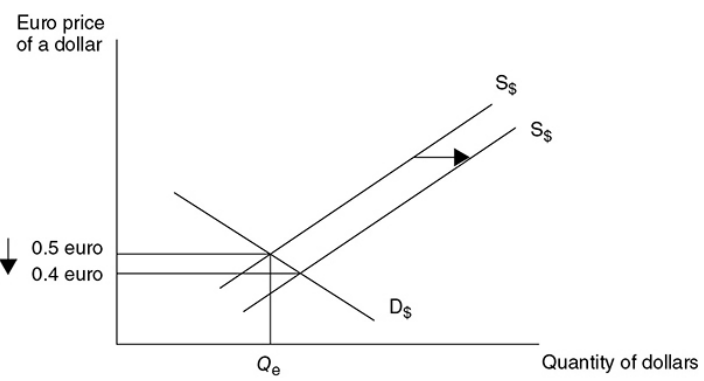
NOTE - It is very important to label the axes correctly. If the market is for the dollar, the x-axis should be labeled “Quantity of dollars.” The label on the y-axis depends on how the dollar is being priced. If we are pricing dollars in terms of the number of euros it takes to purchase 1 dollar, then the correct label is “Euros per dollar” or “Euro price of a dollar”.
Changes in Net Export: Consequences
Changes in net export can bring significant impact.
Decrease in net exports:
decrease in aggregate demand.
exports become more expensive.
decrease in demand for domestic goods.
decrease in production and employment.
decrease in output.
Increase in net exports:
increase in aggregate demand.
exports become cheaper.
increase in demand for domestic goods.
increase in production and employment.
increase in output.
What happens to a country's net exports when its currency appreciates?
Net exports decrease
Net exports increase
Net exports remain unchanged
Net exports fluctuate unpredictably
Which of the following is a result of a depreciating currency?
Increased demand for domestic goods
Decreased production levels
Higher unemployment rates
Reduced economic output
What are some factors that determine exchange rates in the foreign exchange market?
Interest rates and inflation rates
Geographical location
Cultural differences
Political systems
How does a stronger currency affect domestic production and employment?
It may lead to decreased production and employment
It boosts production and employment
It has no effect on production and employment
It causes production and employment to fluctuate
What is the relationship between trade balance and currency values?
Currency fluctuations can impact trade balance
Trade balance has no relation to currency values
Trade balance determines currency values
Currency values are unaffected by trade balance
Why is it important to correctly label the axes in currency market graphs?
For accurate analysis
To make the graph look neat
To confuse competitors
To comply with regulations
What role do traders and investors play in the foreign exchange market?
They influence exchange rates through trading
They stabilize currency values
They have no impact on currency values
They only trade for personal gain
6.6 Real Interest Rates and International Capital Flows
Real Interest Rates and Capital Flows
Real interest rates play a crucial role in determining the direction of international capital flows. When real interest rates are high in a country, it attracts foreign investors who seek higher returns on their investments. This results in an inbound capital flow, where foreign funds are injected into the domestic economy through the purchase of domestic assets. Conversely, when real interest rates fall, domestic investors may seek better returns abroad, leading to an outbound capital flow. This dynamic is essential for understanding how capital moves across borders.
The impact of real interest rates on net exports is significant. A higher real interest rate in one country compared to another can lead to an appreciation of that country's currency. This makes exports from the country with the higher interest rate more expensive for foreign buyers, potentially reducing net exports. On the other hand, a lower real interest rate can cause the currency to depreciate, making exports cheaper and imports more expensive, which can increase net exports. These currency fluctuations are vital for international trade dynamics.
Central banks are pivotal in shaping domestic interest rates through various monetary policy tools. By adjusting open market operations, discount rates, and reserve requirements, central banks influence the cost of borrowing and the attractiveness of saving. When a central bank raises interest rates, it often leads to higher rates across the economy, encouraging foreign investment. Conversely, lowering interest rates can make domestic assets less appealing to foreign investors, affecting capital inflows.
Domestic interest rates have a direct impact on net capital inflows. When domestic interest rates are high, foreign investors are more likely to invest in the country's assets, seeking higher returns. Conversely, low domestic interest rates may deter foreign investment, as investors look for better opportunities elsewhere. This relationship underscores the importance of interest rate policies in attracting or repelling foreign capital.
Banks also play a role in influencing domestic interest rates. By raising the interest rates on loans, banks can increase borrowing costs, which may lead to higher interest rates throughout the economy. Similarly, when banks offer higher interest rates on deposits, it can encourage saving over spending, contributing to an overall increase in interest rates. These actions by banks are crucial in shaping the economic environment.
Understanding the factors affecting capital flow is essential for comprehending global economic interactions. Inflation, exchange rates, and government policies all influence how capital moves across borders. High inflation can erode the real returns on investments, affecting capital flow decisions. Exchange rates impact the relative attractiveness of investing in different countries, while government policies can either encourage or restrict foreign investment. These elements collectively shape the landscape of international capital flows.
SUMMARY
Capital Flow
Inbound capital flow
It is the injection of funds into a domestic economy that occurs through the purchase of domestic assets by foreign investors.
When real interest rates are high, it generates inbound capital flow.
This is because foreign investors look to invest their money into assets that have high-interest rates because they can earn a higher profit.
Outbound capital flow
It is the extraction of funds from a domestic economy that occurs through the purchase of foreign assets by domestic investors.
When real interest rates fall, it generates outbound capital flow.
This is due to the foreign investors look to invest in other countries because the interest rate is higher there than in their own country.
Impact on net exports
A higher real interest rate in one country compared to another will make the currency of the country with the higher interest rate more attractive to foreign investors, leading to an appreciation of that currency. This can make exports from the country with the higher interest rate more expensive for foreign buyers, and imports to that country cheaper, which can lead to a decrease in net exports.
On the other hand, a lower real interest rate in one country compared to another will make the currency of the country with the lower interest rate less attractive to foreign investors, leading to a depreciation of that currency. This can make exports from the country with the lower interest rate cheaper for foreign buyers, and imports to that country more expensive, which can lead to an increase in net exports.
Central Banks and Domestic Interest Rates
Central Banks
It plays a major role in determining domestic interest rates.
It uses monetary policy tools such as open market operations, discount rates and reserve requirements to influence interest rates.
When the central bank raises the interest rate, it will encourage banks to raise their own interest rates as well.
Domestic Interest Rates
Affects net capital inflows:
country’s assets become more or less attractive to foreign investors.
domestic interest rate high → foreign investors may be likely to invest.
domestic interest rate low → foreign investors may be less likely to invest.
Banks affect domestic interest rates:
When banks raise the interest rates they charge on loans, it can lead to higher borrowing costs for businesses and consumers, which can, in turn, lead to higher interest rates across the economy.
When banks raise the interest rates they pay on deposits, it can lead to higher returns for savers, which can encourage them to save more and spend less, which can also lead to higher interest rates across the economy.
What happens to international capital flows when real interest rates are high in a country?
Inbound capital flow occurs as foreign investors seek higher returns.
Outbound capital flow occurs as domestic investors seek better returns abroad.
There is no effect on international capital flows.
Capital flows remain constant regardless of interest rates.
How do higher real interest rates affect a country's currency and net exports?
The currency appreciates, making exports more expensive and potentially reducing net exports.
The currency depreciates, making exports cheaper and increasing net exports.
The currency remains stable, having no effect on net exports.
The currency fluctuates unpredictably, making it hard to determine the effect on net exports.
What role do central banks play in shaping domestic interest rates?
They adjust open market operations, discount rates, and reserve requirements.
They directly control all interest rates in the economy.
They have no influence on domestic interest rates.
They only influence interest rates through government policies.
What is the effect of high domestic interest rates on foreign investment?
Foreign investors are more likely to invest in the country's assets.
Foreign investors are deterred from investing in the country's assets.
Foreign investment remains unaffected by domestic interest rates.
Foreign investors only invest based on inflation rates, not interest rates.
How do banks influence domestic interest rates?
By raising interest rates on loans and deposits, affecting borrowing and saving behaviors.
By setting government policies that control interest rates.
By having no impact on interest rates, which are solely determined by central banks.
By only influencing interest rates through international trade agreements.
What factors are essential for understanding global economic interactions and capital flow?
Inflation, exchange rates, and government policies.
Only government policies and inflation.
Only exchange rates and international trade agreements.
None of these factors are essential.
How can high inflation affect capital flow decisions?
It can erode real returns on investments, affecting capital flow decisions.
It has no effect on capital flow decisions.
It encourages more foreign investment due to higher returns.
It stabilizes capital flow by balancing exchange rates.

