
 Worksheets
Weather Unit Test Review
Total questions: 43
Worksheet time: 31mins
1. A boundary in which two different air masses meet and do not mix, causing a change in the weather is:
a. the jet stream
b. the greenhouse effect
c. air pressure
d. a weather front
2. A large section of air with the same temperature and moisture level is called ________________.
a. a pressure gradient
b. an air mass
c. a hemisphere
d. a hurricane
5. What is humidity?
Water, in liquid or solid form, that falls from the atmosphere.
The atmospheric conditions, along with short-term changes, of a certain place at a certain time.
The amount of water vapor in the air.
The force that a column of air applies on the air or a surface below it.
6. In general, how does air move around the Earth?
a. from areas with deeper ocean to areas with shallower oceans
b. from areas of lower air altitude to areas of higher air altitude
c. from areas of higher temperature to areas of lower temperature
d. from areas of lower temperature to areas of higher temperature
8. A cold front moving into an area can bring what type of weather?
a. warmer temperatures, clear and sunny skies
b. cooler temperatures, clear skies
c. warmer temperatures, clouds
d. cooler temperatures, clouds, and precipitation
10. What is the source for global winds and convection in the atmosphere?
a. unequal heating of the Earth by the Sun
b. the rotation of Earth
c. the moon’s gravity
d. continental
14. High pressure is associated with what type of weather?
a. cloudy weather
b. cold weather
c. warm weather
d. fair/good weather
18. Where does the initial source of energy come from that creates winds and thus surface currents?
a. the moon’s gravity
b. the sun
c. the rotation of the Earth
d. wind

19. In the figure, which of the following is the correct symbol for a cold front?
a. 1
b. 2
c. 3
d. 4
21. ________________ are made of water vapor that condenses in the atmosphere.
a. dew
b. clouds
c. evaporation
d. transpiration
27. The word Low (L) on the map refers to
a. air temperature
b. air pressure
c. relative humidity
d. cloud coverage

This is the symbol for which type of front?
cold front
warm front
stationary front
occluded front

This is the symbol for which type of front?
cold front
warm front
occluded front
stationary front

What type of front is over Texas?
warm front
cold front
stationary front
occluded front
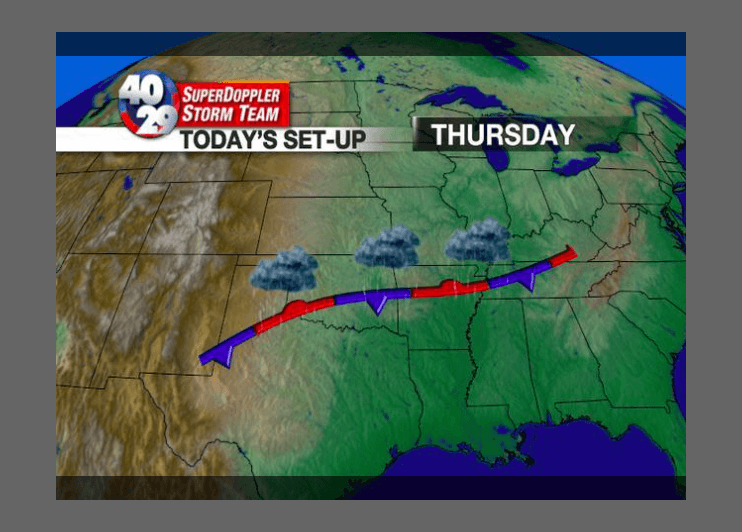
Name that symbol.
Cold Front
Warm Front
Stationary Front
Occluded Front

Neither air mass really takes over the other.
Cold Front
Warm Front
Stationary Front
Occluded Front
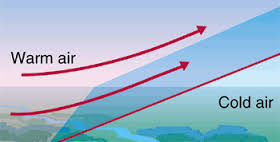
Which type of front is pictured?
Cold front
Warm front
Occluded front
Stationary front
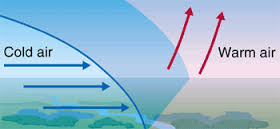
Which type of front is pictured?
Cold front
Warm front
Occluded front
Stationary front
These clouds are wispy or curly, white, thin & feather-like
cumulus
cumulonimbus
cirrus
stratus
These clouds are very high in the sky.
cumulus
cumulonimbus
cirrus
stratus
These clouds are puffy and white and sometimes appear to have a flat bottom.
cumulus
cumulonimbus
cirrus
stratus
These clouds appear in blanket-like layers.
cumulus
cumulonimbus
cirrus
stratus
These clouds are large, dark, billowing clouds with an anvil shaped top.
cumulus
cumulonimbus
cirrus
stratus

Which cloud is this?
cumulus
cumulonimbus
cirrus
stratus
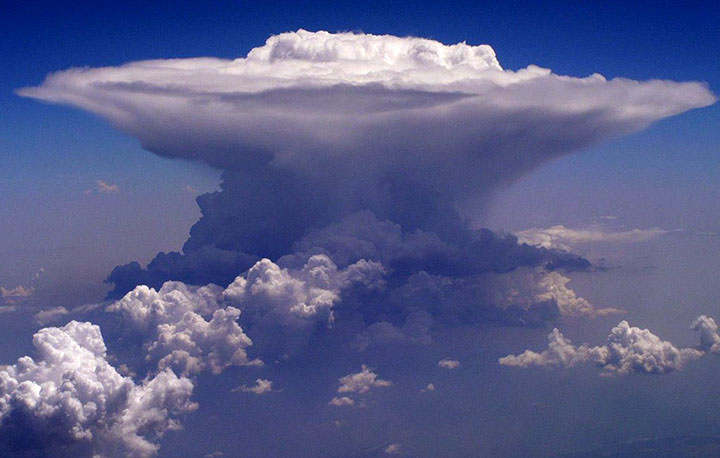
Which cloud is this?
cumulus
cumulonimbus
cirrus
stratus

Which cloud is this?
cumulus
cumulonimbus
cirrus
stratus

Which cloud is this?
cumulus
cumulonimbus
cirrus
stratus
Which weather front is most likely to bring a sudden drop in temperature and possible storms?
Cold front
Warm front
Stationary front
Occluded front

Which air mass is higher in humidity?
purple
blue
Which air mass is warmer?
red
yellow
Which air mass would bring warm and wet weather?
purple
green
blue
yellow
red
Which air mass would be classified as Continental Tropical (cT)?
purple
green
blue
yellow
red
Which air mass would be classified as Maritime Tropical (mT)?
purple
green
blue
yellow
red
Which air mass would be classified as Maritime Polar (mP)?
purple
green
blue
yellow
red
An air mass is a portion of the atmosphere that has similar...
Water and temperature
Air pressure and wind speed
Humidity and temperature
Humidity and air pressure
Which type of air mass bring COLD and DRY weather?
Maritime Polar (mP)
Maritime Tropical (mT)
Continental Polar (cP)
Continental Tropical (cT)
Which type of air mass brings WARM and WET weather?
Maritime Polar (mP)
Maritime Tropical (mT)
Continental Polar (cP)
Continental Tropical (cT)
Sort the information to the correct type of air mass
Continental Tropical (cT) (a)
Continental Polar (cP) (b)
Maritime Tropical (mT) (c)
Maritime Polar (mP) (d)
When combined together, evaporation, condensation and precipitation are all part of what?
making fog
changing of the seasons
the life cycle
the water cycle

What stage of the water cycle is at letter A?
evaporation
condensation
collection
precipitation

Which stage of the water cycle is at letter B?
evaporation
precipitation
collection
condensation

Which stage of the water cycle is at letter C?
precipitation
condensation
evaporation
collection

Which stage of the water cycle is at letter D?
collection/accumulation
condensation
evaporation
precipitation

