NEW
Font size
 Worksheets
Chemistry November Review
Total questions: 16
Worksheet time: 8mins
The physical and chemical properties of the elements are periodic functions of their atomic numbers.
Periodic table
Periodic rules
Periodic Law
Periodic properties
The minimum amount of energy that can be lost or gained by an atom.
Planck's constant
Quantum
Photon
Electron
The lowest allowable energy state of an atom is its:
Lowest state
Neutral state
Excited state
Ground state
The arrangement of electrons in an atom is called:
Atomic number
Atomic orbital model
Quantum mechanical model of the atom
Electron configuration
It is impossible to determine simultaneously both the position and velocity of an electron or any other particle
Heisenberg's uncertainty principle
Hund's rule
Pauli exclusion principle
Aufbau principle
A maximum of two electrons can occupy a single atomic orbital, but only if the electrons have opposite spins
Heisenberg's uncertainty principle
Hund's rule
Pauli exclusion principle
Aufbau principle
This principle states that each electron occupies the lowest energy orbital available.
Heisenberg's uncertainty principle
Hund's rule
Pauli exclusion principle
Aufbau principle
Is an atomic model proposed by Schrödinger, in which electrons are treated as waves
Wave atomic model
Quantum mechanical model
Atomic orbital model
Principal quantum number
The electrons in the atom’s outermost orbitals, generally those orbitals associated with the atom’s highest principal energy level, are called
Dot-diagram
"s" electrons
Ionic electrons
Valence electrons
Is how easily an atom loses an electron.
Ionization energy
Quantum energy
Ionic bond
Electronegativity
The chemical bond that results from sharing valence electrons is:
Ionic bond
Covalent bond
Metallic bond
Molecular bond
The chemical bond that results from giving valence electrons is:
Ionic bond
Covalent bond
Metallic bond
Molecular bond
Characteristics of metals
Group 17, known as halogens, are from this type.
malleable, ductile, shiny when smooth and clean.
poor conductors of heat and electricity.
Have physical and chemical properties of both metals and nonmetals
Physical characteristics of nonmetals
They are poor conductors of heat and electricity.
They are malleable, ductile, shiny when smooth and clean.
Have physical and chemical properties of both metals and nonmetals
Groups 1 and 2 from the periodic table, belong to this type.
Physical characteristics of metalloids
They are poor conductors of heat and electricity.
They are malleable, ductile, shiny when smooth and clean
Have physical and chemical properties of both metals and nonmetals.
Groups 1 and 2 from the periodic table, belong to this type.
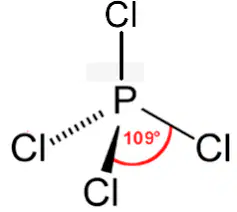
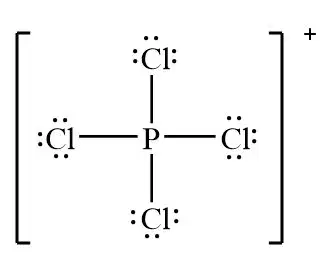
The Lewis structure for PCl4