
 Worksheets
Population Test
Total questions: 40
Worksheet time: 32mins
What is demography?
The study of population
The study of migration
The study of birth rates
The study of natalism
Which of the following is NOT true of large population centers?
They are located near water sources
They are located in extreme climates
They are located in good climate zones
They are located on farmable land
In which geographic areas are there not many population centers?
Coastlines and Rivers
Deserts and Mountains
Wetlands and Tundra
Mountains and Plains
The three largest population clusters in the world are in
East Asia, South Asia, Southeast Asia
East Asia, South Asia, South America
Australia, South Asia, East Asia
Africa, South Asia, East Asia
By measuring the number of farmers per square unit of arable land, you get the
Population Density
Arithmetic Population Density
Physiological Population Density
Agricultural Population Density
By measuring the number of people per square unit of arable land, you get the
Population Density
Arithmetic Population Density
Physiological Population Density
Agricultural Population Density
What is population density?
An increase in the amount of people in one area.
Population divided by the total area.
The number of people in a geographic area.
The pattern where people live.
Population Pyramids measure a country's population growth using what two data points?
Age and Wealth
Age and Gender
Gender and Wealth
Wealth and Birth Rate

Use the image below to answer the following questions. Which of the following is the most accurate statement regarding Pyramid A?
Pyramid A is experiencing rapid population growth
Pyramid A has a declining birthrate and therefore is experiencing low population growth.
Pyramid A likely represents a more developing country.
Pyramid A is likely represents a country in the 3rd stage of the DTM.
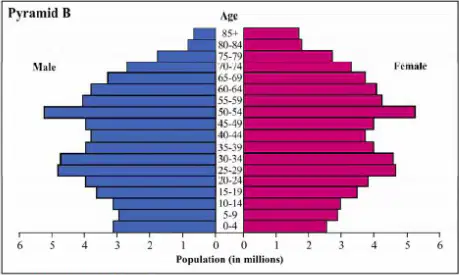
Which of the following is NOT TRUE regarding Pyramid B?
Pyramid B is experience rapid population loss.
Pyramid B likely represents a country in the 1st stage of the DTM.
Pyramid B has access to advanced medical care.
Pyramid B has a declining birth rate.

Describe the healthcare of this country.
Good healthcare available to most
Good healthcare available to some
Poor healthcare for all
Poor healthcare for most

Which country, A or B, has an ageing population?
A
B
Match the following population pyramids with the correct stage of the Demographic Transition Model

Stage 1

Stage 2

Stage 3

Stage 4

Stage 5

How would you describe the population of this country?
They are experiencing stable population growth
They are experiencing rapid population growth
They are experiencing negative population growth

This country has a low birth rate
True
False
Refugee
A person who has been forced to flee their country due to persecution, war, or violence.
Assistance provided to people in need, often during emergencies or crises.
Circumstances or situations that force or encourage people to leave their homes and migrate to another place.
Money sent by migrants back to their families in their home country.
What is a push factor?
Something that makes you leave your home
Something that makes you move to a new home
Something that makes you return to your original home
Something that costs money
What is a 'pull factor?'
Something that makes you want to move to a place
Something that forces you out of your home
Something that encourages you to return to your original home
Something that costs money
What are the barriers or challenges that impede or complicate the process of migration called?
Intervening Opportunities
Intervening Obstacles
Push Factors
Pull Factors
Who is a person that departs from their home country to reside in another country?
Immigrant
Emigrant
Refugee
Diaspora
Who is a person that enters a new country with the intention of living there permanently?
Emigrant
Immigrant
Refugee
Diaspora
Which type of migration is driven by compulsion due to threats such as conflict, natural disasters, or persecution?
Voluntary Migration
Forced Migration
Internal Migration
External Migration

Which of the following is a PULL factor?
Job Opportunities
Religious Persecution
Political Corruption
Warfare

In this population pyramid which side are girls on?
Left
Right
Bottom Half
Top Half

high agricultural density.
low agricultural density.
high arithmetic density.
low physiological density.
low arithmetic density

This image shows Penn State University's stadium during a football game. Choose the phrase to identify the density in the bleachers.
high
low
Which pizza shows less density of pepperoni?


In what stage of the DTM are traditional tribes?
1
2
3
4
5

Which describes the birth and death rate of Stage 1 of the DTM?
The death rate is high but the birth rate is low
Both the death and birth rate are high
The death rate is low but the birth rate is high
Both the death and birth rate are low

Which describes the birth and death rate of Stage 2 of the DTM?
The death rate is decreasing and birth rate remains high
Both the death and birth rate are high
The death rate is low but the birth rate is high
Both the birth rate and death rate are decreasing

Which describes the birth and death rate of Stage 3 of the DTM?
The death rate is decreasing and birth rate remains high
Both the death and birth rate are high
The death rate is low but the birth rate is high
Both the birth rate and death rate are decreasing

Which describes the birth and death rate of Stage 4 of the DTM?
The death rate is decreasing and birth rate remains high
Both the death and birth rate are high
Both the death and birth rate are low and fluctuating
Both the birth rate and death rate are decreasing
Which of these does the DTM not include?
Birth rate
Population
Migration
Death rate
A small island has a population of 50,000 people and an area of 25 square kilometers. What is the population density of the island?
A city has a population of 250,000 and an area of 500. What is the population density?
A city has a population of 3600 and an area of 12. What is the population density?
A city has a population of 3,500 people per square kilometer and covers an area of 120 square kilometers. What is the total population of the city.
A city has a population of 120 people per square kilometer and covers an area of 250 square kilometers. What is the total population of the city.

