
 Worksheets
The War of 1812 and The Era of Good Feelings
Total questions: 17
Worksheet time: 12mins

Use the image to answer the following question. What activity, as shown in this image, strained relations between Great Britain and the United States prior to the War of 1812?
uprising
embargo
smuggling
impressment
Why did the Embargo Act of 1807 make Jefferson extremely unpopular?
It hurt merchants financially.
It pulled the United States into war.
It gave rights to free people of color.
It penalized sailors who took part in wars.
Which of the following phrases describe the “war hawks” associated with the War of 1812? Select the two correct answers.
Native Americans who fought during the War of 1812
young men who had not taken part in the American Revolution
congressional politicians who wanted to enter the War of 1812
pirates who took part in the War of 1812 by bypassing blockades
British troops who burned American cities and destroyed American artifacts

Use the map to answer the following question. How did the British get to Washington, D.C.?
up the Ohio River
through Lake Erie
up the Mississippi River
through the Chesapeake Bay
Who enlisted the help of servants and enslaved workers to save many government records from the White House before the British burned it?
Jean Lafitte
Dolley Madison
James Madison
Andrew Jackson
Which battle was fought after the signing of the Treaty of Ghent?
the Battle of Lake Erie
the Battle of Baltimore
the Battle of Plattsburgh
the Battle of New Orleans
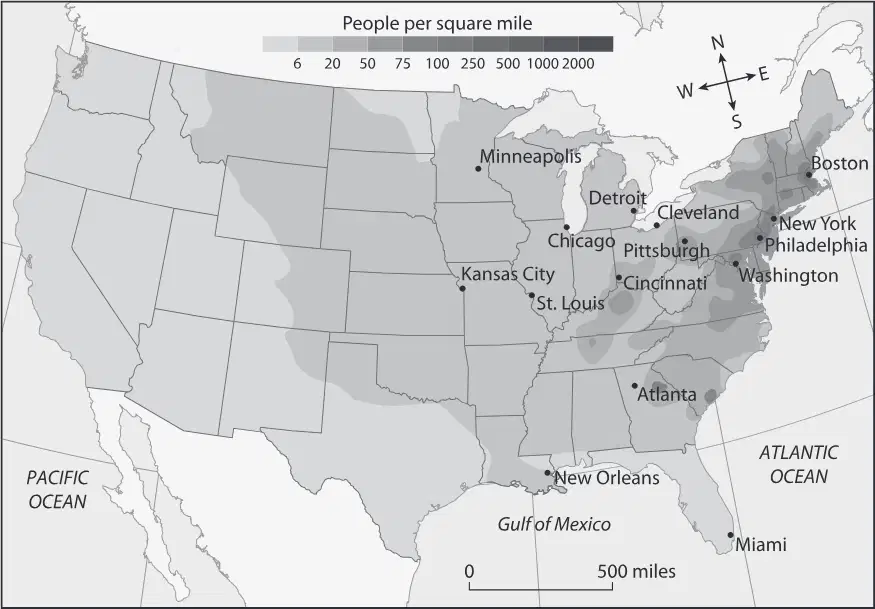
Based on this map, which of the following cities had the lowest population density?
Boston
Pittsburgh
Philadelphia
New Orleans
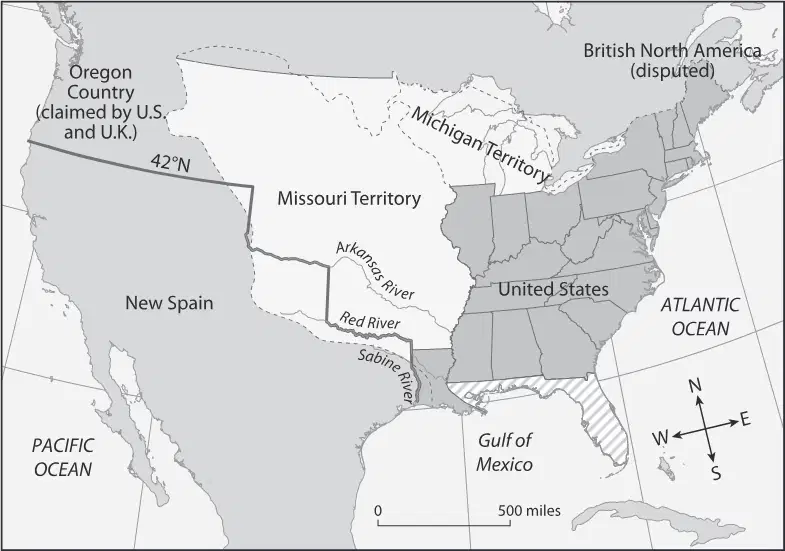
Use the map to answer the following question. Based on this map, where did the United States give up land to New Spain?
north of 32° N
west of the Sabine River
west of 100° W
north of 42° N
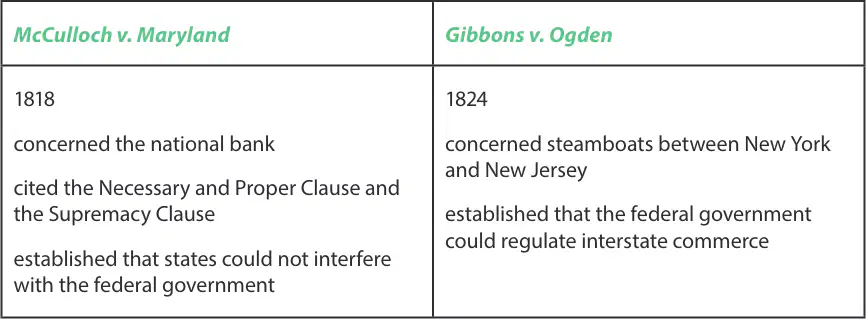
Use the chart to answer the following question. Which part of McCulloch v. Maryland was applicable to Gibbons v. Ogden?
banking on a national scale
the Necessary and Proper Clause
the Supremacy Clause
one party being an individual
Which political parties emerged in the 1820s? Select the two correct answers.
the Whig Party
the Federalist Party
the Democratic Party
the Anti-Federalist Party
the Democratic-Republican Party
Use the excerpt to answer the following question. With the existing colonies or dependencies of any European power we have not interfered and shall not interfere. But with the Governments who have declared their independence and maintain it, and whose independence we have, on great consideration and on just principles, acknowledged, we could not view any interposition for the purpose of oppressing them, or controlling in any other manner their destiny, by any European power in any other light than as the manifestation of an unfriendly disposition toward the United States. What United States position does this excerpt explain?
the Monroe Doctrine
the Supremacy Clause
the Embargo Act of 1807
the Era of Good Feelings
What were the three main parts of Henry Clay’s American System?
a national bank, protective tariffs, and improved transportation infrastructure
embargoes on French and British goods, an end to impressment, and an end to blockades
land battles at Baltimore, naval battles on Lake Champlain, and the port battle at New Orleans
the acquisition of Florida, the establishment of the border with New Spain, and the policing of the Neutral Ground
Use the excerpt to answer the following question. O! say can you see, by the dawn’s early light, What so proudly we hail’d at the twilight’s last gleaming, Whose broad stripes and bright stars through the perilous fight, O’er the ramparts we watch’d, were so gallantly streaming? And the rockets’ red glare, the bombs bursting in air, Gave proof through the night that our flag was still there— O! say, does that star-spangled banner yet wave O’er the land of the free, and the home of the brave? Which battle is commemorated in this poem?
the Battle of Baltimore
the Battle of Lake Erie
the Battle of Tippecanoe
the Battle of New Orleans
Why was the outcome of the War of 1812 important for the United States even though the country did not achieve a clear victory?
It led to significant territorial gains for the United States.
It resulted in a strong sense of national identity and unity.
It caused the United States to lose significant territory.
It marked the end of European influence in North America.
How did the United States grow and change as a result of the War of 1812 and the Era of Good Feelings?

