
 Worksheets
Cells and Life Review
Total questions: 65
Worksheet time: 1hrs 1mins

What are two nonliving things in this environment?
sunlight, grass
trees, rocks
rocks, water
lily pads, trees
a living thing
Unicellular
Organism
Behavior
Multicellular
the smallest part of a living thing that can carry out all the processes of life
Respiratory System
Organism
Trait
Cell
an organism made up of only one cell
Unicellular
Acquired Trait
Multicellular
Organism
an organism made up of more than one cell
Unicellular
Skeletal System
Multicellular
Learned Behavior

What does multicellular mean?
One cell
Nonliving
Many cells
Living

What is the correct order of how our body system is organized?
organs, cells, tissues, systems
systems, organs, cells, tissues
cells, tissues, organs, systems
tissues, cells, organs, systems
Cells working with other similar cells are called _______.
systems
veins
organs
tissues
When systems work together like they should, plants and animals are able to _____________ and reproduce.
live
sleep
grow
travel

5. Based on this image is the Euglena multicellular or unicellular?
1. Multicellular
2. Unicellular

7. Classify the following examples (pictures) as unicellular or multicellular
1. Unicellular
2. Multicellular
1. What does the prefix "uni" means?
1. Two
2. One
4.many

9. Classify the example as unicellular or multicellular.
1. Unicellular
2. Multicellular

10. Classify the example as unicellular or multicellular.
1. Unicellular
2. Multicellular

Bacteria is an example of a(n) ______ organism.
unicellular
multicellular
nonliving
mammal

The cell theory applies to all organisms, including the five shown. Which of the following statements describes how these organisms are an example of the cell theory?
The organisms have cells that lack a nucleus.
The organisms are made of one or more cells.
The cells of the organisms undergo photosynthesis.
The cells of the organisms are identical to each other.
Which invention from the 17th century allowed for the development of modern cell theory?
x-rays
computers
the light microscope
the scanning electron microscope
A plant and an animal are both living things. According to the Cell Theory, what can you conclude about these two very different organisms?
Plants have cells but animals do not.
They are both made of one or more cells.
They both come from the same kind of cell.
They both come from a non-living organism.
Using a microscope in the science lab, Jill observed two unknown cells: Cell 1 and Cell 2. Cell 1 she identified as a plant cell and Cell 2 as an animal cell. Her teacher told her she identified the cells correctly. What did Jill most likely observe to correctly identify the cells?
Cell 2 had a cell membrane and Cell 1 did not.
Cell 1 had a cell wall and Cell 2 did not.
Cell 2 had a chloroplast and Cell 1 did not.
Cell 1 had a nucleus and Cell 2 did not.
Which instrument is credited for helping scientists develop cell theory?


All existing cells are produced by other
living cells
dead cells
atom cells
animal cells
Who looked at cork and named the cell?
Robert Hooke
Van Leeuwenhoek
Robert Brown
Francesco Redi

The 3 parts of the Cell Theory are...?
All living things are composed of cells
Cells are the basic units of structure and function in living things
All cells are produced from other cells
All living things are composed of cells
Cells are the basic units of dance and vibes in living things
All cells are destroyed from other aliens
All living things are composed of Jell-O
Cells are the basic units of structure and function in living things
All cells are produced from factories in Canada
All living things are composed of cells
Cells do karate and practice eating whole pies in their free time
All cells are produced from other cells

What cell part is NOT found in all cells?
Chloroplasts
Cell Membrane
Cytoplasm
Nucleus

This is the brain or control center of the cell.
Cytoplasm
Nucleus
Cell membrane
True or False:
Plant cells have a more rigid structure than animal cells.
True
False
This type of cell needs a cell wall and chloroplasts
Animal Cell
Plant Cell
This cell part is in ALL cells. It is the gel-like substance that provides cell shape.
Chloroplasts
Cell membrane
Cytoplasm
Nucleus
Plants perform photosynthesis through this organelle. It captures energy from the sun and uses it to produce food for the cell.
Cytoplasm
Chloroplasts
Cell Wall
Nucleus

What type of cell is pictured above?
Plant Cell
Animal Cell
What shape are most animal cells?
round
rectangular
What shape are most plant cells?
round
rectangular

What type of cell is pictured above?
Plant Cell
Animal Cell
Which organelle is responsible for making protein in both plant cells and animal cells?
Nucleus
Mitochondria
Golgi apparatus
Ribosomes
Which type of cell has a cell wall for additional protection and shape maintenance?
Animal cell
Eukaryotic cell
Prokaryotic cell
Plant cell
What is the function of the mitochondria in a cell?
Making protein
It is the "Power House" that makes ATP (energy) through cellular respiration
Making glucose through photosynthesis
Sorting and modifying molecules
Which organelle is responsible for making glucose (sugar) through photosynthesis in plant cells?
Nucleus
Mitochondria
Chloroplasts
Golgi apparatus
What is the function of the rough endoplasmic reticulum in a cell?
Making ATP energy
Sorting and modifying molecules
Protein producing and transporting
Detoxification
Eukaryotes (cells with a true nucleus) have several different types of ____________________ that Prokaryotes don't have.
membrane bound organelles
organs
membranes
friends
fluid-filled sacs that store food
cytoplasm
mitochondrion
nucleus
vacuoles
the brain of the cell
cytoplasm
mitochondrion
nucleus
vacuoles
"power house" of the cell - converts sugar into energy
cytoplasm
mitochondrion
nucleus
vacuoles
jelly like material that protects cell organelles
cell membrane
cell wall
chloroplast
cytoplasm
controls movement of materials in and out of the cell, maintains homeostasis
cell membrane
cell wall
chloroplast
cytoplasm
rigid outer layer that supports and allows it to grow tall
cell membrane
cell wall
chloroplast
cytoplasm
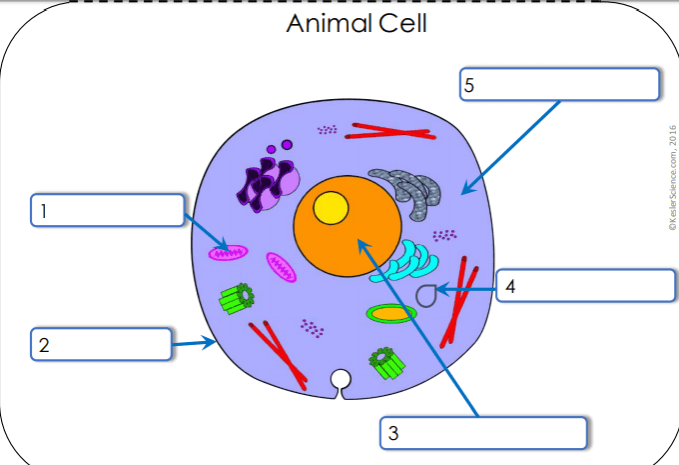
What is #1 in the diagram?
nucleus
cell wall
cytoplasm
mitochondrion
What is #2 in the diagram?
vacuoles
cell membrane
chloroplast
nucleus
What is #3 in the diagram?
vacuoles
cell membrane
chloroplast
nucleus
What is #4 in the diagram?
vacuoles
cell membrane
chloroplast
nucleus
What is #5 in the diagram?
nucleus
cell wall
cytoplasm
mitochondrion
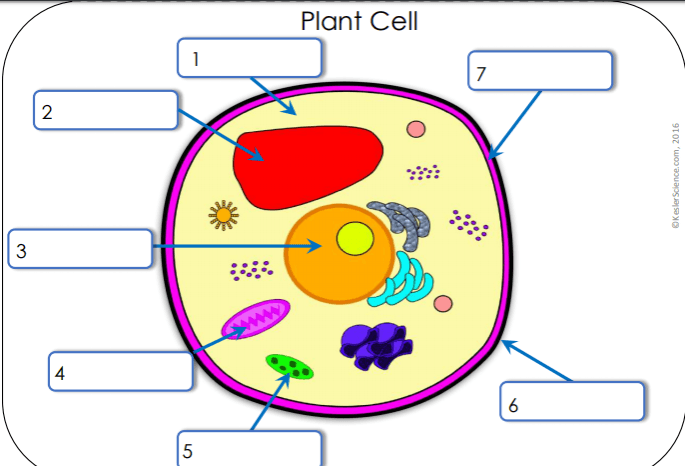
What is #1 in the diagram?
nucleus
cell wall
cytoplasm
mitochondrion
What is #2 in the diagram?
vacuoles
cell membrane
chloroplast
nucleus
What is #3 in the diagram?
vacuoles
cell membrane
chloroplast
nucleus
What is #4 in the diagram?
nucleus
cell wall
cytoplasm
mitochondrion
What is #5 in the diagram?
vacuoles
cell membrane
chloroplast
nucleus
What is #6 in the diagram?
nucleus
cell wall
cytoplasm
mitochondrion
What is #7 in the diagram?
vacuoles
cell membrane
chloroplast
nucleus
Which type of cell has a nucleus?
Eukaryotic Cell
Prokaryotic Cell
Viruses
None of the above
Which type of cell does not have a nucleus?
Eukaryotic Cell
Prokaryotic Cell
Viruses
None of the above
Which of the following is not considered a living organism?
Eukaryotic Cell
Prokaryotic Cell
Viruses
None of the above
Which type of cell is more complex?
Eukaryotic Cell
Prokaryotic Cell
Viruses
None of the above
Which type of cell can perform photosynthesis?
Eukaryotic Cell
Prokaryotic Cell
Viruses
None of the above
Which type of cell lacks membrane-bound organelles?
Eukaryotic Cell
Prokaryotic Cell
Viruses
None of the above
Which type of cell is found in plants, animals, and fungi?
Eukaryotic Cell
Prokaryotic Cell
Viruses
None of the above
Which type of cell is found in bacteria and archaea?
Eukaryotic Cell
Prokaryotic Cell
Viruses
None of the above

