
 Worksheets
GPN's Batch 1 HL
Total questions: 164
Worksheet time: 1hrs 23mins
What does the core-periphery model primarily explain?
Population growth trends
The distribution of natural resources
Economic relationships between regions
Cultural differences across countries
Which region is considered a core in the context of the core-periphery model?
Central Asia
Eastern Europe
Sub-Saharan Africa
Western Europe
What term is used for areas that develop around the core?
Sub-core
Periphery
Semi-periphery
Core
Which is the name for a new core forming in another region?
Satellite
Discoball
Radial
Neosphere
What effect suggests that innovations in the core will eventually benefit the periphery?
Trade effect
Backwash effect
Dependency effect
Globalization effect
Which country's core-periphery is very pronounced, along the Heihe-Tengchong line?
India
Brazil
South Africa
China
Who developed the World System Theory that relates to the core-periphery model?
John Smith
Immanuel Wallerstein
David Harvey
Andre Gunder Frank
What does FDI stand for in the context of economic geography?
Free Trade Investment
Fiscal Dependency Initiative
Financial Development Index
Foreign Direct Investment
Which of the following is NOT a characteristic of core regions?
Higher standards of living
More tax money for infrastructure
Lower population density
Higher profit margins
What does the term 'brain drain' refer to?
Decrease in population growth
Reduction in educational opportunities
Loss of skilled labor to other regions
Migration of unskilled workers
Which of the following countries is considered part of Singapore's semi-periphery?
South Africa
Brazil
Japan
Vietnam
What is the primary criticism of HIC-LIC aid programs according to Wallerstein?
They create dependency
They are ineffective
They promote inequality
They are too expensive
What is the first stage of the Rostow Model?
Pre-Industrial
High Mass Consumption
Economic Take Off
Traditional Society
Which stage of the Rostow Model is associated with Newly Industrialised Countries?
Stage 1
Stage 2
Stage 3
Stage 4
What does DTM stand for?
Demographic Transition Model
Development Transition Model
Development Theory Model
Demographic Theory Model
What is a key characteristic of Stage 2 in the Rostow Model?
High birth and death rates
Offshoring of industries
Mechanisation of farming
Focus on knowledge economy
Which stage of the DTM corresponds with Rostow's Stage 3?
Stage 2
Stage 1
Stage 4
Stage 3
What is a significant factor in Stage 2 of the Rostow Model?
High disposable income
Globalisation
TNC input
Urbanisation
What happens in Stage 4 of the Rostow Model?
Countries have low education levels
Countries focus on primary industries
Countries gain international power
Countries experience high birth rates
What is the focus of the Rostow Model?
Environmental sustainability
Economic development
Social indicators
Cultural development
Which stage of the Rostow Model is characterized by a knowledge economy?
Stage 1
Stage 5
Stage 4
Stage 2
What issue was faced by Stage 5 countries during the Covid lockdowns?
Overpopulation
Shortages of basic goods
High birth rates
Lack of education
What is a result of the demographic dividend in DTM Stage 3?
Economic Take Off
High birth rates
Increased death rates
Traditional Society
What is a characteristic of Stage 1 in the DTM?
Mechanised agriculture
High birth and death rates
Knowledge economy
Urbanisation
What does FDI stand for in the context of economic development?
Foreign Direct Investment
Financial Direct Investment
Financial Development Initiative
Foreign Development Index
What is the definition of diffusion?
The spread of an idea, practice, technology, or disease
The increase in temperature of a substance
The act of moving from one place to another
The process of making something more complex
What is an example of expansion diffusion?
The adoption of bamboo straws in restaurants
The use of social media for marketing
The spread of Covid from Wuhan
The migration of people to urban areas
What type of diffusion occurs when an idea moves to new areas, leaving behind its origin?
(a)
Which of the following is an example of hierarchical diffusion?
The rise of social media influencers
The adoption of electric cars
The spread of literacy
The use of paper straws
What is cultural hybridity?
The spread of cultural practices through globalization
The merging of two cultures to create a new version
The dominance of one culture over others
The resistance to cultural change
An example of network diffusion is (a) .
What factor can affect the speed of adoption of agricultural innovations?
(a)
What is cultural imperialism?
One dominant culture that subsumes all others
The blending of multiple cultures
The spread of local traditions
The resistance to cultural influences
What is contagious diffusion?
The influence of social media on trends
The adoption of a new technology by a community
The spread of a disease through direct contact
The migration of people to new areas
What is an example of resistance to diffusion due to cultural practices?
The spread of fast food chains
The rise of online education
The popularity of electric cars
Boba tea not working well with paper straws
What does 'gross' mean in the context of happiness?
Excessive
Unpleasant
In total
Overwhelming
Which country was the first to officially measure happiness as gross national happiness?
Thailand
India
Bhutan
Nepal
What is the main focus of governments interested in happiness rates?
Improving GDP per capita
Raising perceived quality of life
Reducing taxes
Increasing military spending
What does Bhutan use as their official measure of development?
Gross Domestic Product
Human Development Index
Gross National Happiness
Economic Growth Rate
What is the World Happiness Report?
An environmental study
A financial report
A ranking of countries based on happiness
A health report
Which organization is NOT involved in the World Happiness Report?
University of Oxford
Gallup
UN SDGs
World Health Organization
What is a common characteristic of countries that rank low in happiness?
Low population density
Strong social bonds
War and poverty
High GDP
What does the Happy Planet Index consider in its measurements?
Happiness, health, and equality
Only economic factors
Population growth
Military strength
What is a significant finding regarding GDP per capita and happiness?
Higher GDP always means higher happiness
They are inversely correlated
There is little correlation
They are directly correlated
What does a large ecological footprint do to a country's score in the Happy Planet Index?
Has no effect
Doubles the score
Decreases the score
Increases the score
What aspect of life does subjective happiness data provide that GDP does not?
Personal experience of living
Economic stability
Population demographics
Statistical accuracy
What is a concern regarding the current young generation's happiness?
They lack social bonds
They are too wealthy
They have high GDP
They are overly active in communities
What is the primary goal of measuring happiness in countries?
To increase military power
To improve citizens' lives
To enhance tourism
To reduce environmental impact
Which country consistently tops the Happy Planet Index?
USA
Costa Rica
Bhutan
Norway
What do economies of scale refer to?
Increased competition among small producers
Lower costs per unit for larger quantities
Higher prices for goods in the market
Higher costs for smaller producers
Why do larger producers tend to do better in the market?
They have more employees
They can sell goods at a higher price
They can manufacture goods at a lower cost per unit
They have better marketing strategies
What is one reason small producers might struggle against larger companies?
They cannot compete on price
They can produce goods faster
They have better technology
They have more resources
What example is used to illustrate economies of scale in the text?
Manufacturing of cars
Growing vegetables
Making pancakes
Production of bread
What happens to the villages that cannot compete with Café Fairprice?
They sell their cows and chickens
They start making different products
They thrive and expand
They form a trade bloc
What is a potential negative effect of high-investment technological production methods?
Increased job opportunities
Higher production costs
Fewer jobs available
Lower quality products
What does the text suggest about specialization?
It increases competition
It can make goods cheaper for consumers
It leads to job losses
It is only beneficial for large companies
What is the role of trade blocs as explained in the text?
To reduce the cost of living
To allow villages to specialize in different goods
To increase competition among producers
To promote individual farming
What is one benefit of having high-tech industries and universities in the same location?
More land for farming
Higher prices for goods
Minimized transport costs
Increased competition for jobs
What does the text imply about the relationship between small producers and larger companies?
They always work together
Small producers can benefit from larger companies
Larger companies can drive small producers out of business
Small producers have more advantages
What is the main focus of the text?
The importance of local farming
The role of government in agriculture
The impact of economies of scale
The benefits of individual entrepreneurship
What does the term 'TNC' mean?
Technological New Company
Tired Noseless Camels
Traditional National Company
Transnational Corporation
What is a potential consequence of family farms going bankrupt?
Increased job opportunities in cities
Landless farmers may struggle to find jobs
More competition among large farms
Higher prices for agricultural products
What is a trade bloc?
A group of countries that block trade with each other
A group of countries that agree on policies to reduce trade barriers
A type of economic sanction
A military alliance
What is the most basic form of trade bloc?
Free Trade Area
Economic Union
Customs Union
Common Market
What do Free Trade Areas agree to abolish?
Foreign investments
Labor laws
Import quotas and tariffs
Export taxes
What is a Customs Union?
A trade bloc that restricts immigration
A trade bloc that only allows certain goods
A trade bloc with a common external tariff
A trade bloc with no tariffs
What is one potential downside of Free Trade Areas?
Higher prices for consumers
Less employment opportunities
Increased tariffs on imports
Political challenges in reducing imports from outside the bloc
What does a Common Market allow in addition to free movement of goods?
Free movement of tariffs
Free movement of ideas only
Free movement of military forces
Free movement of people and capital
What is an Economic Union?
A union that focuses solely on trade
A union with shared policies beyond economics
A union that restricts trade
A union that only includes developed countries
Which of the following is an example of an Economic Union?
NAFTA
Mercosur
European Union
ASEAN
What can be a consequence of countries forming trade blocs?
Increased likelihood of conflict
Decreased economic cooperation
Isolation from global markets
Improved peace and stability
What is a challenge that can arise from trade blocs?
Increased tariffs on all goods
Loss of sovereign power
Reduction in trade volume
Complete economic independence
What is one reason trade blocs tend to work best?
Countries are geographically distant
Countries have shared borders and history of trade
Countries have no historical ties
Countries are economically diverse
What is one of the main benefits of trade blocs?
Increased employment opportunities
Higher tariffs on imports
Isolation from global trade
Less competition among member countries
What is a common external tariff?
A tax on exports
A tax that all member countries agree to impose on imports
A tax that varies by country
A tax that only applies to agricultural products
What does the text suggest about the relationship between trade blocs and peace?
Trade blocs can lead to more conflicts
Trade blocs only benefit larger countries
Trade blocs help maintain peace
Trade blocs have no impact on peace
What is the Gender Inequality Index (GII) score range?
1-10
1-2
0-1
0-100
What percentage of parliamentary seats globally are held by women?
10.5%
23.7%
50%
35%
Which country has a GII score of 0.04?
0 is good, 1 is bad
Singapore
Rwanda
Bolivia
Cuba
What is a significant concern for politicians in DTM stage 4 & 5 countries, regarding gender roles?
Decreasing healthcare access
Increasing education levels
Rising employment rates
Falling birth rates
What is the ratio of family admin and care roles that women perform globally?
1:1
4:1
3:1
2.6:1
Which of the following countries has around 50% women in parliament?
India
USA
Rwanda
Afghanistan
What is a major focus in agricultural communities related to gender?
Land ownership
Child education
Healthcare access
Employment opportunities
What is a concerning statistic about violence against women?
1 in 3 women have no access to education
1 in 5 women are married before 20
1 in 4 adult women have experienced violence
1 in 10 women experience violence
Challenges in which area have increased rapidly for young men in DTM stage 4 & 5 countries?
Education
Mental health
Housing
Employment
Which country is mentioned as having terrible gender equality?
USA
Cuba
Afghanistan
Sweden
What is the implication of women working a 'double shift'?
They work less than men
They do more family care and admin
They have more leisure time
They are less educated
What do Gini coefficients measure?
Climate change
Urbanization rates
Wealth distribution
Population density
What score represents perfect equality in Gini coefficients?
100
25
50
0
Which countries are mentioned as having high Gini coefficients?
Middle Eastern countries
South American countries
African countries
Scandinavian countries
What happens to Gini coefficients during a recession?
They become irrelevant
They tend to dip
They remain unchanged
They always increase
What can improve income equality according to the text?
Increased taxation
Investment in social programs
Privatization of resources
Decreased government spending
What is a characteristic of Singapore's economy?
It is very equal on a global scale
It has a centrally controlled economy
It has a very strong informal economy
It has no economic disparities
What does the Lorenz curve visualize?
Urban development
Climate data
Wealth distribution
Population growth
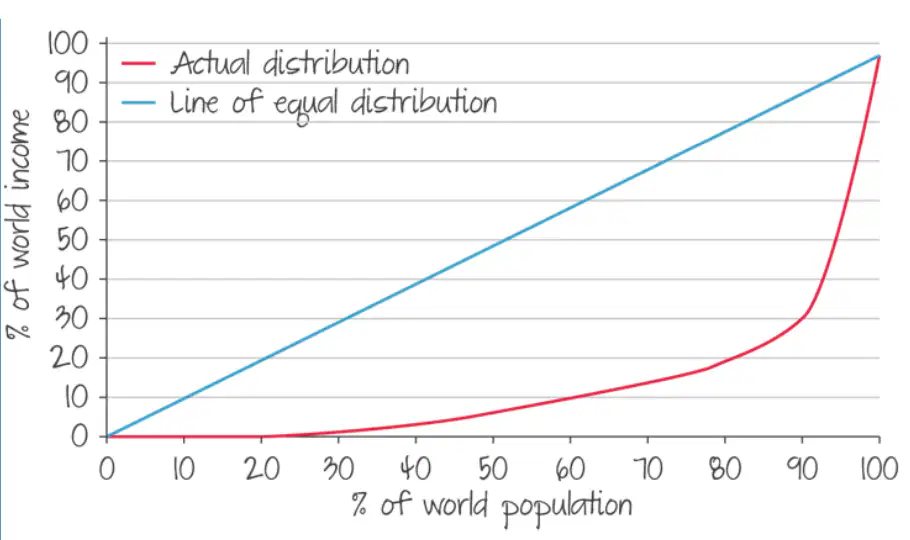
What does the straight blue line in a Lorenz curve represent?
Population equality
Ideal wealth distribution
Actual wealth distribution
Economic growth
What does a Gini coefficient of 100 indicate?
Moderate inequality
Absolute inequality
High equality
Perfect equality
What is a limitation of Gini coefficients mentioned in the text?
They measure only income
They are only applicable to developed countries
They are always accurate
They do not account for informal economies
What is the effect of social healthcare on Gini coefficients?
It decreases inequality
It has no effect
It only benefits the wealthy
It increases inequality
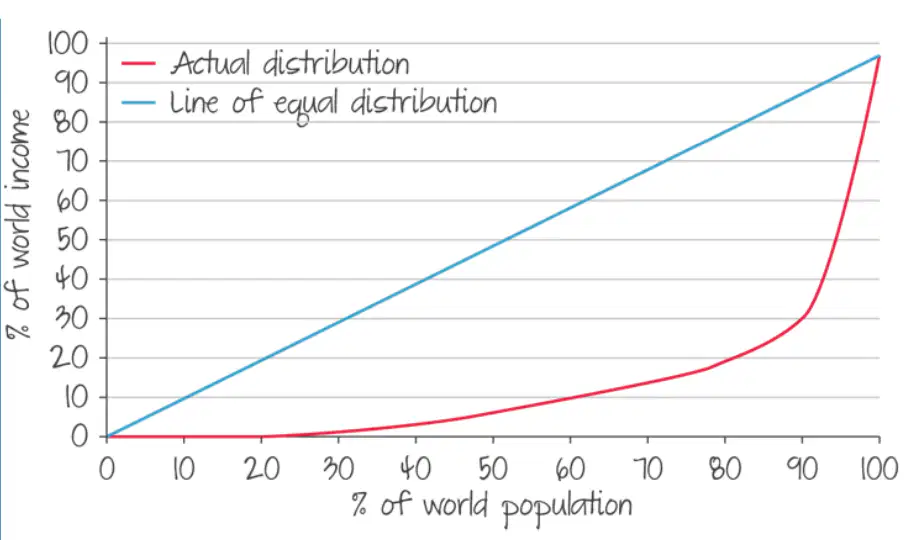
What does the red curved line in a Lorenz curve represent?
Projected wealth distribution
Actual wealth distribution
Historical wealth distribution
Ideal wealth distribution
Which of the following is NOT a factor that can affect Gini coefficients?
Government investment in education
Economic recessions
Social care programs
Population growth
What does UDHR stand for?
Universal Declaration of Human Responsibilities
United Declaration of Human Responsibilities
United Declaration of Human Rights
Universal Declaration of Human Rights
In what year was the UDHR first signed?
1945
1960
1948
1950
How many original members of the UN ratified the UDHR?
50
48
60
58
Which of the following is NOT one of the four freedoms promoted by the UN after WW2?
Freedom from want
Freedom from fear
Freedom of education
Freedom of speech
Which country is NOT a signatory of the UDHR?
Saudi Arabia
France
Australia
Chile
What is a criticism of the UDHR?
It is not needed any more
It is outdated
It is binding
It is western-centric
Which article is related to the right to life and security?
Article 1
Article 3
Article 12
Article 18
What was Singapore's previous anti-natal policy criticized for?
Restricting women's rights
Promoting child labor
Encouraging abortions for educated women
Encouraging abortions for uneducated women
Which organization works to end human trafficking in South East Asia?
Green Peace
Amnesty International
Blue Dragon
Human Rights Watch
What does the Cairo Declaration of Human Rights in Islam represent?
A binding agreement
A supporting document to the UDHR
An alternative to the UDHR
A historical document
Which country is mentioned as having ongoing issues with women's rights?
USA
Saudi Arabia
Brazil
Singapore
What is the main purpose of the UDHR?
To promote economic development
To ensure rights for all citizens
To outline responsibilities of citizens
To provide a binding legal framework
Which of the following articles is related to freedom of thought, conscience, and religion?
Article 1
Article 3
Article 12
Article 18
What is a key aspect of the UDHR's implementation?
It is legally binding for all nations
It requires action from signatories
It is only applicable to UN members
It is universally accepted
Which historical events prompted the creation of the UDHR?
The Great Depression
The Civil Rights Movement
World War I and II
The Cold War
What does DTM stand for?
Demographic Time Model
Dynamic Transition Model
Demographic Transition Model
Dynamic Time Model
How many stages are there in the Demographic Transition Model?
3
4
5
6
What does the gap between the birth rate line and the death rate line indicate?
Healthcare quality
Economic growth
Rate of natural increase
Population density
Which country launched a three child policy in May 2021?
France
Denmark
China
Singapore
What was a common family size in the UK during Stage 1?
2 children
5 children
10 children
15 children
What is a potential issue with Stage 5 of the DTM?
High birth rates
Aging population
Low healthcare costs
High fertility rates
Which campaign did Denmark launch to encourage higher birth rates?
Do it for Denmark
Make Love Not Money
Do It for National Night
Love for the Nation
What type of policies did some countries implement to reduce birth rates?
Healthcare policies
Education policies
Pro-natal policies
Anti-natal policies
What is one of the challenges faced by countries in Stage 5?
High unemployment
Fewer workers
High birth rates
Low healthcare needs
Which country has had pro-natal campaigns since 1987?
China
Denmark
Singapore
France
What is a common characteristic of countries in Stage 4?
High birth rates
Low death rates
Aging populations
High infant mortality
What is the purpose of the DTM for governments?
To increase birth rates
To plan for future social and healthcare needs
To reduce healthcare costs
To promote tourism
What is the name of the type of policy that aims to lower birth rates?
Ante-natal
Anti-natal
Anti-bellum
Ante-bellum
What does DTM stand for?
Demographic Time Model
Dynamic Transition Model
Demographic Transition Model
Dynamic Time Model
How many stages are there in the Demographic Transition Model?
3
4
5
6
What does the gap between the birth rate line and the death rate line indicate?
Healthcare quality
Economic growth
Rate of natural increase
Population density
Which country launched a three child policy in May 2021?
France
Denmark
China
Singapore
What was a common family size in the UK during Stage 1?
2 children
5 children
10 children
15 children
What is a potential issue with Stage 5 of the DTM?
High birth rates
Aging population
Low healthcare costs
High fertility rates
Which campaign did Denmark launch to encourage higher birth rates?
Do it for Denmark
Make Love Not Money
Do It for National Night
Love for the Nation
What type of policies did some countries implement to reduce birth rates?
Healthcare policies
Education policies
Pro-natal policies
Anti-natal policies
What is one of the challenges faced by countries in Stage 5?
High unemployment
Fewer workers
High birth rates
Low healthcare needs
Which country has had pro-natal campaigns since 1987?
China
Denmark
Singapore
France
What is a common characteristic of countries in Stage 4?
High birth rates
Low death rates
Aging populations
High infant mortality
What is the purpose of the DTM for governments?
To increase birth rates
To plan for future social and healthcare needs
To reduce healthcare costs
To promote tourism
What is the name of the type of policy that aims to lower birth rates?
Ante-natal
Anti-natal
Anti-bellum
Ante-bellum
What does 'pro-natal' mean?
Policies that promote adoption
Policies that limit family size
Policies that encourage having more children
Policies that discourage having children
What is the replacement level of children per couple in HICs?
2.1
3.0
2.5
1.5
What is a consequence of having fewer children than the replacement level?
Lower healthcare costs
Higher tax bills for the younger generation
More economic activity
Increased disposable income
What is one of the 'carrot' approaches used by governments?
Higher taxes for parents
Mandatory sterilization
Tax breaks for families
Fines for large families
What does 'anti-natal' refer to?
Encouraging larger families
Discouraging having children
Promoting adoption
Supporting single-parent families
What is a potential issue with ageing populations?
Increased birth rates
Decreased healthcare needs
More economically active individuals
Higher costs for social support
What is meant by 'optimum population'?
The maximum number of children per family
A stable and consistent size for each generation
The ideal number of retirees
The total population of a country
What is one of the 'stick' approaches mentioned?
Tax breaks for families
Fines for having too many children
Free childcare services
Incentives for larger families
Which country had an anti-natal policy until 1987?
Japan
China
India
Singapore
What is a challenge of larger families mentioned in the text?
Lower housing costs
Increased job availability
More disposable income
Higher costs for schooling and healthcare
What is one of the strategies used by governments to encourage childbirth?
Higher taxes for parents
Long periods of fully funded parental leave
Mandatory sterilization
Limiting housing options
What does the core-periphery model primarily explain?
Population growth trends
The distribution of natural resources
Economic relationships between regions
Cultural differences across countries
Which region is considered a core in the context of the core-periphery model?
Central Asia
Eastern Europe
Sub-Saharan Africa
Western Europe
What term is used for areas that develop around the core?
Sub-core
Periphery
Semi-periphery
Core
Which is the name for a new core forming in another region?
Satellite
Discoball
Radial
Neosphere
What effect suggests that innovations in the core will eventually benefit the periphery?
Trade effect
Backwash effect
Dependency effect
Globalization effect
Which country's core-periphery is very pronounced, along the Heihe-Tengchong line?
India
Brazil
South Africa
China
Who developed the World System Theory that relates to the core-periphery model?
John Smith
Immanuel Wallerstein
David Harvey
Andre Gunder Frank
What does FDI stand for in the context of economic geography?
Free Trade Investment
Fiscal Dependency Initiative
Financial Development Index
Foreign Direct Investment
Which of the following is NOT a characteristic of core regions?
Higher standards of living
More tax money for infrastructure
Lower population density
Higher profit margins
What does the term 'brain drain' refer to?
Decrease in population growth
Reduction in educational opportunities
Loss of skilled labor to other regions
Migration of unskilled workers
Which of the following countries is considered part of Singapore's semi-periphery?
South Africa
Brazil
Japan
Vietnam
What is the primary criticism of HIC-LIC aid programs according to Wallerstein?
They create dependency
They are ineffective
They promote inequality
They are too expensive