wayground logo

Free Printable Worksheets

Font size

S
M
L
XL
Worksheets

Pre AP Chem - 1st Semester Final Exam

Total questions: 90

Worksheet time: 2hrs 32mins
Name
Class
Date
1.
Which glassware is most accurate for measuring liquids?
a)
beaker
b)
Erlenmeyer flask
c)
triple beam balance
d)
graduated cylinder
2.
What is the correct unit representation for nanogram?
a)
ng
b)
Ng
c)
nG
d)
NG
3.
What is the SI Base unit for temperature?
a)
candela
b)
mole
c)
Kelvin
d)
kilogram
4.

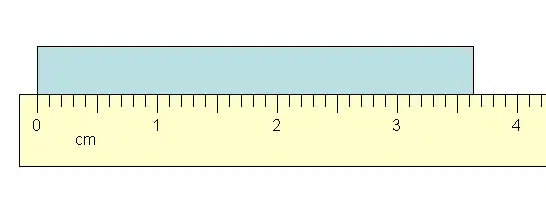
What is the correct measurement in this picture? (Do NOT include units)

(a)  
5.

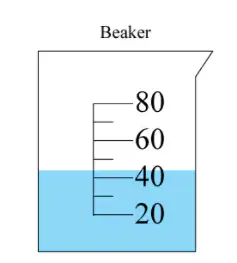
What is the correct measurement of the liquid in the beaker? (Do NOT include units)

(a)  
6.
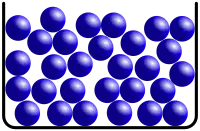
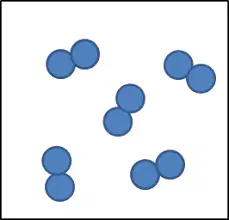
Classify the type of matter from particle diagram.
a)
Element
b)
Compound
c)
Heterogeneous Mixture
d)
Homogeneous Mixture
7.
What type of matter is made up multiple atoms that are chemically joined together?
a)
Element
b)
Compound
c)
Heterogeneous Mixture
d)
Homogeneous Mixture
8.
When a substance combines with another to form a new substance.
a)
physical property
b)
physical change
c)
chemical property
d)
chemical change
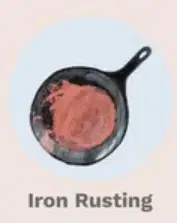
9.
Which of the following choices best fits the picture?
a)
physical property
b)
physical change
c)
chemical property
d)
chemical change
10.

Determine the number of significant figures: 0.042

(a)  

11.

Determine the number of significant figures: 742.0

(a)  

12.
Which particle(s) are found in the nucleus of an atom?
a)
Protons
b)
Neutrons
c)
Electrons
13.
Who discovered the nucleus of an atom?
a)
Dalton
b)
Bohr
c)
Thomson
d)
Rutherford
14.
What is the same between these two nitrogen atoms?
a)
Same number of neutrons
b)
Same number of protons and neutrons
c)
Same number of protons
d)
Same number of neutrons and electrons
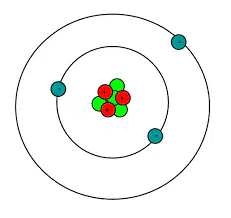
15.
What is the atomic number of at atom below?
a)
3
b)
6
c)
7
d)
10
16.
Which subatomic particle has no charge?
a)
neutron
b)
proton
c)
electron
17.
What does the number 15 represent?
a)
atomic number
b)
mass number
c)
the element
18.

How many electrons does this element have?

(a)  

19.

How many neutrons does this element have?

(a)  
20.
Each element in the same group on the periodic table will have the same number of
a)
alkaline electrons
b)
valence electrons
c)
total electrons
d)
valence groupings
21.
When naming a transition metal ion that can have more than one common ionic charge, the numerical value of the charge is indicated by a ____.
a)
prefix
b)
suffix
c)
roman numeral following the name
d)
superscript after the name
22.
Which element, when combined with fluorine, would most likely form an ionic compound?
a)
lithium
b)
carbon
c)
phosphorus
d)
chlorine
23.
In naming a binary covalent compound, the number of atoms of each element present in the molecule is indicated by ____.
a)
Roman numerals
b)
subscripts
c)
prefixes
d)
suffixes
24.
When the name of an anion that is part of an acid ends in -ite, the acid name includes the suffix ____.
a)
-ous
b)
-ic
c)
-ate
d)
-ite
25.
What force holds ions together in an ionic bond?
a)
force of gravity
b)
electrostatic force
c)
forces of repulsion between opposite charges
d)
the strong force
26.
What type of bond forms when electrons are shared between two nonmetals?
a)
covalent
b)
ionic
c)
metallic
27.
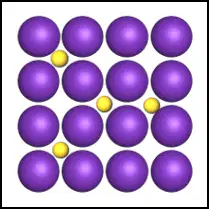
The following picture is a type of alloy. Which one does this best represent?
a)
substitutional alloy
b)
fractional alloy
c)
interstitial alloy
d)
transitional alloy
28.
What types of elements typically make anions?
a)
metals
b)
nonmetals
29.
Which is the stronger intermolecular force present in the following compound?
a)
London Dispersion Force
b)
Dipole-Dipole
c)
Hydrogen Bonding
d)
All of them have the same strength
30.
Which type of intermolecular force(s) would be present with this substance?
a)
London Dispersion Force
b)
Dipole-Dipole
c)
Hydrogen Bonding
d)
All of would be present
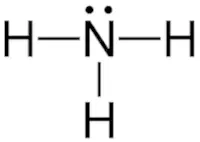
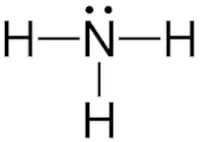
31.
What shape would this molecule form?
a)
linear
b)
tetrahedral
c)
triagonal planar
d)
triagonal pyramidal
32.
Which element has the following electron configuration?
a)
Au
b)
Cu
c)
Cd
d)
Ag
33.
How many electrons can energy level 4 hold?
a)
10
b)
14
c)
32
d)
64
34.
Which of these sublevels has the lowest energy?
a)
2p
b)
3s
c)
3d
d)
4p
35.
The most unreactive group of elements are the ______.
a)
noble gases
b)
alkali metals
c)
halogens
d)
transition metals
36.
What charge will a group 1A element have when it becomes an ion?
a)
+1
b)
+2
c)
-1
d)
-2
37.
If an atom has a positive sign (Na+), then it has
a)
gained electrons
b)
kept the same number of electrons
c)
gained a neutron
d)
lost electrons
38.
The elements on the modern periodic table are arranged by
a)
atomic radius
b)
atomic weight
c)
atomic mass
d)
atomic number
39.
What charge will a group 7A element have when it becomes an ion?
a)
+1
b)
-1
c)
+7
d)
-7
40.
Which is a measure of how strongly an atom in a compound attracts electrons?
a)
electronegativity
b)
atomic radius
c)
ionic radius
d)
ionization energy
41.
As you move down a column on the periodic table, that atomic radius will....
a)
remain the same
b)
increase at first and then stop
c)
increases
d)
decreases
42.
Which state of matter would this picture be?
a)
Solid
b)
Liquid
c)
Gas
43.
During a state change, what happens to the temperature?
a)
Increases
b)
Decreases
c)
Stays the same
44.
What separation technique would you use to separate two liquids that have different boiling points?
a)
centrifuge
b)
chromatography
c)
decanting
d)
distillation
45.

Round this number to 3 significant figures.

11.43504

(a)  

46.

Round this number to 3 significant figures.

1.45697

(a)  

47.

Round this number to 3 significant figures.

123,500

(a)  

48.

Which of the following is an example of a homogeneous mixture?

a)

Oil and water

b)

Salt dissolved in water

c)

Sand and gravel

d)

Fruit salad

49.

How would you classify the matter in the picture above?

a)

Element

b)

Compound

c)

Homogeneous Mixture

d)

Heterogeneous Mixture

50.

How would you classify the matter in the picture above?

a)

Element

b)

Compound

c)

Homogeneous Mixture

d)

Heterogeneous Mixture

51.

How would you classify the matter in the picture above?

a)

Element

b)

Compound

c)

Homogeneous Mixture

d)

Heterogeneous Mixture

52.

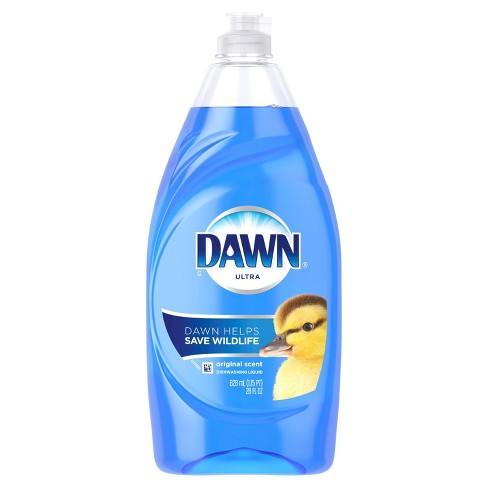
A bottle of dishwashing detergent contains a clear, viscous liquid. The label has a long list of ingredients, including water, sodium lauryl sulfate, fragrance, and Blue dye #5.

What can you infer about the material in the bottle from this label and the appearance of the liquid?

a)

It is a pure substance.

b)

It is a compound.

c)

It is a heterogeneous mixture.

d)

It is a homogeneous mixture.

53.

What type of substance is pictured?

a)

element

b)

compound

c)

mixture

d)

solution

54.

Which is a mixture of compounds?

a)
b)
c)
d)
55.

How would you classify the matter in the picture above?

a)

Element

b)

Compound

c)

Homogeneous Mixture

d)

Heterogeneous Mixture

56.

How would you classify the matter in the picture above?

a)

Element

b)

Compound

c)

Homogeneous Mixture

d)

Heterogeneous Mixture

57.

Density is a ...

a)

Physical Property

b)

Physical Change

c)

Chemical Property

d)

Chemical Change

58.

Slicing a pellet of sodium metal into two pieces is an example of a ...

a)

Physical Property

b)

Physical Change

c)

Chemical Property

d)

Chemical Change

59.

Iron's ability to rust is an example of a ...

a)

Physical Property

b)

Physical Change

c)

Chemical Property

d)

Chemical Change

60.

Ice melting is an example of a ...

a)

Physical Property

b)

Physical Change

c)

Chemical Property

d)

Chemical Change

61.

Milk turning sour is an example of a ...

a)

Physical Property

b)

Physical Change

c)

Chemical Property

d)

Chemical Change

62.

The luster or shine of a metal is an example of a ...

a)

Physical Property

b)

Physical Change

c)

Chemical Property

d)

Chemical Change

63.

Proposed that electrons move around the nucleus in specific paths a fixed distance from the nucleus..

a)

Bohr

b)

Rutherford

c)

Chadwick

d)

Thomson

64.

Which one of these is Dalton's Model?

a)
b)
c)
d)
65.

The elements that make up the "staircase"/green on this table are called...

a)

metals

b)

nonmetals

c)

metalloids

d)

noble gases

66.
Which is a noble gas?
a)
Fluorine
b)
Hydrogen
c)
Iodine
d)
Krypton (Kr)
67.
Which is a halogen?
a)
Fluorine
b)
Carbon
c)
Helium
d)
Lithium
68.
Calcium (Ca)
a)
alkali metal
b)
alkaline earth metal
c)
halogen
d)
noble gas
69.
Cesium (Cs)
a)
alkali metal
b)
alkaline earth
70.
Which is a highly reactive metal?
a)
Zinc
b)
Titanium
c)
Magnesium
d)
Cesium
71.

Which box has a higher density?

a)

A

b)

B

c)

They are the same

72.

Rank the objects from MOST dense to LEAST dense.

a)

left, center, right

b)

right, center, left

c)

left, right, center

d)

right, left, center

e)

center, left, right

73.
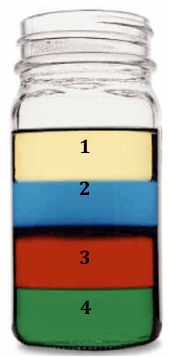
Put the liquids in order from most dense to least dense?
a)
4, 3, 2, 1
b)
1, 2, 3, 4
c)
3, 4, 2, 1, 
d)
4, 3, 1, 2
74.

Particles of a solid​ (a)   . Particles of a liquid (b)   . Particles of a gas ​ (c)   .

Choose from the below words
do not flow or expand and vibrate in place
flow past each other
have a rapid, random motion & can take any shape
75.

Particles of a solid have a​ (a)   attraction for each other and a low kinetic energy. Particles of a liquid have​ (b)   attraction than solids but​ (c)   kinetic energy. Particles of a gas have a​ (d)   attraction for each other and a high kinetic energy.

Choose from the below words
high
less
more
low
76.

Which state change is shown in box 1?

a)

sublimation

b)

condensation

c)

melting

d)

freezing

77.

Which state change is shown in box 3?

a)

deposition

b)

condensation

c)

vaporization

d)

freezing

78.

Which state change is shown in box 4?

a)

deposition

b)

condensation

c)

vaporization

d)

sublimation

79.

Which state change is shown in box 5?

a)

melting

b)

condensation

c)

vaporization

d)

sublimation

80.

Which state change is shown in box 6?

a)

melting

b)

condensation

c)

vaporization

d)

sublimation

81.

Which of the following dimensional analysis setups will correctly convert 27.76 g of Li to atoms of Li?

a)

A

b)

B

c)

C

d)

D

82.
Avogadro's number is
a)
6.02
b)
6.02 x 10⁻²³
c)
6.02 x 23
d)
6.02 x 10²³
83.

What type of chemical reaction is this one?
CuO + CO2 → CuCO3

a)
Decomposition
b)
Combustion
c)
Synthesis
d)
Single Replacement 
84.

Balance this reaction: ____ Na3(PO4) + ____ K(OH) →  ____ Na(OH) + ____ K3(PO4)

a)
1,3,3,1
b)
1,3,2,1
c)
2,3,3,1
d)
1,1,3,1
85.

Which of the following is an example of a decomposition reaction?

a)

2NaF ⟶ 2 Na + F2

b)

P2O5 + 3 H2O ⟶ 2H3PO4

c)

2FeCl3 + 3Zn ⟶ 2Fe + 3ZnCl2

d)

C6H12O6 + 6O2 ⟶ 6CO2 + 6 H2O

86.

Which of the following chemical equations is an example of a double replacement reaction?

a)

2Al2O3 ⟶ 4Al + 3O2

b)

2C5H10 + 15O2 ⟶ 10CO2 + 10H2O

c)

2MgCl2 + Na2CO3 ⟶ 2 NaCl + MgCO3

d)

K2O + H2O ⟶ 2 KOH

87.

Classify the reaction based on the reactants given:
Ca+NaClCa+NaCl\rightarrow   

a)

Synthesis

b)

Decomposition

c)

Combustion

d)

Single Replacement

e)

Double Replacement

88.

Balance this equation:

​ (a)   Fe + ​ (b)   O2 --> ​ (c)   Fe2O3

Choose from the below words
4
3
2
1
0
89.

What are the coefficients that will balance the skeleton equation below?

__MgS + __O₂ → __MgO + __SO₂

a)

3,2,2,3

b)

2,3,2,2

c)

2,3,2,3

d)

3,2,2,1

90.
What are the spectator ions in this reaction?
CuCl2(aq) + NaOH(aq) → Cu(OH)2(s) + NaCl(aq)
 
a)
Cu2+ and OH1-
b)
Na2+ and Cl2-
c)
Na1+ and Cl1-
d)
Na1+ and OH1-