
Font size
 Worksheets
Unit 6 Chapter 3 Bayou Bridges (7th)
Total questions: 70
Worksheet time: 1hrs 10mins
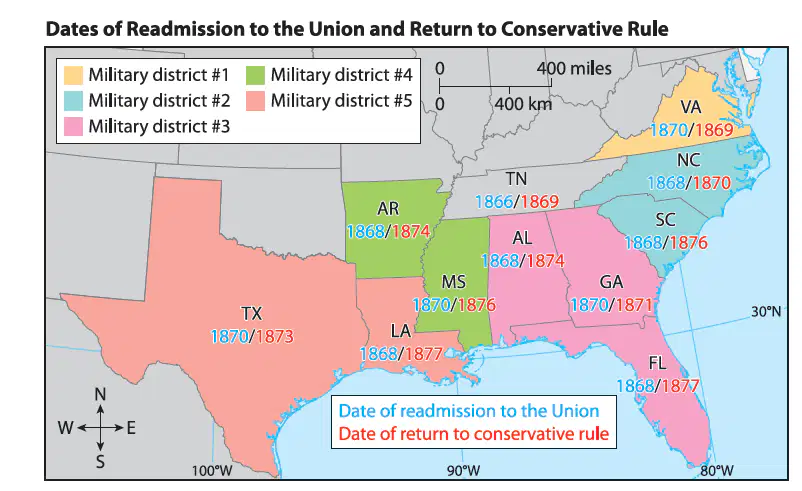
The map reflects the influence of which of the following? Select the two correct answers.
the Compromise of 1877
the work of the Freedmen’s Bureau
passage of the Civil Rights Act of 1866
the rise of groups like the White League
passage of the Fifteenth Amendment
Poll taxes, grandfather clauses, and literacy tests were ways Southern states got around the ________________ Amendment.
First
Thirteenth
Fourteenth
Fifteenth
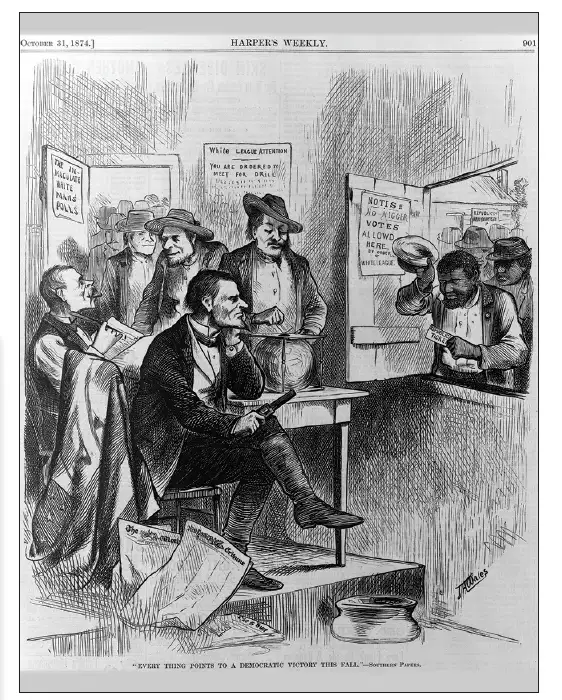
Which statement is supported by the cartoon?
Reconstruction governments in the South were widely supported by poor white Southerners.
By the 1870s, African Americans who wanted to vote faced the threat of violence.
Reconstruction radically changed white Southerners’ views about African Americans.
Republicans reclaimed Southern governments by preventing African Americans from voting.
Why did Congress need to decide the outcome of the presidential election of 1876?
Several electoral votes from Southern states were in dispute.
Neither candidate gained more than 50 percent of the popular vote.
Neither candidate supported the Fourteenth or Fifteenth Amendment.
The Democratic Party did not nominate a candidate for the presidency that year.
Which of the following led to the removal of federal troops from Southern states?
the Civil Rights Act of 1866
the Reconstruction Act of 1867
the formation of the White League in 1874
the Compromise of 1877
Jim Crow laws legalized _________________________ throughout the South.
How were Southern Democrats able to reclaim state governments during and shortly after Reconstruction?
By forming alliances with Northern Republicans
Through the use of violence and intimidation
By promoting economic development in the South
By supporting civil rights for African Americans
What is true about the Ku Klux Klan (KKK)?
They partnered with the Freedmen's Bureau to help feed and clothe former slaves
They terrorized blacks, Carpetbaggers, and Scalawags and did not want blacks to vote.
They helped to establish some of the first black public schools and universities
They protected blacks from being terrorized by the White League

Literacy tests and poll taxes were means by which:
sharecroppers could pay off their debts
African-Americans were denied suffrage rights
southern states paid for public schools
Federal officials prosecuted white terrorist groups
Literacy tests were created as a way to suppress African American voters after the passage of the _______________.
Civil Rights Act of 1964
13th Amendment
14th Amendment
15th Amendment

Who won the Election of 1876 and thus began the end of the Reconstruction Era?
Rutherford B. Hayes
Ulysses S. Grant
Andrew Johnson
Tywin Lannister
Poll taxes, grandfather clauses, and literacy tests were attempts by Southern white legislators to
restrict
the migration of African Americans to the North
increase
the number of Republican voters
prevent
African Americans from voting
improve
public education in the South
The deal that settled the 1876 presidential election; Hayes was given the presidency in exchange for ending Reconstruction by removing Federal Troops from the South.
Election of 1876
Compromise of 1877
Reconstruction Election
Freedman's Bureau

What do these 3 events signify in American history?
The beginning of Reconstruction
The end of Reconstruction
A pause in Reconstruction
The start of the Civil War
Which of these directly impacted the voting of southern African Americans after the Civil War?
(Choose 3 that apply)
Violence and intimidation by angry whites
Ratification of the 15th Amendment
Poll taxes and literacy tests
13th and 14th Amendments

What message best applies to the meaning of the political cartoon displayed below?
The political cartoon is implying that life for African-Americans was worse during Reconstruction than it was during the Civil War.
The political cartoon is implying that the White League and KKK are invincible.
The political cartoon is implying that the Reconstruction of the South was a tremendous all-around success.
The political cartoon is implying that Reconstruction governments in the South were widely supported by poor white Southerners.
Southerners who were determined to win back control of their states formed secret
societies such as the _____________. Wearing white sheets and hoods, members of the
_____________ rode through the countryside on horseback. They were violent
and terrifying.
White League
Red Shirts
Originally a political club, _________________ became a paramilitary group in Louisiana. It was responsible for widespread violence against Republicans, both white and African American, in Louisiana and Mississippi.
The Ku Klux Klan
The Red Shirts
The White League
After the Klan was broken up by federal troops, a number of loosely organized groups arose. Calling themselves “___________________” they claimed to be social clubs but were heavily armed and fiercely loyal to the Democratic Party.
Red Shirts
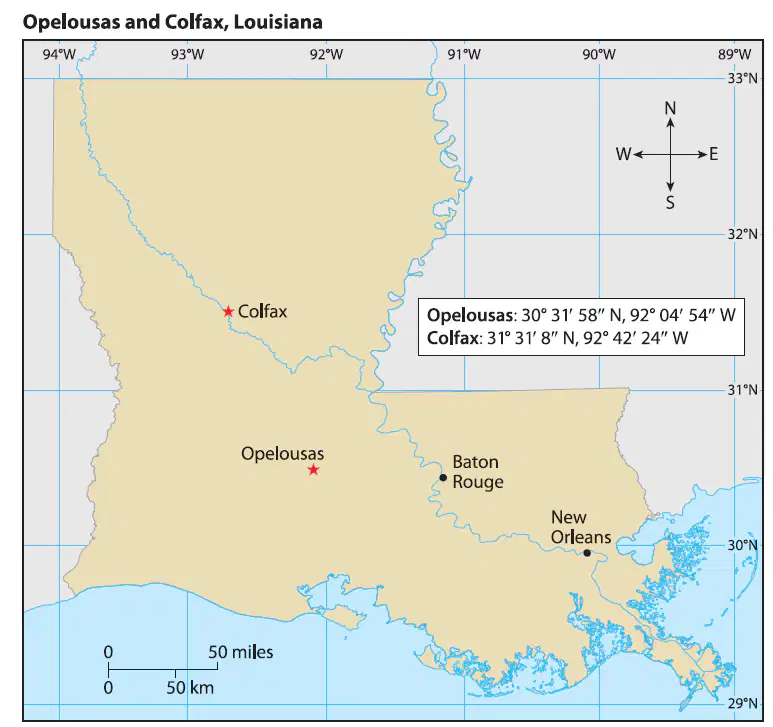
What happened at the places identified by stars on the map?
Formerly enslaved African Americans were elected mayors of both communities.
Violent rallies were held to protest the election of Democrats to state and national offices.
White paramilitary groups carried out massacres against African Americans and their supporters.
Civil rights leaders from both communities helped create the reconstructed constitution of Louisiana.
Use the excerpt to answer the question.
“The fourteenth amendment prohibits a State from denying to any person within its jurisdiction the equal protection of the laws; but this provision does not . . . add any thing to the rights which one citizen has under the Constitution against another. The equality of the rights of citizens is a principle of republicanism. Every republican government is in duty bound to protect all its citizens in the enjoyment of this principle, if within its power. That duty was originally assumed by the States; and it still remains there.”
—from United States v. Cruikshank (1876)
Which of the following is the best summary of this excerpt from United States v. Cruikshank (1876)?
The Fourteenth Amendment applies only to state actions, not to actions of individuals.
Use the excerpt to answer the question.
“Yes, let us have peace, but let us have liberty, law and justice first. Let us have the Constitution, with its thirteenth, fourteenth, and fifteenth amendments, fairly interpreted, faithfully executed, and cheerfully
obeyed in the fullness of their spirit and the completeness of their letter.”
—Frederick Douglass
Which claim is supported by the excerpt?
The Thirteenth, Fourteenth, and Fifteenth Amendments were not being enforced.
The Thirteenth, Fourteenth, and Fifteenth Amendments protected the rights of formerly enslaved people.
The Thirteenth, Fourteenth, and Fifteenth Amendments were part of the Bill of Rights of the
Constitution.
The Thirteenth, Fourteenth, and Fifteenth Amendments allowed all people to vote.
What is true about the Ku Klux Klan (KKK)?
They partnered with the Freedmen's Bureau to help feed and clothe former slaves
They terrorized blacks, Carpetbaggers, and Scalawags and did not want blacks to vote.
They helped to establish some of the first black public schools and universities
They protected blacks from being terrorized by the White League

Which group was removed from the South at the end of Reconstruction?
Southern military leaders
Public officials
Slaves
Federal troops

What brought an end to Reconstruction after the disputed presidential election of Rutherford B. Hayes?
Compromise of 1877
Civil Rights Act of 1866
Ku Klux Klan
Jim Crow Laws
The Thirteenth, Fourteenth, and Fifteenth Amendments allowed all people to vote.
The 15th Amendment...
gave African-American men the right to vote.
impeached Andrew Johnson.
ended Reconstruction.
was approved by the Republican party.

What is the best title for the graphic organizer?
Amendments that address civil rights issues
Amendments found in the Bill of Rights
Amendments that address federalism
Amendments that address privacy rights

What was the primary goal of the Compromise of 1877?
To end the Civil War
To grant women the right to vote
To resolve the disputed presidential election of 1876
To abolish slavery
Which of the following best describes the impact of the withdrawal of federal troops from the South in 1877?
It caused the Southern economy to collapse completely.
It led to the immediate improvement of civil rights for African Americans.
It resulted in the South becoming a stronghold for the Republican Party.
It marked the end of Reconstruction and the beginning of the Jim Crow era.
What did Jim Crow Laws do?
Separate people by race
Separate the rich and poor
Bring people together by race
Nothing, they aren't real.
What was the slogan that went with segregation?
Separate
Separate but equal
equal
Separate but not equal
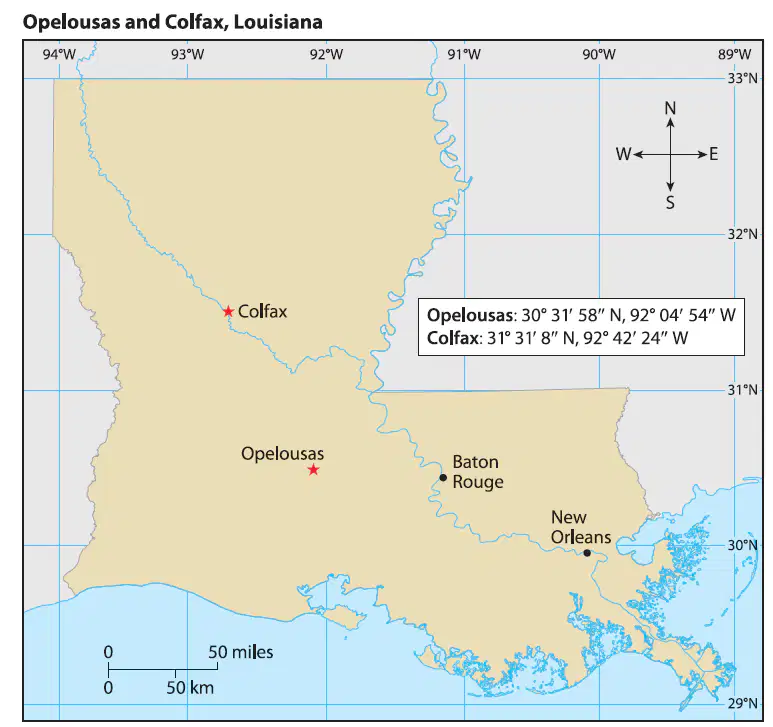
How did events at these places impact the political culture of the South?
Fewer African Americans were elected to office in the South.
Jim Crow laws covered which of the following (select all that apply)
Education
Restaurants
Marriage
Transportation
What three Civil Rights Amendments were passed in the time period from 1865-1877 in the time of Reconstruction?
1st, 2nd, and 3rd Amendments
6th, 7th, and 8th Amendments
9th, 10th and 11th Amendments
13th, 14th, and 15th Amendments
What does it mean to "disenfranchise" somebody?
to take away someone's right to vote in an election
to take away someone's right to serve on a jury
to take away someone's right to marry whoever
putting someone in jail without going to court first
Which one of these answers is not a reason on why Reconstruction ended in 1877? Pick the answer that does not belong
Republicans took over the South after Reconstruction ended
Union (Northern) troops were taken out of the South in the Compromise of 1877
Democrats took over the South after Reconstruction ended
people cared about the bad economy and the Panic of 1873, not civil rights in the South

You are eligible to vote if you grandfather was eligible to vote under this clause.
Grandfather clause
Father Clause
Grandmother Clause
Santa Clause
The Ku Klux Klan was started by a group of former ________ as a social club, but quickly grew into a terrorist group.
Europeans
Union officers
Confederate soldiers
African Americans
The goal of the KKK was to use violence and intimidation to keep African-Americans from exercising their rights under the 13th, 14th, and 15th amendment and therefore, allow the southern whites
the right to vote
to achieve some economic independence
the ability to continue to use African American labor
to regain control of the state and local governments
The Election of 1876 was full of voter fraud that three states’ electoral votes could not be counted, so there was no clear-cut winner. The election was decided
by a convention of state governors
by the House of Representatives
by the outgoing administration
by the Supreme Court
In the Compromise of 1877, in exchange for accepting the Republican candidate as President, Democrats insisted upon
the end of Reconstruction and the removal of the remaining troops from the South
allowing former Confederate officers and officials to serve in Congress
the return of all confiscated lands to the original landowners
Southern war debts to be forgiven
What did the KKK and Southern states use against African Americans to keep them inferior? (select all that apply)
Black Codes
Jim Crow laws
intimidation
free land
Which of these would have been a goal of the Ku Klux Klan in the south during Reconstruction?
making sure Reconstruction went smoothly
assisting the scalawags and carpetbaggers
ensuring that freedmen had the right to vote
restoring southern Democrats to political power
Which is the BEST description of the goals of the Ku Klux Klan during Reconstruction?
The Ku Klux Klan worked in communities to help rebuild churches, libraries, and schools.
The Ku Klux Klan worked with the "carpetbaggers" and the "scalawags" to end segregation.
The Ku Klux Klan worked to help Civil War veterans adjust to life after the war by helping them find jobs and housing.
The Ku Klux Klan worked to prevent African Americans from exercising their newly found rights and wanted whites to regain control of local governments.
Which amendment abolished slavery?
13th Amendment
14th Amendment
15th Amendment
16th Amendment
What obstacles did African Americans face in voting?
Literacy tests, poll tax, grandfather clause
Citizenship requirements, age restrictions, residency
Gender discrimination, property ownership, religious beliefs
School, Video Games, Technology
What was the purpose of the grandfather clause?
To let white voters avoid literacy tests.
To allow African Americans to vote freely
To prevent African Americans from voting
To grant voting rights to immigrants
What was the purpose of the literacy tests during the Reconstruction era?
To educate African Americans
To prevent African Americans from voting
To assess literacy level
To encourage school attendance
What was Jim Crow laws?
It was laws that kept African American separate from other Americans.
It was laws that kept Native Americans separate from other Americans.
It was laws that kept African American separate from other Native Americans.
It was laws that kept Americans separate from other Native Americans.
What was the Freedmen's Bureau?
It was an agency set up by Congress to give support to poor blacks only.
It was an agency set up by Congress to give support to poor Native Americans.
It was an agency set up by Congress to give support to poor blacks and whites.
It was an agency set up by Congress to give support to poor whites only.
Laws passed in the South just after the Civil War aimed at controlling freedmen and enabling plantation owners to exploit African American workers.
Black Codes
Jim Crow Laws
Segregation
Grandfather Clause
Members of the Republican party who believed the Confederacy should be punished for their actions and believed African Americans were entitled to the same political rights and opportunities as whites.
Carpetbagger
Scalawag
Radical Republican
Freedmen
Name given to Northern whites who moved south after the Civil War and supported the Republicans.
Scalawag
Radical Republican
Carpetbagger
Freedmen
Name given by former Confederates to Southern whites who supported the Republican Reconstruction of the South.
Scalawag
Freedmen
Carpetbagger
Radical Republicans
A article that allowed individuals who did not pass the literacy test to vote if their fathers or grandfathers had voted before Reconstruction began.
Poll Tax
Black Codes
Grandfather Clause
Jim Crow Laws
Hate groups created during the Reconstruction Period who tried to limit the rights of newly freedmen & Republicans.
Black Panthers & White League
Ku Klux Klan & Red Shirts
Jim Crow Laws & segregation
gerrymandering & disenfranchisement

Why did Southern Democrats hate northern carpetbaggers?
Southern Democrats hated their beliefs about equality and thought they were stealing what little the south had left.
Southern Democrats blamed Carpetbaggers for losing the Civil War
Southern Democrats hated that carpetbaggers were able to steal their land through trickery.
Southern Democrats agreed with their beliefs about equality, but disagreed with the style of government these northerners wanted.

What did the formation of white supermacy groups such as the White League and Ku Klux Klan(KKK) reveal about Louisiana during reconstruction?
These groups showed a laarge number of white residents were against the equal treatment of African American citizens.
These groups showed that a small number or white residents were against equal treatment of African American citizens.
These groups had no presence in Louisiana.
These groups supported equal treatment of all citizens, regardless of race.
True or False:
Sharecroppers could stop farming and leave if they were in debt?
True
False
Southern Democrats, called ________, worked to limit African American rights.
Redeemers
Radical Democrats
Radical Republicans
Scalawags
Conservatives who worked to reverse social and political progress during Reconstruction.
Redeemers
Progressive Republicans
Populists
Scalawags
Literacy tests, grandfather clauses, and poll taxes were enacted by Southern States to
limit the movement of African Americans
make it more difficult for African Americans to vote
improve the lives of African Americans
give more educational opportunities to African Americans.
Which statement best describes how the status of African Americans in the South changed after the end of Reconstruction in 1877?
The Supreme Court always supported civil rights for African Americans.
Poll taxes and literacy tests were eliminated for African Americans.
The sharecropping system was eliminated for African Americans.
African Americans faced increasing discrimination and segregation.
Southerners who supported Reconstruction governments.
carpetbaggers
scalawags
redeemers
sharecroppers
Democrats that brought their party back to power in the South.
Carpetbaggers
Scalawags
Redeemers
Sharecropper
What was the purpose of the Compromise of 1877?
To end Reconstruction in the South
To establish home-rule in the South
To grant voting rights to African Americans
To resolve the disputed electoral votes

