
 Worksheets
Econ Final Exam Review
Total questions: 179
Worksheet time: 2hrs 40mins
Which of the following shifts the AD curve to the right?
An increase in the stock market
A decrease in real interest rates
A decrease in government spending
1 only
1 and 2
1 and 3
2 and 3
1, 2, and 3
Which of the following shifts the AD curve to the left?
Increased likelihood of a recession in the near future
A decrease in taxes
A decrease in government spending
1 only
1 and 2
1 and 3
2 and 3
1, 2, and 3
Which of the following shifts the AS curve to the right?
Decrease in wages
A decrease in taxes
A decrease in government spending
1 only
1 and 2
1 and 3
2 and 3
1, 2, and 3
Which of the following shifts the AS curve to the left?
Decrease in productivity
A decrease in taxes
Higher import prices because of tariffs
1 only
1 and 2
1 and 3
2 and 3
1, 2, and 3
Which of the following shifts the AS curve to the left?
Decrease in subsidies
An increase in government regulation
Increase in the price of capital goods
1 only
1 and 2
1 and 3
2 and 3
1, 2, and 3
Which of the following shifts the AD curve to the right?
Expectations that the economy will boom in the coming years
An improvement in technology
High excess capacity
An increase in the price of real estate
1 only
1, 2, and 3
1, 3, and 4
1 and 2
2, 3, and 4
Other things equal, if the national income of the major trading partners of the United States were to rise, the US
Aggregate demand curve would shift to the right
Aggregate supply curve would shift to the left
Aggregate supply curve would shift to the right
Aggregate demand curve would shift to the left
Suppose the consumer spending decreases sharply. Draw how the AD/AS model and show how this change would affect the model graphically. What will be the effect on GDP from this change?
(a)
Suppose the consumer spending decreases sharply. Draw how the AD/AS model and show how this change would affect the model graphically. What will be the effect on the Price Level from this change?
(a)
Suppose the consumer spending decreases sharply. Draw how the AD/AS model and show how this change would affect the model graphically. What will be the effect on unemployment from this change?
(a)
Suppose the consumer spending decreases sharply. Draw how the AD/AS model and show how this change would affect the model graphically. What stage of the business cycle is described in this situation?
(a)

Suppose the consumer spending decreases sharply. Draw how the AD/AS model and show how this change would affect the model graphically. Indicate the level of output (GDP) and prices (PL) that will be produced.
A
B
C
D
What can we say about GDP gap when starting from full employment and AD decreases?
(a)
What can we say about GDP gap when starting from full employment and AD increases?
(a)
What can we say about unemployment when there is a decrease in AD?
(a)
What can we say about unemployment when there is a decrease in AD? (Don’t answer below) What type of unemployment is affected by this? (Answer this one)
(a)
Suppose that the government increases spending by $100 billion. If the MPS=0.6, how much will the change in government spending increase aggregate demand?
(a)
The aggregate demand curve
Is upsloping because a higher price level is necessary to make production profitable as production costs rise
Is downsloping because production costs decline as real output increases
Shows the amount of expenditures required to induce the production of each possible level of real output
Shows the amount of real output that will be purchased at each possible level of real output
The determinants of aggregate demand
Explain why the aggregate demand curve is downsloping
Explain shifts in the aggregate demand curve
Demonstrate why real output and the price level are inversely related
Include input prices and resource productivity
Other things equal, if the national incomes of the major trading partners of the United States were to rise, the US
Aggregate demand curve would shift to the right
Aggregate supply curve would shift to the left
Aggregate supply curve would shift to the right
Aggregate demand curve would shift to the left
Other things equal, a decrease in the real interest rate will
Expand investment and shift the AD curve to the left
Expand investment and shift the AD curve to the right
Reduce investment and shift the AD curve to the left
Reduce investment and shift the Ad curve to the right
If investment decreases by $20 billion and the economy’s MPC is 0.5, the aggregate demand curve will shift
Leftward by $40 billion at each price level
Rightward by $20 billion at each price level
Rightward by $40 billion at each price level
Leftward by $20 billion at each price level
Which of the following would most likely reduce aggregate demand (shift the AD curve to the left) ?
A reduced amount of excess capacity
Increased government spending on military equipment
An appreciation of the US dollar
Increased consumer optimism regarding future economic conditions
The immediate short-run aggregate supply curve represents circumstances where
Both input and output prices are fixed
Both input and output prices are flexible
Input prices are fixed, but output prices are flexible
Input prices are flexible, but output prices are fixed
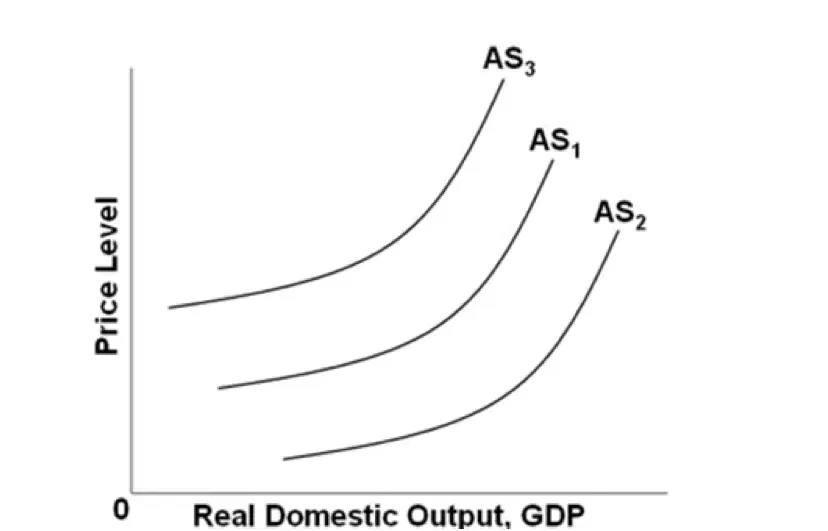
In the diagram, a shift from AS1 to AS3 might be caused by a(n)
Increase in productivity
Increase in the prices of imported resources
Decrease in the prices of domestic resources
Decrease in business taxes
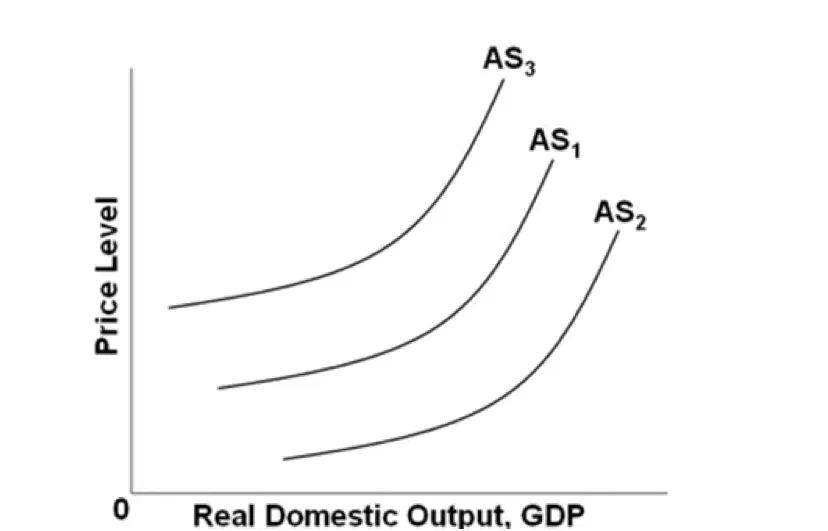
In the diagram, a shift from AS3 to AS2 might be caused by an increase in
Business taxes and government regulation
The prices of imported resources
The prices of domestic resources
Productivity
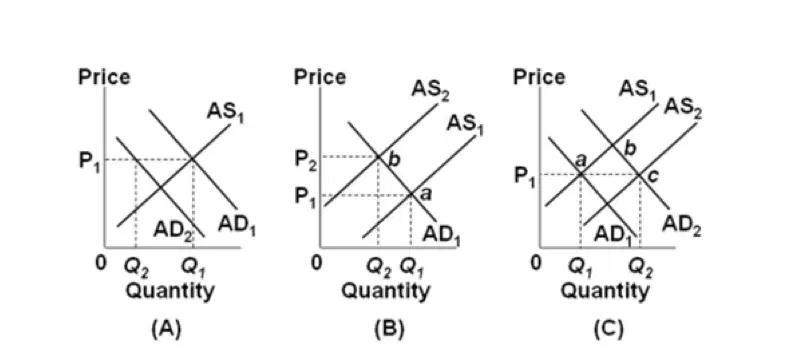
Refer to the diagrams, in which AD1 and AS1 are the “before” curves and AD2 and AS2 are the “after” curves. Other things equal, a decline in net exports caused by a change in incomes abroad is depicted by
A
B
C
B and C
If aggregate demand decreases, and, as a result, real output and employment decline but the price level remains unchanged, it is most likely that
The money supply has declined
The price level is inflexible downward and a recession has occurred
Cost-push inflation has occurred
Productivity has declined
A decrease in aggregate demand will cause a greater decline in real output the
Less flexible is the economy’s price level
More flexible is the economy’s price level
Steeper in the economy’s AS curve
Larger is the economy’s marginal prosperity to save
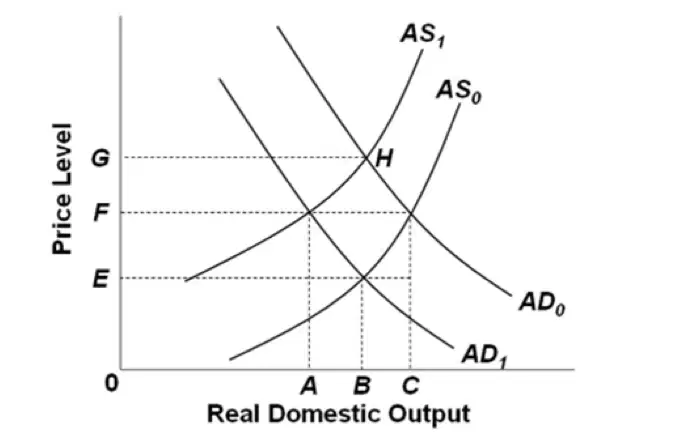
Refer to the diagram. Other things equal, a shift of the aggregate supply curve from AS0 to AS1 might be caused by a(n)
Increase in government regulation
Increase in aggregate demand
Increase in productivity
Decline in nominal wages
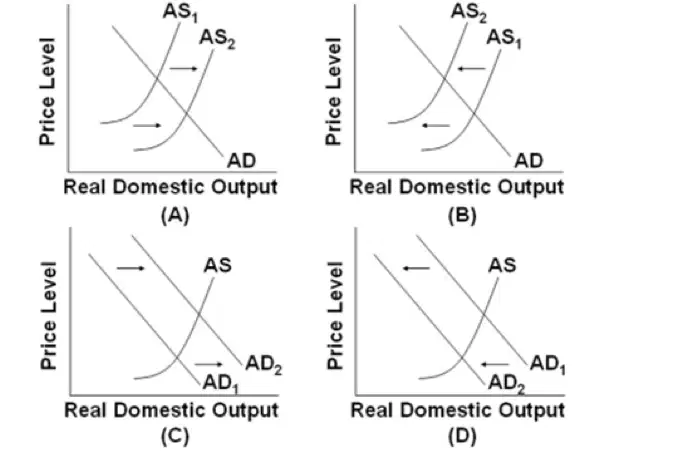
Which of the diagrams for the US economy best portrays the effects of declines in the incomes of US trading partners?
A
B
C
D
The size of the multiplier associated with an initial increase in spending will be
The same whether or not inflation occurs
Diminished if inflation occurs
Zero if any increase in the price level occurs
Enhanced if inflation occurs
When aggregate demand declines, many firms may reduce employment rather than wages because wage reductions may
Reduce per-unit production costs
Reduce worker morale and work effort and thus lower productivity
Increase the firms’ cost of raising financial capital
Reduce the demands for their products
When aggregate demand declines, some firms may reduce employment rather than wages because wage reductions may
Not be possible due to the minimum wage law
Increase the cost of raising money capital
Reduce the demands for their products
Set off a price war
What percentage of the average US firm’s costs is accounted for by wages and salaries?
40
60
85
75
An economy’s aggregate demand curve shifts leftward or rightward more than changes in initial spending because of the
Multiplier effect
Real-balance effect
Net export effect
Wealth effect
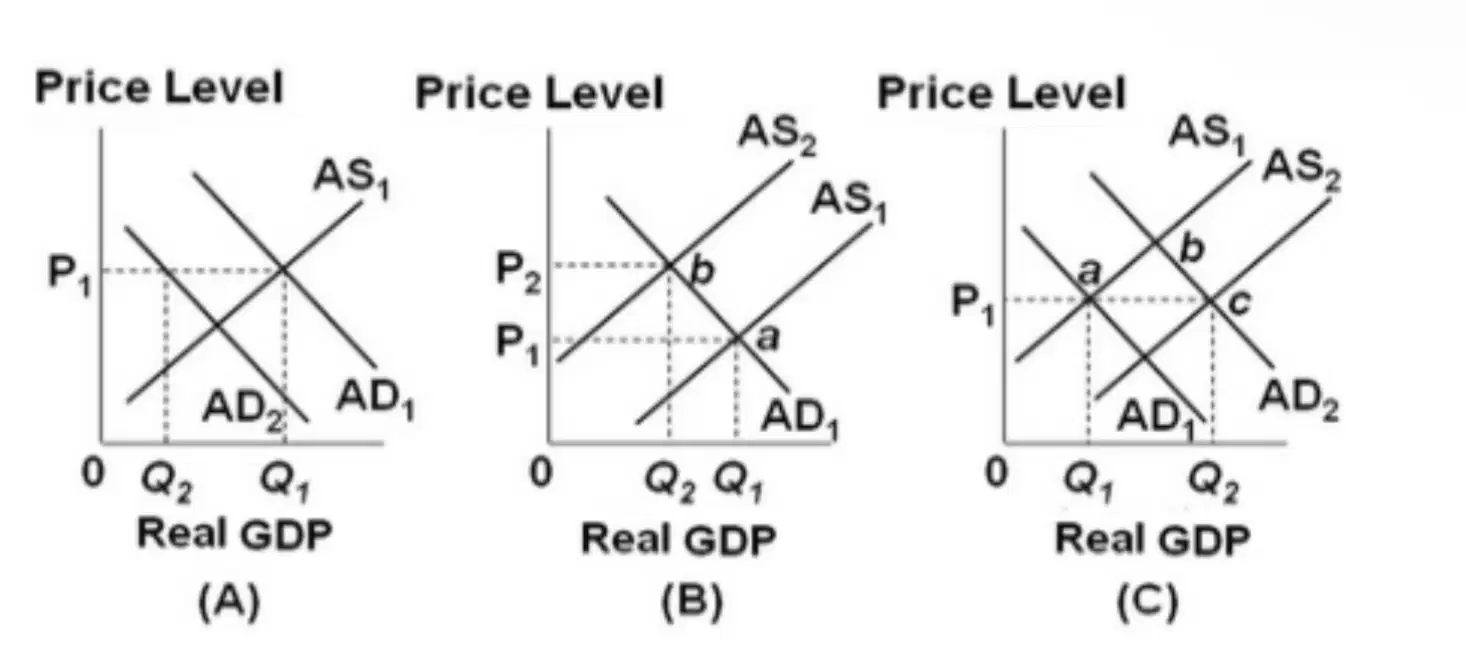
Refer to the diagrams, in which AD1 and AS1 are the “before” curves and AD2 and AS2 are the “after” curves. Other things equal, a decline in productivity is depicted by
B and C
C
A
B
In an effort to avoid recession, the government implements a tax rebate program, effectively cutting taxes for households. We would expect this to
Reduce aggregate supply
Affect neither aggregate supply nor aggregate demand
Increase aggregate demand
Reduce aggregate demand

Refer to the diagrams, in which AD1 and AS1 are the “before” curves and AD2 and AS2 are the “after” curves. Cost-push inflation is depicted by
B
B and C
A
C
Given a fixed upsloping AS curve, a rightward shift of the AD curve will
Increase the price level but not real output
Increase both the price level and real output
Cause cost-push inflation
Increase real output but not the price level
The determinants of aggregate supply
Are consumption, investment, government, and net export spending
Explain why real domestic output and the price level are directly related
Include resource prices and resource productivity
Explain the three distinct ranges of the aggregate supply curve
The fear of unwanted price wars may explain what many firms are reluctant to
Reduce prices when a decline in aggregate demand occurs
Provide wage increases when labor productivity rises
Expand production capacity when an increase in aggregate demand occurs
Reduce wages when a decline in aggregate demand occurs
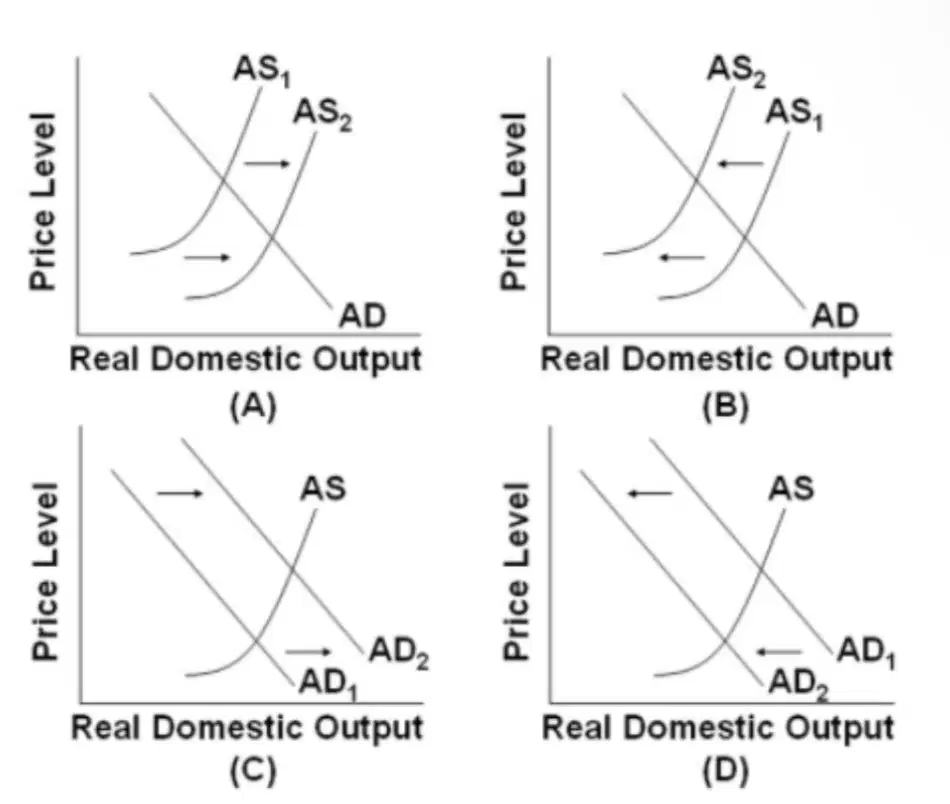
Which of the diagrams for the US economy best portrays the effects of a substantial reduction in government
B
D
A
C
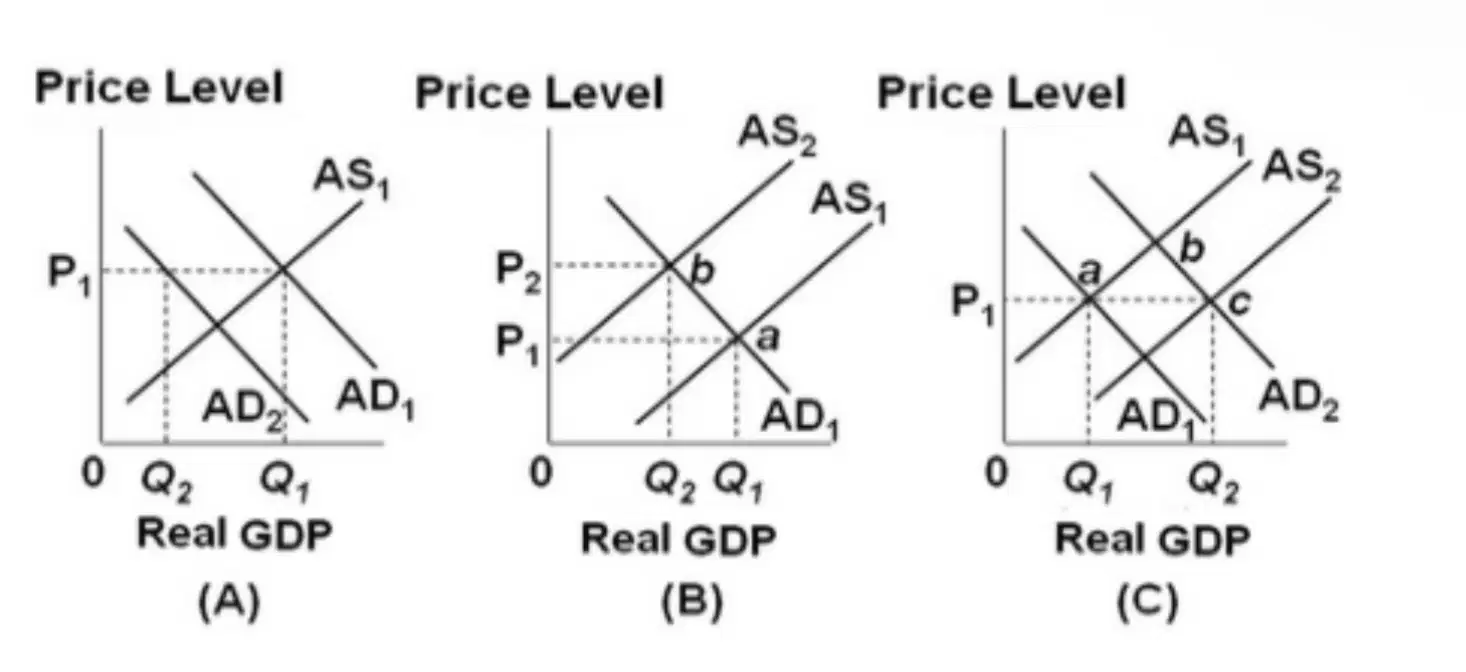
Refer to the diagrams, in which AD1 and AS1 are the “before” curves and AD2 and AS2 are the “after” curves. Other things equal, an increase in investment spending is depicted by
B and C
B
A
C
A decline in investment will shift the AD curve to the
Left by a multiple of the change in investment
Right by a multiple of the change in investment
Right by the same amount as the change in investment
Left by the same amount as the change in investment
Others things equal, an improvement in productivity will
Increase the price level
Shift the aggregate demand curve to the left
Shift the aggregate supply curve to the left
Shift the aggregate supply curve to the right
Which of the following would most likely shift the aggregate demand curve to the right?
A reduction in household borrowing because of tighter lending practices
Increased fear that a recession will cause workers to lose their jobs
An increase in stock prices that increases consumer wealth
An increase in personal income tax rates
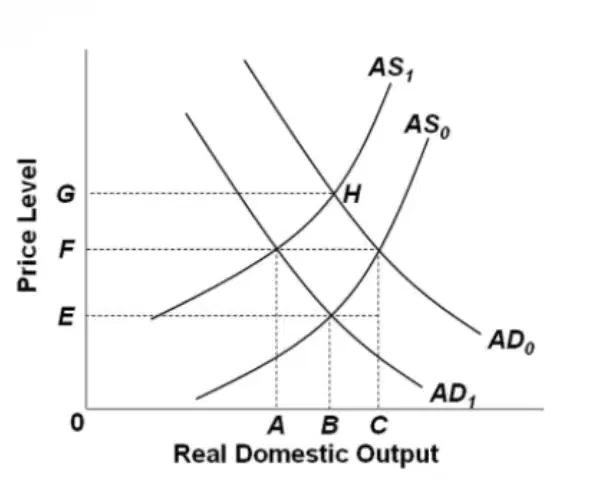
Refer to the diagram. A shift of the aggregate demand curve from AD1 to AD0 might be caused by a(n)
Increase in investment spending
Decrease in aggregate supply
Decrease in the amount of output supplied
Decrease in net export spending
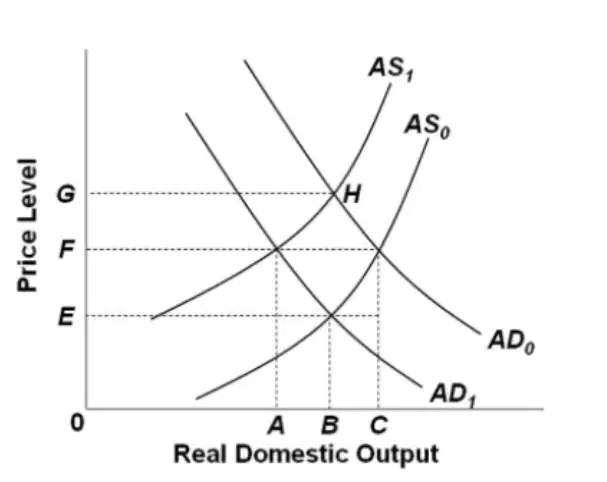
Refer to the diagram. Other things equal, a shift of the aggregate supply curve from AS0 to AS1 might be caused by a(n)
Increase in productivity
Increase in aggregate demand
Increase in government regulation
Decline in nominal wages
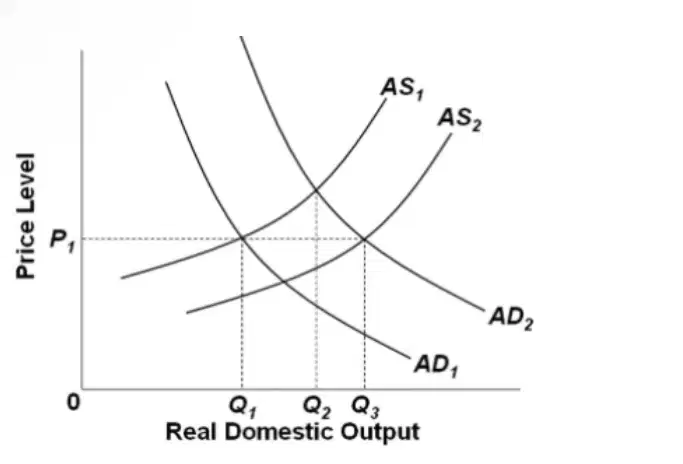
In the figure, AD1 and AS1 represent the original aggregate supply and demand curves, and AD2 and AS2 show the new aggregate demand and supply curves. The change in aggregate supply from AS1 to AS2 could be caused by
An increase in business taxes
A reduction in the price level
The increase in productivity
The real-balances, interest-rate, and foreign purchases effects
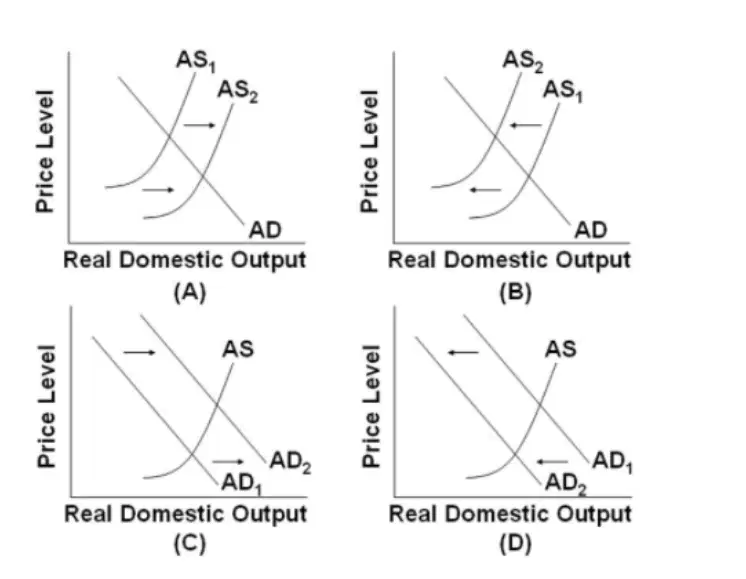
Which of the diagrams for the US economy best portrays the effects of an increase in foreign spending on US products?
C
B
A
D
Suppose that technological advancements stimulate $20 billion in additional investment spending. If the MPC=0.6, how much will the change in investment increase aggregate demand?
$12 billion
$20 billion
$50 billion
$33.3 billion
Which of the following would increase per-unit production cost and therefore shift the aggregate supply curve to the left?
Production bottlenecks occurring when producers near full plant capacity
A reduction in business taxes
An increase in the price of imported resources
Deregulation of industry
An increase in net exports will shift the AD curve to the
Left by a multiple of the change in net exports
Left by the same amount as the change in net exports
Right by the same amount as the change in net exports
Right by a multiple of the change in net exports

The International Monetary Fund chief, Christine Lagarde, in a widely broadcasted interview on Tuesday April 2, 2019 stated that she expects the global economy to slow down this year and that the global economy is in “delicate moment” now. In a graph below show the AD/AS model and show how this news would affect the model. Indicate the level of of output (GDP) and prices (PL) that will be produced after this news became public.
(a)

The International Monetary Fund chief, Christine lagarde, in a widely broadcasted interview on Tuesday April 2, 2019 stated that she expects the global economy to slow down this year and that the global economy is in a “delicate moment” now. In a graph below show the AD/AS model and show how this news will affect the model. What will be the affect of GDP from this change?
(a)

The International Monetary Fund chief, Christine lagarde, in a widely broadcasted interview on Tuesday April 2, 2019 stated that she expects the global economy to slow down this year and that the global economy is in a “delicate moment” now. In a graph below show the AD/AS model and show how this news will affect the model. What will the effect be on the Price Level from this change?
(a)

The International Monetary Fund chief, Christine lagarde, in a widely broadcasted interview on Tuesday April 2, 2019 stated that she expects the global economy to slow down this year and that the global economy is in a “delicate moment” now. In a graph below show the AD/AS model and show how this news will affect the model. What will be the effect of unemployment from this change?
(a)

The International Monetary Fund chief, Christine lagarde, in a widely broadcasted interview on Tuesday April 2, 2019 stated that she expects the global economy to slow down this year and that the global economy is in a “delicate moment” now. In a graph below show the AD/AS model and show how this news will affect the model. What stage of the business cycle is described by this situation?
(a)

The International Monetary Fund chief, Christine lagarde, in a widely broadcasted interview on Tuesday April 2, 2019 stated that she expects the global economy to slow down this year and that the global economy is in a “delicate moment” now. In a graph below show the AD/AS model and show how this news will affect the model. If the fiscal policy was the only tool you have to affect the economy, what type of fiscal policy would you implement?
(a)
By how much should the government changing spending in order to shift the aggregate demand curve rightward by $40 billion? (Increase or decrease)
(a)
In order to shift the aggregate demand curve rightward by $40 billion, the change in spending was increased by $4 billion. What if the government wanted to change taxes only, how much should they change them?
(a)

Refer to the diagram, in which Qf is the full-employment output. A contractionary fiscal policy would be most appropriate if the economy’s present aggregate demand curve were at
(a)

Refer to the diagram, in which Qf is the full-employment output. An expansionary fiscal policy would be most appropriate if the economy’s present aggregate demand curve were at
(a)
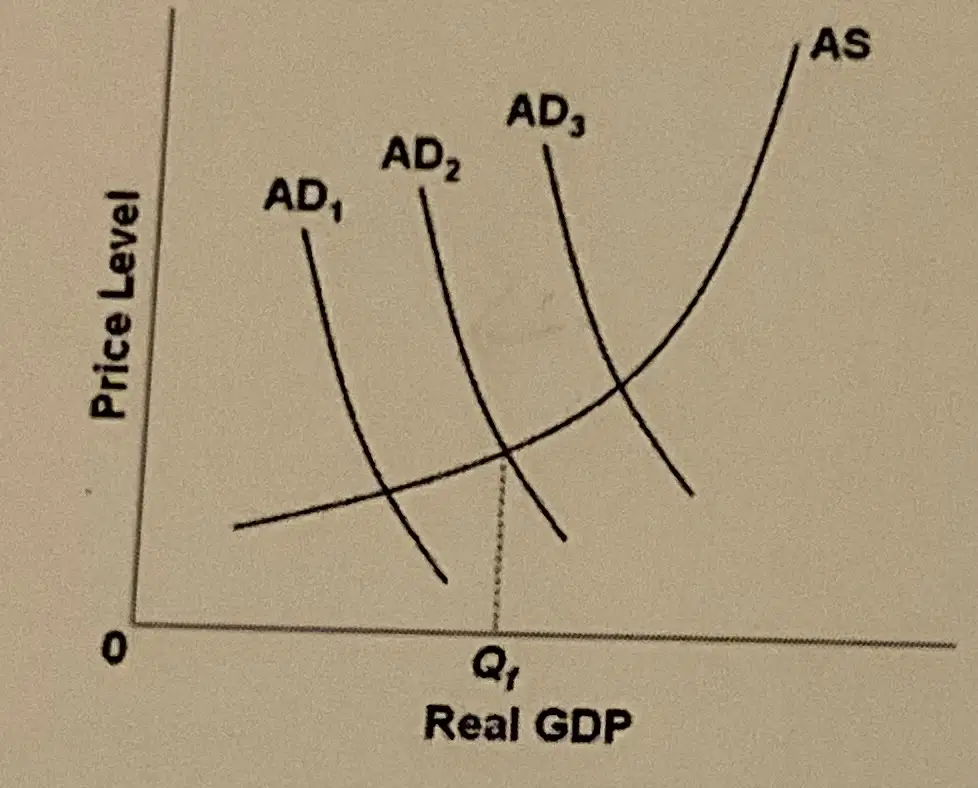
Refer to the diagram, in which Qf is the full-employment output. The shift in the aggregate demand curve from AD3 to AD2 could result from which of the following fiscal policy actions?
A tax reduction
A tax reduction accompanied by an even larger reduction in government spending
A tax increase accompanied by an even larger increase in government spending
An increase in government spending
Which of the following represents the most contractionary fiscal policy?
a $30 billion tax cut
A $30 billion increase in government spending
A $30 billion tax increase
A $30 billion decrease in government spending
The government hires 2000 workers for new infrastructure projects. Over half of the newly hired construction workers, however, were employed in other sectors of the economy and quit their job to take this better paying opportunity. Which of the options below is described here?
Expansionary fiscal policy
Contractionary fiscal policy
Crowding out
A and C only
B and multiplier effect
Discretionary fiscal policy refers to
Any change in government spending or taxes that destabilizes the economy
the authority that the president has to change personal income tax rates
Intentional changes in taxes and government expenditures made by congress to stabilize the economy
The changes in taxes and transfers that occur as GDP changes
Expansionary fiscal policy is so named because
Involves an expansion of the nations money supply
Necessarily expands the size of government
Is aimed at achieving greater price stability
Is designed to expand real GDP
If the MPS in the economy is 0.1, government could shift the aggregate demand curve rightward by $40 billion by
Increasing government spending by $4 billion
increase government spending by $40 billion
Decreasing taxes by $4 billion
increasing taxes by $4 billion
If the MPC in an economy is 0.75, government should a shift the aggregate demand curve leftward by $60 billion by
Reducing government expenditures by $12 billion
reducing government expenditures by $60 billion
increasing taxes by $15 billion
increasing taxes by $20 billion
In a certain year the aggregate amount demanded at the existing price level consisted of $100 billion of consumption,$40 billion of investment, $10 billion of net exports, and $20 billion of government purchases. Full-employment GDP is $200 billion. To achieve full employment under these conditions, the government should
encourage personal savings by increasing the interest rate on government bonds
Decrease government expenditures
Reduce tax rates and/or increase government spending
Discourage private investment by increasing corporate income taxes
In aggregate demand-aggregate supply diagram, equal decreases in government spending and taxes will
shift the AD curve to the right
Increase the equilibrium GDP
not affect the AD curve
Shift the AD curve to the left
A tax reduction of a specific amount will be more expansionary the
Smaller is the economy’s MPC
larger is the economy’s MPC
Smaller is the economy’s multiplier
Less is the economy’s built in stability
The cyclically adjusted budget refers to
The inflationary impact that the automatics stabilizers have in a full-employment economy
the portion of a full-employment GDP that is not consumed in the year it is produced
The size of the federal governments budgetary surplus or deficit when the economy is operating at full employment
The number of workers who are underemployed when the level of unemployment is 4-5 percent
The amount by which government expenditures exceeds revenues during a particular year is the
public debt
budget deficit
Full employment
GDP gap
The US public debt
Refers to the debts off all units of government - federal, state, and local
consists of the total debt of US households, businesses, and government
Refers to the collective amount that US citizens and business owners to foreigners
Consists of the historical accumulation of all past federal deficits and surpluses
The crowding-out effect of expansionary fiscal policy suggests that
Government spending increases at the expense of private investment
Imports replace domestic production
private investment increases at the expense of investment
Saving increases at the expense of investment
Other things equal, the stock of capital inherited by future generations is likely to be smaller when government spending
Is financed by borrowing
Is primary for capital-type goods
Increases during a period of recession, rather than prosperity
Is financed by taxation
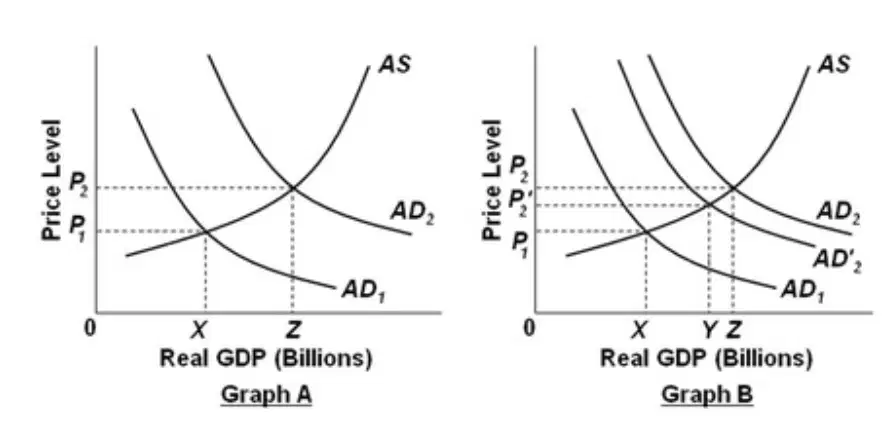
Refer to the diagrams. Suppose that government undertakes fiscal policy designed to increase aggregate demand from AD1 to AD2 and thereby to increase GDP from X to Z. In terms of the graph B, which of the following might explain why GDP increases to Y rather than Z?
Deprecation of the dollar
Reduction in tariffs imposed by our trading partners
Crowding-out effect
Decrease in the saving schedule
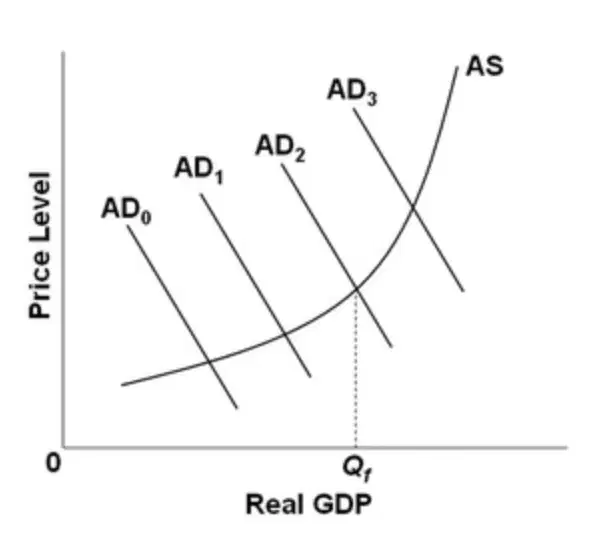
Refer to the diagrams, in which Qf is the full-employment output. If the economy’s current aggregate demand curve is AD3, it would be appropriate for the government to
Reduce unemployment compensation benefits
Reduce government expenditures and taxes by equal-size amounts
increase government expenditures or reduce taxes
reduce government expenditures or increase taxes
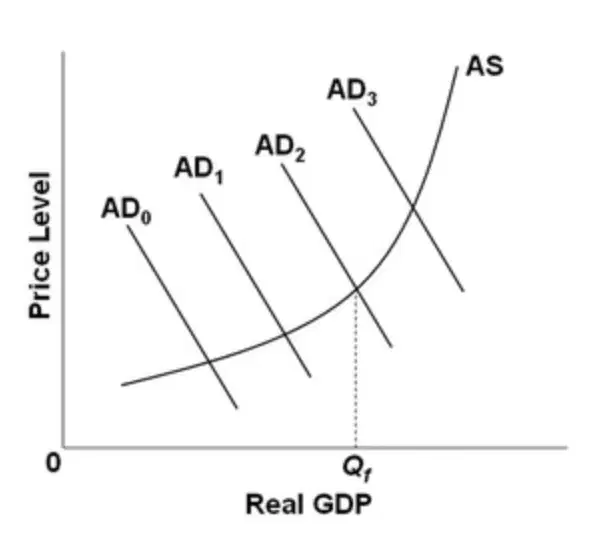
Refer to the diagrams, in which Qf is the full-employment output. If the economy’s current aggregate demand curve is AD0, it is experiencing
a negative GDP gap
An adverse supply shock
inflation
A positive GDP gap
Which of the following did not contribute directly to the Great Recesiion?
Crisis in mortgage lending market
Pessimism originating from financial market turmoil
Freezing credit markets
Bursting of the dot-com stock market bubble
The amount by which federal tax revenues exceed federal government expenditures during a particular year is the
public debt
federal reserve
Budget surplus
budget deficit
Which of the following represents the most expansionary fiscal policy?
A $10 billion tax cut
A $10 billion increase in government spending
A $10 billion tax increase
a $10 billion decrease in government spending
The most likely way the public debt burdens future generations, if at all, is by
Reducing the current level of investment
Causing deflation
reducing real interest rates
Causing future unemployment
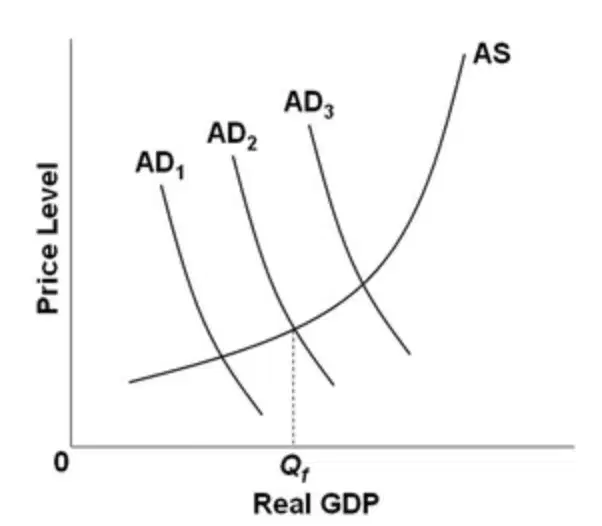
Refer to the diagrams, in which Qf is the full-employment output. If aggregate demand curve AD1 describes the current situation, appropriate fiscal policy would be to
Reduce taxes and increase government spending to shift the aggregate demand curve from AD1 to AD2
Increase taxes and reduce government spending to shift the aggregate demand curve rightward to AD2
do nothing since the economy appears to be achieving full-employment real GDP
reduce taxes on businesses to shift the aggregate supply curve leftward
The American recovery and reinvestment act of 2009 was implemented primarily to
reduce inflationary pressure caused by oil price increases
curb the overspending by households that contributed to the Great Recession
Bring the federal budget back into balance
Stimulate aggregate demand and employment
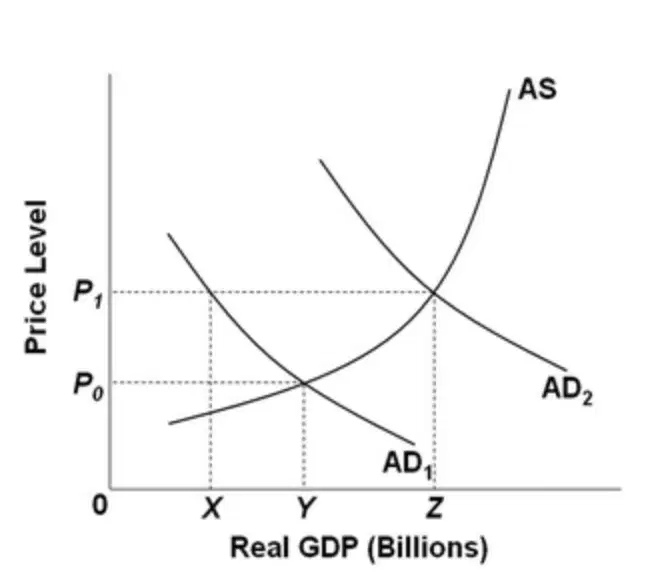
Refer to the figure. Suppose that the economy’s current aggregate is currently operating at the intersection of AS and AD2 and that the full-employment level of output is Y. Because of the ratchet effect,
fiscal policy will need to be more contractionary to reduce output to Y than if no ratchet effect occurred
Contractionary fiscal policy that shifts aggregate demand to AD1 will cause real GDP to fall below its full-employment level
Tax increases will be more effective at reducing demand-pull inflation than cuts in government spending
It is impossible to enact fiscal policy that will both reduce output to Y and reduce demand-pull inflation
The crowding-out effect is
strongest when the economy is at full employment
Weakest when there is demand-pull inflation
strongest when the economy is in a deep recession
equally strong, regardless of the state of the macroeconomy
The public debt is the amount of money that
the federal government owes to taxpayers
americans owe to foreigners
State and local governments owe to the federal government
The federal government owes to holders of US securities
An appropriate fiscal policy for severe demand-pull inflation is
a tax rate increase
A reduction in interest rates
an increase in government spending
depreciation of the dollar
Answer the question on the basis of the following sequence of events involving fiscal policy: (1) the composition index of leading indicators turns downward for three consecutive months, suggesting the possibility of a recession. (2) economists reach agreement that the economy is moving into a recession. (3) a tax cut is proposed to congress. (4) the tax cut is passed by congress and signed by president. (5) consumption spending begins to rise, aggregate demand increases, and the economy begins to recover. The administrative lag of fiscal policy is reflected in events
1 and 2
3 and 4
4 and 5
2 and 3
Suppose that the economy’s current aggregate is in the midst of a recession. Which of the following policies would most likely end the recession and stimulate output growth?
Reductions in agricultural subsidies and veterans benefits
Postponement of a highway construction program
reductions in federal tax rates on personal and corporate income
A congressional proposal to incur a federal surplus to be used for the retirement of public debt
Discretionary fiscal policy will stabilize the economy most when
Deficits are incurred during recessions and surpluses during inflations
Budget surpluses are continuously incurred
the budget is balanced each year
defecits are incurred during inflations and surpluses during recessions
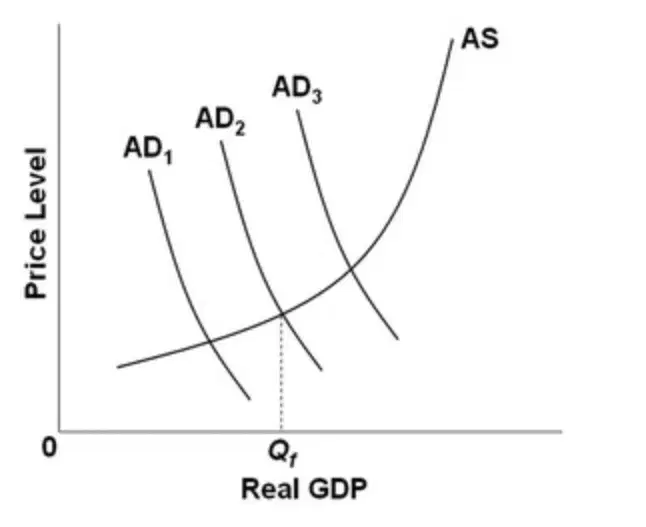
Refer to the diagram, in which Qf is the full-employment output. The shift of the aggregate demand curve from AD3 to AD2 is consistent with
a major recession
An expansionary fiscal policy
demand-pull inflation
A contractionary fiscal policy
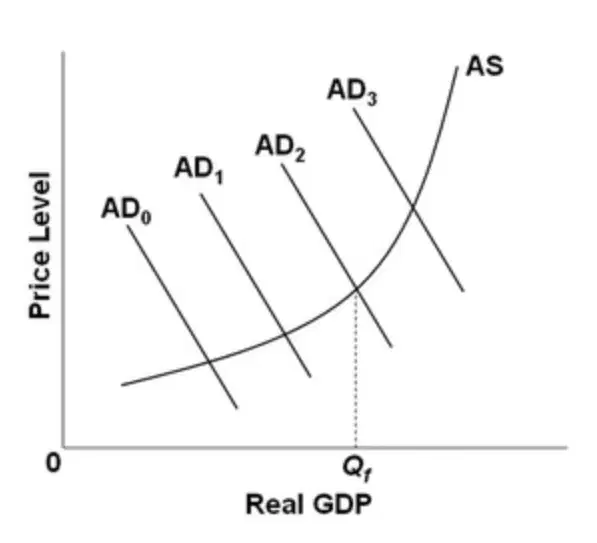
Refer to the diagram, in which Qf is the full-employment output. If the economy’s current aggregate demand curve is AD3, it is experiencing
Cost-push inflation
a negative GDP gap
A recession
A positive GDP gap
An expansionary fiscal policy is shown as a
Leftward shift in the economy’s aggregate supply curve
movement along an existing aggregate demand curve
Leftward shift in the economy’s aggregate demand curve
rightward shift in the economy’s aggregate demand curve
If you are estimating your total expenses for school next semester, you are using money primarily as
a medium of exchange
A store of value
A unit of account
An economic investment
A $70 price tag on a sweater in a department store window is an example of money functioning as a
Unit of account
Standard of deferred payments
store of value
medium of exchange
In the united stated, the money supply (M1) includes
Coins, paper currency, and checkable deposits
Currency, checkable deposits, and series E bonds
coins, paper currency, checkable deposits, and credit balances with brokers
Paper currency, coins, gold certificates, and time deposits
Currency held in the vault of first national bank is
Counted as part of M1
Counted as part of M2 but not M1
Only counted as part of M1 if it was deposited into a checking account
Not counted as part of the money supply
In defining money as M1, economists exclude time deposits because
The intrinsic value of time deposits is nil
The purchasing power of time deposits is much less stable than that of checkable deposits and currency
They are not directly or immediately a medium of exchange
They are not recognized by the federal government as a legal tender
The M2 money supply includes
Stock certificates
Currency in bank vaults
The cash value of life insurance policies
Individual shares in money market mutual funds
Money market deposit accounts are included in
M1 only
M2 only
Neither M1 or M2
Both M1 and M2
The largest component of the money supply (M1) is
Currency in bank vaults
Currency in circulation
Checkable deposits
Stock certificates
Coins in peoples pockets and purses are
Included in M1 but not in M2
Included both in M1 and M2
Included in M2 but not M1
Excluded from M1 and M2 because people can exchange them for federal reserve notes
The money supply is backed
By the governments ability to control the supply of money and therefore to keep its value relatively stable
By government bonds
Dollar-for-dollar by gold and silver
By gold reserves representing a fraction of the total value of dollars in circulation
The purchasing power of money and the price level vary
Inversely
Directing during recessions but inversely during inflations
Directly but not proportionately
Directly and proportionately
If the price index rises from 200 to 250, the purchasing power value of the dollar
May either rise or fall
Will rise by 25 percent
Will fall by 25 percent
Will fall by 20 percent
During periods of rapid inflation, money may cease to work as a medium of exchange
Unless it has been designated legal tender
Unless it is backed by gold
Because it is to scarce for everyone to have enough for transactions
Because people and businesses will not want to accept it in transactions
The central authority of the US banking system is the
Federal open market committee (FOMC)
Board of governors of the federal reserve
Federal monetary authority
Council of economic advisors
The board of governors of federal reserve has (a) members.
The members of the federal reserve board
Serve seven-year terms
Are appointed by the American economic association
Are elected by votes of the 12 presidents of the federal reserve banks
Are appointed for 14-year terms
What are “mortgage-backed securities”?
Company stock shares for financial institutions that lend to home buyers
Bonds backed by mortgage payments
Treasury bills and saving bonds that banks sold to maintain liquidity during the Mortgage default crisis
Insurance against mortgage loan defaults
An assets liquidity refers to its ability to be
Bought and stored
Increasing in value over time
Used and enjoyed
A means of payment
Some economists are concerned that the financial rescue provided by TARP will encourage financial investors and firms to take on greater risks in the future. This is an example of
Moral hazard
Adverse selection
A prisoners dilemma
Shadow banking
The Federal Open Market Committee (FOMC) is made up of
the chair of the Board of Governors along with the 12 presidents of the Federal Reserve Banks
The seven members of the Board of Governors along with the president of the New York Federal Reserve Bank
the seven members of the Board of Governors of the Federal Reserve System along with the president of the New York Federal Reserve Bank and four other Federal Reserve Bank presidents on a rotating basis
The seven members of the Board of Governors of the Federal Reserve System along with the three members of the Council of Economic Advisers
As it relates to the Federal reserve activities, the acronym FOMC describes the
Federal Organization for Money Creation
Federal Options Market Committee
Federal Organization for Monetary Control
Federal Open Market Committee
The Federal Reserve System is a bankers’ bank and thereby acts as a “lender of last resort” to banks.
True
False
An important routine function of the Federal Reserve Bank is to
Help large commercial banks develop correspondent relationships with smaller commercial banks
supervise the liquidation of the assets of bankrupt state banks
Provide facilities by which commercial banks and thrift institutions may collect checks
Advise commercial banks as to the most profitable ways of reinvesting profits
Stock market price quotations best exemplify money serving as a
Index of satisfaction
Unit of account
Medium of exchange
Store of value
The value (or purchasing power) of money increases when the price level increases.
true
False
The paper money used in the United States is
National Bank notes
United States notes
Treasury notes
Federal Reserve notes
If you write a check on the bank to purchase a used Honda Civic, you are using money primarily as
A store in value
an economic investment
A medium of exchange
A unit of account
When a consumer wants to compare the price of one product with another, money is primarily functioning as a
Unit of account
Store of value
medium of exchange
Checkable deposit
Other things equal, an excessive increase in the money supply will
Decrease the purchasing power of each dollar
Reduce the price level
Increase the purchasing power of each dollar
have no impact on the purchasing power of the dollar
The most important function of the Fed is:
Act as a fiscal agent for US government
Supervise banks
Control the money supply
Lender of last resort
Which of the following does not explain what backs the money supply in the United States?
it is relatively scarce
It is backed by gold
It is designated “legal tender” by the federal government
It is widely accepted in transactions
The value of money varies
Directly with the price level
directly with the interest rate
inversely with the price level
Directly with the volume of employment
Correctly in circulation is part of
Neither M1 nor M2
M1 only
both M1 and M2
M2 only
When economists say that money serves as a store of value, they mean that it is
A means of payment
A monetary unit for measuring and comparing the relative value of goods
a way to keep wealth readily spendable form future use
Declared as legal tender by the government
Overnight loans from one bank to another for reserve purposes entail an interest rate called the
Treasury rate
Prime rate
Federal funds rate
Discount rate
Mostly modern banking systems are based on
Commodity money
fractional reserves
Money of intrinsic value
100 percent reserves
The goldsmiths ability to create the money was based on the fact that
the goldsmiths was required to keep 100 percent gold reserves
Paper money in the form of gold receipts was rarely redeemed for gold
Consumers and merchants preferred to use gold for transactions, rather than paper money
Withdrawals of gold tended to exceed deposits of gold in any given time period
Items: 1. Money market mutual funds held by individuals 2. Money market mutual funds held by businesses 3. Currency held by the public 4. Small time deposits 5. Checkable deposits
Refer to the accompanying list. The M1 money supply is composed of items
1 and 4
1, 2, and 4
3 and 4
4 and 5
The money supply is vertical (does not change with the interest rate) because:
Because at any point in time the amount of gold that backs the money supply is fixed
It is hard to change the money supply of money
banks always supply a fixed amount of money regardless of the interest rate
It is controlled by the Fed
The asset demand for money
is unrelated for both the interest rate and the level of GDP
varies inversely with the rate of interest
Varies inversely with the level of real GDP
Varies directly with the level of nominal GDP
The total demand for money curve will shift to the right as a result of
An increase in nominal GDP
An increase in the interest rate
A decline in the interest rate
A decline in nominal GDP
It is costly to hold money because
deflation may reduce its purchasing power
In doing so, one sacrifices interest income
Bond prices are highly variable
The rate at which money is spent may decline
The asset demand for money is downsloping because
The opportunity cost of holding money increases as the interest rate rises
It is more attractive to hold money at high interest rates than at low interest rates
Bond prices rise as interest rates rise
The opportunity cost of holding money declines as the interest rate rises
If the quantity of money demanded exceeds the quantity supplied,
the supply-of-money curve will shift to the left
the demand-for-money curve will shift to the right
the interest rate will rise
The interest rate will fall
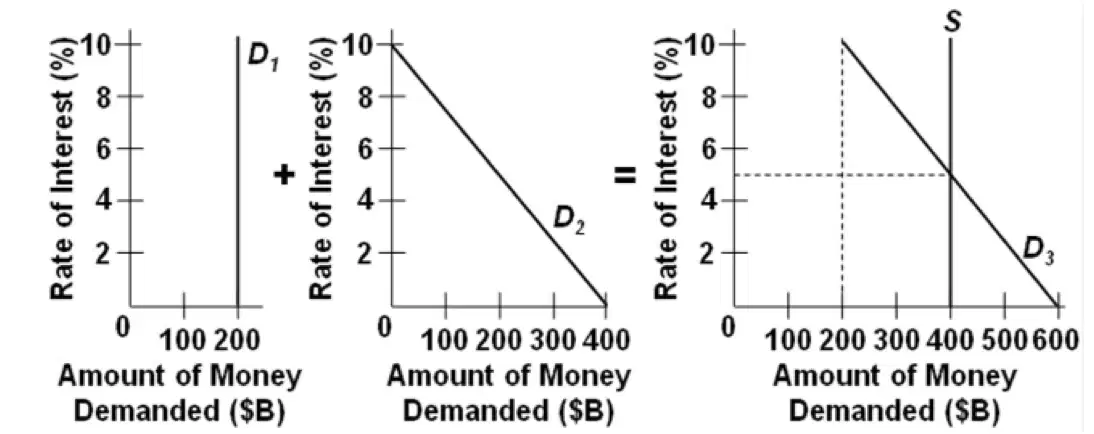
Refer to the given market-for-money diagrams. If the Federal Reserve increased the stock of money, the
s curve would shift leftward and the equilibrium interest rate would rise
S curve would shift rightward and the equilibrium interest rate would fall
D3 curve would shift leftward and the equilibrium interest rate would fall
D3 curve would shift leftward and the equilibrium interest rate would rise
Since the financial crisis that began in 2007, the Federal Reserve has added a significant amount of which of the following securities?
Corporate bonds
mortgage-backed securities
Common stock of financial institutions
Certificate of deposit
When a commercial bank borrows from a Federal Reserve Bank,
the supply of money automatically increases
it indicates that the commercial bank is unsound financially
The commercial banks lending ability is increased
The commercial banks reserves are reduced
Open-market operations include
Changes in the reserve ration
Repos and reverse repos
Paying interest on excess reserves held at Federal Reserve Banks
changes in the discount rate
Assume the reserve ratio is 25 percent and Federal Reserve Banks buy $4 billion of US securities from the public, which deposits this amount into checking accounts. As a result of these transactions, the supply of money is
Not directly affected, but the money-creating potential of the commercial banking system is increased by $12 billion
Directly increased by $4 billion and the money-creating potential of the commercial banking system is increased by an additional $16 billion
Directly reduced by $4 billion and the money-creating potential of the commercial banking system is decreased by an additional $12 billion
directly increased by $4 billion and the money-creating potential of the commercial banking system is increased by an additional $12 billion
Open market operations refer to
purchases of stock in the New York Stock Exchange
the purchase or sale of government securities, as well as collateralized money loans, by the Fed
Central bank lending to commercial banks
the specifying of loam maximums on stock purchases
Which of the following best describes the cause-effect chain of a restrictive monetary policy?
A decrease in the money supply will lower the interest rate, increase investment spending, and increase aggregate demand and GDP
A decrease in the money supply will raise the interest rate, decrease investment spending, and decrease aggregate demand and GDP
An increase in the money supply will raise the interest rate, decrease investment spending, and decrease aggregate demand and GDP
An increase in the money supply will lower the interest rate, decrease investment spending, and increase aggregate demand and GDP
The purpose of an expansionary monetary policy is to shift the
aggregate demand curve leftward
Aggregate demand curve rightward
Aggregate supply curve leftward
Investment demand curve leftward
If severe demand-pull inflation was occurring in the economy, proper government policies would involve a government
Budget deficit, the purchase of securities in the open market, a higher discount rate, and higher reserve requirements
Budget deficit, the sale of securities in the open market, a higher discount rate, and lower reserve requirements
Budget surplus, the sale of securities in the open market, a higher discount rate, and higher reserve requirements
Budget surplus, the sale of securities in the open market, a lower discount rate, and lower reserve requirements
Assume the economy is operating at less than full employment. An expansionary monetary policy will cause interest rates to _____, which will _____ investment spending.
decrease; decrease
decrease; increase
Increase; increase
increase; decrease
Which of the following actions by the Fed would cause the money supply to increase?
Purchases of government bonds from banks
An increases in the reserve requirement
An increase in the discount rate
sales of government bonds to the public
The purpose of a restrictive monetary policy is to
Alleviate recessions
raise interest rates and restrict the availability of bank credit
Increase aggregate demand and GDP
increase investment spending
To increase the federal funds rate, the Fed historically has
bought government bonds from the public
decreased the discount rate
decreased the prime interest rate
sold government bonds to commercial banks
The Feds response to the zero lower bound problem was
To raise the lower bound
Quantitive easing
To lower the reserve ratio
restrictive monetary policy
The Federal Reserve System regulates the money supply primarily by
controlling the production of coins of the US mint
altering the reserve requirements of commercial banks and thereby the ability of banks to make loans
Altering the reserves of commercial banks, largely through sales and purchases of government bonds
Restricting the issuance of Federal Reserve Notes because paper money is the largest portion of the money supply
Open-market operations change
the size of the monetary multiplier but not commercial banks reserves
commercial banks reserves but not the size of the monetary multiplier
Neither commercial bank reserves nor the size of the monetary multiplier
Both commercial bank reserves and the size of the monetary multiplier
If the Fed were to reduce the legal reserve ratio, we would expect
Lower interest rates, an expanded GDP, and a higher rate of inflation
Lower interest rates, an expanded GDP, and a lower rate of inflation
Higher interest rates, a contracted GDP and a higher rate of inflation
higher interest rates, a contracted GDP, and a lower rate of inflation
The discount rate is the interest
Rate at which commercial banks lend to the public
Rate at which the Federal Reserve Banks lend to commercial banks
Yield on long-term government bonds
Rate at which the central banks lend to the US treasury
Which of the following is part of Congress’s dual mandate to the Fed?
1. Stable inflation
2. Stable money supply
3. Stable government spending
4. No cyclical unemployment
5. Stable bond purchases
1 and 4
1, 2, and 4
1, 2, and 3
4 and 5
2, 3, and 4
An increase in the money supply will
lower interest rates and lower equilibrium GDP
increase interest rates and increase the equilibrium GDP
Lower interest rates and increase the equilibrium GDP
Increase interest rates and lower the equilibrium GDP
Which of the following is the most important tool of the Fed today?
Reserve Ratio
Forward Guidance
Interest on reserves
Discount Rate
When the Fed lends money to a commercial bank, the bank
Increases its reserves and enhances its ability to extend credit to bank customers
Pays the prime interest rates on the loan
pays the federal funds interest rate on the loan
Decreases its reserves and reduces its ability to extend credit to bank customers
If the Federal Reserve system buys government securities from commercial banks and thereby public,
commercial bank reserves will be unaffected
The money supply will contract
It will be easier to obtain loans at commercial banks
Commercial bank reserves will decline
One of the m=reasons many economists favor monetary policy to be used first is because it:
can be implemented very fast
Can help the government have a low cost of borrowing during recessions
it can be easily approved by congress and the president
Can affect interest rates and through that affect investment
The Federal Reserve Banks buy government securities from commercial banks. As a result, the checkable deposits
Of commercial banks are unchanged, but their reserves increase
and reserves of commercial banks both decrease
And reserves of commercial banks are both unchanged
Of commercial banks are unchanged, but their reserves decrease
The federal funds rate is the interest rate that _____ charge(s) ______.
the Fed; commercial banks
Banks; on federal student loans
banks; other banks
Banks; their best corporate customers
A contraction of the money supply
increases both the interest rate and aggregate demand
Lowers the interest rate and increases aggregate demand
Lowers both the interest rate and aggregate demand
increases the interest rate and decreases aggregate demand
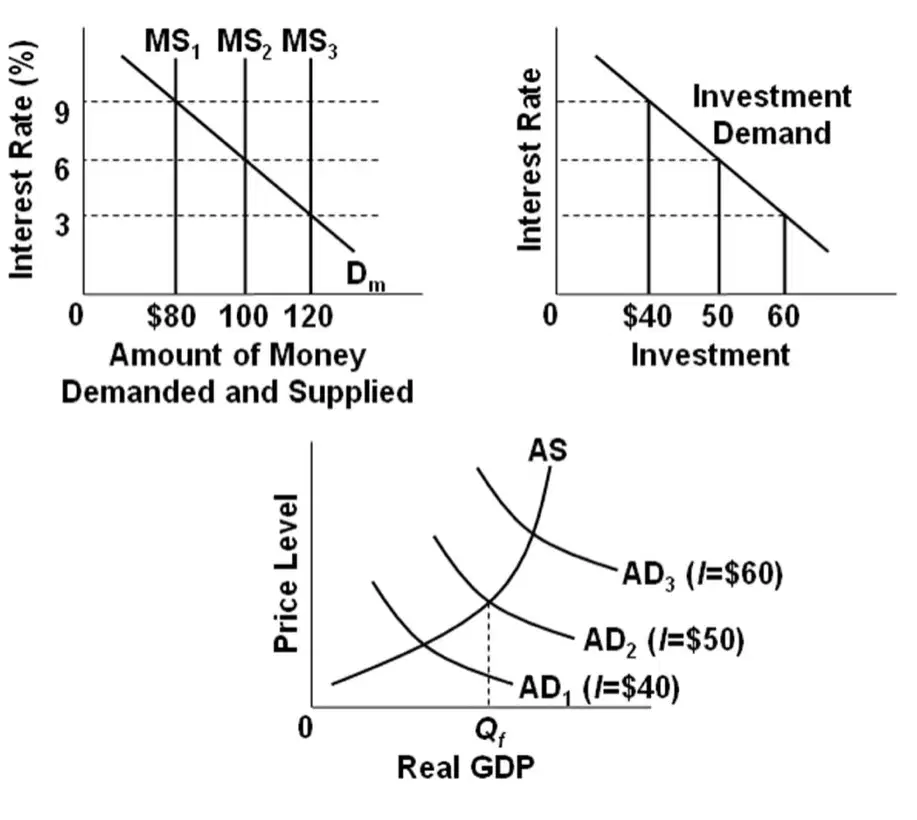
Refer to the diagrams. The numbers in parentheses after the AD1, AD2, and AD3 labels indicate the levels of investment spending associated with each curve. All figures are in billions. Which of the following would shift the money supply curve from MS1 to MS3?
an increase in the discount rate
purchases of US securities by the Fed in the open market
An increase in the reserve ratio
Sales of US securities by the Fed in the open market
Quantitive Easing (QE) was implemented by the Fed when:
The banks needed more money to lend
Fiscal policy was no longer helpful
It reached the zero lower bound
The fed no longer could control the money supply
If the economy were encountering a severe recession, proper monetary and fiscal policies would call for
Buying government securities, reducing the discount rate, reducing interest paid on reserves held at Fed banks, and a budgetary deficit
Selling government securities, lowering the discount rate, increasing interest paid on reserves held at Fed banks, and a budgetary surplus
buying government securities, raising the discount rate, reducing interest paid on reserves held at Fed banks, and a budgetary deficit
buying government securities, raising the discount rate, reducing interest paid on reserves held at Fed banks, and a budgetary surplus
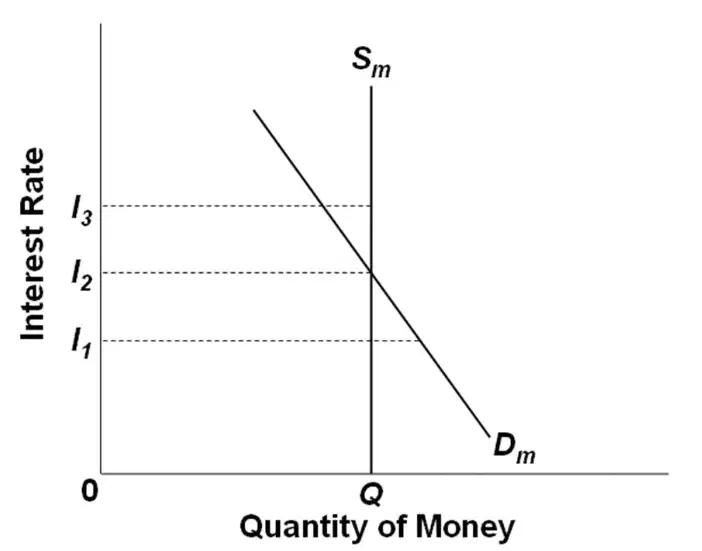
Refer to the diagrams of the market for money. The vertical money supply curve Sm reflects the fact that
lower interest rates result in lower opportunity costs of supplying money
the rate at which money is spent is zero
The stock of money is determined by the Federal reserve System and does not change when the interest rate changes
Bond prices and interest rates are inversely related
Before the Great Recession the most important tool of the Fed was:
the reserve ratio
The interest on reserves
Open market operations
The discount rate
It is costly to hold money because
The rate at which money is spent may decline
deflation may reduce its purchasing power
in doing so, one sacrifices interest income
Bond prices are highly variable
A restrictive monetary policy is designed to shift the
Aggregate supply curve rightward
aggregate demand curve leftward
Aggregate supply curve leftward
aggregate demand curve rightward
Which of the following statements is correct?
Interest rates and bond prices are unrelated
interest rates and bond prices vary inversely
Interest rates and bond prices vary directly
Interest rates and bond prices vary directly during inflations and inversely during recessions
If the Fed wants to discourage commercial bank lending, it will
increase the interest paid on excess reserves held at the Fed
Buy government securities from commercial banks
Decrease the interest paid on excess revenues held at the Fed
lower the federal funds rate target
Which of the following is a tool of monetary policy?
Changes in tax rates
open-market operations
Changes in banking laws
Changes in government spending