
 Worksheets
Legislative and Executive Branch Quiz
Total questions: 29
Worksheet time: 15mins
What is the best summary of this quotation? “Congress has a split personality. On the one hand, it is a lawmaking institution and makes policy for the entire nation. In this capacity, all the members are expected to set aside their personal ambitions and perhaps even the concerns of their constituencies. Yet Congress is also a representative assembly, made up of 535 elected officials who serve as links between their constituents and the National Government. The dual roles of making laws and responding to constituents’ demands forces members to balance national concerns against the specific interests of their States or districts.”—James M. Burns, et al., Government by the People
Representatives and senators should spend most of their time drafting and passing new laws.
Members of Congress must balance the interests of their constituencies along with national concerns.
The primary purpose of Congress is to serve the interests of the American people.
It is impossible for representatives and senators to balance their roles at work along with their home lives.
Which statement best explains the oversight function of congressional committees?
It protects the President from overreach by the Senate and the House.
It is one of the checks the legislative branch holds over the executive branch.
It prevents members of the majority party from steamrolling members of the minority party.
It ensures that the judicial branch interprets laws as the members of Congress intended.
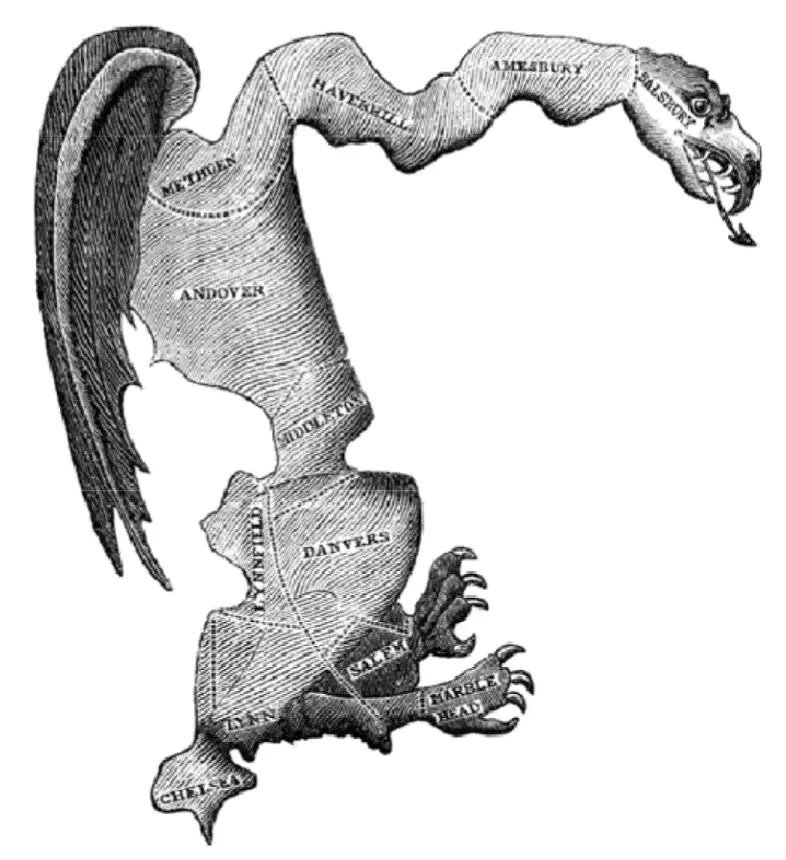
Choose the answer that best completes the sentence. This political cartoon from the past probably comments on problems caused by
congressional terms.
reapportionment.
off-year elections.
gerrymandering.
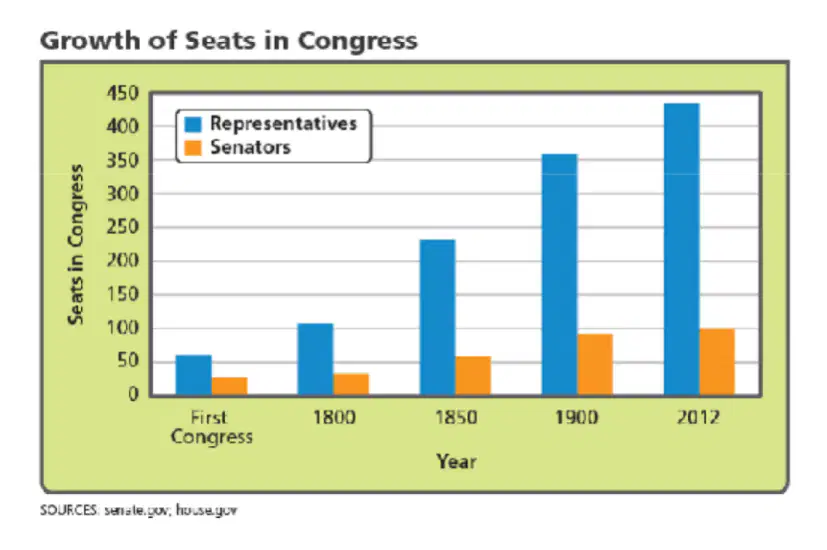
This graph compares the number of congressional members from the first Congress to 2012. Which statement is most likely supported by the graph?
The number of senators rose from 1900 to 2012 as several States were added to the Union.
The number of representatives rose from the First Congress to 1800 as a result of the passing of the Reapportionment Act.
The number of senators rose from 1850 to 1900 because of the number of immigrants who came to the United States.
The number of representatives rose from 1850 to 1900 as a result of the passage of the Seventeenth Amendment.
Read this quotation from President Wilson and then answer the question: “It is indispensable that besides the House of Representatives which runs on all fours with popular sentiment, we should have a body like the Senate which may refuse to run with it at all when it seems to be wrong—a body which has time and security enough to keep its head, if only now and then and but for a little while, till other people have had time to think."—Woodrow Wilson, Congressional Government. According to President Wilson, how should the Senate function?
The Senate should be more measured in its thinking than the House.
The Senate should be swayed by the immediate impact of current events.
The Senate should always stand in opposition to the concerns of House members.
The Senate should primarily work to address the short-term concerns of constituents.
How does the commerce power differ from the currency power?
The commerce power relates to trade, both interstate and international, while the currency power relates to creating laws about bankruptcy.
The commerce power relates to trade, both interstate and international, while the currency power relates to providing a stable monetary system.
The commerce power relates to the ability to borrow money against the credit of the United States, while the currency power relates to creating laws about bankruptcy.
The commerce power relates to the ability to borrow money against the credit of the United States, while the currency power relates to providing a stable monetary system.
Read this excerpt from the United States Constitution. “To declare War, grant Letters of Marque and Reprisal, and make Rules concerning Captures on Land and Water; To raise and support Armies, but no Appropriation of Money to that Use shall be for a longer Term than two Years;” —Article I, Section 8 This section of the Constitution relates to
the implied powers of the executive branch.
the expressed powers of the executive branch.
the implied powers of the legislative branch.
the expressed powers of the legislative branch.
Read this excerpt from the text about foreign policy in the United States. “The Constitution gives the President primary responsibility for the conduct of American foreign policy. As the Supreme Court put that point in a leading case, United States v. Curtiss-Wright Export Corp. in 1936, the Chief Executive is ‘the sole organ of the Federal Government in the field of international relations.’" The Constitution provides the President with this power because
the executive branch best understands how to handle foreign policy.
the fifty States are not sovereign and, therefore, have no standing in international law.
it is nearly impossible to gain consensus in Congress in matters related to foreign affairs.
senators and representatives are too focused on domestic issues to address international policy.
Read this excerpt from the text: “The Framers of the Constitution intended to create a new and stronger National Government. The ratification of their plan was opposed by many, and that opposition was not stilled by the adoption of the Constitution. Rather, the conflict between the Federalists and the Anti-Federalists continued into the early years of the Republic.” What was the ultimate resolution of this conflict in the McCulloch v. Maryland case?
The strict constructionists prevailed and the implied powers of the Federal Government were cemented and have grown ever since.
The strict constructionists prevailed and the implied powers of the Federal Government were curtailed and have lessened ever since.
The liberal constructionists prevailed and the implied powers of the Federal Government were cemented and have grown ever since.
The liberal constructionists prevailed and the implied powers of the Federal Government were curtailed and have lessened ever since.
What expressed power did the Supreme Court cite when it upheld the constitutionality of the Affordable Care Act?
Borrowing Power
Commerce Power
Currency Power
Tax Power
Read this excerpt from the text about the power of Congress to carry out investigations: “Both houses may choose to conduct investigations for any one or a number of reasons. Most often, those inquiries are held to (1) gather information necessary to the framing of legislation, (2) oversee the operations of various agencies in the executive branch, (3) focus public attention on some particular matter, (4) expose the questionable activities of some public official or private person or group, and/or (5) promote the particular interests of some members of Congress.” A recent investigation into the unfair process of reviewing tax exemptions within the IRS by groups called "Patriots" would fall under
the first reason.
the second reason.
the third reason.
the fourth reason.
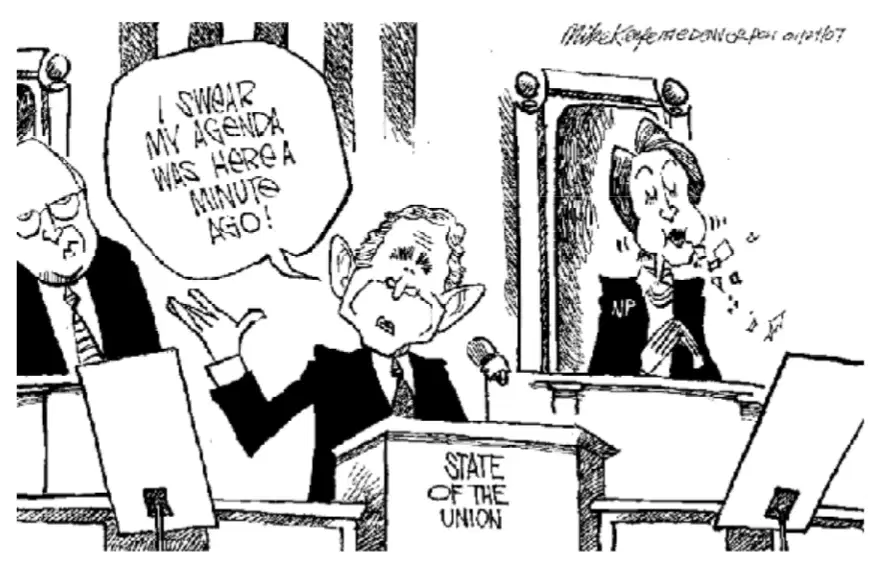
This political cartoon shows President George Bush about to give a State of the Union address as Speaker of House Nancy Pelosi sits behind him. What is the cartoon’s main message?
Congress must follow the agenda the President outlines in the State of the Union.
Presidents often struggle to deliver an articulate message at the State of the Union.
The State of the Union requires Presidents to speak in broad terms rather than in specifics.
Congress often tries to undermine the President’s message in a State of the Union address.
What is one way the Speaker of the House differs from the president of the Senate?
The Speaker of the House is not a member of his or her chamber, while the president of the Senate is a member of his or her chamber.
The Speaker of the House is the presiding officer of the upper chamber, while the president of the Senate is the presiding officer of the lower chamber.
The Speaker of the House is voted into the position by colleagues, while the Vice President of the United States serves as president of the Senate.
The Speaker of the House is typically from the minority party, while the president of the Senate is typically from the majority party.
Read this quotation from the United States Senate website. “The chair of each committee and a majority of its members represent the majority party. The chair primarily controls a committee’s business. Each party assigns its own members to committees, and each committee distributes its members among its subcommittees. The Senate places limits on the number and types of panels any one senator may serve on and chair.”—The United States Senate What would most likely happen in the wake of the Democrats taking over the Senate from the Republicans after an election?
The chairs would be replaced by Democratic senators while most of the committee members would remain Republican.
Both the chairs and most of the Democratic committee members would be replaced by Republicans.
Both the chairs and most of the Republican committee members would be replaced by Democrats.
The chairs would be replaced by Republican senators while most of the committee members would remain Democratic.
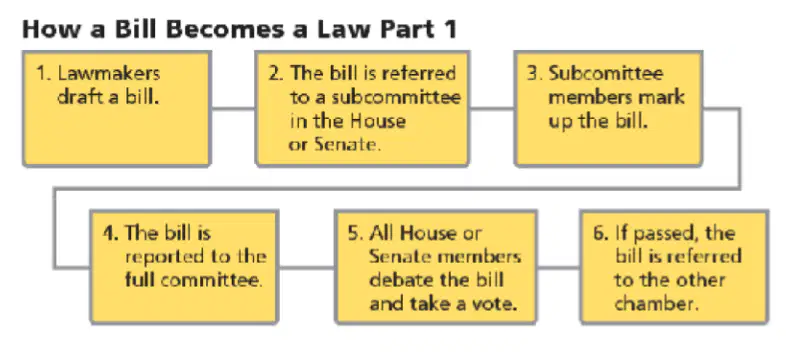
This diagram shows the first steps to a bill becoming a law.
The President decides whether or not to sign the bill.
The subcommittee in the other chamber now votes on the bill.
Members of both chambers take conference action on the bill.
The subcommittee in the other chamber now begins to process the bill.
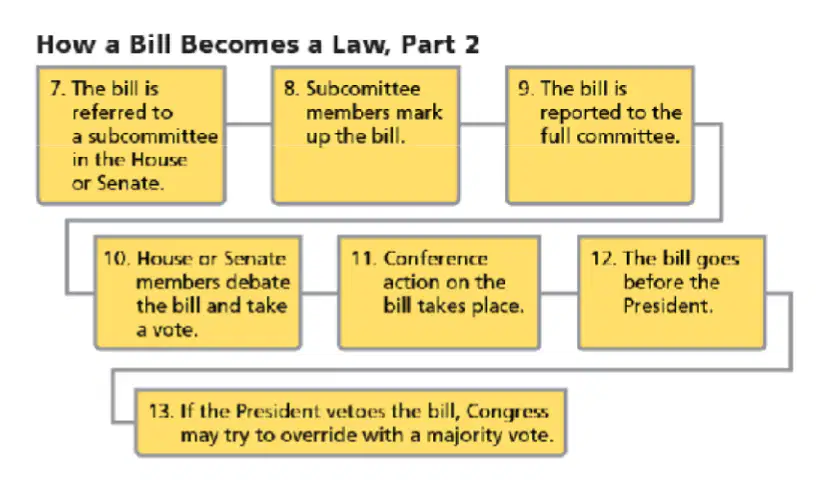
Why is step 11 an important part of the process?
It allows for settling any differences over the bill.
It helps Congress override a presidential objection to the bill.
It results in the bill being placed on one of the five calendars.
It leads to the first floor debate on the bill in either chamber.
Why does the House impose severe limits on floor debates?
It allows the Speaker to better control the contents of a bill.
Bills mainly are debated in subcommittees, not on the floor.
Most debates take place in the Senate rather than the House.
The House is so big that long debate is extremely time-consuming.
The President is the author of the nation’s public policies in his or her role of
commander in chief.
chief legislator.
chief of party.
chief citizen.
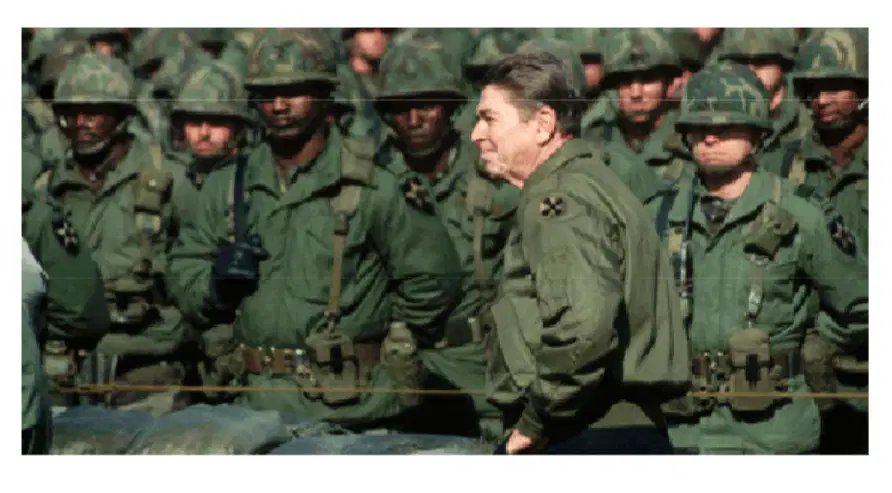
The photo shows President Ronald Reagan with some U.S. troops. Which presidential role does this photograph illustrate?
the President as commander in chief
the President as chief administrator
the President as chief economist
the President as chief of state
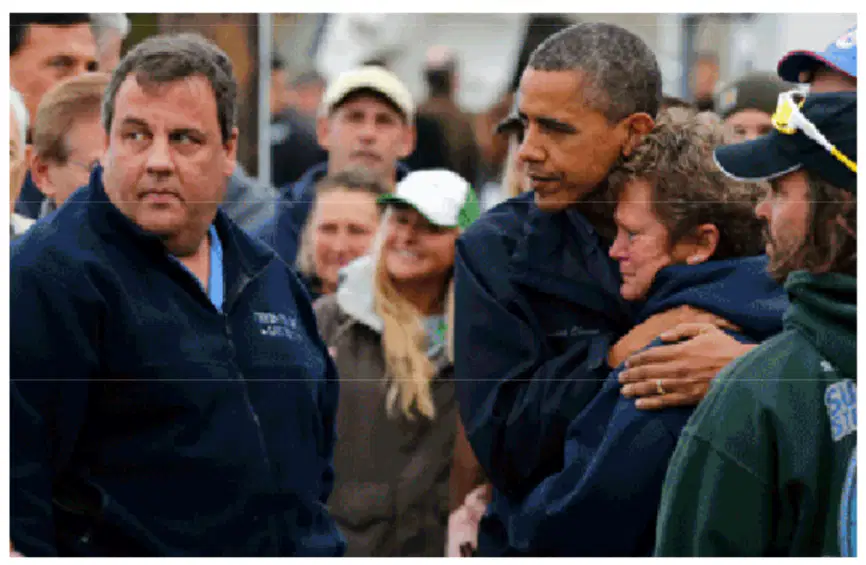
This photograph of President Obama and New Jersey governor Chris Christy was taken in the aftermath of Hurricane Sandy. Which presidential role does it illustrate?
the President as chief of party
the President as chief diplomat
the President as chief citizen
the President as chief administrator
Charles Dawes, Vice President under Calvin Coolidge, commented that he had little to do as Vice President but “look at newspapers every morning to see how the President's health is.” Based on this quotation, what was Dawes' point of view about the vice presidency?
The Vice President has little responsibility, except to be ready to assume the presidency.
The Vice President has responsibility for keeping up with current events.
The Vice President must be ready at all times to undertake any work assigned to him by the President.
The Vice President must stop any rumors in the press that the President is in ill health.
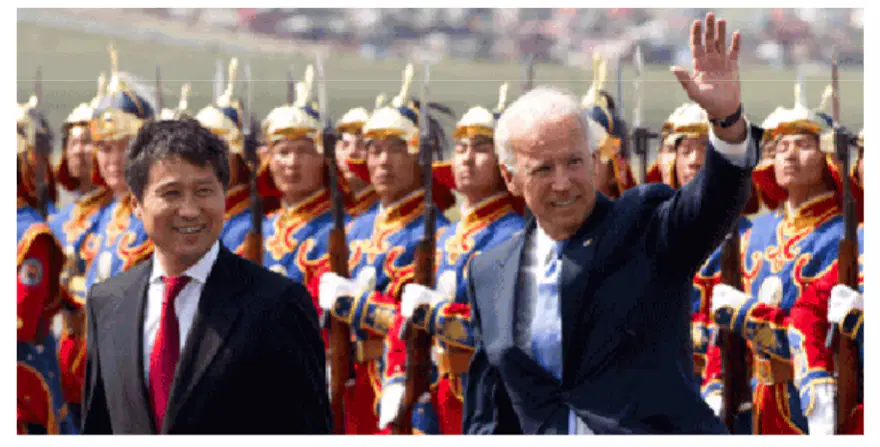
Which statement BEST expresses what the photograph of Vice President Joe Biden shows about the role of modern Vice Presidents?
Among the expanded responsibilities of the Vice President is the role of acting commander in chief.
The Vice President now plays a larger part in managing government spending.
The Vice President often has an important role in diplomacy with other nations.
The Vice President sometimes takes the place of the President as chief citizen.
Which of the following statements about the President's judicial powers is FALSE?
The President’s power of amnesty is a blanket pardon offered to a group of law violators.
A President's power to pardon is absolute except in the case of impeachment.
The President’s power of commutation can reduce a fine or the length of a sentence imposed by a court.
The President’s power of clemency may be used in cases involving both State and federal offenses.
If a President receives a bill that has some provisions he or she supports and some provisions he or she opposes, the President can
veto the provisions he or she opposes and sign the rest of the bill.
sign the bill and issue a signing statement addressing the parts of the bill he or she opposes.
veto parts of the bill and sign others, and provide reasons to Congress in writing.
issue a signing statement that orders Congress to rewrite the bill.
Read this excerpt from the text: “At times, a President has had to turn to roundabout methods in order to achieve his [treaty] goals. When a Senate minority defeated a treaty to annex Texas, President John Tyler was able to bring about annexation in 1845 by encouraging passage of a joint resolution—a move that required only a majority vote in each house. In 1898, President William McKinley used the same tactic to annex Hawaii." What does this excerpt illustrate about the process of approving treaties?
The treaty-making process must be followed exactly as described in the Constitution.
A treaty is not the only tool a President can use to make agreements with other countries.
The treaty-making process is usually controlled by a Senate minority.
A treaty can be approved by the House of Representatives instead of the Senate.
Read this excerpt from the text about the presidential power of recognition: “Recognition does not mean that one government approves the character or the conduct of another. The United States recognizes several governments about which it has serious misgivings. . . . The facts of life in world politics make relations with these governments necessary.” Which of the following is an example of a nation whose government the United States recognizes, but about which our nation has serious misgivings?
Iran
France
Mexico
Ireland
When Theodore Roosevelt sent the Great White Fleet around the world, he was acting in his role of
commander in chief.
chief diplomat.
chief legislator.
chief administrator.
Read this excerpt from the text: “Congress has not declared war since World War II. On eight occasions since then, however, it has enacted joint resolutions to authorize the President to meet certain international crises with military force.” Which is the STRONGEST conclusion that can be drawn based on this statement?
Congress and the President are often in conflict about when to declare war.
Congress and the President do everything they can to avoiding using military force.
The Constitution is flexible enough to allow Congress and the President to meet crises in a number of ways.
The Constitution has many checks and balances for how the government deals with foreign policy.
Read this passage from the War Powers Resolution of 1973: “(c) The constitutional powers of the President as Commander-in-Chief to introduce United States Armed Forces into hostilities, or into situations where imminent involvement in hostilities is clearly indicated by the circumstances, are exercised only pursuant to (1) a declaration of war, (2) specific statutory authorization, or (3) a national emergency created by attack upon the United States, its territories or possessions, or its armed forces.” What is the intent of this section of the document?
to expand Congress' power to authorize the President to commit the U.S. to military action
to give Congress the authorization to commit the U.S. to military action
to expand the power of the United States Armed Forces to initiate military activity on their own
to limit the President’s power to commit the U.S. to military action without meeting certain conditions

