
 Worksheets
Review GRAMMAR for SAS
Total questions: 20
Worksheet time: 10mins
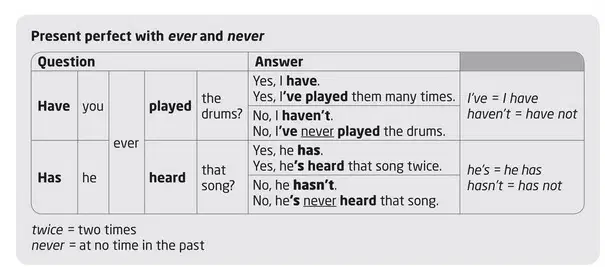
Which of the following sentences uses the present perfect tense to express an action that has never happened in the past?
I have never played the drums.
He has played the drums many times.
Have you ever heard that song?
I have heard that song twice.
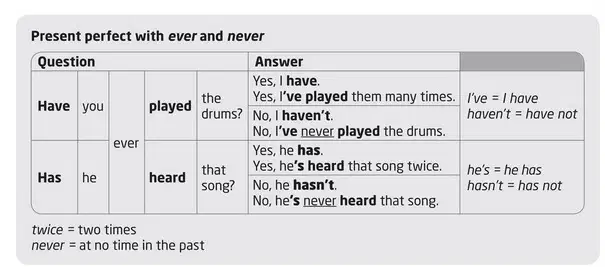
What is the difference between using "ever" and "never" in present perfect questions?
"Ever" is used to ask about past experiences, while "never" is used to express future intentions.
"Ever" is used to express positive past experiences, while "never" is used to express negative past experiences.
"Ever" is used to ask about general past experiences, while "never" is used to emphasize a lack of experience.
"Ever" is used to ask about specific past experiences, while "never" is used to deny specific past experiences.
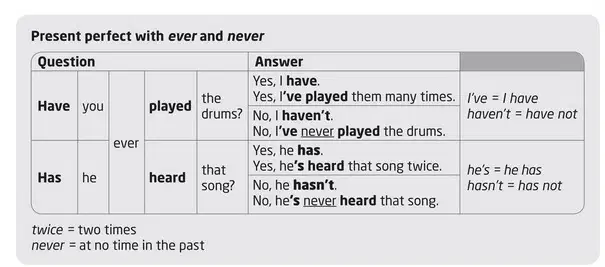
Which of the following sentences uses the present perfect tense to express an action that has happened more than once in the past?
I have never played the drums.
He has heard that song twice.
Have you ever played the drums?
I have not heard that song.
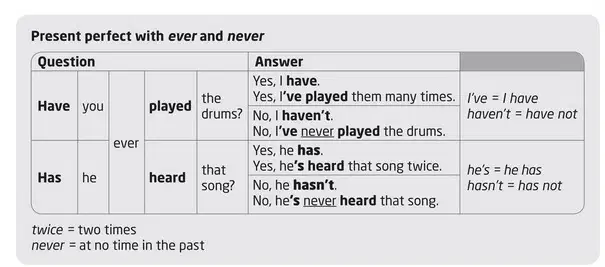
How does the present perfect tense differ from the simple past tense when talking about past experiences?
The present perfect tense focuses on the completion of an action in the past, while the simple past tense emphasizes the duration of the action.
The present perfect tense focuses on the result or consequence of a past action, while the simple past tense emphasizes the specific time when the action occurred.
The present perfect tense is used to talk about past experiences that are still relevant to the present, while the simple past tense is used to talk about past experiences that are completely finished.
The present perfect tense is used to talk about past experiences that are habitual, while the simple past tense is used to talk about past experiences that are specific.

Which of the following sentences uses the present perfect tense to express a general experience in the past?
I have played the drums many times.
He has never heard that song.
Have you ever played the drums?
I have heard that song twice.
Which of the following sentences uses a comparative adverb to show that one person does something to a greater degree than another?
She sleeps as long as I do.
He practices more often than I do.
She plays well as I do.
He sings beautifully as I do.
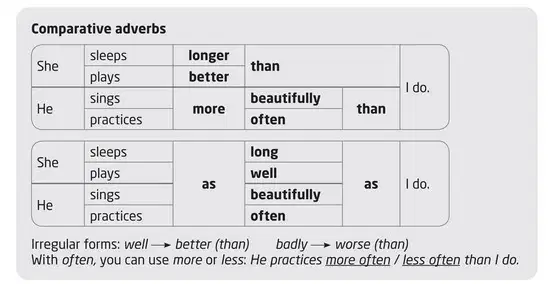
What is the difference between using "more" and "-er" to form comparative adverbs?
"More" is used for one-syllable adverbs, while "-er" is used for two-syllable adverbs.
"More" is used for adverbs that end in "-ly," while "-er" is used for adverbs that do not end in "-ly."
"More" is used for adverbs that compare two things, while "-er" is used for adverbs that compare three or more things.
"More" is used for adverbs that compare quantities, while "-er" is used for adverbs that compare qualities.
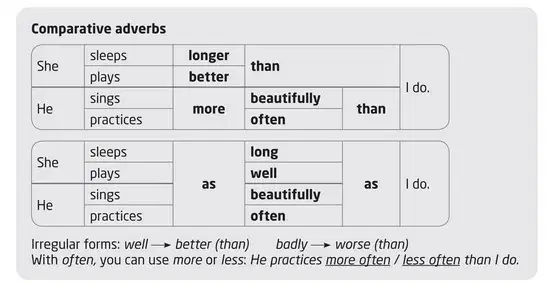
Which of the following sentences uses a comparative adverb to show that two people do something to the same degree?
She sleeps longer than I do.
He practices more often than I do.
She plays as well as I do.
He sings more beautifully than I do.
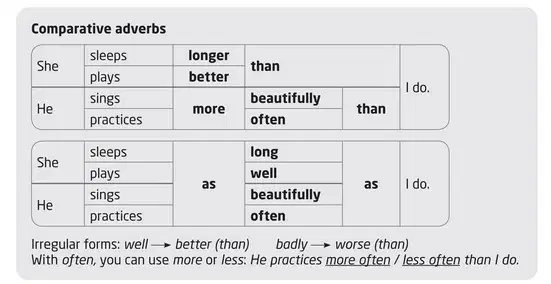
How do irregular comparative adverbs differ from regular comparative adverbs?
Irregular comparative adverbs do not follow the same pattern as regular comparative adverbs.
Irregular comparative adverbs are used to compare more than two things, while regular comparative adverbs are used to compare only two things.
Irregular comparative adverbs are used to compare quantities, while regular comparative adverbs are used to compare qualities.
Irregular comparative adverbs are used to compare abstract concepts, while regular comparative adverbs are used to compare concrete things.
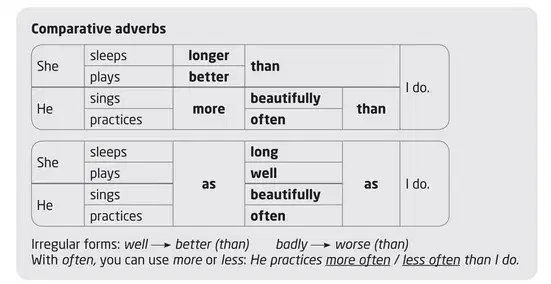
Which of the following sentences uses a comparative adverb incorrectly?
She sleeps more longer than I do.
He practices more often than I do.
She plays as well as I do.
He sings more beautifully than I do.

Which of the following sentences uses "may" correctly to express possibility in the present or future?
There may be life in our solar system outside Earth.
We may received messages from extraterrestrials in the future.
They may have gone to the park yesterday.
I may go to the store tomorrow.
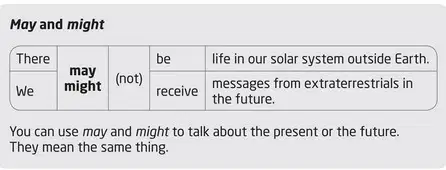
What is the difference between using "may" and "might" to express possibility?
"May" is used for certain possibilities, while "might" is used for uncertain possibilities.
"May" is used for past possibilities, while "might" is used for present or future possibilities.
"May" is used for formal situations, while "might" is used for informal situations.
There is no significant difference in meaning between "may" and "might" in this context.
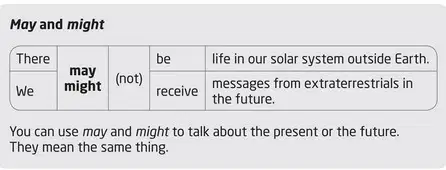
Which of the following sentences uses "might" correctly to express a less certain possibility?
We might receive messages from extraterrestrials in the future.
They might have gone to the park yesterday.
I might go to the store tomorrow.
There might be life in our solar system outside Earth.
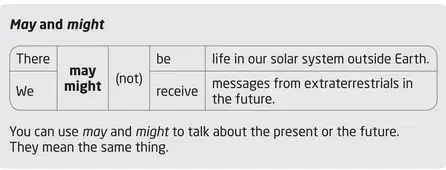
How can the use of "may" and "might" affect the tone or style of a sentence?
"May" suggests a more formal tone, while "might" suggests a more informal tone.
"May" suggests a higher degree of certainty, while "might" suggests a lower degree of certainty.
"May" is used for positive possibilities, while "might" is used for negative possibilities.
There is no significant difference in tone or style between "may" and "might" in this context.
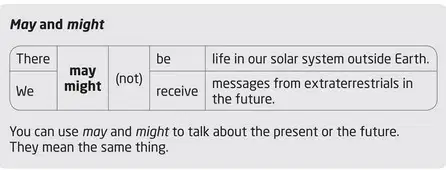
Which of the following sentences is grammatically incorrect?
There may be life in our solar system outside Earth.
We might not receive messages from extraterrestrials in the future.
They might have went to the park yesterday.
I might go to the store tomorrow.
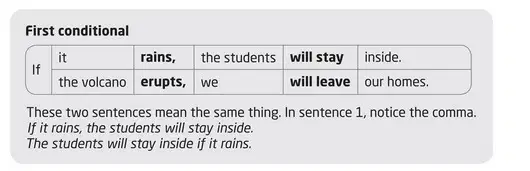
Which of the following sentences is an example of the First Conditional?
If I win the lottery, I will buy a car.
I would have gone to the party if I had known about it.
If you are tired, you should go to bed.
I wish I could fly like a bird.
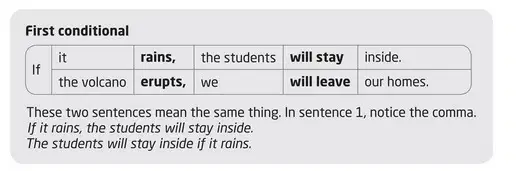
What is the purpose of the comma in the sentence "If it rains, the students will stay inside"?
To separate two independent clauses.
To introduce a dependent clause.
To emphasize the importance of the "if" clause.
To create a pause for dramatic effect.
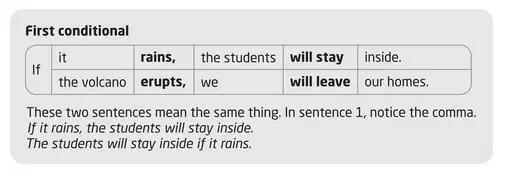
How does the First Conditional differ from the Second Conditional?
The First Conditional is used for real and possible situations in the present or future, while the Second Conditional is used for imaginary or unlikely situations.
The First Conditional uses the present simple tense in the "if" clause, while the Second Conditional uses the past simple tense.
The First Conditional uses "will" in the main clause, while the Second Conditional uses "would."
All of the above.
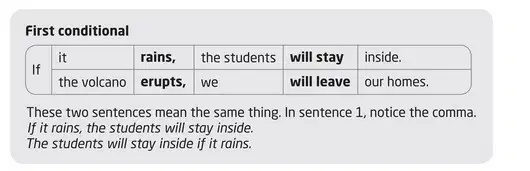
Which of the following sentences is grammatically incorrect?
If I will study hard, I will pass the exam.
If it rains tomorrow, we will stay indoors.
If you had studied harder, you would have passed the exam.
I would travel the world if I had enough money.
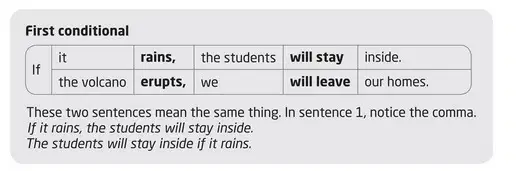
How can the order of the clauses in a First Conditional sentence affect the meaning or emphasis?
Placing the "if" clause first emphasizes the condition, while placing the main clause first emphasizes the result.
The order of the clauses does not affect the meaning or emphasis.
Placing the "if" clause first is always more formal than placing the main clause first.
Placing the main clause first is always more formal than placing the "if" clause first.

