
 Worksheets
Astronomy Unit 5: Intro to the Solar System
Total questions: 15
Worksheet time: 20mins

Which planet is a terrestrial planet?
Venus
Neptune
Uranus
Jupiter

The Asteroids, which are large objects in space, are primarily made of ___________.
ice and dust
rock
small ice crystals
gaseous materials
Label the four Jovian planets, also known as gas giants or ice giants.
According to scientists, the solar system formed from
colliding planetesimals.
rotating stars.
colliding nebulae.
a rotating disk of dust and gases.
These planets are made of heavier elements or metals
Terrestrial
Jovian
These planets are referred to as the "inner" planets
Terrestrial
Jovian
Select TWO ways that scientists can estimate the age of celestial objects:
The color of the surface
counting craters
Radiometric dating
spectroscopy
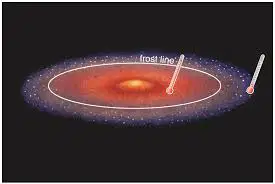
This image shows a frost line in a protoplanetary disk.
If a planet forms inside of the frost line, what will it be composed of?
icy gasses
rocks and metals
strawberries and cream
equal parts rocks, metals, and gasses

Commonly called "shooting stars" astronomers call small grains of dust that hit the Earth's atmosphere __.
unicorns
comets
asteroids
meteors
To be considered a planet, a celestial body must follow the following constraints. (Choose 3)
orbit the Sun
made of rock and metals
spherical in shape
cleared its path of debris
bigger than a moon
Put the planets in the correct order. (Imagine the Sun is on the left)
Mercury
Venus
Earth
Mars
Jupiter
These celestial objects are mostly made of ice and frozen gases, and have very elliptical orbits of the sun.
asteroids
meteors
comets
moons

