
 Worksheets
Exploring Glaciers and Their Features
Total questions: 21
Worksheet time: 11mins
What is the process by which a glacier freezes into, picks up, and then pulls away rocks from the ground as it moves?
Glacial accumulation
Glacial plucking
Glacial deposition
Glacial abrasion
Which type of glacial landform is a deep bowl-shaped depression found at the head of a glacier?
Kettle
Cirque
Drumlin
Arete
What is the name of a sharp ridge formed between two glacial valleys or cirques?
horn
kettle
arete
glacial moraine
What kind of valley is created by a glacier, characterised by steep sides and a flat bottom?
C-shaped valley
Flat-bottomed valley
U-shaped valley
V-shaped valley
What is the name for huge rocks or boulders that have been transported and deposited by a glacier far from their place of origin?
Glacial erratics
Moraines
Drift rocks
Glacial deposits
Which Italian glacier was located in the Apennines and was the southernmost glacier in Europe (but has now almost completely melted)?
Mont Blanc Glacier
Mer de Glace
Calderone Glacier
Aletsch Glacier
What is the process called when a glacier scrapes against the bedrock, cutting away rock and sediment and dragging it along?
Glacial deposition
Glacial erosion
Glacial polishing
Glacial abrasion
What is the name for a series of small, round, bowl-shaped lakes found in a glacial valley, at the centre of cirques, where glaciers start, often connected by streams?
Lakes
Reservoirs
Ponds
Tarns
What are the large mounds of debris, usually in ridge shapes, deposited at the end of a glacier called?
Kettles
Drumlins
Erratics
Moraines
What type of landform is created when a glacier carves through a river valley, widening it into a curved shape?
V-shaped valley
Plateau
Canyon
U-shaped valley
What is the term for the melting of glaciers due to rising temperatures?
Glacial melt
Ice cap expansion
Thermal contraction
Glacial freeze
What is the name of huge ice mass formed from compacted snow that flows slowly downwards over land due to gravity?
iceberg
snowfield
frozen lake
glacier
What are the two main types of glaciers?
Continental glaciers and alpine glaciers
Permafrost and sea ice
Ice sheets and snowfields
Glacial lakes and icebergs
What is the term for the area where a glacier begins to form?
valley formation area
glacial retreat zone
zone of accumulation
zone of ablation
What is the name of the process by which glaciers can create new landforms?
Glacial sculpting
Sediment deposition
Erosion by wind
Glacial melting
What is the term for the area at the lower end of a glacier where melting occurs?
Zone of accumulation
Zone of ablation
Glacial retreat zone
Glacial front
What is the name of the phenomenon where a glacier moves down a slope due to gravity?
Glacial retreat
Glacial positioning
Glacial freeze
Glacial flow
What type of glacier is typically found in mountainous regions and flows down valleys?
Ice cap
Alpine glacier
Ice sheet
Continental glacier

What was different about our planet from around 11,700 years ago to 120,000 years ago?
Dinosaurs were still around, and humans lived side by side with giant sauropods who helped ancient humans to build giant complex structures such as the pyramids at Giza.
Planet Earth was in the midst of the last ice age. Global ice covered 25% of all land (compared to 11% today) and sea levels were approximately 125 meters lower.
The human population was tiny and isolated within Africa because early humans could not survive the dangerous sea crossings required to reach other continents like Australia or the Americas.
The mega-tsunamis and rapid coastal flooding caused by melting glaciers were the main reasons why massive animals like woolly mammoths went extinct right at the 11,700-year mark.

Why is the last ice age, (which officially ended around 11,700 years ago,) important for understanding how glaciers have shaped our current landscapes?
It marks the transition to the Holocene, where retreating glaciers carved iconic U-shaped valleys in the Alps, created the massive Italian lakes like Garda and Como, and flooded land bridges to form the modern Mediterranean coastline.
It represents the only time in Earth’s history when atmospheric CO2 levels remained perfectly stable, allowing for the formation of the first permanent mountain glaciers in Italy.
It was the moment when the Alps and Apennines first rose from the sea, as the weight of the melting ice caused the European continent to pop upward like a cork.
It triggered a 5,000-year "super-monsoon" that provided the high-pressure water flow necessary to erode the Grand Canyon and the Verdon Gorge in France into their current depths.
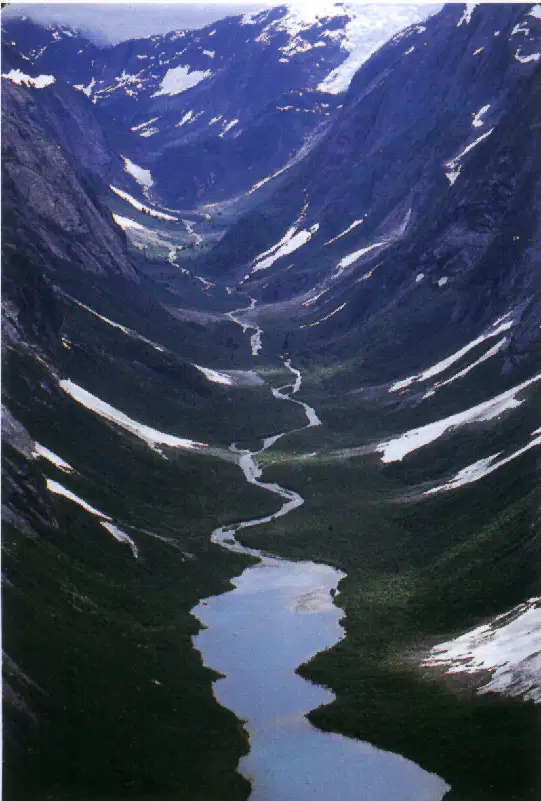
Why do glaciers create huge, wide, u-shaped valleys, while rivers (especially in their upper, early stages in mountainous areas) create narrower v-shaped valleys?
The weight of a glacier is so immense that it pushes the valley floor downward into the Earth’s mantle, while rivers are too light to affect the crust and must stay on the surface. In addition, Ireland's landscape was heavily shaped by glaciers during the last ice age, which is part of the reason why Ireland has such a great rugby team.
Glaciers are chemically acidic due to trapped ancient gases, allowing them to dissolve the valley walls of the Dolomites horizontally, while river water is pH-neutral and can only erode downward.
While a river only vertically erodes the tiny point where water touches the ground, a glacier is a massive "wall of ice" that fills the entire valley, using trapped rocks to grind away both the floor and the high side-walls simultaneously—a process that carved the deep, wide valleys seen today in the Italian Alps, through a combination of both vertical and lateral erosion.
Rivers are faster and generate higher friction, which creates heat that "melts" a narrow path into the rock, whereas glaciers move so slowly that the rock has time to expand and widen out into a U-shape.

