
Font size
 Worksheets
Year 7A and 7B Quiz Challenge
Total questions: 256
Worksheet time: 2hrs 26mins

Which of the following is NOT an advantage of Rome's location on the Tiber River?
Access to fresh water supply
Easy transport of goods to the sea
Carries away human waste from the city
River provides energy to drive watermills

The name of the river that Rome is located on is
The Rhine
The Tiber
The Po
The Danube

The Tiber links the city of Rome to...
The port of Ostia
The port of Pompeii
The port of Subura
The port of Naples

Where does the river that runs through Rome originate? (the source of the river)
The Appennine Mountains
The Alps
The Atlas Mountains
The Po Valley

Ostia was a town located...
On the coast, many day's journey from Rome
Inland, deep in the Appennine Mountain range
On the coast, a short journey from Rome
On the other side of the Appenine Mountains, many months journey from Rome
These three features were the main Southern boundaries of Rome's Empire (in Africa).
Danube, Nile & Syrian Desert
Atlas Mountains, Sahara Desert, Libyan Desert
Rhine, Danube, Alps
Syrian Desert, Nile, Atlas Mountains
This natural feature gave Rome access to food & trade.
The Alps
The Apennines
The Mediterranean
The Po Valley

The Romans called the Mediterranean Sea...
Oceanus Mediterraneos
The Aegean
Mare Nostrum
Aqua Vita

Which of these is NOT a mountain range?
Danube
Alps
Appennines
Atlas

The Syrian Desert is located in
Europe
Africa
Asia
Italy
Which of these is NOT an advantage Rome had related to its location in the middle of the Mediterranean Sea?
Access to food sources
Access to trade
A mild climate
Access to oil

The city of Rome is built on _____ hills.
2
3
5
7
'Via' was the Roman (Latin) word for
Bridge
Field
Road
Square
A 'basilica' was a Roman
Bathhouse
Temple
Theatre
Marketplace
An 'aqueduct' is used to transport...
Water
Grain
People
Electricity

The Tarpeian Rock was used by Romans ...
To sunbathe
To execute traitors
As a final defensive refuge
For military practice

Which of the following is an open area in the middle of Rome where government and business was done?
Circus Maximus
Collosseum
Forum
Basilica

The Colosseum (pictured) was used to:
Race Chariots
Hold Elections
Stage Gladiator Fights
Store Water
The main mountain range that runs down the middle of the Italian peninsula is
The Atlas Mountains
The Alps
The Apennines
The Pyrenees
The city of Rome was located in the region of ______________, which is now found in modern ___________________
Latium, Italy
Etruria, Italy
Cappodocia, Turkey
Attica, Greece

What continent is 8?
North America
Africa
Europe
Australia

What sea is #1?
Mediterranean Sea
Adriatic Sea
Gulf of Mexico
Red Sea

What River is number 5?
Tigris
Tiber
Nile
Adriatic

What city is number 3?
Carthage
Rome
Venice
Athens

What mountains make up #7?
Olympic
Alps
Mt. Hood
Mt. Everest

What is #4?
Rome
Persia
Greece
Macedonia

What is the continent labeled 11?
Europe
Australia
Africa
South America
What are the three phases/governments of Ancient Rome?
Monarchy, Republic (Democracy), Emperor
Democracy, Oligarchy, Monarchy
Monarchy, Dictatorship, Democracy
Democracy, Republic, Democracy
Which Ancient Roman Period is known for its democratic government, its expansion due to beating Carthage, and wealth?
Monarchy
Dictatorship
Republic
Empire
Which government is the first period of Roman history. This period is when Rome was still a city and ruled by kings. During this period Rome borrowed its culture from Ancient Greece.
Monarchy
Republic
Empire
Democracy
Which government/period saw Rome's most wealth and at its largest empire. During this period one leader ruled over the people. During this period Christianity spread throughout Europe, Asia, and Africa.
Empire
Monarchy
Democracy
Republic
What is direct democracy?
When 1 person rules.
When every citizen votes and has power to make government decisions.
When citizens vote for representatives to represent them and make their decisions for them.
When a King or Queen rules
What is representative democracy?
When one person makes all of the government's decisions.
When people vote for representatives to represent them. The people give their power to the people they elect to make decisions for them.
When a group of people have all the power to make decisions for the people living under the government.
When a king or queen rules.
What type of democracy did Athens have?
representative democracy because citizens all lived in the same city
direct democracy because the citizens all lived in the same city
Rome had a representative democracy because its citizens were spread out across the empire. It would have been impossible to get every citizen to vote because they were all over Europe, Italy, North Africa, and Asia.
True
False
After Rome fell it would take more than 1,300 years for another democratic government to be created.
True
False
The first democratic government to be created after the fall of Rome was the United States almost 1,300 years after the Roman empire fell.
True
False
What type of government does the United States have?
A republic (representative democracy)-people vote for representatives to make their decisions for them.
A direct democracy-every citizen votes on governmental decisions.
What are 4 things the Ancient Roman left for Western Civilization?
Direct democracy, English/Spanish, art, Christianity
Food supply, oligarchy, Hellenism, architecture
Representative democracy, English/Spanish, architecture(buildings and creation of cement), Christianity
English/Spanish, Christianity, Direct Democracy, architecture
What helped Ancient Rome become an empire?
Its victory of Carthage in the Punic Wars. After the Punic Wars Rome was able to control the surrounding rim of the Mediterranean Sea.
When Romulus killed Remus and built his new city in Rome, 15 miles inland on the Tiber River.
It had a representative democracy.
It had a direct democracy.
Where was ancient Rome initially located?
Modern Italy in Southern Europe
Northern Africa
Central America
Eastern Asia
What mountain range edged the northernmost part of Italy?
The Alps
The Rockies
The Himalayas
The Andes
Which river provided the largest freshwater source for the people of ancient Rome?
The Tiber River
The Mississippi River
The Amazon River
The Nile River
What was the second largest city-state of ancient Rome?
Florence
Milan
Venice
Naples
Which sea were the islands of Corsica and Sardinia located in?
The Red Sea
The Baltic Sea
The Tyrrhenian Sea
The Black Sea
What type of meat was often prepared in small cuts or sausages due to its expense?
Fish
Poultry and pork
Beef
Lamb
What did wealthy Romans eat to show off their riches?
Grains and vegetables
A variety of birds
Only fish
Strictly vegetarian meals
What crops could survive the hot climate of ancient Rome?
Grapes, olives, barley, and wheat
Cucumbers, tomatoes, peppers, and zucchini
Corn, rice, soybeans, and oats
Potatoes, carrots, onions, and lettuce
What was the primary reason for the isolation of settlements between mountains in ancient Rome?
Lack of transportation
Trade restrictions
Difficult travel and communication
Frequent wars
What form of government did Rome adopt after overthrowing the last Roman King?
Oligarchy
Dictatorship
Monarchy
Democratic government
Who was the goddess of corn and agriculture?
Zeus
Hera
Demeter
Hades
Who was the goddess of love and beauty?
Aphrodite
Apollo
Athena
Artemis
Who was the goddess of home--thought to be the kindest?
Hades
Poseidon
Hestia
Apollo
Was was the god of war?
Athena
Persephone
Ares
Hermes
Who was "the battle maiden" and the goddess of wisdom?
Hera
Athena
Persephone
Hephaestus
Who is the god of fire and the forge?
Hades
Zeus
Demeter
Hephaestus
Who is the god of music, poetry, light, and truth? Hint: He never told a lie.
Apollo
Hermes
Hestia
Aphrodite
Was the goddess of spring and Queen of the Underworld?
Artemis
Hestia
Hera
Persephone
What is a traditional story about gods and heroes that explains practices or beliefs of people?
Poem
Myth
Epic
Haiku
Where was the Home of the Gods?
Rome
Mount Everest
Mount Olympus
Minoa
Who is the God of the sky, lightning, and thunder--carrying a thunderbolt as his symbol?
Zeus
Hades
Posideon
Demeter
Who is the lord of the underworld and ruler of the dead?
Hestia
Apollo
Artemis
Hades
Who is the ruler of the seas and the oceans?
Poseidon
Aphrodite
Zeus
Hermes
Who is Zeus' wife and protector of marriage and married women?
Demeter
Hera
Persephone
Artemis
What played an important role in the daily life of the ancient Greeks?
Government
Work
Religion
Love
Who was the father of Romulus and Remus?
Mars
Numitor
Amulius
Zeus
King Amulius stole the throne from his ___.
brothers, Romulus and Remus.
father, Numitor.
brother, Numitor.
cousin, Mars.
Why did King Amulius have Romulus and Remus thrown into a river?
He was fearful they would seek revenge.
He was afraid they would try to take the throne from him.
An oracle told him to do it.
He was following orders from the previous king, Numitor.
Romulus and Remus were saved by ___ and later a ____ raised them as his own.
a lioness; farmer
a servant girl; blacksmith
a mother wolf; shepherd
Mars; potter
What event led Remus to be captured by Numitor?
A fight over the location of the city walls
An unfair trade deal between two citizens
A dispute among the shepherds
A war between the cities
After Numitor, Romulus and Remus all figure out they are family, what do they set out to do?
Remove the false king, Amulius, from the throne!
Join with the rest of the family for a reunion
Build a new city for themselves
Call upon the gods to curse King Amulius
Now that Numitor is King again, he wants to reward his grandsons with ___ since they helped him get his throne back.
Gold
Two ships
Seats on his council
Land
What problem did Romulus and Remus encounter when they set out to build their city?
They couldn't agree on a location
There were tribes already living there
The many hills would make it hard to farm
There wasn't a fresh water source nearby
A fight soon breaks out, and Romulus wins. What happens after he begins building his city walls?
Remus and his supports tear them down.
Remus makes fun of the city walls.
Remus calls upon the gods to curse Romulus.
Remus seeks advice from his grandfather, the King.
How does Romulus respond to Remus' mocking of his city walls?
He challenges him to a duel.
He looks for another omen.
He kills him in a fit of rage.
He asks for Remus' advice about what he should do differently.
Romulus was very sorry he killed his brother. He wasn't able eat or sleep until after...
He had a ceremony for Remus' spirit.
He sought forgiveness from the gods.
He made many offerings to the gods.
He meditated and fasted for 7 weeks.
Remus' supporters joined Romulus and together they named the city ___.
Remus
Roma
Romulus
Aventine
T/F: Ancient Rome had a more developed social hierarchy than those civilizations we studied earlier in history like the four River Valley civilizations.
True
False
Who was at the top of the social hierarchy in Ancient Rome?
Patricians
King & Royal Family
Plebeians
Emperor
What was the emperor's role in Ancient Rome? Check ALL that apply.
Absolute Ruler of Roman Empire
Chosen based on their abilities to be an emperor
Chosen based on being born into the right family
Lived in the best villas, ate the best food, and worse the best clothes
Wanted to get rid of slavery
Which group of people were directly under the emperor on the Ancient Roman social pyramid?
Plebeians
Patricians
Equestrians
Freedmen
Explain the role of the patricians in the Roman Empire. Check all that apply.
These families provided the empire’s political, religious, and military leadership.
Young men were educated
They COULD NOT be a Senator
They HAD to serve in the military
Only patricians could become emperor
What group of people were directly under the patricians/members of Senate on the social pyramid in Ancient Rome?
Plebeians
Freedmen
Equestrians
Slaves
What is the role of the equestrians in the Ancient Roman Empire? Check ALL that apply.
They could move up to the patrician class if they became wealthy enough.
Their work revolved around the business roles within the empire.
They had jobs like tax collectors, bankers, miners, exporters, and managing road building/construction projects.
The could not move up to the patrician class, regardless of how much wealth they had.
What group of people were directly under the equestrians in the social pyramid in the Roman Empire?
Gladiators
Freedmen
Women
Plebeians
What is the role of the plebeians in the Ancient Roman Empire? Check ALL that apply.
They did not have to pay taxes.
They had to pay taxes.
They were the smallest group of people in the Ancient Roman Empire.
Plebeians were average working citizens of Rome – farmers, bakers, builders or craftsmen.
A few plebeians did manage to have slaves.
What group of people were directly underneath the plebeians in the Ancient Roman social hierarchy?
Slaves
Freedmen
Women
Gladiators
What is the role of the freedmen in Ancient Rome? Check ALL that apply.
They were a slave that was freed from the bonds of slavery.
They worked the same jobs as plebeians.
They could not become wealthy.
Many people in the Roman Empire thought of them in a positive way because they worked so hard.
Explain the role the soldiers played in the Ancient Roman Empire. Check ALL that apply.
Soldiers were feared for their training, stamina, and discipline.
The Roman Army wasn't very strong and lost many battles
The Roman Army was important in politics and the emperor made decisions that would benefit the army.
The minimum term of service for a soldier was 25 years.
The minimum term of service for a soldier was 20 years.
What group of people were at the bottom of the Ancient Roman Empire?
(a)
Explain the role the slaves played in the Ancient Roman Empire. Check all that apply.
Many slaves came from the Roman army after fighting in the war.
35% of the population in Ancient Rome were slaves
Some slaves were treated fairly BUT most lived hard lives.
Some slaves did jobs for profit where others did not and were used for show.
Some slaves could and would be freed.
What were the gladiators in Ancient Rome?
They were a division in the Roman Army.
They were part of the slaving class that were forced to fight to the death for the enjoyment of others.
They worked directly for the emperor and the royal family.
They staged rebellions against the emperor and fought to bring down the Roman Empire.
What mountain range forms the "backbone" of Italy?
Alps
Apennine Mountains
Rocky Mountains
Andes
Which river cuts through central Italy?
Nile River
Amazon River
Tiber River
Mississippi River
Which sea is located to the east of Italy?
Adriatic Sea
Black Sea
Red Sea
Baltic Sea
Where did the early ancestors of the Romans first settle?
Campanian Plains
Latium Plains
Tuscan Plains
Sahara Desert
What was the most important city founded by the early Romans?
Naples
Carthage
Rome
Athens
What was one of the essential criteria for choosing the site of Rome?
High mountains
Fresh water
Desert land
Dense forests
Why was sea access important for the site of Rome?
For fishing
For safe harbor and trade
For swimming
For building bridges
What type of land was necessary for a city to flourish according to the text?
Flood-prone land
Desert land
Good land for farming
Rocky land
What natural feature provided additional protection for Rome?
Large forests
Steep banks
High mountains
Deep lakes
What was the climate like near the Mediterranean Sea according to the text?
Cold and dry
Hot and dry summers, wet and mild winters
Hot and humid
Cold and snowy
What were the most prized crops in Ancient Rome?
Wheat and barley
Grapes and olives
Corn and rice
Apples and oranges
What was olive oil used for in Ancient Rome?
Building materials
Currency
Fuel in lamps and cleaning the body
Jewelry making
What products did goats and sheep provide in Ancient Rome?
Silk and spices
Milk, cheese, meat, and wool
Gold and silver
Fruits and vegetables
What was a favorite sport for many Romans?
Soccer
Hunting wild animals like boar and deer
Swimming
Running
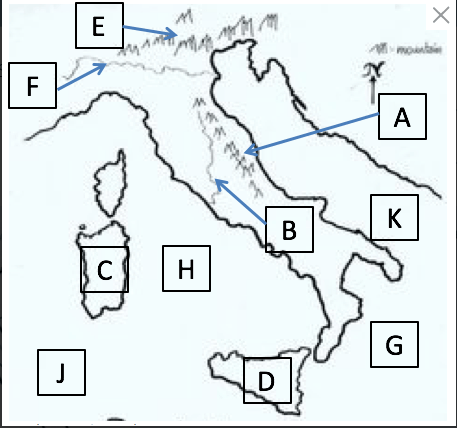
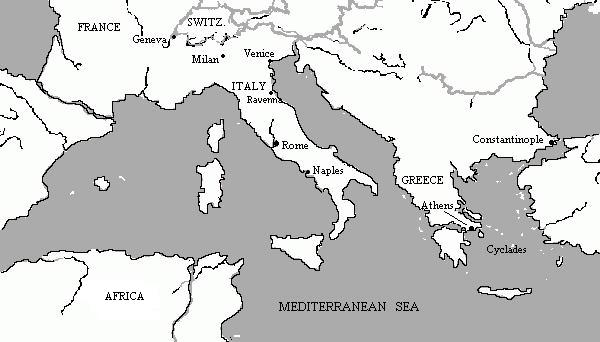
What geographical term best describes Italy?
subcontinent
island
peninsula
mountain range
Which body of water was surrounded by the Roman Empire?
Pacific Ocean
Atlantic Ocean
Red Sea
Mediterranean Sea

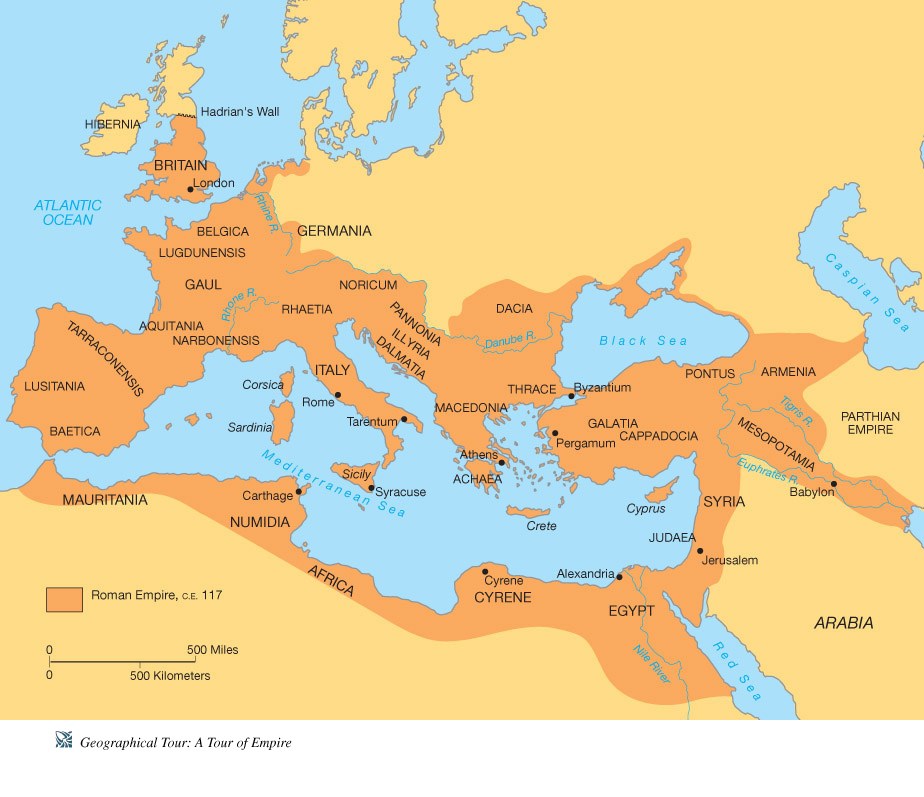
Which letter indicates the location of Gaul (modern day France)?
A
E
G
D
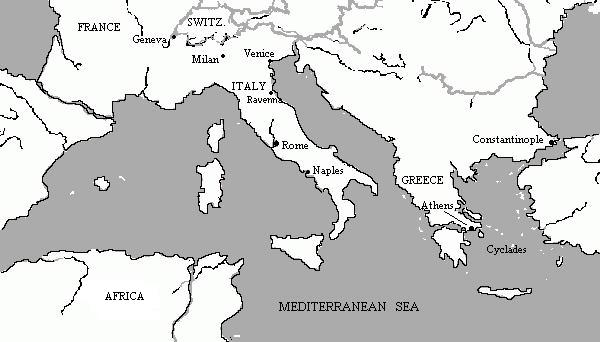

Which letter indicates the location of Spain?
G
H
B
F
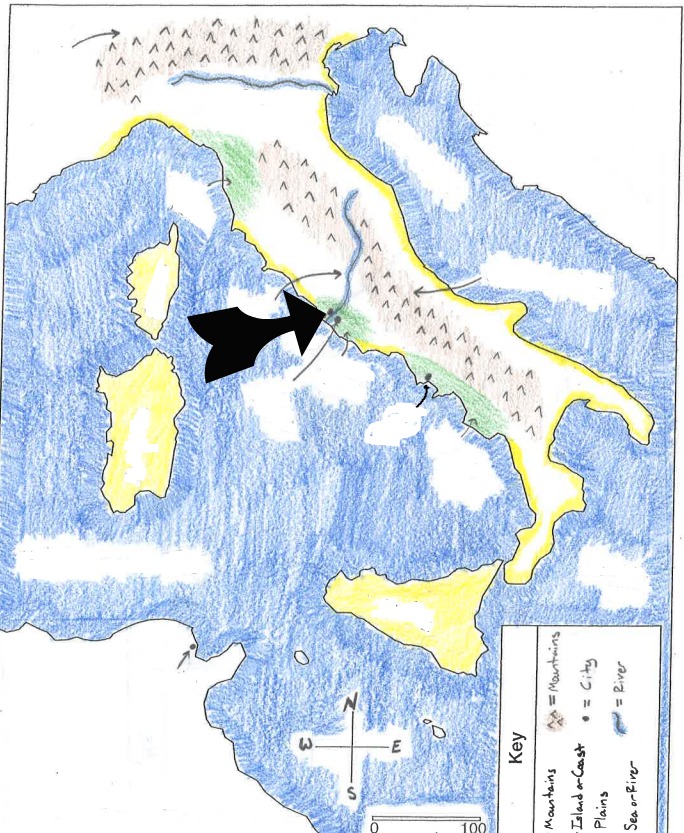
In Charge of the Roman Empire
Consuls
Senate
Emperor
The People
an area of land surrounded by water on three sides
peninsula
Pax Romana
island
plebian
a member of a wealthy upper class family in the Roman Republic
consul
tyrant
partician
plebeian
an ordinary citizen in the Roman Republic
consul
tyrant
partician
plebeian
What is a disadvantage to the islands connected with Italy?
isolated from Italy
good climate
many ports
defensible position in battle
What was an advantage to having lots of rain in Rome?
better roofs
erosion from runoff
plenty of drinking water
flooding of rivers
What was a disadvantage to Italy being a peninsula?
They are isolated from the mainland.
There is easy access to waterways.
There are three coasts to defend.
Trade is limited.
What was an advantage for Italy with being on the Mediterranean Sea?
It was a central location making travel and trade easier.
The location was so desirable, invaders wanted to attack.
It gave an easier way to irrigate farm fields.
It provided protection.
Plebeians...
were the larger social class and had the most power.
were the main people who were magistrates.
were typically wealthier than the other social class.
were the larger social class and had the least power.
Patricians...
were the smaller social class with the most power.
were the social class who only participated in the Assembly.
were the smaller social class with the least power.
were the social class that held a protest to gain power.
Roman myths were created to...
teach lessons and entertain.
entertain and pass on history.
teach government practices and pass on history.
teach lessons and pass on history.
Who were the two main characters in the myth about the founding of Rome?
Latins and Etruscans
Romulus and Remus
Aeneas and the Shepherd
Romulus and the Sabines
What is a virtue?
admirable quality of characteristic a person should live out
a prized possession that should be cherished
a quality people should avoid at all costs
a method of revenge the gods approved of
Who was Julius Caesar?
one of Rome's first Consuls
a popular leader of Rome
a dictator who took over Rome by force
the first Praetor in Rome
What is a Republic?
a form of government in which a king makes decisions
a government where representatives collect people's votes
a form of government where there are three wealthy kings
a form of government where people vote for representatives
Consuls in ancient Rome were similar to the job of
Justice in the United States.
President in the United States.
Tax collector in the United States.
Legislator in the United States.
Praetors in ancient Rome were similar to the job of
Justice in the United States.
President in the United States.
Tax collector in the United States.
Legislator in the United States.
Senators (some Patrician and Plebeians) in ancient Rome were similar to the job of
Justice in the United States.
President in the United States.
Tax collector in the United States.
Legislator in the United States.
Censors in ancient Rome were similar to the job of
Justice in the United States.
President in the United States.
Tax collector in the United States.
Legislator in the United States.

What played a large role in the type of life Romans had?
Social Class
Spouse
Geography of home
Food they ate

Which statement does not describe a Patrician?
Rich
Poor
Held a political office
Lived in villas/townhouses

Which statement does not describe a Plebeian?
Rich
Working Class
Lived in apartment buildings
Used a pot in their home to use the restroom

What percentage of Rome's population were slaves?
At least 10%
At least 15%
At least 20%
At least 25%


How long was the Tiber river?
400 km in length
600 km
200 km
1000 km


Who were the two main characters in the story that tells the beginnings of Rome?
Romulus & Remus
Zeus & Hera
Ronulus & Roman
Bill & Ted


What continent is 8?
North America
Africa
Europe
Australia
What sea is #1?
Mediterranean Sea
Adriatic Sea
Gulf of Mexico
Red Sea
What River is number 5?
Tigris
Tiber
Nile
Adriatic
What city is number 3?
Carthage
Rome
Venice
Athens
What mountains make up #7?
Olympic
Alps
Mt. Hood
Mt. Everest
What civilization is #4?
Rome
Persia
Greece
Macedonia
What is the continent labeled 11?
Europe
Australia
Africa
South America
What are the three phases/governments of Ancient Rome?
Monarchy, Republic (Democracy), Emperor
Democracy, Oligarchy, Monarchy
Monarchy, Dictatorship, Democracy
Democracy, Republic, Democracy
Which Ancient Roman Period is known for its democratic government, its expansion due to beating Carthage, and wealth?
Monarchy
Dictatorship
Republic
Empire
Which government is the first period of Roman history. This period is when Rome was still a city and ruled by kings. During this period Rome borrowed its culture from Ancient Greece.
Monarchy
Republic
Empire
Democracy
Which government/period saw Rome's most wealth and at its largest size. During this period one leader ruled over the people. During this period Christianity spread throughout Europe, Asia, and Africa.
Empire
Monarchy
Democracy
Republic
What helped Ancient Rome become an empire?
Its victory over Carthage in the Punic Wars. After the Punic Wars Rome was able to control the surrounding rim of the Mediterranean Sea.
When Romulus killed Remus and built his new city in Rome, 15 miles inland on the Tiber River.
It had a representative democracy so the people could vote directly for who should be emperor.
It was isolated from other civilizations so they didn't have to fear invaders.
What are the mountains in the north of Italy called?
Alps
Rocky Mountains
Andes Mountains
Himalayas
Tiber
Nile
Tigris
Rhine
What is a benefit of living near the Mediterranean Sea?
Winters were always very cold, which stopped invaders
It was easy to colonize other nations
Trade was easier and the economy could grow faster
The land was surrounded by fresh water
What river runs through the city of Rome?
Nile River
Tiber River
Danube River
Seine River
Which mountain range runs down the length of the Italian Peninsula?
Alps
Pyrenees
Apennine Mountains
Carpathian Mountains
What sea is located to the south of Rome?
Black Sea
Red Sea
Mediterranean Sea
Baltic Sea
Which of the following is a major geographical feature of Ancient Rome?
Sahara Desert
Tiber River
Amazon Rainforest
Rocky Mountains
The Apennine Mountains are located in which country?
Greece
Italy
Spain
France
Which body of water was crucial for trade and military activities in Ancient Rome?
Atlantic Ocean
Mediterranean Sea
Indian Ocean
Pacific Ocean
What is the primary river that provided water and transportation for Ancient Rome?
Euphrates River
Tiber River
Ganges River
Thames River
Which mountain range provided a natural barrier to the east of Rome?
Andes Mountains
Apennine Mountains
Ural Mountains
Himalayas
The city of Rome is located on which continent?
Asia
Africa
Europe
North America
Which river was central to the founding and development of Rome?
Tigris River
Tiber River
Mississippi River
Yangtze River
What is the name of the river that runs through Rome?
Tiber River
Amazon River
Nile River
Danube River
How many hills was Rome built on?
nine
five
seven
three
What were the administrative regions of the Roman Empire called?
districts
states
provinces
territories
Which city was the capital of the Roman Empire?
Athens
London
Rome
Paris
What were the structures used by Romans to transport water over long distances?
Tunnels
Aqueducts
Dams
Bridges
What geographical feature separated Italy from the rest of Europe to the north?
The Carpathian Mountains
The Ural Mountains
The Pyrenees mountain range
The Alps mountain range
Which sea borders the Italian peninsula to the south of Rome?
Ionian Sea
Tyrrhenian Sea
Adriatic Sea
Mediterranean Sea
Which mountain range runs across northern Italy and separates it from the rest of Europe?
Alps
Himalayas
Rocky Mountains
Andes
Which Roman city was famously destroyed by the eruption of Mount Vesuvius?
Athens
Sparta
Rome
Pompeii
What was the purpose of the Roman aqueducts?
To build roads
To store food supplies
To house soldiers
To transport water into cities
Who was the first Roman Emperor?
Julius Caesar
Augustus
Nero
Caligula
What was the primary language of the Roman Empire?
Greek
Latin
Italian
French
Which ancient structure was the center of public life in Rome?
The Colosseum
The Pantheon
The Roman Forum
The Circus Maximus

Which letter marks the Mediterranean Sea?
A
B
C
D
Which letter marks Europe?
A
B
C
D
Which letter marks Africa?
A
B
C
D
Which letter marks Asia?
A
B
C
D

Which number marks Athens?
1
2
3
4
Which number marks Byzantium (later called Constantinople)?
1
2
3
4
Which number marks Rome?
1
2
3
4
Which number marks Alexandria?
1
2
3
4
When Rome elected senators to govern, they had this type of government:
empire
republic
plebeian
forum
Later in Ancient Rome's history, it expanded to cover a lot of land that was ruled by one person. This was called...
an empire
a republic
a patrician
the Twelve Tables
This was the name for the lowest class of citizens of Rome:
patrician
republic
plebeian
forum
This was the name for the upper class of citizens of Rome:
patrician
aqueducts
plebeian
gladiator
What group created laws during the Roman Republic?
senate
the Twelve Tables
Pax Romana
gladiator
What allowed Romans to see the laws for Rome?
forum
the Twelve Tables
Pax Romana
gladiator
Like the agora in Greek city-states, this was the public place for people to meet and talk.
the aqueduct
The Pax Romana
the forum
the plebeian
This was the period where Rome was extremely successful.
The Pax Romana
the senate
gladiators
the forum
In order to have fresh water in their cities, Rome used...
Patricians
Twelve Tables
forums
aqueducts
For entertainment, many Romans would go watch slaves fight each other. The name for these slaves who had to fight was...
gladiators
plebeians
patricians
senators

What is the shape of the Italian peninsula?
Square
Triangle
Boot
Circle

Which sea is located to the east of the Italian peninsula?
Adriatic Sea
Ionian Sea
Turanian Sea
Mediterranean Sea

What is the name of the island that the Italian peninsula is kicking?
Sicily
Sardinia
Corsica
Crete

What river is Rome located on?
Tiber River
Nile River
Danube River
Amazon River
What type of climate does the Italian peninsula have?
Tropical
Arctic
Desert
Mediterranean
Why did Rome become powerful early on?
Strong military
Rich natural resources
Good climate for agriculture
Advanced technology

Why is Italy considered a peninsula?
It is surrounded by water on three sides
It has a unique shape
It is a small landmass
It is located in the Mediterranean Sea

How many hills is the city of Rome built on?
Three
Five
Seven
Ten
What is the capital city of Italy?
Rome
Florence
Venice
Milan

Which famous volcano is located in Italy?
Mount Etna
Mount St. Helens
Mount Fuji
Mount Vesuvius
Which body of water is located to the west of Italy?
Mediterranean Sea
Adriatic Sea
Tyrrhenian Sea
Black Sea
What is the capital of the Roman Empire?
Rome
Athens
Alexandria
Byzantium
Which mountain range runs through central Italy?
Alps
Apennines
Pyrenees
Tigris River
Which sea is located at the tip of the Italian 'boot'?
Mediterranean Sea
Adriatic Sea
Tyrrhenian Sea
Black Sea
Which island is located south of Italy?
Corsica
Sardinia
Crete
Cyprus
Which river runs through Rome?
Tiber River
Nile River
Po River
Euphrates River
Which sea is located east of Italy?
Mediterranean Sea
Adriatic Sea
Tyrrhenian Sea
Black Sea
Which sea is located west of Italy?
Mediterranean Sea
Adriatic Sea
Tyrrhenian Sea
Black Sea
Which continent is Italy located on?
Europe
Asia
Africa
North America
Which city is north of Africa?
Rome
Athens
Alexandria
Byzantium