
 Worksheets
Social Studies Skills: Timelines, Identifying Sources, Venns
Total questions: 34
Worksheet time: 51mins

Which letter identifies the following event?
Ferdinand Magellan and his crew sail around the world. (1519)
D
E
F
G
A

Which letter represents the following event?
Christopher Columbus sails to 'The New World', landing in Cuba. (1492)
B
C
H
L
M

Which letter represents the following event?
Fransisco De Coronado explores the Southwestern United States. (1540)
D
E
F
I
J
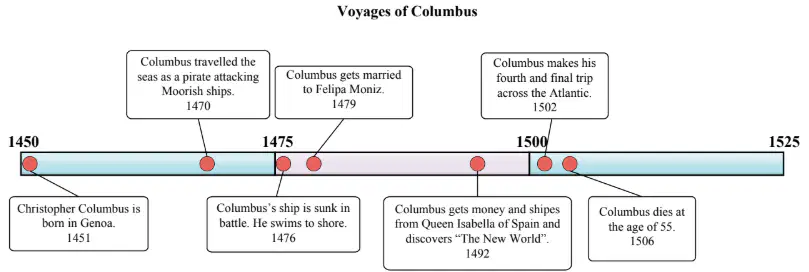
What year did Columbus discover ‘The New World’?
1476
1499
1502
It doesn't show this event on this timeline
1492
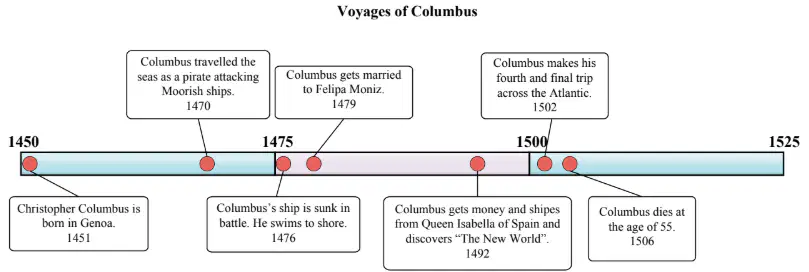
Which event happened the earliest?
Columbus discovers "America"
Columbus gets married
Columbus's ship is sunk in battle
Columbus makes his fourth and final trip across the Atlantic Ocean
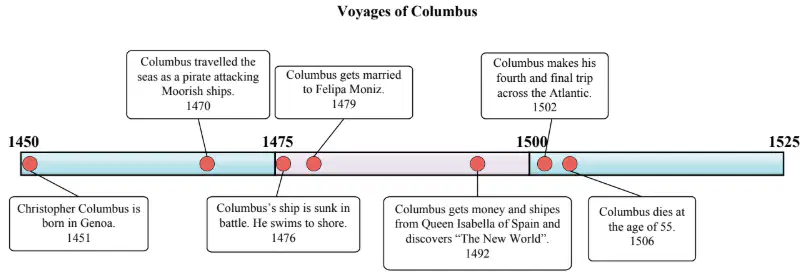
How many trips across the Atlantic Ocean did Columbus make?
2
3
4
5
7
Which of the following statements best explains the difference between primary and secondary sources?
Primary sources are always more accurate than secondary sources.
Secondary sources are always longer than primary sources.
Primary sources are created by people who experienced the event, while secondary sources analyze or interpret those events.
Secondary sources are only useful for modern history.
What makes a primary source valuable for understanding historical events?
It provides the most recent analysis of events.
It reflects firsthand experiences and original evidence from the time.
It offers an objective and unbiased perspective.
It summarizes different interpretations of the event.
A student is researching the impact of the Haitian Revolution.
Which source would NOT be considered a primary source?
A treaty signed at the end of the revolution.
A painting from the time of the revolution.
Letters written by Toussaint L’Ouverture.
An interview with a historian discussing the revolution.
Which of these would most likely be a secondary source for a research project on the Cuban Revolution?
A speech given by Fidel Castro in 1960.
A photograph of Cuban revolutionaries from the 1950s.
A scholarly article analyzing the Cuban Revolution written in 2015.
A diary entry by a Cuban soldier in 1958.
Why is a newspaper article written in 1910 about a political event considered a primary source?
It provides firsthand accounts from that time.
It includes analysis of historical events.
It was written by a historian.
It contains images and illustrations.
Which of the following is an example of a primary source?
A documentary about the causes of the Mexican Revolution.
A biography of Pancho Villa written in 2020.
A letter written by Emiliano Zapata during the Mexican Revolution.
A textbook chapter about the Mexican Revolution.
Why might a historian use both primary and secondary sources in their research?
Secondary sources are more reliable than primary sources.
Secondary sources are easier to find than primary sources.
Primary sources give context, while secondary sources offer interpretation and analysis.
Primary sources are always biased, so secondary sources are needed for accuracy.
A historian writing about the life of Simón Bolívar uses several sources. Which of the following is a secondary source?
Official documents signed by Bolívar.
A biography written about Bolívar in 2021.
A diary Bolívar kept during his military campaigns.
Letters written by Simón Bolívar.
Which source would be considered a primary source for a project on the Aztec Empire?
An article analyzing Aztec religious practices.
A history textbook about pre-Columbian civilizations.
A modern documentary about Aztec culture.
A 16th-century codex written by an Aztec scribe.
Which factor most likely influenced the start of the Haitian Revolution?
The desire to expand trade with France
The success of the American and French Revolutions
A conflict between the French and Spanish colonies
The election of a new French governor
How did the "Grito de Dolores" contribute to the Mexican War of Independence?
It inspired widespread support for rebellion against Spanish rule.
It was a peace treaty ending the conflict.
It outlined a plan for Mexico’s new government.
It created an alliance with neighboring countries.
Why was the independence of Brazil different from most other Latin American countries?
It involved a long and violent war with Spain.
It resulted in a communist government.
It led to a division into multiple smaller countries.
It was declared without significant conflict.
What was the significance of the Battle of Ayacucho in the broader context of Latin American revolutions?
It marked the start of the Mexican War of Independence.
It marked the beginning of revolutions against Portugal.
It symbolized the end of Spanish control in South America.
It led to the abolition of slavery in Latin America.
How did the outcomes of the Haitian Revolution influence later independence movements in Latin America?
It showed that peaceful negotiations were the most effective way to achieve independence.
It demonstrated that enslaved and oppressed groups could successfully overthrow colonial powers, inspiring other revolutions.
It established a monarchy in Haiti, which other Latin American leaders sought to emulate.
It convinced European powers to abandon all colonies in Latin America without resistance.

How many senior boys play football AND wrestle?
9
12
18
39


How many senior boys play football AND/OR wrestle?
9
21
30
39


How many people own cats?
3
4
6
7
10
How many people ONLY own dogs?
3
4
6
7
9
How many people own a cat AND a dog?
3
4
6
7
9

How many students have all 3 streaming services at the same time?
40
360
10
140

The venn diagram shows the number of students in chorus, band, and/or orchestra.
How many students are in the orchestra AND band?
16
46
36
8
23
The venn diagram shows the number of students in chorus, band, and/or orchestra.
How many students are in chorus, band, and orchestra?
5
9
24
15
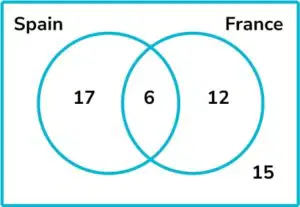
How many students went to Spain OR France?
17
12
15
6
29
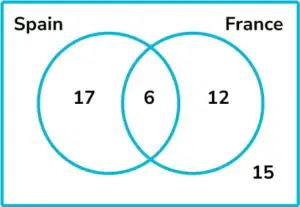
How many students went to Spain AND France?
6
18
23
15
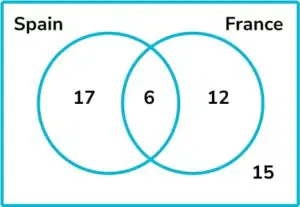
BONUS: How many students didn't go to Spain OR France?
0
15
6
18
23

What is the span of this timeline?
12
30
22
25
42

