
 Worksheets
INTRODUCTION TO ACCOUNTING
Total questions: 113
Worksheet time: 19hrs 50mins
Bookkeeping and accounting are one and the same because the bookkeeping function includes the accounting process.
True
False
The primary role of accounting is to determine the amount of taxes a business will be required to pay to taxing entities.
True
False
Accounting is thought to be the "language of business" because business information is communicated to stakeholders.
True
False
Managerial accounting information is used by external and internal users equally.
True
False
Financial accounting provides information to all of the business stakeholders, while the main focus for managerial accounting is to provide information to the management.
True
False
Accounting Information System deals with helping clients to improve their information system and business performance.
True
False
Which of the following best describes accounting?
Records economic data but does not communicate the data to users according to any specific rules.
Used only for filling out tax returns and for financial statements for various type of governmental reporting requirements.
Of no use by individuals outside of the business.
An information system that provides reports to stakeholders.
Which of the following is NOT a role of accounting in business?
To assess the various informational needs of stakeholders and design its accounting system to meet those needs.
To provide information for managers to use in operating the business
To personally guarantee loans of the business.
To provide information to other stakeholders to use in assessing the economic performance and condition of the business to make decisions regarding the economic condition of the company.
Tax accountants would be responsible for providing the following information:
Expansion of a product line report to management
Consumer reports to customers
Profit reports to owners and management.
Compliance and planning of tax reports to government agencies.
Deals with the review of financial statements to assess their fairness and adherence to accounting principles
Forensic Accounting
Accounting Education
Cost Accounting
Auditing
The rights or claims to the assets of a business may be subdivided into rights of creditors and rights of owners thus making creditors and investors the primary users of financial statements.
True
False
Primary users of accounting information are accountants.
True
False
An example of a business stakeholder is the government.
True
False
The following are examples of internal users of financial statements EXCEPT:
Managers
Employees
Owners
Financial Analysts
A regulatory agency that oversees the financial information provided by publicly listed companies
Bureau of Internal Revenue
Credit-rating agency
Trade association
Securities and Exchange Commission
Which of the following statements is TRUE?
Proprietorships are owned by one owner and provide only services to their customers.
Manufacturing and merchandising companies are similar because they purchase products from other companies to sell to their customers.
Senior executives cannot be criminally prosecuted for the wrong doings they commit on behalf of the companies where they work.
A corporation is a business that is legally separate and distinct from its owners.
Most businesses are
Sole Proprietorships
Partnerships
Corporations
Separate Entities
Which of the items below is not a business organization form?
Corporation
Entrepreneurship
Proprietorship
Partnership
The following are components of the definition of a partnership, EXCEPT:
The partners can contribute money, property, or industry to a common fund
The partners may also legally agree that the richest partner be excluded from profit sharing as long as that partner agrees to such arrangement.
Two or more persons may also form a partnership for the exercise of a profession.
There should at least be two persons.
Which of the following is FALSE about a manufacturing business?
Only large business can be considered a manufacturing business.
They change inputs to products which are sold to their customers.
All are true
Their primary goal is to maximize profits.
The two fundamental qualitative characteristics that make accounting information useful for decision-making by interested users are predictive value and confirmatory value.
True
False
In order for accounting information to be relevant in making a difference in decision-making, it must have predictive value, confirmatory value, or both, and also must be free from error to be relevant.
True
False
A fundamental qualitative characteristic that ensures that accounting information is presented without bias in the selection or presentation of financial information.
Predictive Value
Neutrality
Completeness
Free from Error
When there is an agreement between a measure or description and the phenomenon it purports to represent, relevant information possesses which quality?
Confirmatory value
Completeness
Faithful representation
Free from error
The following are attributes that enhance the relevance and faithful representation of financial information, EXCEPT
Understandability
Materiality
Timeliness
Comparability
Generally accepted accounting principles are
principles that have been proven correct by academic researchers
standards that indicate how to report economic events.
income tax regulations of the Bureau of Internal Revenue.
theories that are based on physical laws of the universe
An organization for accounting purposes, stands apart from other organizations and individuals as a separate accounting entity.
True
False
The business entity concept means that
the business entity is organized according to the rules determined by the Bureau of Internal Revenue.
the business entity is organized according to the rules determined by the International Accounting Standards Board.
the owner of the business entity and the business entity are treated the same from a legal and accounting viewpoint.
the business entity is considered a separate entity apart from the owner or owners.
The going-concern principle states an entity will remain in operation for only the next accounting period.
True
False
A problem with the monetary unit assumption is that
the peso has been stable over time.
it is impossible to account for international transactions.
the peso is a common medium of exchange.
the peso has not been stable over time.
Which of the following statements is TRUE?
The monetary unit assumption requires that all peso amounts be rounded to the nearest peso.
The value of a peso changes over time but it is assumed to be stable once recorded in the Accounting records.
The stable-monetary-unit concept requires adjustments to the accounting records for the effects of inflation.
Filipino accountants record transactions in any Asian currency.
The Time Period Assumption requires that all business transactions must occur within the same accounting period.
True
False
The Time Period Assumption is most essential for which financial statement?
Statement of Owner's Equity
Statement of Financial Position
Statement of Cash Flows
Statement of Profit or Loss
Under the Accrual Assumption, revenue is recognized before cash is received, as long as it is earned; while expense is recognized before cash is paid, as long as it is incurred.
True
False
The Accrual Assumption in accounting dictates that
Revenues should be recognized before expenses
Revenues and expenses should be recognized when cash is received or paid
Revenues and expenses should be recognized when they are earned or incurred.
All financial transactions should be reported immediately.
The historical cost principle requires that when assets are acquired, they be recorded at
Exchange price paid
List Price
Appraisal Value
Selling Price
The relevant measure of value of the assets of a company that is going out of business is their
Book Value
Current Market Value or Liquidation Value
Higher of historical cost or current market value
historical cost
Services or goods delivered in 2023 but collected in 2024 should be recognized as income in 2023.
True
False
A referral fee was given to a doctor for bringing his patients for laboratory exams at A1 Laboratory. Referral Expenses and Laboratory Expenses are recorded by A1 Laboratory against the service fees earned for the period. The method of recording expenses and revenue supports the principle of
Materiality
Cost
Accrual
Matching
What is the primary objective of full disclosure in financial reporting?
To minimize the amount of information disclosed to competitors.
To provide a complete and transparent picture of a company’s financial position and financial performance.
To manipulate financial statements for better market perception.
To highlight only positive information
A deviation from generally accepted accounting principles is
permissible if the amount involved is immaterial
never allowed
permissible if the amount involved is material.
permissible only if it is required in order to conform to the monetary unit assumption.
The cost-benefit constraint goes hand in hand with which principle?
Materiality
Historical cost basis
Revenue Recognition
Full disclosure
The cost-benefit test constraint refers to the benefit of complying with an accounting principle should not outweigh the cost of compliance.
True
False
With Conservatism, if an accountant has more than one Generally Accepted Accounting Principles options to choose from when facing an accounting challenge, the one that yields inferior numbers should be selected.
True
False
It is usually the case that industry practice becomes acceptable as GAAP in what types of industries?
Industries to which unusual regulatory requirements apply.
Industries where it is simple to apply GAAP.
Industries to which typical tax laws apply
Industries in which there is unusually low risk.
Financial statements provide information about business activities to decision-makers.
True
False
The Statement of Financial Position lists all the entity's assets, liabilities, and owner's equity as of a specific date.
True
False
In order to possess future service potential, an asset must have physical substance.
True
False
Owner’s equity is often referred to as capital and represents the residual amount of business assets that can be claimed by the owner.
True
False
The basic accounting equation is in balance when the creditor and ownership claims against the business equal the assets.
True
False
A Statement of Profit or Loss is dated for a period of time such as "Year Ended December 31, 2023."
True
False
The Statement of Profit or Loss must be prepared before the Statement of Owner’s Equity since net income or net loss is added or subtracted from the beginning balance in the owner’s capital account.
True
False
The Statement of Cash Flows shows how much the cash account either increased or decreased including how cash is sourced and used during the period.
True
False
Net income for the period is determined by subtracting total expenses and drawings from total revenues.
True
False
n the Statement of Owner’s Equity, revenues are listed first, followed by expenses, and net income (or net loss).
True
False
The common characteristic possessed by all assets is
long life
great monetary value
future economic benefit
tangible nature
Current assets are presented in the Statement of Financial Position according to
Solvency
Liquidity
Record date
Magnitude
Liabilities are
Increases in owner's equity earned by delivering goods or services.
Insider claims to the business's assets
Economic resources of a business.
Outsider claims to the business's assets
Liabilities
are things of value used by the business in its operation.
are future economic benefits
are existing debts and obligations.
possess service potential
Statement of Financial Position format that presents assets on the left side and liabilities and owner’s equity on the right side
Natural Form
Report Form
Functional Form
Account Form
A written promise for future collections of cash is a(n)
Prepaid Asset
Note Receivable
Account Receivable
Owner Withdrawal
The amount owed by an entity when it makes a purchase on account is termed a(n)
Note receivable
Accounts receivable
Note payable
Accounts payable
A liability evidenced with a collateral of an asset
Mortgage Payable
Notes Payable
Accounts Payable
Loans Payable
Owner's equity can be described as
ownership claim on total assets
debtor claim on total assets
benefactor's claim on total assets.
creditorship claim on total assets.
Cash investments by the owner are reported on the
Statement of Cash Flows
Statement of Financial Position
Statement of Profit or Loss
Statement of Profit or Loss and the Statement of Financial Position.
All are TRUE about the Notes to Financial Statements EXCEPT
provide information that is not presented elsewhere in the financial statements but is relevant to an understanding of any of them.
disclose the information required by IFRSs that is not presented elsewhere in the financial statements.
present information about the basis of preparation of the financial statements and the specific accounting policies used
disclose all information including those that can give competitive advantage to competitors.
If owner's equity is ₱135,000 and total liabilities are ₱90,000, then total assets would be
(a)
Owner’s equity and total assets were ₱32,000 and ₱79,000 at the beginning of the period. Assets increased 50% and liabilities decreased 60% during the period. The owner's equity at the end of the period is
(a)
If total liabilities decrease by ₱22,000 and owner's equity increases by ₱8,000 during the period, then assets must have decreased by
(a)
On December 31, the assets of a business include Cash, ₱3,500, Accounts Receivable, ₱14,000, and Supplies, ₱1,050. The liabilities on December 31 total ₱7,600. The owner's equity on December 31 is
(a)
Beginning owner’s equity is ₱20,000, cash withdrawals by the owner amount to ₱7,000, and ending owner’s equity is ₱37,000. Net income for the period is
(a)
Net income is ₱34,000, beginning owner’s equity is ₱29,000, and ending owner’s equity is ₱45,000. Owner’s withdrawals for the period is
(a)
Total assets at the end of the period were ₱325,000 and liabilities were 40% of owner’s equity. Owner’s equity at the end of the period is
(a)
A company has the following data during the current period:
Net income for the current period = ₱55,000
Ending owner’s equity = ₱85,000
Beginning owner’s equity = ₱49,000
Owner withdrawals = ₱12,600
Revenue for the current period = ₱96,000
Total expenses for the current period amounted to
(a)
A company has the following data during the current period:
Accounts receivable = ₱9,000
Accounts payable = ₱4,200
Service revenue = ₱25,550
Furniture = ₱4,000
Rent expense = ₱4,500
Note payable = ₱3,800
Supplies = ₱900
Owner’s Capital, beginning = ₱30,000
Salary expense = ₱9,650
Cash = ₱18,500
Total Current assets amounted to
(a)
A company purchased a piece of farm land 8 years ago for ₱670,000. It is considering selling the land. The piece of land was recently appraised for ₱1,370,000. The owner received an offer from a prospective buyer for ₱1,220,000, and a similar piece of land 2 blocks away recently sold for ₱1,300,000. The land should be reported in its Statement of Financial Position at
(a)
The following information pertain to Aim High Services:
Rental was paid September 2022 in advance for 3 months (October to December 2022). Rent consumed during the month of December 2022 is worth ₱7,200.
Rental was paid December 2022 in advance for 3 months (January to March 2023) for ₱22,500. Rental for 2023 increased by roughly 5%.
Purchased supplies for ₱650 on December 1, 2022. Inventory of supplies was ₱100 on December 31, 2022.
Paid the November electricity bill on December 10, 2022 ₱5,000.
The total expense which must be recorded by the company pertaining to December 2022 is
(a)
The account balances of various assets, liabilities, revenues and expenses for Aim High Services on December 31, 2023, the end of its first year of operations are presented below:
Accounts receivable = ₱15,000
Accounts payable = ₱5,700
Salary expense = ₱4,500
Repairs expense = ₱800
Equipment = ₱14,800
Notes payable = ₱8,200
Cash = ₱6,800
Supplies expense = ₱1,600
Service income = ₱12,800
Gasoline expense = ₱800
The owner invested ₱22,600 at the beginning of the year and withdrew ₱5,000 during the year for personal use.
The net income or loss for the year was (encode as negative if net loss)
(a)
Use the Following information for the last 4 items.
The account balances of various assets, liabilities, revenues and expenses for Aim High Services on December 31, 2023, the end of its first year of operations are presented below:
Accounts receivable = ₱15,000
Accounts payable = ₱5,700
Salary expense = ₱4,500
Repairs expense = ₱800
Equipment = ₱14,800
Notes payable = ₱8,200
Cash = ₱6,800
Supplies expense = ₱1,600
Service income = ₱12,800
Gasoline expense = ₱800
The owner invested ₱22,600 at the beginning of the year and withdrew ₱5,000 during the year for personal use.
Total assets at year-end amounted to
(a)
Accounts receivable = ₱15,000
Accounts payable = ₱5,700
Salary expense = ₱4,500
Repairs expense = ₱800
Equipment = ₱14,800
Notes payable = ₱8,200
Cash = ₱6,800
Supplies expense = ₱1,600
Service income = ₱12,800
Gasoline expense = ₱800
The owner invested ₱22,600 at the beginning of the year and withdrew ₱5,000 during the year for personal use.
Owner’s equity at year-end amounted to
(a)
Accounting not only involves the recording of financial transactions but also includes the analysis,
interpretation, and communication of financial information to help stakeholders make informed decisions.
True
False
Management accounting is primarily concerned with providing information to external users such as investors
and creditors
True
False
Understandability allows users to identify and understand similarities and differences between financial
information from different periods or different companies
True
False
Under the Revenue Recognition Principle, revenue should be recognized when it is earned and realizable,
regardless of when the cash is received
True
False
The Monetary Assumption assumes that only transactions that can be expressed in monetary terms are
recorded and assumes that the peso is used to record transactions and that it is relatively free from value
fluctuations and although the actual value of money could change due to inflation or deflation, accounting
does not account for such changes.
True
False
The Statement of Financial Position reports a company’s assets, liabilities, and equity at a specific point in
time
True
False
Inventory is classified as a non-current asset on the Statement of Financial Position because it is possible
to sell it after 12 months
True
False
Income in the Statement of Profit and Loss includes only revenues from sales and services, excluding
interest income and rent received
True
False
Withdrawals by the owner are recorded as an expense on the Statement of Changes in Owner’s Equity
True
False
In the expanded accounting equation used in the Statement of Changes in Owner’s Equity, equity changes
are calculated by adding net income and additional owner investments and subtracting owner’s
withdrawals.
True
False
Who is often credited with the development of double-entry bookkeeping, which significantly advanced the field of accounting?
Karl Marx
Luca Pacioli
Adam Smith
William Shakespeare
Which of the following best describes the primary purpose of accounting?
To design marketing strategies for a business
To conduct scientific research and development
To provide financial information for decision-making and reporting
To analyze stock market trends and make investment decisions
Which of the following is NOT typically considered a primary user of accounting information?
Lenders
Investors
Creditors
Competitors
Which of the following qualitative characteristics ensures that financial information is provided in a manner
that reflects economic phenomena accurately and without bias?
Relevance
Timeliness
Comparability
Faithful Representation
The time period (or Periodicity) assumption in accounting allows businesses to:
Recognize income and expenses only when cash transactions occur
Report financial results for specific periods, such as months or years, to provide timely and relevant information
Delay reporting financial performance until the business is liquidated.
Combine all financial transactions over the life of the business into a single set of financial statements
The concept of materiality in accounting allows for:
Reporting all financial information in excessive detail to ensure completeness
Valuing all assets and liabilities at their fair market value regardless of their cost
Ignoring minor accounting errors if they do not affect the financial statements significantly.
Adjusting financial statements based on subjective judgments of relevance to users.
n the natural form of the Profit and Loss Statement, how are expenses typically presented?
By nature of expenses
By department, such as sales and production departments
By function, such as cost of goods sold and administrative expenses
By income source, such as operating income and non-operating income
In the Statement of Changes in Owner’s Equity, how is an additional investment by the owner presented?
An Increase
A decrease
Could be an increase or decrease
Not presented in the statement of changes in owner's equity
FDN SERVICES purchased a furniture for ₱60,000. Per checking, the fair market value of this
furniture is ₱50,000. Appraisal value is ₱40,000.
How should FDN SERVICES account for the initial cost of this furniture?
(a)
FDN SERVICES provided the following data:
• Beginning balance of Liability: 78,000
• Furniture and Fixture purchased on account for ₱50,000
• Company Car purchased for cash, ₱400,000
• Rent Payable, ₱25,000
(a)
As of August 31, 2024, FDN SERVICES shows the following account balances:
Office equipment, ₱101,000
Office supplies, ₱14,000
Prepaid expense, ₱23,000
Accounts payable, ₱7,000
Accounts receivable, ₱50,000
Cash, ₱66,000
Furniture and fixtures, ₱97,000
How much is the current assets as of August 31, 2024?
(a)
As of August 31, 2024, FDN SERVICES shows the following account balances:
Office equipment, ₱81,000
Office supplies, ₱21,000
Prepaid expense, ₱22,000
Accounts payable, ₱11,000
Accounts receivable, ₱42,000
Cash, ₱20,000
Furniture and fixtures, ₱67,000
How much is the non-current assets as of August 31, 2024?
(a)
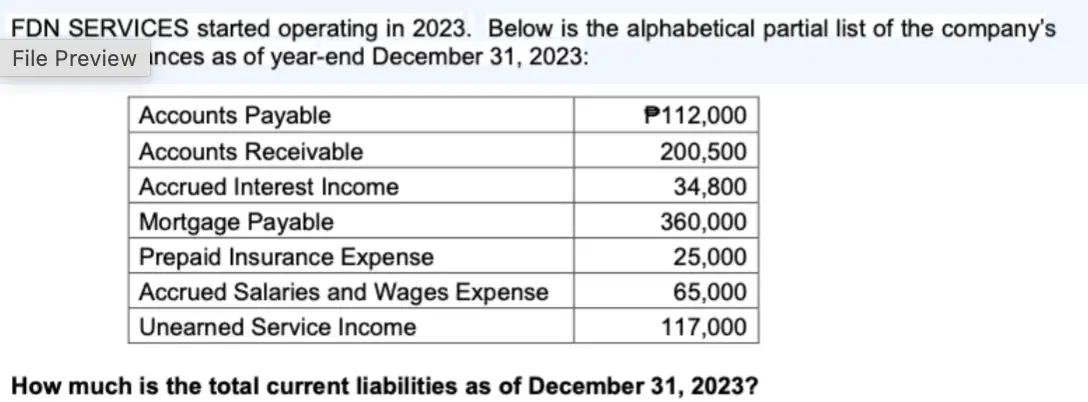
How much is the total current liabilities as of December 31, 2023?
(a)
The new accountant of the FDN SERVICES prepared the list of expenses for August 31, 2024,
amounting to ₱75,000 which included the following:
• Interest, ₱5,000
• Miscellaneous, ₱2,000
• Insurance ₱6,000
• Purchased machinery ₱12,000
• Remaining supplies ₱3,500
• Repairs ₱7,000
What should be the correct total expenses for the month ended August 31, 2024??
(a)
FDN SERVICES received the following cash in the month of August:
₱70,000 for the services rendered last month, July 2024.
₱75,000 for the services rendered this month.
₱80,000 for the services that will be provided next month, September 2024.
It also rendered services amounting to ₱85,000, and the payment from the customer will only be
collected in October 2024.
How much is the total income that should be reported for the month ended August 31, 2024?
(a)
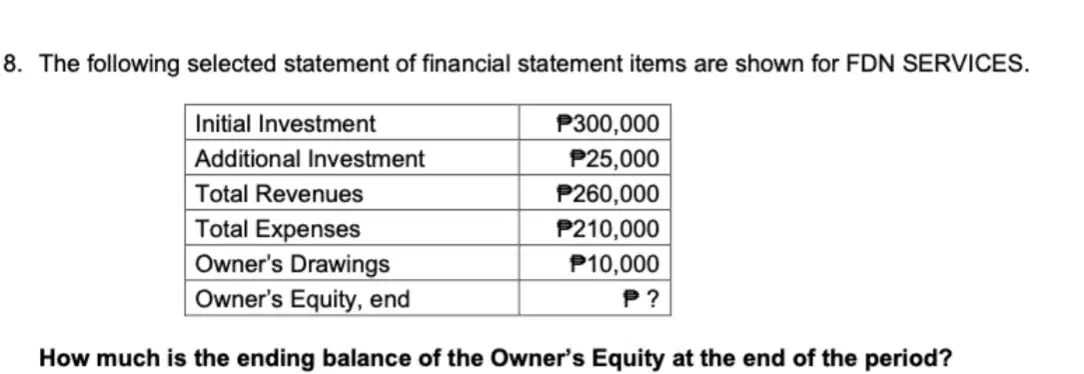
How much is the ending balance of the Owner's Equity at the end of the period?
(a)
At the end of the year, December 2023, FDN SERVICES reported an ending balance of the Owner’s
Equity account for ₱740,000. During this year, Net Income amounted to ₱340,000. Out of this Net
Income, the owner, Faith D. Nakpil, withdrew 20%. It is also reported that she made an additional
investment during the year worth ₱120,000. How much was the initial investment made by the
owner on FDNACCT’s first year of operations?
(a)
The following data were provided by FDN SERVICES:
Accounts Receivable, ₱28,000
Accounts Payable, ₱11,000
Cash, ₱36,000
Interest Payable, ₱2,500
Supplies, ₱3,500
Salaries Payable, ₱15,000
Using the data given, how much is the total Owner’s Equity?
(a)
If the total Liabilities of FDN SERVICES to ₱150,000, and the total Assets amount to ₱675,000,
how much is the total Equity?
(a)
If the total Revenue is worth ₱670,000, and the total Expenses is ₱760,000, how much is the total
Net income or Net Loss? Encode as a negative number if your answer is a net loss.
(a)
The assets of the business at the start of the month totaled ₱100,000 with owner’s equity at
₱80,000. Before the month ended, equipment worth ₱50,000 were purchased, with a down payment
of ₱15,000, the balance on credit. How much is the liabilities to be reported at the end of the
month?
(a)
The following information was provided by FDN SERVICES:
• Beginning Balance of Asset, ₱380,000
• Beginning Balance of Liabilities, ₱50,000
• Ending Balance of Owner’s Equity ₱325,000
How much is the Owner’s Drawings for the period?
(a)
The following data are provided by FDN SERVICES Company:
Service Income, ₱380,000
Accrued Interest Expense, ₱5,000
Rent Expense, ₱60,000
Utilities Expense, ₱35,000
Supplies Expense, ₱28,000
Salaries Expense, ₱70,000
How much is the Net Income?
(a)

