
 Worksheets
Black Plaque
Total questions: 172
Worksheet time: 1hrs 25mins
Why is it called the black plague?
Only white animals die from it
Only black cats die from it
Peoples blood goes black from internal bleeding
Your head turns black as an effect


Some scientists think the plague arrived in Europe from?
Ships
Airplanes
Camel caravans
Trains
The Black Plague was thought to be brought to Western Europe through the —
trade routes
Crusades
Mongol invasions
Viking raids
What disease decimated the population of much of Asia and Europe?
the Adriatic flu
malaria
small pox
the Black Death
What name describes the type of society in medieval times?
Tic Tok
Tribal society
Feudal Society
Benevolent society

What is the nickname for The Bubonic Plague?
The Big Blister
The Black Death
The Measles
The Mumps

What famous nursery rhyme is about the Bubonic Plague that ravaged EUROPE, AFRICA, AND ASIA?
Humpty Dumpty
Ring around the Rosie
Twinkle Twinkle Little Star
3 Little Pigs

Pockets full of posies could have represented what?
Carrying flowers to help drown out the terrible smells
Collecting butterflies
Collecting coins and trinkets
Carrying little crackers for snacks later

Ashes, Ashes could represent...
The dead bodies were burned and the ashes fell back down on the towns
The ashes represented the wood from the fires that would burn
The ashes represented the changing of the seasons
The ashes represented the wildfires burning during that time

The Bubonic Plague was spread...
From terrible smells from the dead bodies
Through hand to hand touching
Through the air from sneezing
Between animals and humans by the bite of infected fleas

How did the Bubonic Plague get from place to place?
Trading routes connecting each continent
By air
By touch
By sight

What were THREE causes for the start of the Bubonic Plague?
Increased international trade
Rising population
Lack of medical knowledge
Rising rat population


What was a result of the Black Death of the fourteenth century?
African populations destroyed from disease
African culture destroyed from forced slave captures
war in western Europe
dramatic shortages of laborers and people throughout Europe
What did the scarcity of labor created by the Black Death cause?
economic collapse
a reduction in wages
an increase in wages
dependence on slavery
How did life change for surviving peasants and serfs after the plague?
they began to demand pay for their labor
they all moved from towns to the country
they now had to work much longer days
they rioted and took over the manors
Which of the following best describes how the Bubonic Plague was spread from one person to another?
through the air
through bites from infected fleas
through physical contact with the infected
all of the above
Approximately what percentage of the population of Europe was lost because of the Black Death?
1/2
1/3
1/4
1/8
What was the name of the bacteria that spread the Black Plague?
Bacteria
Yersinia Pestis
Blue Green Bacteria
Athletes Foot
What group was blamed and persecuted for spreading the Black Plague?
Jews
Catholics
Muslims
Buddhists

There was no cure for the Black Death & it was highly ____________ (likely to spread to others).
Ravaging
Contagious
Influential
Potent

Where did the Black Death technically start?
Asia
Northern Europe
Australia
Northern Africa
The Black Plague was thought to be brought to Western Europe through the —
trade routes
Crusades
Mongol invasions
Viking raids
Because of the Black Death —
people entered into feudal agreements for protection.
Africa became the most powerful continent.
people lost faith in the Church.
all monarchs of Europe and Asia died.
What was a result of the Black Death of the fourteenth century?
African populations destroyed from disease
African culture destroyed from forced slave captures
war in western Europe
dramatic shortages of laborers and people throughout Europe
Which of the following best explains why the Black Death spread so quickly throughout Europe?
doctors ran out of vaccinations for the plague
doctors ran out of antibiotics for the plague
doctors had little knowledge of how to cure the disease
doctors were too sick themselves to help others suffering
What did most people believe the Black Death was caused by?
dogs and cats
biological war affairs
God's punishment
food mites
Where/how did the Black Plague first enter Europe?
Through port cities first because of trade routes.
The Black Death took several centuries to spread throughout Europe.
The Black Death spread from Europe to Asia in 1854.
The Black Death did not affect northern Europe the most.
What is the bubonic plague ?
It is a disease that wiped out most of North America. It was mainly spread by plants or some animals.
It is a disease caused by the bacteria Yersinia pestis. It is mainly spread by fleas from small animals.
How many forms of the plague were there ?
1
2
3
4
How long did it take to die from the Black Death?
days
weeks
months
years
What was the only way to avoid dying in the Black Death?
medicine
therapy
isolation
healthy diet
How many died in the Black Death?
hundreds of thousands
tens of millions
millions
thousands
The epidemic began in the 1600s in Italy.
true
false
Many believed the Black Death was God punishing people for their sins.
true
false
The Black Death Killed millions of people worldwide.
true
false
How did life change for surviving peasants and serfs after the plague?
they began to demand pay for their labor
they all moved from towns to the country
they now had to work much longer days
they rioted and took over the manors
Which of the following best describes how the Bubonic Plague was spread from one person to another?
through the air
through bites from infected fleas
through physical contact with the infected
all of the above
Where did the Bubonic Plague originate?
Northern Europe
South Africa
Central Asia
Middle East
Which of the following best explains why the Black Death spread so quickly throughout Europe?
doctors ran out of vaccinations for the plague
doctors ran out of antibiotics for the plague
doctors had little knowledge of how to cure the disease
doctors were too sick themselves to help others suffering
What was a major impact of the Black Death?
the loss of natural resources
the decline of feudalism
the increase in population
the decrease of kings' power
Approximately what percentage of the population of Europe was lost because of the Black Death?
1/2
1/3
1/4
1/8
How did the Plague arrive in Italy?
on trade ships
on the Silk Road
on the trans-Saharan trade route
on camels
The plague was spread by which of the following?
rats/ animals
humans
fleas
rain water
What did most people believe the Black Death was caused by?
dogs and cats
biological war affairs
God's punishment
food mites
How did life change for surviving peasants and serfs after the plague?
they began to demand pay for their labor
they all moved from towns to the country
they now had to work much longer days
they rioted and took over the manors
Which of the following best describes how the Bubonic Plague was spread from one person to another?
through the air
through bites from infected fleas
through physical contact with the infected
all of the above
Where did the Bubonic Plague originate?
Northern Europe
South Africa
Central Asia
Middle East
Which of the following best explains why the Black Death spread so quickly throughout Europe?
doctors ran out of vaccinations for the plague
doctors ran out of antibiotics for the plague
doctors had little knowledge of how to cure the disease
doctors were too sick themselves to help others suffering
What was a major impact of the Black Death?
the loss of natural resources
the decline of feudalism
the increase in population
the decrease of kings' power
Approximately what percentage of the population of Europe was lost because of the Black Death?
1/2
1/3
1/4
1/8
How did the Plague arrive in Italy?
on trade ships
on the Silk Road
on the trans-Saharan trade route
on camels
The plague was spread by which of the following?
rats/ animals
humans
fleas
rain water
What did most people believe the Black Death was caused by?
dogs and cats
biological war affairs
God's punishment
food mites

What was the most distinctive symptom of the Black Plague?
Vomiting
Aches and Pains
Swellings under the armpit
Fever
Coughing up blood
What group was blamed and persecuted for spreading the Black Plague?
Jews
Catholics
Muslims
Buddhists
What percentage of the world was killed by the Black Plague?
10 to 20 percent
15 to 30 percent
25 to 50 percent
50 to 90 percent
What group was highly likely to get the black death?
Doctors
Priests
Poor
All of the above
None of the above
What year did the Black Plague hit Europe?
1347
1348
1349
1350
Why is the Black Plague in deadlier in some places or times in history than in others?
Human-to-human transmission became more rampant because of population growth.
Warmer periods were more conducive to the spread of the disease in animals.
The bacteria has evolved into a stronger strain over time.
Human hosts might be weaker due to socio-economic and biological factors.
Which of the following is NOT a social / economic effect following the Black Death?
Increased life expectancy for the population
Higher wages for surviving laborers
Populations with stronger immune system
Political reforms that ended feudalism
Which of the following was NOT a direct result of the Black Plague?
Scarcity of labor
Decrease in population
Decline of the influence of the church
Political reform
The Black Plague was thought to be brought to Western Europe through the —
trade routes
Crusades
Mongol invasions
Viking raids
How did the Black Death change the role of the Church in the lives of people during the 1300’s?
The Christian Church was replaced by other religions.
The power of Church grew more.
Many began to question the power of their religious leaders.
There was no change. People still attended church in great numbers.
The Black Death was also known as the —
Bubonic plague
Flu epidemic
Death epidemic
Poison of the rats
What disease decimated the population of much of Asia and Europe?
the Adriatic flu
malaria
small pox
the Black Death
Because of the Black Death —
people entered into feudal agreements for protection.
Africa became the most powerful continent.
people lost faith in the Church.
all monarchs of Europe and Asia died.
What was a result of the Black Death of the fourteenth century?
African populations destroyed from disease
African culture destroyed from forced slave captures
war in western Europe
dramatic shortages of laborers and people throughout Europe
What did NOT result from conditions after the Black Death?
the growth of towns and cities
the beginning of capitalism
a strengthening of Church authority
the gradual elimination of serfdom
What did the scarcity of labor created by the Black Death cause?
economic collapse
a reduction in wages
an increase in wages
dependence on slavery
Who were the educated people during the Middle Ages?
church scholars
wealthy patrons
monarchs
knights
How did the Black Plague spread to humans initially?
Airborne Illness
Flea Bites
Rat Bites
Bathing in/Drinking Contaminated Water
What century did the Black Plague start in?
14th Century (1300s)
16th Century (1500s)
18th Century (1700s)
20th Century (1900s)
What continents were affected by the Black Plague?
France and Spain
Europe and South America
Africa and Asia
Asia and Europe
What continent did the Black Plague affect the most?
Asia
Africa
South America
Europe
What did Plague Doctors put in their beak to prevent getting the Black Plague?
Cotton
Herbs/Spices
Daisies
Roses and Vinegar
Why did religious people believe the Plague had happened?
Punishment from God
To strengthen relations with God
The Rapture
Testing Their Faith

Fill in the blanks
Rats; Fleas
Fleas; Humans
Rats; Humans
Fleas; Rats
How did the Black Plague affect people's faith?
Decreased; The church didn't help/find a cure
Increased; Hard times caused people to draw closer to God
Decreased; The Church ignored all those who were sick
Increased; The Church provided prayers for the sick
All of the following were ECONOMIC IMPACTS of the Black Plague EXCEPT:
Peasants begin to demand better wages and living conditions as their ability to harvest food is now in high demand after the outbreak.
As the Black Plague continues to devastate all people, all social classes (rich and poor) work together to help rebuild society within Europe.
Due to the wildlife being isolated from the Plague, Europe experiences an increase in profitable animals such deer, cows and chickens which helps rebound the economy.
European populations decrease dramatically thus slowing down trading, education and farming.
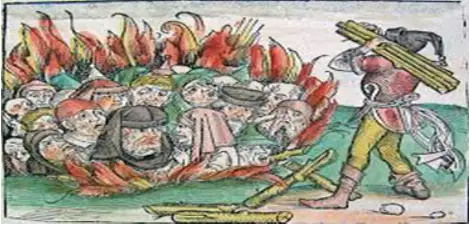
Which of the following groups of people were singled out and blamed for the spread of the disease as displayed in the picture
Muslims
Jews
Christians
Atheists
How did the Black Plague contribute to changes in medical practices?
It led to the discovery of antibiotics
It increased the use of bloodletting
It reinforced ancient herbal remedies
It promoted more scientific approaches to medicine
What measures were taken to contain the Black Plague?
Quarantines and isolation
Mass vaccination campaigns
Famine relief efforts
Expansion of trade routes
What was the average time from exposure to death for individuals infected with the bubonic plague?
Several weeks
A few months
Three to four days
Over a year
What is the actual name for the Black Plague?
Rodent Plague
Black Misery
My life is over Plague
Bubonic Plague
What happened to most people who were infected with the plague?
Nothing because they got a vaccine for the disease
Their hair fell out, but then they got better
All of their skin turned black, but then they got better
They got covered in swollen blisters (buboes) and mostly died
Some scientists think the plague arrived in Europe from?
Ships
Airplanes
Camel caravans
Trains
Where did the Black Death technically start?
Asia
Northern Europe
Australia
Northern Africa
Which of the following best explains why the Black Death spread so quickly throughout Europe?
doctors ran out of vaccinations for the plague
doctors ran out of antibiotics for the plague
doctors had little knowledge of how to cure the disease
doctors were too sick themselves to help others suffering
What other name did the Bubonic Plague have?
Black Death
Terrible Death
Scary Death
What did a typical Medieval doctor look like?


What were the three reasons why the Bubonic Plague continued to spread?
More traveling because of trading
The Bubonic Plague did not spread
Cities began to grow
Doctors did not know how to help
What animal carried the plague?
cat
mouse
rat
lion
Name one way that COVID and the Plague are similar.
The Bubonic Plague is also known as the Black Death because...
your lips would turn black
your eyes would turn black
your toes and fingers would turn black
it was never known as the Black Death
The Bubonic Plague still exists today.
Yes
No
Which were symptoms of the Bubonic Plague?
swollen lymph nodes (neck)
thirst
fever
The remedies the doctors used to make the plague better were great and cured everyone!
Yes
No
I am beginning to understand the Bubonic Plague more.
I already understood it
Yes
Kind of
No
The Bubonic Plague (Black Death) was a...
very minor event
new religion
series of religious wars
major pandemic (disease)
The Bubonic Plague began in...
central Asia, spreading to Europe
Europe, spreading to the world
Africa, in the Sahara Desert
Africa, spreading to Asia
Which is not a characteristic of the Bubonic Plague?
Spread by Jews
Large black boils/pustules
High death rate
Spread by fleas
Because of the plague, the world's population...
significantly increased
increased
decreased
significantly decreased
What are two reasons why the plague spread to Europe?
trade on the Silk Road
the North Atlantic Drift
Mansa Musa's pilgrimage
warfare by the Mongols
Christian missionaries
Which is not an economic effect of the Black Death?
Many working farmers died.
Workers had to develop new techniques to farm with fewer people.
Manors weren't significantly impacted, and manorialism continued.
Demand for agriculture dropped because of lower population.
What's a long-term impact of the Black Death on agriculture?
Farming was not really impacted.
Many fields became unusable.
More people became farmers.
Many farmers would seek jobs in cities.
What is not a social impact of the Bubonic Plague?
Working people revolted in cities.
The feudal system began to crumble.
Governments tried to pass laws to enforce feudalism.
Nobles kept much of the power and land
After the Black Death, many workers began to...
demand more rights
become nobles
train to be knights
sail to the Americas
T/F: The Bubonic Plague strained the feudal system, and it many ways, it collapsed.
True
False
The Black Plague was thought to be brought to Western Europe through the —
trade routes
Crusades
Mongol invasions
Viking raids
How did life change for surviving peasants and serfs after the plague?
they began to demand pay for their labor
they all moved from towns to the country
they now had to work much longer days
they rioted and took over the manors
Where did the Bubonic Plague originate?
Northern Europe
South Africa
Central Asia
Middle East
Which of the following best explains why the Black Death spread so quickly throughout Europe?
doctors ran out of vaccinations for the plague
doctors ran out of antibiotics for the plague
doctors had little knowledge of how to cure the disease
doctors were too sick themselves to help others suffering
What was a major impact of the Black Death?
the loss of natural resources
the decline of feudalism
the increase in population
the decrease of kings' power
What did most people believe the Black Death was caused by?
dogs and cats
biological war affairs
God's punishment
food mites
Guess which one is the lie
Bubonic plague is one of three types of plague caused by bacterium Yersinia pestis.
Bubonic plague is mainly spread by infected fleas from small animals.
Dead plague infected animals carry no risk to healthy people.
Guess which one is the lie!
The Black Death originated in England and spread from Italy and then throughout other Eastern Europe
Mongols cut off the trade route, the Silk Road, which halted the spread of the Black Death from eastern Russia to Western Europe.
Italian merchants fled on their ships, unknowingly carrying the Black Death.
Guess which one is the lie!
Bubonic plague is an infection of the cardiovascular system
The best-known symptom of bubonic plague is one or more infected, enlarged, and painful lymph nodes, known as buboes.
One to seven days after exposure to the bacteria, flu-like symptoms develop
Guess which one is the lie!
Vaccines are now the most effective method of combating the spread of plague
Several antibiotics are effective for treatment
In the 21st century, the disease is most common in Africa
Guess which one is the lie!
The plague resurfaced for a third time in the mid-19th century
During an outbreak from 1900 to 1904 in San Francisco, authorities made permanent the Chinese Exclusion Act.
The last major outbreak in the United States occurred in Los Angeles in 1904
Guess which one is the lie!
Without treatment, plague results in the death of 30% to 90% of those infected.
Death, if it occurs, is typically within two days.
Globally there are about 650 documented cases a year, which result in ~120 deaths.
Guess which one is the lie!
The plague is believed to have killed an estimated 50 million people in the 14th century
The plague is believed to have killed an estimated 20 million people in the 14th century
The plague killed an estimate of 25% to 60% of the European population in the 14th century
Guess which one is the lie!
Armies of the 14th century were recorded catapulting fire bombs over the walls of towns and villages to stop the spread of disease
Some of the earliest instances of biological warfare were said to have been products of the plague
In 1940, the Imperial Japanese Army Air Service bombed Ningbo with fleas carrying the bubonic plague
Guess which one is the lie!
Between 1900 and 2015, the United States had 1,036 human plague cases with an average of 9 cases per year
In June 2018, a child was confirmed to be the first person in Idaho to be infected by bubonic plague in nearly 30 years
US cases usually occur in the southeastern part of the country, with the highest concentration in Florida
Guess which one is the lie!
Because the plague killed so many of the working population, wages rose due to the demand for labor
Some historians see the plague as a turning point in European economic development
The term bubonic is derived from the Greek word βουβών, meaning "bubble"

Look at the map below. In what region (continent) of the world did the Black Death BEGIN?
Europe
Middle East
Asia
Africa
Look at the map below. In what region (continent) of the world did the Black Death END?
Europe
Middle East
Asia
Africa
How was the Black Death spread?
Rats and fleas
Dogs and ticks
Cats and Bats
Birds
Which of these is not a result of the Black Death?
It affected the economy of Europe
It weakens the Feudal system
Peasants demanded more rights
It lead to the 100 year War
What class did the Black Death Affect?
Nobility
Peasants / Serfs
Monarchy
All of the above
What were NOT symptoms of the Bubonic plague?
Hair falling out
Bubos' on the skin
High fever
Skin turned grey/black
People thought the plague was happening because..
God was punishing them
They were not bathing enough
They had a poor diet
God was happy with them
Which European Country did the Plague affect FIRST
England
France
Germany
Italy
The Black Death (Plague) ORIGINATED (started) in what country?
China
India
Turkey
Spain
The Black death killed _____________ or more people in the 14 Century
1 Million
25 Million
14 Million
7 Million

