
 Worksheets
Unit 2.1 Review (Chemistry, Water, Enzymes)
Total questions: 19
Worksheet time: 10mins

Which pair of molecules are both compounds?
H₂, CO₂
H₂O, N₂
CO₂, H₂O
O₂, C₆H₁₂O₆

Which conclusion is supported by this model?
Hydrogen atoms in water molecules are only attracted to other hydrogen atoms.
Oxygen atoms in water molecules are attracted to both oxygen atoms and hydrogen atoms.
Oxygen atoms in water molecules are also attracted to hydrogen atoms in other water molecules.
Hydrogen atoms in water molecules are only attracted to an oxygen atom in the same water molecule.
Which property of water is most responsible for water moving from the roots to the leaves of a plant?
osmosis
adhesion / capillary action
low boiling point
high specific heat
Which of the following is NOT a property of water?
high specific heat
low boiling point
cohesion
adhesion
How many hydrogen atoms are in this chemical formula: 2H₂O?
4 hydrogen atoms
2 hydrogen atoms
1 hydrogen atom
3 hydrogen atoms
Law of conservation of mass states that
matter is created
matter is neither created nor destroyed
matter is destroyed
matter does not change
Why do atoms bond?
Atoms bond because they have a need to have their outermost level of electrons be "full".
Atoms bond because they need to complete their valence electrons to 9.
Atoms bond when they have a complete outer shell of electrons.
All of the above

Using the information in the graph, choose the correct statement below.
More energy would be released than absorbed in the reaction.
The enzyme raised the activation energy required for the reaction.
The reactants in this reaction have less energy than the products.
Energy is absorbed in this reaction.
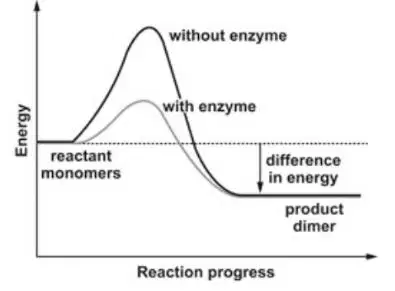
Using the graph pictured, which statement is accurate when comparing the reactants with the products? Choose the letter of the correct answer.
The reactants have more mass than the products.
The reactants form more quickly than the products.
The bonds of the reactants contain more energy than the bonds of the products.
The bonds of the reactants contain the same amount of energy as the bonds of the products.
Which of these explains how a large increase in temperature would most likely affect the function of the enzyme?
The enzyme’s effectiveness would increase, because it would have more energy to catalyze the reaction.
The enzyme’s effectiveness would increase, because it would interact with more of the reactants.
The enzyme’s effectiveness would decrease, because it would change shape and be less able to catalyze the reaction.
The enzyme’s effectiveness would decrease, because it would no longer be able to provide the energy needed to bond the monomers.
How do changing temperatures and pH effect an enzyme?
they break down the reactants
they break down the product
they lessen the effectiveness of the enzyme
they increase the effectiveness of the enzyme

The following equations represent chemical reactions. Which equation shows that the total mass during a chemical reaction stays the same? law of conservation of mass
1
2
3
4
Atoms connected by covalent bonds share ____.
hydrogen ions
ionic compounds
pairs of electrons
carbon and oxygen

The diagram above shows the particles that make up an atom. What is the name of the negatively charged particles shown in this model of an atom?
prions
protons
neutrons
electrons
In an __________ bond, the atoms are bound together by the attraction between oppositely-charged ions.
In a __________ bond, the atoms are bound by shared electrons.
A liquid has a pH of 1. What does this mean?
It is neutral
It is a strong acid
It is weak acid
It is a strong base
Water is a polar molecule because ______.
it has a charge
it does not have a charge
it contains two hydrogen atoms for each oxygen atom
different parts of the molecule have slightly different charges
A liquid has a pH of 8. What does this mean?
It is a weak acid
It is a weak base
It is a strong base
It is neutral

