
 Worksheets
Roaring 20s/Great Depression/New Deal Test Review
Total questions: 40
Worksheet time: 20mins
Name
Class
Date
1.
Which of these was an example of President FDR trying to extend his powers as president?
a)
The passing of his New Deal Legislation
b)
Running for office for a third term
c)
Attempting to create 6 new spots on the Supreme Court in order to gain a majority
d)
Utilizing the radio for his fireside chats
2.
How was FDR able to get so many of his New Deal Legislation passed?
a)
His party had a majority in both Congress and the Supreme Court
b)
He used his executive powers
c)
It had the support of all the people in the country
d)
It is easy to pass legislation in the United States
3.
Which of these were problems occurring in the late 20s
a)
Crop Overproduction
b)
Americans overextending on credit
c)
Bad stock market habits
d)
All of the above
4.
Which generalization best characterizes the Scopes Trial?
a)
A clash between state authority and federal power
b)
A conflict between modern science and creationism
c)
A contest between public and private school philosophies
d)
A challenge between individual freedom and social conformity
5.
Which development most contributed to the increasing social independence of Americans in the early twentieth century?
a)
Greater access to automobiles
b)
Improved telecommunications
c)
Emergence of Victorian ideals
d)
Rise of the Populist movement
6.
With which of the following are Zora Neale Hurston and Langston Hughes most closely associated?
a)
World War II
b)
Women’s Suffrage
c)
Harlem Renaissance
d)
Great Depression
7.
Consider this conversation from the 1920’s: “Have you bought an automobile yet?” “No, we felt we couldn’t afford one?” “Mr. Budge has one, and he is not as well off as you are.” “Yes. I know. But their second installment came due, and they had no money to pay it.” “Did they lose the car?” “No, they got the money and paid the installment.” “How did they get the money?” “They sold the cook-stove.” “How could they get along without a cook-stove?” “They didn’t. They bought another one on the installment plan.” What does the conversation best represent?
a)
Increasing consumer reliance on credit
b)
Growing postwar profits in the industrial sector
c)
Federal deregulation of the banking industry
d)
Reduced wages and rising unemployment
8.
Which of the following provided loans to European countries rebuilding from World War I?
a)
Kellogg-Briand Pact
b)
Fordney-McCumber Tariff
c)
Dawes Plan
d)
Washington Naval Conference
9.
All of the following are true about Prohibition EXCEPT
a)
Alcohol was consumed at Speakeasies
b)
It was illegal to buy, sell, or consume alcohol
c)
It was established by the 18th Amendment
d)
The consumption of alcohol decreased dramatically
10.
Which statement about race in the United States is more consistent with the beliefs of Marcus Garvey than with those of W.E.B. Du Bois?
a)
African Americans should strive for political and social equality with whites
b)
African Americans should not endeavor to end segregation but should instead strive to better educate them
c)
African Americans should assimilate into white society and culture
d)
African Americans should focus on economic self-sufficiency and pride in their African heritage
11.
The phrase “Red Scare” refers to what?
a)
The fear immigrants felt concerning postwar nativism
b)
The fear many reformers felt when Prohibition was repealed
c)
The nation’s fear that Communist revolution could occur in the US
d)
The fear African Americans and immigrants felt concerning the Ku Klux Klan
12.
A fundamentalist could best be described as which of the following?
a)
A critic of FDR’s New Deal
b)
A Christian who believes that the Bible is God’s word
c)
A progressive who looks to science for fundamental truths
d)
An economist who opposes direct relief
13.
Who likely made this statement? “I wear bobbed hair and powder my nose. I wear fringed short skirts and bright-colored sweaters with low-heeled shoes. I adore smoking, drinking, and dancing.”
a)
A Gilded Age feminist
b)
A Depression-era homemaker
c)
A Roaring Twenties flapper
d)
A post-World War II subordinate
14.
Which Amendment repealed Prohibition?
a)
17th Amendment
b)
21st Amendment
c)
19th Amendment
d)
18th Amendment
15.
The quote below is most likely from whom? “The best day of my life was when they passed Prohibition. Before that, I was struggling to make enough money to even eat. But now…I can’t count it all, the money rolls in so fast. Hey, a grown man’s gonna drink. All I do is supply what people want. Can I sleep at night? You bet I can.”
a)
Henry Ford
b)
A union worker
c)
A fundamentalist
d)
A bootlegger
16.
Historian Frederick Lewis Allen wrote this description about what historical circumstance?
“It was an era of lawless and disorderly defense of law and order, of unconstitutional defense of the Constitution, of suspicion and civil conflict- in a very literal sense, a reign of terror.”
a)
Prohibition
b)
The Scopes Trial
c)
The Red Scare
d)
World War I
17.
Which achievement made Charles Lindbergh an instant celebrity?
a)
Development of the first polio vaccine
b)
Release of the first motion picture with sound
c)
Completion of the first solo flight across the Atlantic Ocean
d)
Receipt of the first Nobel Peace Prize awarded to an American
18.
Which of these would be an example of Nativism in the US?
a)
Prohibition
b)
The Trial of Sacco and Vanzetti
c)
The Red Scare
d)
Labor Unions
19.
Which of these would be reasons that prohibition was repealed?
a)
It was hard to police.
b)
It increased crime due to bootleggers and speakeasies(Al Capone).
c)
It was an underfunded effort.
d)
All of the above.
20.
The agency hired local workers to construct a series of dams and hydroelectric power plants, which brought cheap electricity to thousands of people.
a)
CCC
b)
TVA
c)
AAA
d)
NRA
21.
How did the New Deal affect how the government was involved in the economy?
a)
It had no effect on the involvement of the government in the economy
b)
It led to less government involvement
c)
It led to more government involvement
d)
None of the above
22.
Which of the following put young men (18-25) to work building roads, developing parks, planting trees, and other helpful projec?
a)
Public Works Administration (PWA)
b)
Civilian Conservation Corps (CCC)
c)
Work Progress Administration (WPA)
d)
Tennessee Valley Authority (TVA)
23.
As President Hoover neared the end of his term in office, he responded to the deepening crisis of the Great Depression by:
a)
Supporting legislation to provide loans to banks, states, and businesses
b)
Proposing policies that would have provided direct aid to farmers and homeowners
c)
Encouraging US citizens/businesses to provide aid and comfort to those in need
d)
Ending programs that provided federal low-interest loans to struggling businesses
24.
Which New Deal reform established government payments for the elderly, unemployed and disabled?
a)
National Labor Relations Act
b)
Agricultural Adjustment Act
c)
Fair Labor Standards Act
d)
Social Security Act
25.
The National Recovery Administration (NRA) tried to address what Great Depression issue?
a)
The high unemployment rate
b)
The Dust Bowl
c)
The Stock Market Crash
d)
Disagreements between workers and business owners
26.
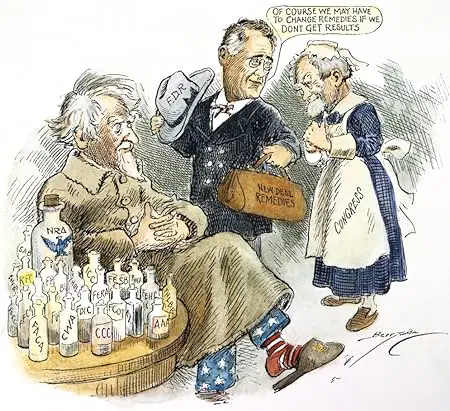
The doctor in the political cartoon below is
a)
President Warren Harding
b)
President Franklin Roosevelt
c)
President Herbert Hoover
d)
President Calvin Coolidge
27.
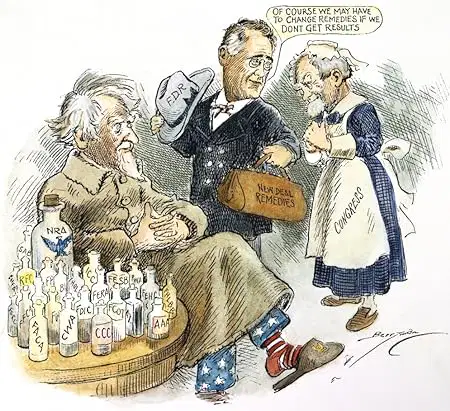
The bottles on the left are supposed to represent
a)
Various labor unions
b)
Various New Deal laws
c)
Various 1920’s organizations
d)
Laws passed by Congress during the 1920’s
28.

Who most likely would have been the author of the above cartoon?
a)
A Democrat who supported the New Deal
b)
A World War I veteran
c)
A Harlem Renaissance artist
d)
A Republican who felt FDR was overstepping his bounds as President
29.
Which of the following is most responsible for the improvement of the economy from 1933 through 1939?
a)
The effects of New Deal relief and recovery efforts
b)
The establishment of the Lend-Lease program to aid Allied nations
c)
The impact of the Great Depression on stockholders’ profits
d)
The increase in War Production Board orders to munitions manufacturers
30.
What was significant about FDR’s fireside chats?
a)
They called for an end to direct relief and deficit spending
b)
They helped FDR defeat Calvin Coolidge
c)
They sparked controversy by suggesting that the nation was in a depression
d)
They marked the first time that a president effectively used radio
31.
The Securities and Exchange Commission (SEC) was established to:
a)
Insure bank deposits and promote economic stability
b)
Mediate between business and labor and to ensure fair competition
c)
Regulate the prices of agricultural goods and to reduce surpluses
d)
Oversee stock trading and to prevent fraud
32.

The picture to the right shows a shack that the poor lived in during the Great Depression. In their anger, they named these shacks after which President?
a)
Warren Harding
b)
Calvin Coolidge
c)
Franklin Roosevelt
d)
Herbert Hoover
33.
Roosevelt’s plan for economic relief and recovery was called what?
a)
The New Deal
b)
Fireside Chats
c)
The Roaring Twenties
d)
Deficit Relief
34.
Which New Deal reform protects bank deposits?
a)
Tennessee Valley Authority (TVA)
b)
Federal Deposit Insurance Corporation (FDIC)
c)
Wagner Act
d)
Securities and Exchange Commission (SEC)
35.
All of the following are true about the Bonus Army incident EXCEPT
a)
They were protesting outside the White House
b)
President Hoover was applauded for compromising with the veterans
c)
President Hoover ordered the army to attack them when they refused to leave
d)
They wanted their pensions from World War I
36.
Someone who buys stock for less than what it is worth, then borrows the difference in the hopes of making money is said to be doing what?
a)
Buying on margin
b)
Purchasing tariffs
c)
Engaging in mass production
d)
Undermining laissez-faire economics
37.
All of the following were causes of the Great Depression EXCEPT
a)
The Dust Bowl
b)
The Stock Market Crash
c)
Immigration Quotas
d)
High Unemployment
38.
Which of the following identifies a significant impact that radio had on US society?
a)
It stimulated greater readership of newspapers
b)
It transformed attitudes toward gender roles
c)
It heightened consumer interest in television
d)
It increased access to news and entertainment
39.
How would an active supporter of the Socialist Party during the Great Depression most likely have felt about the Tennessee Valley Authority?
a)
Enthusiastic, because government was asserting itself in the private sector to benefit many people
b)
Discouraged, because government was undermining small family farmers and subsidizing agribusiness
c)
Angry, because it represented a threat to the spirit of free enterprise and entrepreneurial capitalism
d)
Alarmed, because it was an unprecedented and dangerous step toward collectivization
40.
Hoover advocated a strict laissez-faire (hands-off) policy dictating that the federal government should
a)
Only interfere on a temporary basis to stop inflation
b)
Provide direct relief to the American public
c)
Only interfere if our national security was threatened
d)
Not interfere with the economy but rather let the economy right itself.
100 %

