
 Worksheets
Semester 1 Final Exam Vocab Review
Total questions: 75
Worksheet time: 1hrs 27mins
Match each term to its definition
Two or more line segments which have the same length
Congruent Segments
Three or more points which lie on the same line
Collinear Points
Two or more Geometric Figures which lie on the same plane
Coplanar Figures
A set of points which two or more Geometric Figures have in common
Intersection
Match each term to its definition
Two angles whose measure add up to 90
Complementary Angles
Non-adjacent angles formed by intersecting lines
Vertical Angles
Two angles whose measures add up to 180 degrees
Supplementary Angles
A pair of adjacent angles that are supplementary
Linear Pair

Which of the following are sets of collinear points? Select all that apply
Q, T, and N
R, T, and Q
P, T, and N
M, T and R
Name a point that is not contained in plane PTQ
R
M
j
Q

Which of the following is not another name for Plane S?
Plane RTP
Plane PTQ
Plane QTN
Plane PTN
What is the intersection of line j and Plane S ?
g
Line MT
T
They do not intersect
Match each Acronym to the appropriate picture

ASA

AAS

HypLeg

SSS

SAS

What is the intersection of Plane S and line j ?
Point T
line h
line MT
Plane PTQ
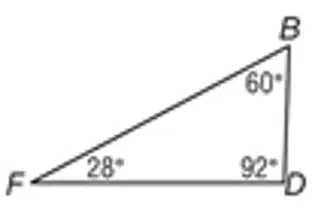
The triangle shown is most accurately described (based on angle measure) as
Acute
Obtuse
Equiangular
Right
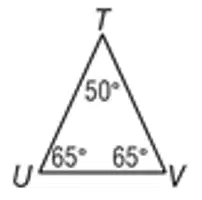
The triangle shown is most accurately described (based on angle measure) as
Acute
Obtuse
Equiangular
Right
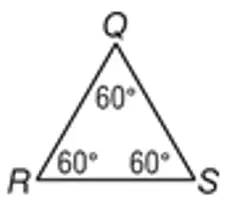
The triangle shown is most accurately described (based on angle measure) as
Acute
Obtuse
Equiangular
Right

Which term best describes Segment CD and Segment BX?
Parallel
Intersecting
Skew
Adjacent

Select the line segments which are parallel to segment AD. Select all that apply
BC
ZY
ZW
AW
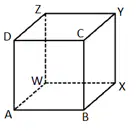
In the picture, Plane ABX is parallel to plane (a)
What does the Acronym CPCTC stand for? Drag the correct words onto the image
Trigonometry
Pencil
Complementary
Congruent
Corresponding
Parts of
are Congruent
Triangles

Match the following Pairs of Angles with the appropriate vocabulary term
Angle 1 and Angle 11
Alternate Exterior Angles
Angle 2 and Angle 4
Vertical Angles
Angle 9 and Angle 13
Corresponding Angles
Angle 6 and Angle 16
Alternate Interior Angles
Angle 4 and Angle 5
Consecutive Interior Angles
Match the Term to its definition:
Complementary Angles
Two angles whose measures add up to exactly 90 degrees.
Two angles whose measures add up to exactly 180 degrees.
A pair of angles which have the same orientation at different points of intersection
Two angles which share a common vertex and a common side.
Match the Term to its definition:
Supplementary Angles
Two angles whose measures add up to 90o
Two angles with a common vertex and a common side
Two angles whose measures add up to 180o
Non adjacent angles formed by intersecting lines.
Match the term to its definition:
Vertical Angles
Two angles which share a common vertex and a common side.
Non-adjacent angles formed by intersecting lines
A pair of Adjacent Angles whose non-common sides are opposite rays
Two angles whose measures add up to exactly 180 degrees
Match the term to its definition:
Adjacent Angles
Two angles whose measures add up to exactly 180 degrees
Two angles whose measures add up to exactly 90 degrees
Two angles with a common vertex and a common side
Non adjacent angles formed by intersecting lines.
Match the term to its definition:
Linear Pair
Adjacent Angles whose non-common sides are opposite rays.
Non-adjacent angles formed by intersecting lines
Two angles whose measures add up to exactly 90 degrees.
Two angles whose measures add up to exactly 180 degrees.
Match the term to its definition
Ray
A part of a line with one distinct endpoint that extends infinitely in one direction.
A piece of a line with two distinct endpoints.
Two angles with a common vertex and a common side
Two noncollinear rays which share a common endpoint
Match the term to its definition
Line Segment
A part of a line with one distinct endpoint that extends infinitely in one direction.
A piece of a line with two distinct endpoints.
Two angles with a common vertex and a common side
Two noncollinear rays which share a common endpoint
Match the term to its definition
Angle
A part of a line with one distinct endpoint that extends infinitely in one direction.
A piece of a line with two distinct endpoints.
Two angles with a common vertex and a common side
Two noncollinear rays which share a common endpoint
Match the term to its definition
Skew Lines
A part of a line with one distinct endpoint that extends infinitely in one direction.
Coplanar lines which do not intersect
Non-coplanar lines which do not intersect
Two noncollinear rays which share a common endpoint

The shape shown is best described as:
Convex Decagon
Concave Decagon
Convex Dodecagon
Concave Dodecagon

The shape shown is best described as:
Convex Decagon
Concave Decagon
Convex Dodecagon
Concave Dodecagon

The shape shown is best described as:
Convex Heptagon
Concave Heptagon
Convex Hexagon
Concave Hexagon

The shape shown is best described as:
Convex Quadrilateral
Concave Octagon
Convex Octagon
Concave Quadrilateral

The shape shown is best described as:
Convex Heptagon
Concave Heptagon
Convex Hexagon
Concave Hexagon

Classify the Triangle as Acute, Obtuse, Equiangular, or Right
Acute
Obtuse
Equiangular
Right

Classify the Triangle as Acute, Obtuse, Equiangular, or Right
Acute
Obtuse
Equiangular
Right

Classify the Triangle as Acute, Obtuse, Equiangular, or Right
Acute
Obtuse
Equiangular
Right

Classify the Triangle as Acute, Obtuse, Equiangular, or Right
Acute
Obtuse
Equiangular
Right

Classify the Triangle as Acute, Obtuse, Equiangular, or Right
Acute
Obtuse
Equiangular
Right

Classify the triangle as Scalene, Isosceles or Equilateral
Scalene
Isosceles
Equilateral

Classify the triangle as Scalene, Isosceles or Equilateral
Scalene
Isosceles
Equilateral

Classify the triangle as Scalene, Isosceles or Equilateral
Scalene
Isosceles
Equilateral

Classify the triangle as Scalene, Isosceles or Equilateral
Scalene
Isosceles
Equilateral

What type of angle pair is shown?
adjacent angles
complementary angles
linear pair
vertical angles

What type of Angle Pair are angles 4 and 8?
Corresponding Angles
Consecutive Exterior Angles
Alternate Interior Angles
Linear Pair

What is the angle pair relationship shown?
Alternate Interior Angles
Alternate Exterior Angles
Corresponding Angles
Consecutive Interior Angles

Classify the relationship between angles 1 and 7?
Alternate Interior Angles
Alternate Exterior Angles
Corresponding Angles
Consecutive Exterior Angles

What type of angle pair is ∠1 and ∠3?
Alternate Interior Angles
Linear Pair
Corresponding Angles
Vertical Angles

Which angles are alternate exterior?
∠2 and ∠6
∠2 and ∠8
∠2 and ∠7
∠2 and ∠4

Name the angle pair relationship shown.
Alternate Interior Angles
Alternate Exterior Angles
Corresponding Angles
Vertical Angles

Which angles are alternate interior?
∠2 and ∠6
∠10 and ∠16
∠12 and ∠3
∠7 and ∠13

Name the angle which is alternate interior to ∠3 .
∠4
∠5
∠6
∠8

∠12 and ∠13 are......
Corresponding Angles
Alternate Interior Angles
Consecutive Exterior Angles
Consecutive Interior Angles

∠2 and ∠7 are .......
Corresponding Angles
Alternate Interior Angles
Consecutive Exterior Angles
Consecutive Interior Angles

∠3 and ∠4 are......
Corresponding Angles
Alternate Interior Angles
Alternate Exterior Angles
a Linear Pair
Match the following terms to their definitions
A statement which has been proven
Theorem
A statement which is accepted as true without a proof
Postulate
A conditional statement which follows from a proven theorem (or postulate) without a proof
Corollary
Match the following Notation statements to their meanings

Line AB

Line Segment AB

Ray AB

Length of segment AB
Match the following symbols to their meanings
≅
Congruent
∧
And
∨
Or
∼
Similar

What two formulas can you use to find the circumference?
C = π·d
C = π·r2
C = 2·π·r
C = d2


Put the Related Terms in each space
x-values
Input
independent Variable
y-values
Output
Dependent Variable
Which of the following Terms mean the same thing as Solutions?
y-intercepts
x-intercepts
vertex
roots
zeros

What is the vertex of ∠6 ?
N
R
M
6
What is the vertex of ∠3 ?
N
R
S
P
What are the sides of ∠3 ? Select All that Apply
RN
RP
NR
RQ
What are the sides of ∠4 ? Select All that Apply
QR
QP
NR
RQ
Which of the following is NOT another name for ∠NPR ?
∠RPN
∠7
∠MPR
∠5

Match Each Angle to its Alternative Name
∠AGE
∠8
∠5
∠GEF
∠ABE
∠EBA
∠3
∠CBD
∠AEB
∠AEC
Choose the Property that Justifies the following statement
If 80=m∠A Then m∠A=80
Symmetric Property
Reflexive Property
Subtraction Property
Distributive Property
Choose the Property that Justifies the following statement
If RS=TU and TU=YP Then RS=YP
Symmetric Property
Transitive Property
Division Property
Addition Property
Choose the Property that Justifies the following statement
If 7x=28 Then x=4
Reflexive Property
Distributive Property
Division Property
Addition Property
Choose the Property that Justifies the following statement
If VR+TY=EN+TY Then VR=EN
Reflexive Property
Symmetric Property
Division Property
Subtraction Property
Choose the Property that Justifies the following statement
If m∠1=30 and m∠1=m∠2 Then m∠2=30
Distributive Property
Symmetric Property
Substitution Property
Subtraction Property
Choose the Property that Justifies the following statement
If m∠1=m∠2 Then m∠2=m∠1
Distributive Property
Symmetric Property
Substitution Property
Subtraction Property
Choose the Property that Justifies the following statement
If AB=RS and RS=WY Then AB=WY
Transitive Property
Symmetric Property
Substitution Property
Subtraction Property
Choose the Property that Justifies the following statement
If AB=CD Then 21AB=21CD
Transitive Property
Distributive Property
Multiplication Property
Subtraction Property
Choose the Property that Justifies the following statement
AB=AB
Transitive Property
Distributive Property
Multiplication Property
Reflexive Property

