
 Worksheets
Middle School Adventure Final Exam Review Quiz
Total questions: 27
Worksheet time: 14mins
Which of the following knots is part of the Figure 8 family and is most commonly used for tying into a harness?
Double Fisherman's Knot
Bowline Knot
Figure 8 Follow-Through Knot
Prusik Knot
In the PBUS belay technique, what does "P" stand for?
Prevent
Position
Pull
Proper
Which of the following is a common belay command used in top rope climbing?
"Climbing!"
"Fire!"
"On belay?"
"Ready to rappel?"
When falling while bouldering, which of the following is the safest way to land?
With your arms fully extended
Feet first with your knees slightly bent
On your back
On your stomach
What is the primary purpose of flaking a rope before use?
To reduce the rope's weight
To prevent tangles and ensure smooth handling
To determine the rope's strength
To make the rope more flexible
Contour lines are lines drawn on a map that connect points of ___________?
different elevation
equal elevation
different temperature
equal distance
different pressure
Closed contour lines (circles) usually show ________?
hills
lakes
flatlands
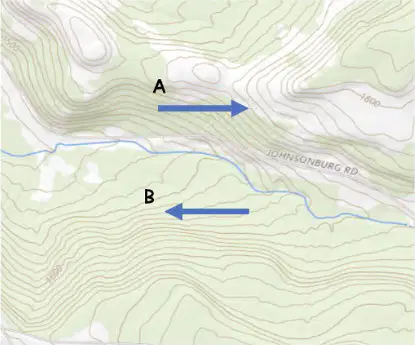
Which way does this stream flow?
A
B
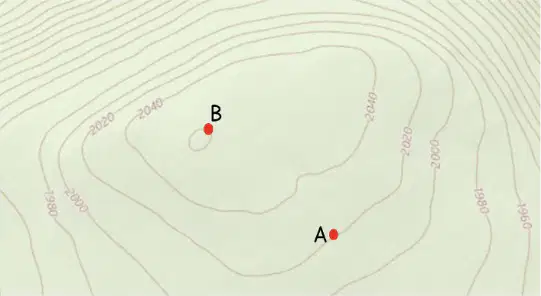
What is the elevation of points A and B on this map?
2000 feet and 2040 feet
2040 feet and 2080 feet
2080 feet and 2120 feet
2120 feet and 2160 feet
A Figure 8 on a Bight is used to tie a rope directly to an anchor or a harness without the need for tying a knot at the end of the rope.
True
False
The "B" in PBUS stands for "Brake," which refers to maintaining the correct amount of slack in the rope while belaying.
True
False
"Climbing" is a command given by the climber to signal they are ready to start climbing.
True
False
Coiling a rope is primarily done to store it when not in use, but it is also useful for carrying it over long distances.
True
False
Topo maps define natural and manmade features like hills, valleys, vegetation, water, trails, bridges and roads.
True
False
Contour lines never cross each other.
True
False
Which piece of climbing gear is used to protect a climber in case of a fall?
Harness
Paddle
Helmet
Wetsuit
How do you properly execute the PBUS technique while belaying?
Keep your body leaned back, hand in the brake position, and focus on controlling the rope.
GIve the rope a lot of slack to let the climber climb up as far as they can.
Let go of the brake strand only occasionally when feeding rope.
What are the common mistakes when using PBUS in top rope belaying?
Belaying with both hands on the brake side of the rope.
Not maintaining a stable and strong stance while belaying.
Giving too much slack to the climber.
All of the above.
How should you respond to this climbing command as a belayer?
Climber says "Climbing"
You say "_____ __"
(a)
When should you use "on belay" and "belay on" during top rope belaying?
"On belay" when ready to climb, "belay on" when belaying begins.
"On belay" is used only after a fall, "belay on" is for initial belaying.
"On belay" is used only for outdoor climbs, "belay on" is for indoor climbs.
What is the primary role of the belayer in ensuring climbing safety?
To ensure the climber is moving quickly
To provide encouragement and support
To keep the rope tight and manage slack while protecting the climber
To climb as fast as possible to rescue the climber if injured
How can you check your harness before starting to climb to ensure it is properly secured?
Only check the leg straps since the waist loop is optional.
Ask the climber if they feel safe.
Pull on all straps and make sure they are tight, and check the waist and leg loops for snugness.
When should you flake a rope before starting a climb?
After every climb, whether it’s tangled or not.
Only when you see a knot in the rope.
Before each use to prevent tangling.
Only when the rope is wet
When falling from a bouldering route, what is the role of your arms?
Stretch your arms straight out to break your fall.
Tuck your arms into your body to prevent injury.
Use your arms to protect your head and neck.
Try to catch yourself with your arms extended.
What type of knot is commonly used to tie the climbing rope to a harness?
Bowline knot
Square knot
Figure-eight knot
Clove hitch
What is a common sign that a climbing rope is worn out and needs to be replaced?
The rope becomes too stiff to coil properly.
The rope has visible frays, cuts, or flat spots.
The rope is difficult to untangle after use.
The rope becomes too light in weight.
What is the primary reason for wearing climbing shoes?
To keep your feet warm.
To protect your feet from injury.
To improve your grip and footwork on the rock.
To look stylish while climbing.

