wayground logo

Free Printable Worksheets

NEW

Font size

S
M
L
XL
Worksheets

unit 4 (congruence) Prep

Total questions: 36

Worksheet time: 2hrs 40mins
Name
Class
Date
1.
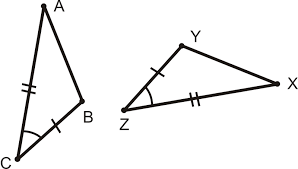
Which triangle congruence theorem can be used to prove the triangles are congruent?
a)
SAS
b)
SSS
c)
ASA
d)
HL
2.
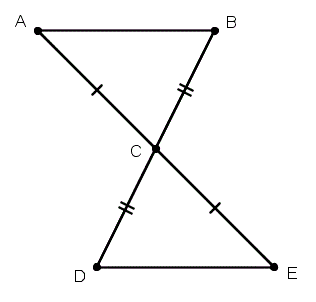
Which triangle congruence theorem can be used to prove the triangles are congruent?
a)
SSS
b)
ASA
c)
AAS
d)
SAS
3.
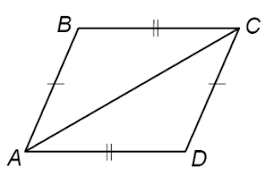
Which triangle congruence theorem can be used to prove the triangles are congruent?
a)
AAS
b)
SSS
c)
SAS
d)
SSA
4.
Which triangle congruence theorem can be used to prove the triangles are congruent?
a)
SAS
b)
Not enough information
c)
SSS
d)
AAS
5.

Which congruency statement can be written for the triangles pictured?

a)

ΔACBΔABD\Delta ACB\cong\Delta ABD

b)

ΔBACΔBAD\Delta BAC\cong\Delta BAD

c)

ΔCABΔDBA\Delta CAB\cong\Delta DBA

d)

ΔADBΔBCA\Delta ADB\cong\Delta BCA

6.

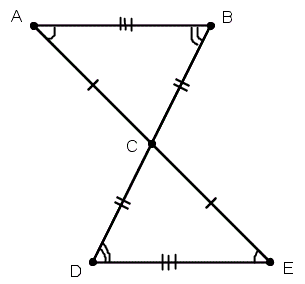
Which congruency statement can be written for the triangles pictured?

a)

ΔABC ≅ ΔEDC

b)

ΔACB ≅ ΔEDC

c)

ΔECD ≅ ΔCAB

7.

Which triangle congruence theorem can be used to prove the triangles are congruent?

a)

SSS

b)

SAS

c)

ASA

d)

NONE

8.
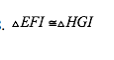
Use the congruency statement to answer the following: 
∠F = ___
a)
∠H
b)
∠I
c)
∠G
d)
not congruent to another angle
9.
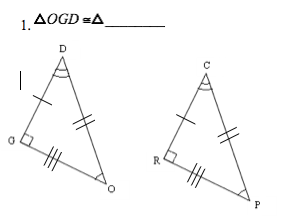
Complete the congruence statement.
a)
CRP
b)
PCR
c)
RPC
d)
PRC
10.

State if the two triangles are congruent. If they are, state which theorem you would use.

a)

Yes, SAS

b)

Yes, SSS

c)

Yes, HL

d)

Yes, ASA

e)

Not Congruent

11.
What is the measure of <C?
a)
5º
b)
25º
c)
100º
d)
125º
12.
If ΔDEF ≅ ΔRST, then we can conclude that DE = what?
a)
ST
b)
RS
c)
DF
d)
RT
13.
These triangles are congruent. If ∠E is 45o and ∠B is 55o what is the measure of ∠C?
a)
45o
b)
55o
c)
80o
d)
100o
14.
∆ABC≅∆XYZ
which is true?
a)
AB≅XY
b)
AB≅YX
c)
AB≅XZ
d)
BC≅CB
15.
Use the congruence statement to find the missing part of the statement
a)
WV
b)
WU
c)
VU
d)
WB
16.
Which set of equivalent measures does NOT make it possible to determine if any two given triangles are congruent?
a)
Angle-Side-Angle
b)
Side-Angle-Side
c)
Angle-Angle-Side
d)
Angle-Angle-Angle
17.

Determine whether the given triangles are congruent.

a)

congruent

b)

not congruent

18.

If ΔEHGΔKFC\Delta EHG\cong\Delta KFC , which statement is true? 

a)

EHFK\overline{EH}\cong\overline{FK}  

b)

HG  KF\overline{HG}\ \cong\ \overline{KF}  

c)

EG  KC\overline{EG}\ \cong\ \overline{KC}  

d)

EC\angle E\cong\angle C  

19.
a)

20

b)

63

c)

35

d)

78

20.
Identify the transformation from ABC to A'B'C'.
a)
90o clockwise rotation
b)
90o counter clockwise rotation
c)
Reflection across the y-axis
d)
Reflection across the x-axis
21.
Identify the transformation from C to D.
a)
90o Clockwise Rotation
b)
180o Rotation
c)
270o Clockwise Rotation
d)
360o Rotation
22.
If you were to rotate ABCD 90° counterclockwise about the origin, what would the coordinate of A' be?
a)
(-5, 5)
b)
(-3, 5)
c)
(-5, 3)
d)
(-3, 3)
23.
Identify the transformation from ABC to A'B'C'.
a)
Reflection across the x-axis
b)
Reflection across the y-axis
c)
90o clockwise rotation
d)
90o counterclockwise rotation
24.
C(-6, 2) and B(-1, -1)
Reflect over the line y = x
a)
C' (-6, 2), B' (-1, -1)
b)
C' (6, 2), B' (1, -1)
c)
C' (2, -6), B' (-1, -1)
d)
C' (-6, -2), B' (-1, -1)
25.

Identify the transformation from ABCD to A'B'C'D'.

a)

Translation

b)

Reflection across the x-axis

c)

Reflection across the y-axis

d)

90o counter clockwise rotation

26.

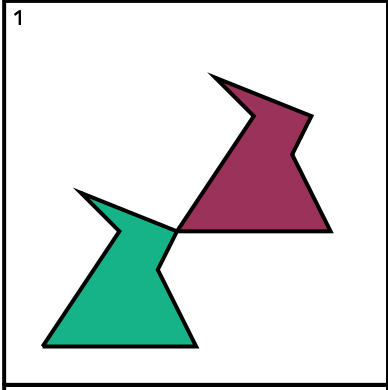
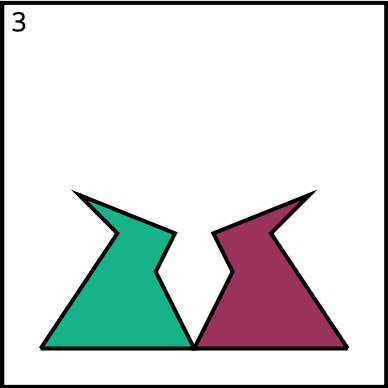
What transformation is this?

a)

Reflection

b)

Translation

c)

Rotation

27.

What transformation is this?

a)

Reflection

b)

Translation

c)

Rotation

28.

What transformation is this?

a)

Translation

b)

Reflection

c)

Rotation

29.

What is the image of the point (3, 3) under the translation (x, y)(x+1, y4)\left(x,\ y\right)\rightarrow\left(x+1,\ y-4\right)  

a)

(4, -1)

b)

(2, 7)

c)

(-1, 4)

d)

(7, 2)

30.

What is the translation rule that maps the point P (4, 1) to the point P' (-3, -5)?

a)

(x, y)(x  7, y 6)\left(x,\ y\right)\rightarrow\left(x\ -\ 7,\ y\ -6\right)  

b)

(x, y)(x +7, y + 6)\left(x,\ y\right)\rightarrow\left(x\ +7,\ y\ +\ 6\right)  

c)

(x, y)  (x1, y + 4)\left(x,\ y\right)\ \rightarrow\ \left(x-1,\ y\ +\ 4\right)  

d)

(x, y)  (x+1, y 4)\left(x,\ y\right)\ \rightarrow\ \left(x+1,\ y\ -4\right)  

31.

What is the translation rule that maps the black image onto the blue image?

a)

(x, y)(x3, y+2)\left(x,\ y\right)\rightarrow\left(x-3,\ y+2\right)

b)

(x, y)(x+3, y2)\left(x,\ y\right)\rightarrow\left(x+3,\ y-2\right)

c)

(x, y)(x+2, y1)\left(x,\ y\right)\rightarrow\left(x+2,\ y-1\right)

d)

(x, y)(x+2, y3)\left(x,\ y\right)\rightarrow\left(x+2,\ y-3\right)

32.

Which rule describes the transformation from RSTUVW to R'S'T'U'V'W'?

a)

(x, y)  (y, x)\left(x,\ y\right)\ \rightarrow\ \left(-y,\ x\right)

b)

(x, y)  (y, x)\left(x,\ y\right)\ \rightarrow\ \left(y,\ -x\right)

c)

(x, y)  (x, y)\left(x,\ y\right)\ \rightarrow\ \left(-x,\ -y\right)

d)

(x, y)  (y, x)\left(x,\ y\right)\ \rightarrow\ \left(-y,\ -x\right)

33.

Rotate ΔQJH 90⁰ counter-clockiwse about the origin and determine the location of ΔQ'J'H'.

a)

Q'(0, -1); J'(-5, 3); H'(-3, -5)

b)

Q'(1, 0); J'(3, -5); H'(5, -3)

c)

Q'(-1, 0); J'(-3, -5); H'(-5, -3)

d)

Q'(-1, 0); J'(-3, 5); H'(-5, 3)

34.

ΔABC is rotated 90⁰ clockwise. Determine the coordinates of ΔA'B'C'.

a)

A'(-2, -2); B'(5, 2); C'(2, 4)

b)

A'(-2, 2); B'(-5, 2); C'(-4, 2)

c)

A'(2, -2); B'(5, -2); C'(4, -2)

d)

A'(2, 2); B'(5, 2); C'(4, 2)

35.

An octagon is located in Quadrant II and its rotated 180⁰ clockwise. Which quadrant does it end up in?

a)

Quadrant I

b)

Quadrant II

c)

Quadrant III

d)

Quadrant IV

36.
∆QRS contains the points: Q(4, 2) R(5, 1) S(3,7). If the triangle is reflected across the y-axis, what will S' be?
a)
S'(3, 7)
b)
S'(-3, 7)
c)
S'(-3, -7)
d)
S'(3, 7)