
 Worksheets
Aging Fossils
Total questions: 11
Worksheet time: 14mins
Name
Class
Date
1.
States that younger rocks lie above older rocks if the layers have not been disturbed
a)
Law of crosscutting
b)
Law of superposition
c)
Relative Dating
d)
Unconformity
2.
How does the law of crosscutting explain the age of a fault?
a)
The fault is younger than the rocks above it.
b)
The fault is younger than the rocks it cuts through.
c)
The fault is older than the rocks above it.
d)
The fault is older than the rocks it cuts through.
3.

According to the law of superposition, which layer is the youngest?
a)
A
b)
B
c)
C
4.

Which layer is OLDER? Layer E or Intrusion A?
a)
Layer E
b)
Intrusion A
5.

Which rock layer in the diagram seems to be the oldest?
a)
F
b)
E
c)
B
d)
A
6.
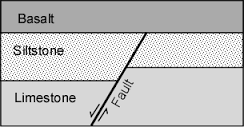
What are the relative ages of the features in order from oldest to youngest?
a)
Limestone, Basalt, Fault, Siltstone
b)
Siltstone, Fault, Basalt, Limestone
c)
Limestone, Fault, Basalt, Siltstone
d)
Limestone, Siltstone, Fault, Basalt
7.
Relative dating of rock layers tells us that the deeper we dig, _______.
a)
the younger the rocks get
b)
the smellier the rocks get
c)
the harder the rocks get
d)
the older the rocks get
8.
How does sedimentary rock usually form?
a)
Vertically
b)
Diagonally
c)
Folding
d)
Horizontally
9.
The Law of Superposition helps scientists to determine what?
a)
The absolute age of rock layers
b)
The age of fossils
c)
The relative age of rock layers
d)
the super powers of squirrels
10.
A trace of an ancient organism that has been preserved in rock.
a)
Fossil
b)
Law of Superposition
c)
Law of Original Horizontality
d)
Law of Fossils
11.
How do most fossils form?
a)
An insect becomes trapped in amber.
b)
An entire organism becomes frozen in ice.
c)
A dead organism becomes buried in sediment.
d)
A dead organism becomes buried in tar.
100 %

