
 Worksheets
QB 2 Review 2024 Pt
Total questions: 20
Worksheet time: 39mins
SS.7.CG.1.6-Consent of the Governed means that government can only get their power from _____________.
God
The King
The People
Parliament

SS.7.CG.1.11-What is the Rule of Law?
The government and those who govern are bound by the law
People are the source of any and all governmental power
The government is not all powerful, and only do the things that the people have allowed it to do
The government must follow procedures before they may deprive a person of their rights
Use the quote to answer the question.
SS.7.CG.1.11-“The President, Vice President, and all civil Officers of the United States shall be removed from Office on Impeachment for, and Conviction of, Treason, Bribery, or other high Crimes and Misdemeanors.”
Source: U.S. Constitution, Article II, Section 4
Which Constitutional Principle is being described in this quote?
Equality of mankind
Rule of Law
Limited Government
Due Process of Law
SS.7.CG.1.7-Why did Shays' Rebellion happen?
The government raised taxes on poor farmers, who were getting their land taken away for non-payment
The government was taking away farmers rights to price their crops as they saw fit
Daniel Shays was angry at his local government for creating too much competition for his products
The government was forcing farmers to pay a tax on its use of farm equipment
SS.7.CG.1.10-What was the primary concern of the Anti-Federalists during the ratification of the U.S. Constitution?
SS.7.CG.1.10-What was the outcome of the debate between Federalists and Anti-Federalists over the ratification of the U.S. Constitution?
SS.7.CG.1.1-Who had an influence on the American government?
Greeks, Europeans, Judeo-Christian
Greeks, Romans, Judeo-Christian
Judeo-Christian
Romans, Persians, Greeks
SS.7.CG.3.3-The main job of the legislative branch is to
resolve disputes involving the law
enforce and carry out federal laws
make laws needed for the country
obey laws once they are passed
SS.7.CG.3.3-The judicial branch is responsible for
resolving disputes under the law
putting federal laws into effect
vetoing laws it doesn't like
making new laws to stop crime
SS.7.CG.3.5-Which government institution may vote on constitutional amendments?
bureaucracy
executive
judicial
legislative

SS.7.CG.3.5-Based on the headline, what happened before the event presented in the image?
Two-thirds of each house of Congress voted to support the amendment
The president rejected the amendment after Congress voted to support it
Three-fourths of each house of Congress voted to support the amendment
The president forwarded the amendment to the states after Congress voted to support it
SS.7.CG.3.5-Ratification of proposed amendments happens
SS.7.CG.3.5-After a change to the constitution has been proposed by 2/3 of both Houses of Congress, what fraction of the state legislatures must ratify (approve) the amendment before it is added to the U.S. Constitution?
2/3
1/2
3/4
1/3
SS.7.CG.1.7-How did the U.S. Constitution address the problem under the Articles of Confederation that
Congress had no power to ensure its laws were followed by the states.
It created an executive branch to enforce laws
It gave each state sovereign authority over its laws.
It required the president to resolve disputes between states.
It required unanimous consent of states to create new laws.
SS.7.CG.1.6-The Declaration of Independence included these complaints:
• Taxation without representation
• Limiting judicial powers
• Quartering Troops
• Dissolving legislature
Which complaint should be added to this list?
Requiring colonists to send representation to Parliament
Suspending trial by jury in many cases
Ordering colonists to move from Native American land
Allowing the wealthy to avoid local laws

SS.7.CG.1.5-The diagram describes a cause that led to the writing of the Declaration of Independence.
Which action completes the diagram?
British eliminate all taxes on colonists
Colonists vote to elect new member of Parliament
British ignore colonist grievances
Colonist send troops to Britain in protest

SS.7.CG.1.5-The Quartering Act forced the colonists to
House and feed British soldiers
Give up all of their quarters
Pay property taxes
Pay taxes on tea
The following rules are part of the Judeo-Christian tradition.
· Do not kill
· Do not steal
· Respect your mother and father
· Do not envy your neighbor's possessions
Which influence on the American constitutional republic is illustrated by those rules?
republicanism
separation of powers
democratic principles
ethical ideas of justice
The statements below are from an ancient history of Rome.
(1) When the news of these proceedings reached the camp, the king; alarmed at the turn that events were taking, hurried to Rome to quell the outbreak . . .
(2) [The king] found the gates shut, and a decree of banishment passed against him; the liberator of the city received a joyous welcome in the camp, and the king's sons were expelled from it . . .
(3) The whole duration of the royal government from the foundation of the city to its liberation was 244 years.
(4) Two consuls were then elected [by the citizens] in the assembly . . . in accordance with the regulations . . .
— Livy, From the Founding of the City, Book I
Which statement reflects the principle of representative government?
Statement (1)
Statement (2)
Statement (3)
Statement (4)
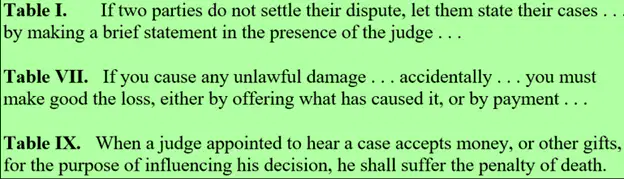
The statements below were among those publicly displayed in ancient Rome around 450 BC. Which influence on the founders of the American constitutional republic is illustrated by these statements?
representative government
rule of law
republicanism
civic participation

