
 Worksheets
8th grade Winter Exam
Total questions: 82
Worksheet time: 56mins
Matching: Reconstruction Constitutional Amendments
"All persons born or naturalized in the United States…are citizens of the United States."
14th Amendment
"The right of citizens of the United States to vote shall not be denied."
15th Amendment
"Neither slavery nor involuntary servitude…shall exist within the United States."
13th Amendment
The Radical Republicans were Congressional Republicans who --
supported slavery.
Wanted to bring the south back into the Union quickly.
wanted to send Union troops to the South to protect the rights of freed Blacks.
All of the above.
Why was Abraham Lincoln’s Reconstruction Plan sometimes called “The 10% Plan?”
It called for a 10% tax on Southern products to pay their Civil War debts.
10% of each Southern state’s voters were required to pledge loyalty to the United States and support emancipation before that state was readmitted into the Union.
Southern states would be required to provide employment for 10% of the freed Blacks in their population.
None of the above
The Wade-Davis Bill—
Was drafted by Congressional Democrats in 1864.
Stated that 50% of voters in Southern states must take the oath of allegiance to the United States.
Passed both houses of Congress and was signed into law by President Lincoln.
All of the above.
True/False: President Andrew Johnson
Originally took office after Lincoln's assassination
was impeached
called for state conventions to repeal secession.
was reelected twice
would not allow Southern states to rejoin the Union
6. What was a “Scalawag?”
A derogatory term for Southern whites who supported Reconstruction
A nickname for Northern carpetbaggers
A term for Confederate soldiers
A name for Southern plantation owners
7. What was a “Carpetbagger?”
A person from the northern states who went to the South after the Civil War to profit from the Reconstruction.
A Southern farmer who supported the Confederacy during the Civil War.
A member of the Confederate army during the Civil War.
A Southern politician who opposed Reconstruction policies.
The Freedmen’s Bureau—
Helped former enslaved people with school, jobs, and housing.
Registered former slaves for the purpose of collecting their debts for Southern governments.
Had as a major goal of assisting Black women start their own businesses and buy property.
Supported indigenous populations, specifically the Cherokee of Georgia.
What was the Ku Klux Klan?
A group of Southern Democrat politicians that supported the rights of freed Blacks.
A group of Republican U.S. Senators that opposed returning to the Union.
Former Confederate soldiers who terrorized Black people across the South.
Former Union soldiers who opposed Southern re-entry into the Union.
How was sharecropping similar to the old plantation system?
Freed Black people ended up working plantations again for very little (if any) money.
By becoming sharecroppers, freed Black people agreed to give up all of their new rights as promised by the 13th, 14th, and 15th Amendments.
Plantations returned to producing massive amounts of rice and beans, which had always been their main products.
Sharecropping was not similar at all to the old plantation system.
What were the Black Codes?
A written code system used by freed Blacks in the South to secretly communicate with and assist the Black slaves of Haiti who were planning a revolution against white French plantation owners.
A code of conduct freed Black people created to ensure community-wide respect, fairness, and inclusion.
Laws passed in the South that limited the rights of free Black people.
Laws passed in the South that guaranteed the civil rights of all Black people.
Organize these options into the right categories
elected US president in 1868
advocated for the rights of freed slaves
urged Southerns to reconcile with the Union
On June 19th, 1865—
The Emancipation Proclamation was two years old.
The 13th Amendment had already been written.
The Confederate Army had already surrendered.
Union soldiers arrived in Texas and freed the last remaining 250,000 Black people who were still enslaved.
All of the above.
Which of the following is NOT true of the Compromise of 1877?
Free Black men in the South agreed to send 100,000 Black soldiers to join the Union army.
All Union troops were pulled out of the South.
Democrats in Congress agreed not to dispute the results of the election of 1876.
It marked the end of Reconstruction.
"Jim Crow" was—
a nickname given to any free Black man running for political office in the South
The free Black man who started the movement that founded the free nation of Liberia in Africa
A former Confederate soldier who led Southerners in supporting the rights of free Black people
An era in which white supremacists took power across the South, segregation became the norm, and Southern states found ways to strip fee Black citizens of their new civil rights
The term Reconstruction means:
to rebuild the South after the Civil War
to build up industry in the North after the Civil War
to reconstruct the White House after the Civil War
to rebuild the lives of slaves in the south
Which of the following was NOT used to keep African Americans from voting?
literacy tests
intimidation by the Ku Klux Klan
poll taxes
blood tests
What is the meaning of the term "Gilded Age?"
Many craftsmen’s “gilds” were established in the US, similar to those in the Middle Ages.
Mark Twain used this term to describe the time period in American history when many social problems masked by a thin layer of gold that made things look better than they actually were.
A “gild” is a form of government similar to a democracy, and Mark Twain was making a comparison between the two.
None of the above.
What does “Melting Pot” mean and how is it related to the Gilded Age?
The blending together of cultures in America due to high immigration numbers in the late 19th century.
A term once used for New York City because the “heat” of so much political chaos in the late 19th century made people feel like the city government was “melting.”
The summer of 1886 when major heatwaves swept the East Coast and the West.
The fall of 1890 when severe wildfires swept across the South burning crops and “melting” the agricultural economy.
Nativism was —
A movement to fully include indigenous groups in American society.
New immigrants’ loyalty to their “native” country, such as Ireland, Poland, or Italy.
An anti-immigrant movement during a period of high immigration in the late 19th century.
None of the above.
During the Gilded Age, Ellis Island was—
A detention center for immigrants from Asia who were denied entry into the U.S. due to their race.
A processing center for incoming European immigrants arriving in New York.
The main port of entry for white immigrants from South America.
Not a real island, rather a description of an Irish immigrant neighborhood in New York.
Organize these options into the right categories
A big oil company in Pennsylvania buying up all the other oil companies in the Northeast
a supermarket chain buying up cattle ranches, railway cattle yards, beef slaughterhouses
a big department store chain buying cotton plantations, textile mills and garment factories
The Chinese Exclusion Act was a United States federal law that did what?
Prohibited all immigration of Chinese laborers
Encouraged Chinese immigration to the United States
Granted citizenship to Chinese immigrants
Allowed Chinese immigrants to own land
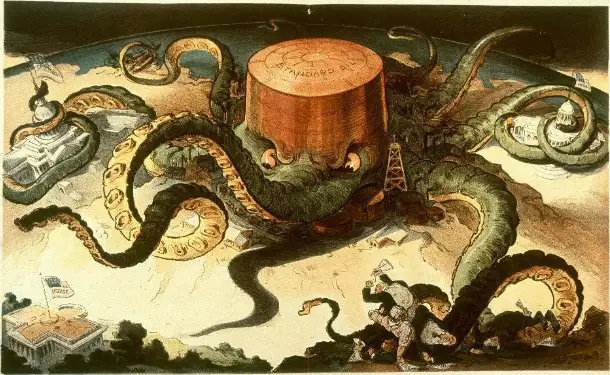
In this political cartoon from 1904, the octopus represents the Standard Oil corporation. Why was an octopus a good symbol of that company?
Most of their oil wells were in the Gulf of Mexico, so a sea creature represented their geographical location.
Octopuses are gentle creatures, much like Standard Oil’s business practices.
The octopus has always been the traditional symbol of the oil industry.
An octopus has many arms that can grab lots of things all at once and Standard Oil had its “hands” controlling political figures in Washington, D.C. as well as other oil companies.
Urbanization is the —
Development of suburbs outside cities.
Growth of cities.
Return of population numbers to rural areas.
Growth of immigrant populations, specifically, in cities.
John D. Rockefeller was most closely associated with—
Standard Oil
The Union-Pacific Railroad
U.S. Steel
General Electric
Which of the following is NOT true of the Homestead Act?
Women were allowed to participate and received ownership of land.
It gave settlers up to 160 acres of land in the West.
It required settlers to improve their land and live on it for five years.
It was signed into law by President Lincoln.
Many male Chinese immigrants came to the United States to work on/at—
The railroad.
The Hoover Dam.
Fruit and vegetable farms in California.
Silver mines in Colorado.
What was the “Iron Horse?”
Steamships traveling north and south on the Mississippi River.
The Transcontinental Railroad.
U.S. Navy vessels, built of iron, patrolling the Great Salt Lake.
The automobile, which was invented in 1849.
Promontory Point was--
The site of a massacre committed on a group of Arapahoe by the U.S. Army in Colorado.
Later renamed Las Vegas and became the largest city in silver-rich Nevada.
The place where the eastern and western parts of the Transcontinental Railroad met, linking both coasts of the United States for the first time.
The site of the assassination of President Rutherford B. Hayes.
The Wright brothers invented the first—
Functional airplane.
Rapid-fire machine gun.
Hot air balloon.
Version of pavement, which they called “tarmac.”
A good example of a monopoly is—
Ford Motor Company branching out into the production and sale of home appliances such as refrigerators.
Standard Oil as the only source of oil for 94% of the U.S. population.
General Electric only hiring white male workers of English ancestry.
The Bank of the United States only lending money to men in the Northeast.
The U.S. government had laissez-faire policies towards businesses during the Gilded Age. This meant—
Companies were held accountable to the government in regard to employee safety and wages.
A business owner could move his company to France and pay no U.S. taxes.
There were few government regulations on industry.
Businesses were required to hire a specific number of women and minorities.
Which of the following was NOT true of most Robber Barons during the Gilded Age?
They squashed all competition.
They paid very low wages.
They exploited their workers.
They used their influence to manipulate government policies in a direction that was good for their companies.
All of the above statements are true.
Andrew Carnegie was different from other wealthy business owners because he—
Inherited his entire fortune from his father, including 14 oil companies.
Gave away millions of dollars to the poor, schools, and other social programs.
Was the only person to have a monopoly on oil, steel, and the cotton industry at the same time.
Was a communist.
Cornelius Vanderbilt was best known for—
His mansion on Long Island known as the Biltmore.
Controlling shipping and railroads.
Inventing the rotary telephone.
Donating large amounts of money to the women’s suffrage movement.
Which of the following is NOT true of J.P. Morgan?
He sold U.S. Steel and used the money to back a revolution in Haiti.
He bailed out the U.S. government.
He created General Electric.
He bought Carnegie Steel.

What would be the BEST caption for the above photographs?
Students at America’s First Public School.
Irish Immigrant Children Arrive Unaccompanied at Ellis Island.
Child Laborers After a Day Working in a Coal Mine.
Orphaned Child Claims Land Under the Homestead Act.
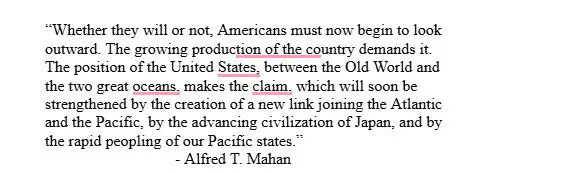
Based on the excerpt above, Alfred T. Mahan could be described as a/n—
Isolationist
Imperialist
Socialist
Nativist
True/False Theodore Roosevelt
set aside land for a national park system
based polices on the ideas of the Monroe Doctrine
Established a policy that made the US the police of the Western Hemisphere
opposed corporate monopolies and was know as a Trust Buster
wrote the Monroe Doctrine
vetoed the Monroe Doctrine
supportred corporate monoplies becasue the y were good for the US economy
A muckraker was a(n) -
unskilled immigrant who worked “raking muck” at the farms of wealthy landowners.
Investigative reporter whose work “rakes up” the corruption and inequalities of society.
steamboat traveling the shallow Mississippi River, where “muck” got caught in the paddle wheel.
Chinese immigrant working in a textile factory.
Matching: Influential Women of the Progressive Era
Ida Tarbell
Muckraking reporter.
Liliuokalani
Found herself powerless to stop wealthy and powerful businessmen from taking her land.
Jane Addams
Founder of Hull House, a settlement house in Chicago.
Match the following terms with their correct definitions:
Roosevelt Corollary
An addition to the Monroe Doctrine that made the U.S. the “police force” of the Western Hemisphere.
Dollar Diplomacy
Policy of investing in Latin America so that the region would become a market and solid ally for the United States.
Big Stick Policy
Policy of working with other countries using the threat of a powerful military to back up words with action.
Open Door Policy
Policy proposed by U.S. Secretary of State John Hay to keep China open to trade for all nations.
Social Gospel
Christian felt it was their duty to end poverty and inequality.
Whose work exposing sanitary conditions in the meatpacking industry led to the Pure Food and Drug Act?
Ida Tarbell
Ida B. Wells
Jacob Riis
Upton Sinclair
What was the Square Deal?
Woodrow Wilson’s promise that all Americans would have three “square” meals a day.
Teddy Roosevelt’s agenda as president which included trust-busting and giving all Americans a “square” (fair) deal.
William Taft’s promise to European allies that we would stand with them during war, looking the enemy “square” in the face.
None of the above.
All of the following statements are true about Booker T. Washington EXCEPT
He was the son enslaved parents.
He believed Black Americans would eventually “earn” their equality, but that it would take time.
He believed vocational training was the first step toward equality for Black Americans.
He planned and led multiple civil rights protests in Washington, D.C. and Richmond, Virginia.
All of the following statements are true about W.E.B. DuBois EXCEPT
He was the first Black American to earn a Ph.D. from Harvard University.
He opened the Tuskegee Institute, an educational institution for Black Americans.
He helped establish the NAACP.
He disagreed with Booker T. Washington’s tolerance of “separate but equal.”
The purpose of the Panama Canal was to--
Make trade and travel easier and faster between the Atlantic Ocean and the Pacific Ocean.
Make travel safer between North America and Europe.
Allow more ships to sail between South America and the United States.
Provide a quicker route around Africa.
President William Taft is best known for his—
Moral Diplomacy
Dollar Diplomacy
Trust-busting
Assassination
Who was the leader of the Cuban Revolution against Spain?
Jose Martí
Simón Bolivar
Fidel Castro
Bartolomé de las Casas
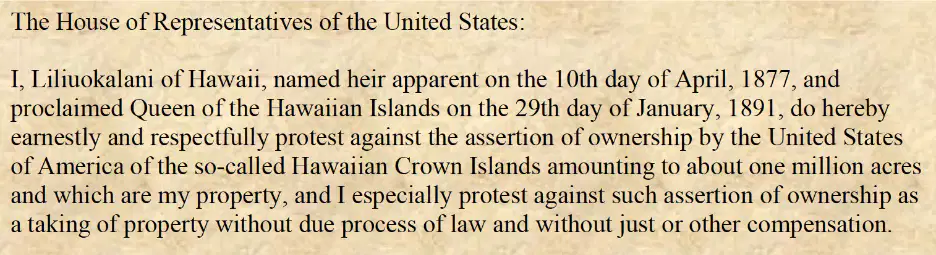
Above, Queen Liliuokalani was writing about her experience with—
Isolationism
Interventionism
Imperialism
Nativism
Which of the following was NEVER a Spanish colony?
Guam
Puerto Rico
The Philippines
Malaysia
What was “Yellow Journalism?”
Reporting of events using sensational, and sometimes false, headlines
The very best journalism in the United States, considered the gold standard.
Muckraking
none of the above
What was the significance of the U.S.S. Maine?
It exploded in the harbor of Havana, Cuba in February 1898.
Its destruction caused yellow journalists to immediately blame Spain.
“Remember the Maine” became the rallying cry of pro-war Americans.
All of the above statements are true.
Emilio Aguinaldo was—
A Cuban revolutionary who guided the Rough Riders from Guantanamo Bay to Havana at the start of the Spanish-American War.
The Spanish governor of Puerto Rico.
A Filipino revolutionary who allied with the US against Spain.
The native king of Guam who was allied with the Spanish.
Which two groups won major victories against Spain in Cuba?
The Colombian army and a squad of British Royal Marines from Bermuda.
The Rough Riders and the Buffalo Soldiers, a Black regiment.
The Roosevelt Five and members of the French Foreign Legion.
Canadian special forces and American cavalry under the command of “Black Jack” Pershing.
True/False: The U.S. gained the territory of Puerto Rico from Spain.
True
False
True/False: The U.S. paid Spain $20 million dollars for the Philippines.
True
False
The US became an imperial power
True
False
Spanish forces left Cuba
True
False
Guam came under the control of Spain
True
False
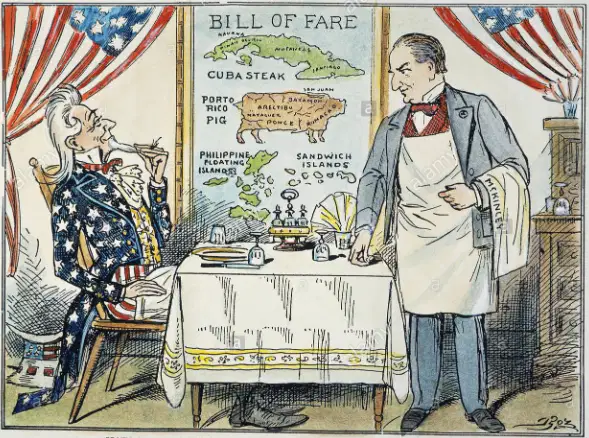
The above cartoon shows American—
Imperialism
Isolationism
Nativism
Urbanization
Which of the following is NOT a traditional reason for a country to become imperialist?
The desire to add new markets in which to sell their products.
To obtain natural resources such as gold, timber, or specific high-value crops.
To benefit the military, for example with new parts of the world to build navy bases.
For the purpose of strengthening diplomacy.
Matching
16th amendment
established income tax
17th Amendment
direct election of senators
18th Amendment
probation
19th Amendment
women’s right to vote
What were the four major causes of World War I?
Militarism, Alliances, Imperialism, Nationalism
Economic Depression, Political Instability, Technological Advancements, Cultural Differences
Colonial Rivalries, Economic Competition, Religious Conflicts, Social Reforms
Trade Disputes, Environmental Changes, Scientific Discoveries, Artistic Movements
New military technologies, an arms race between countries, and the glorification of war are all part of—
Nationalism
Militarism
Nativism
Interventionism
An “alliance” is a(n) - ?
Specific trade agreement between two countries, usually involving silver or gold.
Relationship between two countries going back hundreds of years linked to a shared language.
Agreement between two countries to aid each other if attacked.
All of the above.
What were the two alliances formed in Europe PRIOR to World War I?
NATO and the Warsaw Pact.
The Triple Alliance and the Triple Entente.
The Central Powers and the Détente.
None of the above.
What were the two alliances that PARTICIPATED in World War I?
The Allies and the Central Powers.
The Allies and the Axis Powers.
NATO and the Warsaw Pact.
NATO and the Central Powers.
What are the Balkans?
Russian soldiers famous for their bravery in World War I.
A “powder keg” region in Europe where nationalism was very strong before World War I.
The nickname given to the British air force because they never “balked” at danger.
A breed of German dog that played a major role in trench warfare defense during World War I.
The events that were the IMMEDIATE cause of World War I were —
Archduke Franz Ferdinand is assassinated, Austria declares war on Serbia, all of the allies join in.
Czar Nicholas is assassinated, Russia declares war on France, all of the allies join in.
Woodrow Wilson is assassinated, America declares war on Germany, Russia joins in.
None of the above.
Matching: Battles on the Western Front
Over one million total casualties.
The Somme
A costly Allied victory in 1914.
The Marne
A long, deadly battle throughout the entire year of 1916.
Verdun
The Revolution of 1917 caused—
France to leave the war.
Russia to leave the war.
Britain to win the war.
The Ottoman Empire to collapse.
Which of the following was NOT true of the Russian Revolution?
It was led by Vladimir Lenin.
It overthrew the Czar (Tsar).
The goal was to make Russia a democracy.
The goal was to make Russia communist.
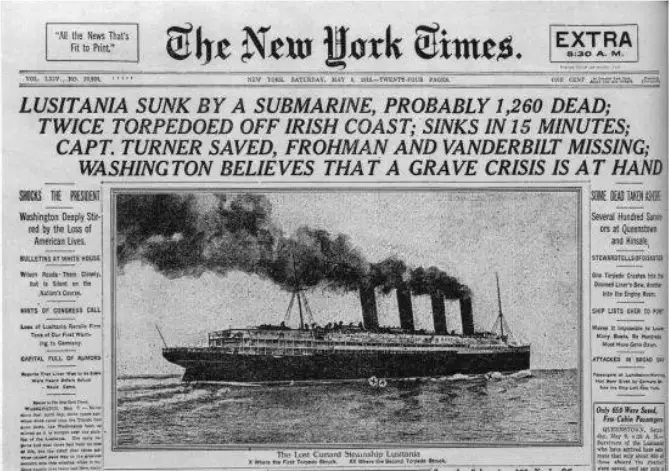
The event reported on the above front page of the New York Times from May 1915 led to —
The end of World War I.
The beginning of American isolationism.
Calls for America to join the war.
Archduke Franz Ferdinand’s assassination.
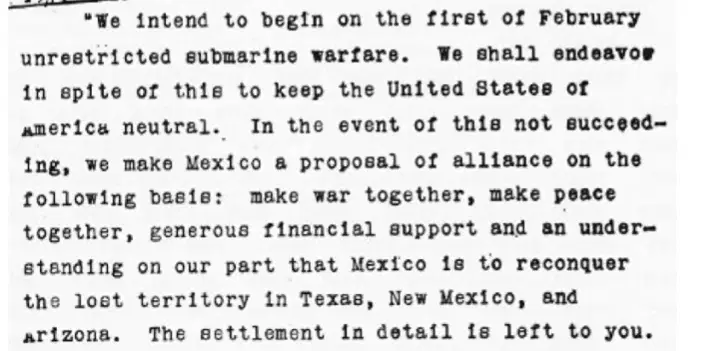
The above excerpt is from—
German naval orders during the Battle of the Marne.
The Zimmerman Telegram.
President Woodrow Wilson’s plan for American neutrality.
The last communication from the U-boat that sank the Lusitania.
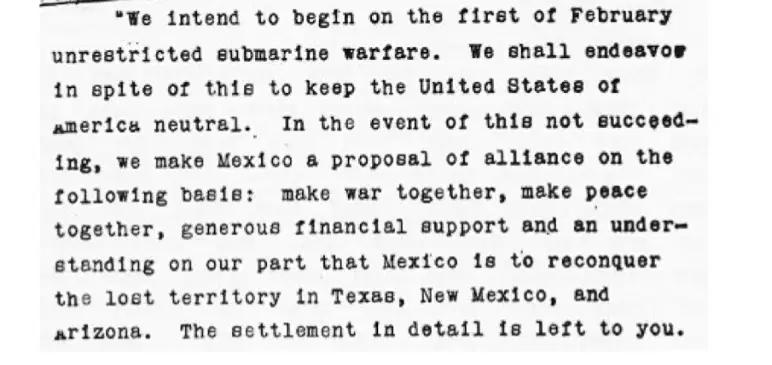
What happened as a DIRECT result of the document ?
Mexico invaded Texas.
Unrestricted American submarine warfare began in the Pacific.
The United States Congress declared war on Germany.
Russia left the war to focus on issues at home.
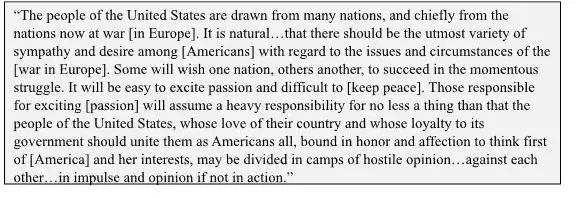
The above excerpt was—
Woodrow Wilson’s statement on the possible reaction of American citizens if America entered the war in Europe.
Andrew Carnegie’s statement, as a Scottish immigrant, showing his concern that the United States should not stay neutral on the war in Europe.
Vladimir Lenin’s speech on the success of American capitalism and neutrality.
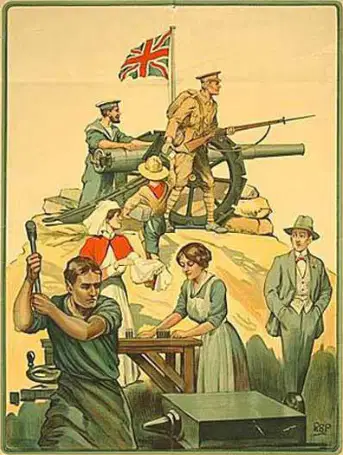
The above poster is an example of—
Advertising
Neutrality
Propaganda
Nativism
Which of the following is NOT true of Liberty Bonds?
Almost half of Americans bought them.
Americans who bought them were “lending” money to the American government.
They were used extensively during the Civil War.
Their sale brought in two thirds of the money needed to fight the war.
The Treat of Versailles, Goals of Nations
to prevent war in the near future
reparation payments from Germany
to punish Germany for the war
to regain its territory in the Rhineland
to create lasting peace
a peacetreaty that was fair to all nations, even Germany
True/False: Armistice
Germany was blamed for the war
Germany paid war reparations
The US joined the League of Nations
Germany received war reparations
The US, France, and Britain all signed the Treaty of Versailles
The Ottoman Empire was gien control overmost of the Middle East

