
 Worksheets
US History Midterm Review
Total questions: 100
Worksheet time: 1hrs 9mins
When and where did the French and Indian War begin?
The war started in 1776 in New England
The war started in 1754 in New England
The War started in 1754 in the Ohio River Valley
The war started in 1776 in the Ohio River Valley
During the French and Indian War the British and the French were fighting over control of which area?
Mississippi River Valley
Connecticut River Valley
Pennsylvania River Valley
Ohio River Valley
Who won the French and Indian War?
Great Britain
France
Spain
Native Americans
This created a temporary boarder at the Appalachian Mountains, restricting movement west for the colonists..
Treaty of Paris
Colonial Boarder 1763
Proclamation of 1763
Northwest Ordinance
Why were colonist not happy with the Proclamation of 1763?
They didn't want the Natives to have the land in the West.
They don't like being told what to do.
They would lose trade in the West.
They had just fought a war to win land that they now couldn't move to.
For the well Governing of this Province and Territories there shall be an Assembly yearly Chosen by the Freemen thereof to Consist of four persons out of each County… - William Penn, Pennsylvania Charter of Privileges, 1701 8.
Which feature of colonial self-government does this charter establish?
Direct Democracy
Separate on Powers
An Elected Legislature
Checks and Balances
New England's economy was based on:
Ship building, fishing and lumbering
Art and music
Plantations and slavery
Farming grains, wheat, and corn.
Independence (in this context) means:
Who was the main author of the Declaration of Independence?
Roger Sherman
John Adams
Benjamin Franklin
Thomas Jefferson
What was the date the Continental Congress adopted the Declaration of Independence?
July 4,1776
August 2, 1775
April 18, 1776
July 2, 1776

Which of the following is a section of the Declaration of Independence?
Introduction
Conclusion
Preamble
Constitution
The List of Grievances was the part of the Declaration that
detailed the colonists' complaints with King George III.
According to the Preamble of the D.O.I., why was the Declaration of Independence written?
to explain why the colonies were separating from Great Britain
the start the American Revolution
to offer a peace settlement to Great Britain.
to instruct how a county wins its freedom.
What are the three inalienable rights that all people have according to the DOI?
Acccording to the DOI (in the Declaration of Natural Rights), who gives our government the right to govern?
According to the D.O.I. (in the Declaration of Natural Rights section), when government becomes oppressive of the people's rights, the people have the right to...
In which order do the sections of the Declaration of Independence go?
Preamble, Declaration of Natural Rights, Resolution, Grievances
Preamble, Declaration of Natural Rights, Grievances, Resolution
Declaration of Natural Rights, Preamble, Grievances, Resolution
Declaration of Natural Rights, Resolution, Grievances, Preamble
Who is the head of the Executive Branch in the United States?
Chief Justice
Speaker of the House
Vice President
President
Which amendment in the Bill of Rights guarantees freedom of speech?
Second Amendment
Tenth Amendment
Fourth Amendment
First Amendment
Which branch of government is responsible for making laws?
administrative branch
judicial branch
executive branch
legislative branch
Which compromise resolved the issue of representation in the US Congress?
Three-Fifths Compromise
Missouri Compromise
Compromise of 1850
Great Compromise
Who has the power to declare war in the United States?
Congress
The Secretary of Defense
The Supreme Court
The President
Which branch of government interprets the laws and the Constitution?
executive branch
legislative branch
administrative branch
judicial branch
Based on the US Constitution, the government is run by _________.
The President
Congress
The Supreme Court
"The People"
Some powers belong to the state government and some belong to the national government. This best describes:
anarchy
federalism
checks and balances
popular sovereignty

Some powers belong to the state government and some belong to the national government. This best describes:
anarchy
federalism
checks and balances
popular sovereignty
Compared to government under the Articles of Confederation, the Constitution
Is harder to amend
created a league of friendship among the states
created a unitary system of government
called for separation of powers among the three branches of government
The Bill of Rights includes-
the Preamble
the Articles of Confederation
the articles of the Constitution
the first 10 amendments
the representative body which elects the president; created to limit excessive popular influence and insulate the presidency from popular whims
Congress
Electoral College
The Supreme Court
Popular Vote
The Constitutional Convention was held in Philadelphia, at which a new federal government was created.
1787
1783
1793
1776
End of the Revolutionary War, Treaty of Paris is signed recognizing the U.S. as an independent nation
1787
1783
1776
1777
End of the Revolutionary War, Treaty of Paris is signed recognizing the U.S. as an independent nation
1787
1783
1776
1777
Following the revolution, women were responsible for educating their children on the virtues of democracy
Suffrage
Democratic Motherhood
Republican Motherhood
Federalist Motherhood
In what year was the Declaration of Independence signed?
1812
1776
1787
1804
What does the Declaration of Independence emphasize?
Consent of the governed
Colonial expansion
Economic policies
Monarchy
What is the main purpose of the U.S. Constitution?
To declare independence
To outline the government's structure
To establish a new currency
To form an alliance
Which principle prevents one branch of government from becoming too powerful?
Popular Sovereignty
Judicial Review
Federalism
Checks and Balances
What does the 1st Amendment protect?
Right to privacy
Trial by jury
Right to bear arms
Freedom of speech
What is a key observation Alexis de Tocqueville made about America?
Monarchical tendencies
Individualism
Centralized government
Lack of religious faith
How can one become a U.S. citizen?
Through naturalization
By inheritance only
By purchasing citizenship
By winning a lottery
What is a civic responsibility of U.S. citizens?
Learning a second language
Traveling abroad
Paying bribes
Voting
What does the Bill of Rights aim to protect?
The rights of the monarchy
The power of the military
The interests of foreign nations
Citizens' freedoms from government overreach
What is the significance of the year 1776 in American history?
The signing of the Declaration of Independence
The year of the Louisiana Purchase
The start of the Civil War
The end of the Revolutionary War
Which amendment ensures the freedom of religion?
5th Amendment
4th Amendment
2nd Amendment
1st Amendment
What does 'In God We Trust' signify?
A legal requirement for religious practice
A government endorsement of a single religion
The national motto reflecting faith's role
A phrase from the Declaration of Independence
What is a key value observed by Alexis de Tocqueville in America?
Collectivism
Liberty
Authoritarianism
Aristocracy
What does the separation of powers entail?
Dividing power among the legislative, executive, and judicial branches
Separating the powers of the military and the government
Splitting power between the federal and state governments
Dividing power among different religious institutions
What are the first ten changes to the Constitution called?
Amendments
Bill of Rights
Articles of Confederation
Declaration of Independence
Which amendment guarantees freedom of religion, assembly, press, petition, and speech?
1st Amendment
2nd Amendment
4th Amendment
5th Amendment
What does the concept of egalitarianism mean?
Valuing your own freedom over government control.
The belief that all people should be treated equally.
The drive to make your own path without interference.
A preference for the government to not be involved in business.
What was the result of the government giving land to railroad companies?
increased mining in the west
increased immigration to the US
resolved disputes between Populists and railroads
economic development of the west
Why did the Populist Party fail in the election of 1896?
corporations gave huge donations to McKinley
populists had no platform
William Jennings Bryan didn't campaign enough
populists failed to get the vote of urban laborers
Populism was partially a response to...
decreasing prices for crops
lack of availability of jobs
poor working conditions in cities
rising shipping rates on railroads
How did the expansion of transportation in the west and completion of the transcontinental railroad affect the standard of living?
It led to better working conditions in factories
It made it easier to transport goods west
It led to the rise of towns and communication in the west
It created employment opportunities for women
Which of the following was NOT a problem for farmers in the 1890's?
overproduction
expensive farm equipment
drought and dust storms
lack of access to railroads
What was the cumulative effect of America's Indian policy in the 1800's?
Native Americans received large plots of land
Indian culture declined significantly
Indians regained their sovereignty
Indians became some of the wealthiest people in the US
Anything rural or related to farming
urban
industrial
legislative
agrarian
Actions by the US that angered Native Americans included -
miners invading tribal lands
placement of Natives on reservations
encouraging preservation of tribal cultures
buffalo being hunted to almost extinction
Why did the Founding Fathers need to add a Bill of Rights to the Constitution?
to encourage people to vote
to give the federal government more power
to establish the roles of each branch of government
to protect unalienable rights and individual liberties
Rights that belong to every human being (ex: life, liberty, the pursuit of happiness)
unalienable rights
laissez-faire
explicit rights
populism
How did the Founding Fathers reconcile the issue of population and representation?
the gave larger states more votes in the Electoral College
They came to the 3/5 compromise
They created a system of checks and balances
They created two legislative houses (House & Senate)
How did movement of American settlers west impact Native Americans?
increased conflict between the two groups
diseases killed many Indians
loss of traditional tribal lands
Native American culture spread
The government is "hands-off" and does not interfere with people's lives or the economy
liberty
egalitarianism
individualism
laissez-faire
Power of the people; people make the choices
Popular Sovereignty
Individualism
Egalitarianism
Laissez-faire
Power given to the courts to determine if government actions are constitutional or unconstitutional
Checks & Balances
Separation of Powers
Federalism
Judicial Review
Power is shared between the state & federal government
Judicial Review
Federalism
Separation of Powers
Popular Sovereignty
No government is all powerful; government can only do what the people give it power to do
Federalism
Populism
Limited Government
Republicanism
The Constitution distributes power to 3 branches of government
checks & balances
limited government
federalism
separation of powers
Each branch is subject to restraints or restrictions by the other branches
separation of powers
checks & balances
limited government
individualism
Which branch of government makes the laws?
Legislative
Executive
Judicial
Which branch of government carries out the law?
legislative
executive
judicial

This painting best illustrates which of the following concepts?
Manifest Destiny
Popular Sovereignty
Transcendentalism
Abolitionism
Which statement best defines the concept of Manifest Destiny?
The government of the United States should expand military control around the world.
The government of the United States should move Native Americans to reservations.
The people of the United States are entitled to expand across the continent.
The people of the United States are filled with the creative energy of immigrants.
Policy by the US to force Native American groups away from their homes and settle in land in the west
Louisiana Purchase
Indian Removal
Mexican-American War
Homestead Act
U.S. bought Louisiana Territory from France. Doubled the size of the United States.
Louisiana Purchase
Indian Removal
Mexican-American War
Homestead Act
What does the following symbol represent?
Telegraph Wires
Education
Transportation
Communication
Religion
What does the following symbol represent?
School Book
Education
Transportation
Communication
One action taken by the United States with the Indian Removal Act of 1830 was . . .
Native American tribes were forcibly removed from their lands.
A treaty was agreed upon to share land claimed by the United States.
Native Americans were allowed to peacefully live in "reservations."
Appealed to Congress to challenge Native American ownership of their land.
True/False: Andrew Jackson agreed with the Supreme Court's ruling regarding the Indian Removal Act.
True
False
The name of the deadly journey for Native American Indians was called the . . .
(a)
Frederick Douglass was a slave.
True
False
Who is Sojourner Truth?
an abolitionist
a NAACP founder
A black panther

An area of public lands set aside for Native Americans
annex
reservation
mudslinging
impressment
The forcing of people into service, as in the navy.
reservation
nationalism
impressment
annex
In the case Worcester v. Georgia, the Supreme court ruled that
Georgia could make laws for the Cherokee land
The Creek had to give up their lands
The Indian Removal act was constitutional
Georgia had no authority over Cherokee lands.
The U.S. Army forced the Indian to march to the Indian Territory in Oklahoma in what is known as
The Trail of Tears
The Trail of Sorrow
The Trail of Shame
The Trail of Fear
To kidnap and force individuals to serve in the navy or military of another country.
Volatile
Abundance
Impressment
Scavenger

What happened to the US as a result of the purchase?
People began speaking French
It almost doubled in size
It ran out of money
The US went to war with Mexico
What were the main causes of the Nat Turner Rebellion?
Harsh conditions of slavery, religious beliefs, and the desire for freedom
Personal vendettas, disputes over land, and competition for resources
Influence of foreign powers, cultural differences, and environmental factors
Lack of access to education, economic inequality, and political oppression
In the case Worcester v. Georgia, the Supreme court ruled that
Georgia could make laws for the Cherokee land
The Creek had to give up their lands
The Indian Removal act was constitutional
Georgia had no authority over Cherokee lands.

Letter 'E" marks which of the following:
United States in 1783
Mexican Cession
Texas
The Louisiana Purchase
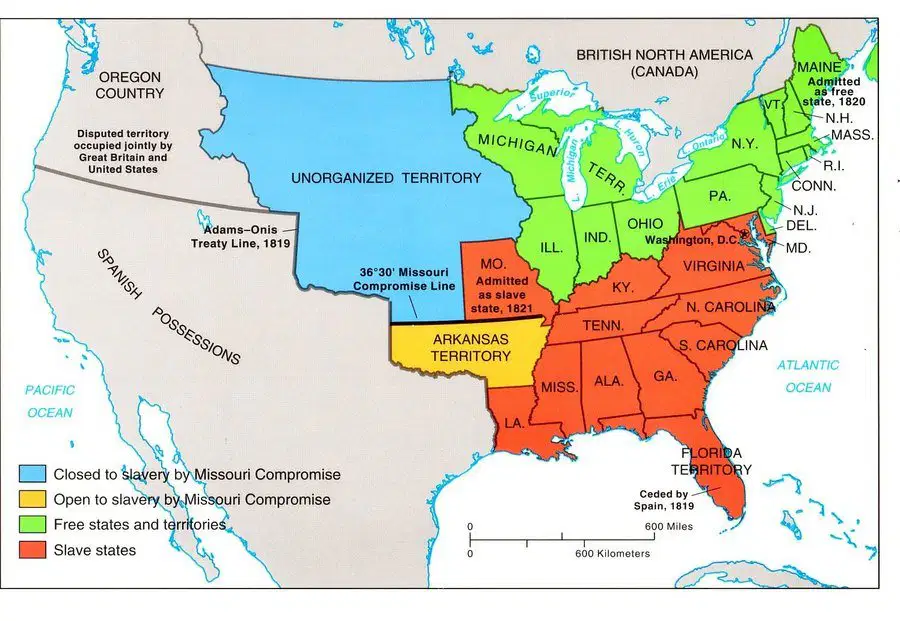
The Missouri Compromise Line determined the status of slavery in future states. North of the line slavery was ___________, while south of the line slavery was _________.
permitted, prohibited
prohibited, permitted
sometimes prohibited, never allowed
expensive, cheap

