wayground logo

Free Printable Worksheets

Font size

S
M
L
XL
Worksheets

Unit 6: Great Depression and New Deal

Total questions: 19

Worksheet time: 10mins

Name
Class
Date
1.
What is the goal of the Stock Market?
a)
Buy low, sell high
b)
Buy high, sell low
2.
High risk investements were known as what?
a)
Speculation
b)
Stock market
c)
Margin
d)
Credit
3.
What is a bank run?
a)
The stock market dropped
b)
Closure of banks due to people withdrawing money
c)
People ran to the US banks to withdraw their money in a panic
d)
People tried to participate in the US stock market
4.
What was the purpose of the Smoot- Hawley Tarrifs?
a)
To allow farmers to increase their crops
b)
To lower the prices of the stock market
c)
To raise taxes on foreign goods
d)
To increase the prices of public goods
5.
One reason farmers had trouble paying their bills in the 1920s was because
a)
farm productivity had rapidly increased as a result of World War I.
b)
banks refused to lend money to farmers following World War I.
c)
the demand for crops dropped after World War I.
d)
farms increased in size and production
6.
What was the cause(s) of the Great Depression?
a)
The invention of the television
b)
The rise of the internet
c)

The end of World War III

d)

The stock market crash of 1929

7.
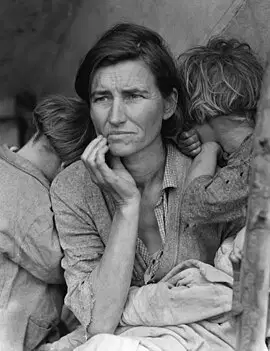
These images, and many like them, were published in the 1930s in newspapers and magazines. What kind of effect do you think they had on the public?
a)
They led to increased support for wealth inequality.
b)
They raised awareness and empathy for the struggles of the poor, influencing public opinion and support for social reforms.
c)
They encouraged people to ignore social issues.
d)
They promoted a sense of indifference towards the poor.
8.
How would you describe the woman's expression - what does it reveal about how people felt during the Depression Era?
a)
The woman's expression shows joy and optimism about the future.
b)

The woman's expression reveals a universal sense of worry and despair.

c)
The woman's expression indicates indifference to her surroundings.
d)
The woman's expression reflects a carefree attitude towards life.
9.
During the 1930s, poor land management and severe drought conditions across parts of the Midwest resulted in the…
a)
development of Dust Bowl conditions on the Great Plains
b)
creation of wheat surpluses
c)
formation of the United States Department of Agriculture
d)
growth of the Granger movement
10.
Which of the following is FALSE?
a)
Only the richest felt the effects of the Great Depression
b)
During the Great Depression, the US government deported millions of Mexican-American citizens
c)
The Great Depression was caused by a mix of things including stock market crashes and the Dust Bowl
d)
Homeless communities called Hoovervilles appeared in cities
11.
What role did Fireside Chats play in FDR's presidency?
a)
Helped him gain the confidence of the American people
b)
Allowed him to buy the votes from wealthy Americans who listend
c)
Provided him the resources to receive feedback on his New Deal
d)
Gave him an outlet to vent his frustrations with the economy
12.
How was the economic struggle during the Great Depression different for rural Americans than for those who lived in cities?
a)
Rural Americans had to deal with Hoovervilles in the cities
b)
The environment made the Depression worse in the Depression
c)
Urban areas were affected by the Dust Bowl due to the lack of farms
d)
Urban Americans had no problems with banks or the bank runs
13.

God invited us all to come and eat and drink all we wanted. He smiled on our land and we grew crops of plenty to eat and wear. . . . [But then] Rockefeller, Morgan, and their crowd stepped up and took enough for 120,000,000 people and left only enough for 5,000,000 for all the other 125,000,000 to eat. And so the millions must go hungry and without those good things God gave us unless we call on them to put some of it back.” —Huey Long radio broadcast, 1934

In this radio broadcast, Long opposes the New Deal because he believes that the solution to poverty is to...

a)
Return to the days of Rockefeller and J. P. Morgan.
b)
create a more powerful federal government.
c)
redistribute money that is owned by the wealthy
d)
allow riches to “trickle down” from the wealthy to the poor.
14.
What group of Americans were forcibily and illegally deported in an effort to "save American jobs" during the Great Depression?
a)
Chinese
b)
Mexican
c)
German
d)
Native American
15.

"We had been poor, but we knew every night there was a bed there, and this was our room. . . . But that all of a sudden changed. When you’re small, you can’t figure these things out. You know something’s not right and you don’t like it, but you don’t let that get you down. You sort of just continue to move." - Cesar Chavez

How does Chavez’s statement reflect the experience of many Americans during the Great Depression?

a)
Chavez's statement highlights the financial stability many Americans enjoyed during the Great Depression.
b)
Chavez's statement reflects the resilience and uncertainty faced by many Americans during the Great Depression.
c)
Chavez's statement suggests that Americans were indifferent to their struggles during the Great Depression.
d)
Chavez's statement indicates that all Americans were able to find jobs easily during the Great Depression.
16.
How did the New Deal coalition affect social and ethnic divisions in the United States?
a)
It worsened racial tensions, leading to the rise of hate groups.
b)
It reduced divisions by appealing to workers from different backgrounds.
c)
It helped eliminate class distinctions in both political parties.
d)
It removed divisions by putting all Americans on an equal economic footing.
17.
What were the effects of New Deal legislation on the role of the federal government?
a)
The federal government gave up some of its power to state governments.
b)
The federal government’s role remained largely the same.
c)
The federal government's role expanded in the United States
d)
The federal government became less involved in the economy.
18.
How did the Indian New Deal affect Native Americans?
a)
It led to several Native Americans sitting in the Cabinet.
b)
It placed Native American land under federal control.
c)
It divided tribal land into larger plots to encourage assimilation.
d)
It gave economic assistance and control to Native Americans.
19.
How did Eleanor Roosevelt contribute to women’s rights?
a)
She became the first female to serve as a member of the Cabinet.
b)
She effectively ended gender discrimination in the United States.
c)
She advocated for women to join in political affairs
d)
She reinforced the ceremonial significance of the office of the First Lady.