
 Worksheets
ECON Final Review
Total questions: 73
Worksheet time: 2hrs 26mins
Which is NOT a factor that shifts the demand curve?
Income
Price
Consumer Expectations
Number of Buyers
is the good or services consumers are able and willing to purchase at a set price
Quantity Demanded
Marginal Utility
Supply
Demand
When price falls, ___________ increases
Demand
Quantity Demanded
What does a leftward shift in the demand curve indicate?
An increase in demand
A decrease in demand
An increase in supply
A decrease in supply

Which of the following scenarios would result in the shifting demand curve shown here?
Increase in consumers' incomes
A good or service becomes out of style
Suppliers find new resources
Government decides to tax the good/service more
Which of the following factors can cause the demand curve to shift to the right?
A decrease in the price of the good.
An increase in consumers' income.
An increase in the price of a substitute good.
Both B and C are correct.
Which of the following is a determinant of demand?
Consumer preferences
Production costs
Technology
Number of suppliers
A shift of the demand curve represents
a movement on the demand curve
a change in the quantity demanded
a change in demand
all of the above
A normal good
has not been damaged
will be purchased, regardless of changes in income
will be in higher demand if a person's income increases
will be in higher demand if a person's income decreases
If a decrease in income increases the demand for a good, the good is
inferior
normal
a complement
a substitute
substitute goods
complementary goods
normal goods
inferior goods
Products that tend to be used together that typically have little value on their own are considered
complementary goods
substitute goods
inferior goods
normal goods
a complementary good
High levels of mercury found in canned tuna. Market: canned tuna
Demand Increase
Demand Decrease
Supply increase
Supply Decrease
Which of these shows a decrease in the quantity demanded?


If the demand curve is downward-sloping and supply is perfectly elastic, then the burden of an excise tax is:
borne entirely by consumers.
borne entirely by producers.
shared by consumers and producers, with the burden falling mainly on consumers.
shared by consumers and producers, with the burden falling mainly on producers.
Luis is willing to sell his pool table for $600, but if he gets $840, the producer surplus Luis receives is ________.
$600
$840
$240
$1,440
Maria wants to get rid of her bookshelf. She is willing to give it away for free but her neighbor offers to pay $30 for it. Maria experiences a:
consumer surplus gain.
consumer surplus loss.
producer surplus gain.
producer surplus loss.
Along a given supply curve, an increase in the price of a good will:
increase producer surplus.
decrease producer surplus.
increase consumer surplus.
decrease producer surplus and increase consumer surplus

(Figure: Consumer Surplus III) Look at the figure Consumer Surplus III. In the figure, when the price falls from $30 to $25, consumer surplus ________ for a total consumer surplus of ________.
increases by $25; $74
decreases by $15; $34
increases by $15; $64
increases by $5; $54

(Figure: Consumer Surplus II) Look at the figure Consumer Surplus II. If the price of the good is $2, consumer surplus will equal:
$30.
$45.
$60.
$90
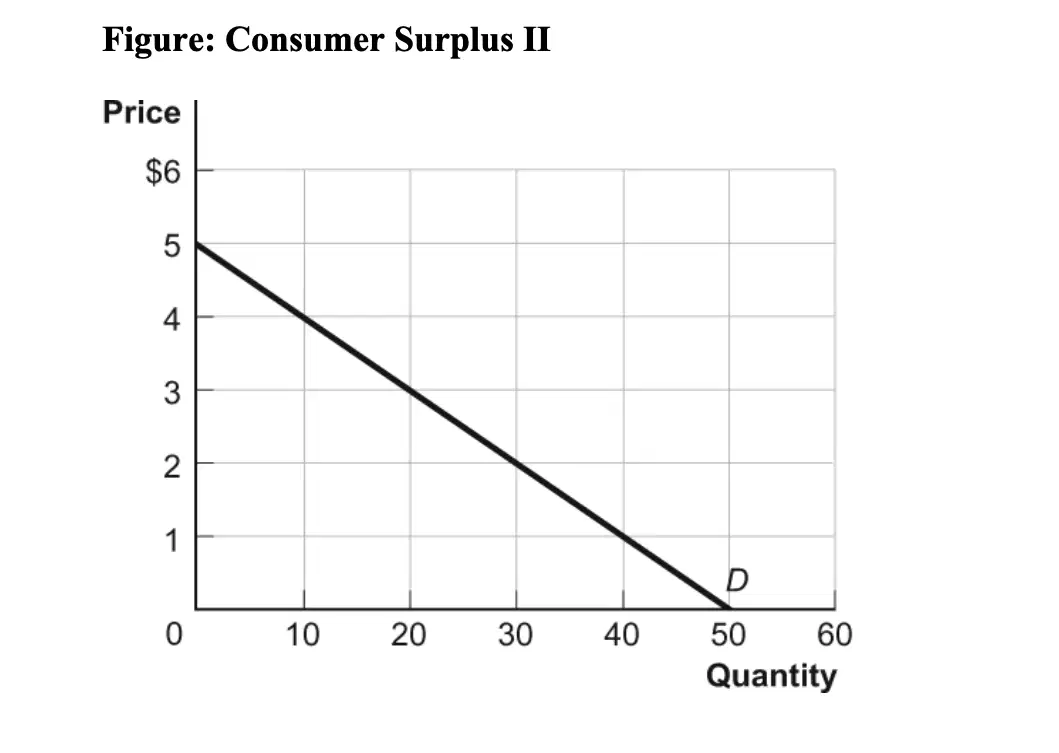
(Figure: Consumer Surplus II) Look at the figure Consumer Surplus II. If the price of the good decreases from $2 to $1, consumer surplus will increase by:
$30.
$35.
$60.
$90

(Figure: The Market for Sandwiches) Look at the figure The Market for Sandwiches. At the competitive price of $5, 10 sandwiches are sold. At this competitive price, consumer surplus equals _______ and producer surplus equals _______.
B) $100; $50
A) $50; $50
C) $50; $25
D) $100; $25
E) $75; $50
A price control is:
A) when a firm controls the price of the good it produces.
B) a legal restriction on how high or low a price in a market may go.
C) an upper limit on the quantity of some good that can be bought or sold.
D) a tax placed on the sale of a good which controls the market price.
If the minimum wage is a binding price floor, then:
A) the number of workers who want to work will be greater than the number of jobs available.
B) the equilibrium wage will increase.
C) there will be a job for everyone who is willing to work.
D) business owners will hire more workers.
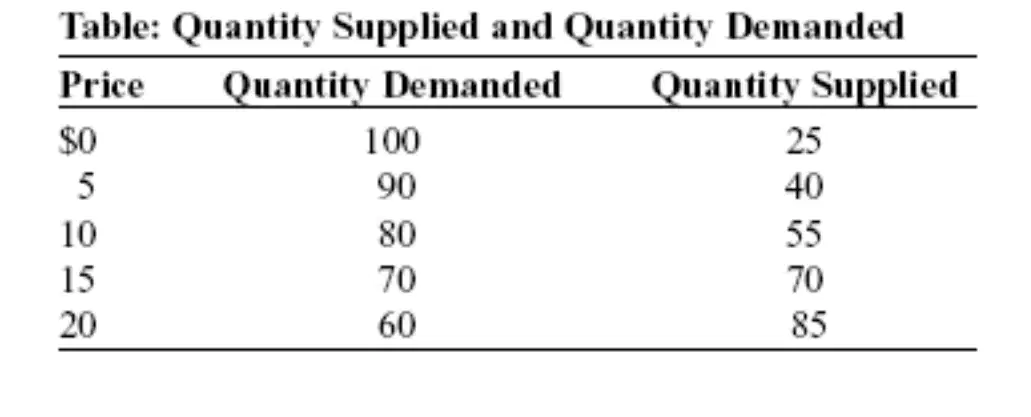
(Table: Quantity Supplied and Quantity Demanded) Look at the table Quantity Supplied and Quantity Demanded. Excess supply would exist in this market if a price floor equal to _______ was imposed in this market.
A) $5
B) $10
C) $15
D) $20

(Figure: Price Controls) Look at the graph Price Controls. An effective price ceiling would be at price ________ and a ________ would result in the difference between points________.
d; shortage; i and h
a; surplus; b and c
b; shortage; e and f
c; surplus; g and h
A price ceiling will have no effect if:
it is set above the equilibrium price.
the equilibrium price is above the price ceiling.
it is set below the equilibrium price.
it creates a shortage.
The burden of a tax that is imposed on a good is said to fall completely on the consumers if the:
price paid by consumers for the good declines by the amount of the tax.
price paid by consumers for the good increases by the amount of the tax.
price paid by consumers does not change.
wages received by workers who produce the good increase by the amount of the tax.
Given any upward-sloping supply curve for a good, the more inelastic the demand curve, the _______ equilibrium output will fall and the _______ will be the deadweight loss when the government imposes an excise tax.
more; smaller
more; larger
less; smaller
less; larger
Suppose the production of DVDs generates sulfur dioxide, an air pollutant. Then the equilibrium market quantity of DVDs produced and consumed:
is less than the socially optimal quantity.
is more than the socially optimal quantity.
equals the socially optimal quantity.
may be more than, less than, or equal to the socially optimal quantity.
If drivers decide to make phone calls without considering the costs imposed on others, the:
number of phone calls made while driving will be above the socially optimal quantity
number of phone calls made while driving will be below the socially optimal quantity
marginal social cost curve will lie below the marginal cost of production curve
marginal social benefit curve will lie below the marginal social cost curve

(Table: The Marginal Social Cost of Batteries) The accompanying table lists several price (P) and quantity (QS) values along the market supply curve for batteries. Because batteries generate toxic wastes, there is an external cost associated with their production. The marginal external cost is estimated to be $10. The marginal social cost would then be indicated by the values in the column labeled:
MSC1.
MSC2.
MSC3.
MSC4.
Assume there are external benefits associated with the production of good X. Without government regulation, the market will:
produce too much of good X.
price good X less than the marginal social cost.
price good X less than the marginal social benefit.
price good X greater than the marginal cost.
Suppose the price elasticity of demand for yachts equals 4.04, while the price elasticity of supply for yachts equals 0.22. If Congress reinstates a luxury tax on yachts, who will pay more of the tax?
Yacht builders will pay more.
Yacht buyers will pay more.
Yacht builders and buyers will pay equally.
It's impossible to tell without additional information.
If a product has inelastic demand the _______________ pays more of the tax.
Seller
Consumer
If a product has elastic demand the _______________ pays more of the tax.
Seller
Consumer

The diagram shows a tax on a good rising supply from S1 to S2.
The price to the consumer rises from $4 to $5. What is the amount of tax?
$2
$3
$4
$5

Which sections represent the deadweight loss arising from the imposition of the tax?
A + B + C + E
E + F + G + J
E+F
H + I + J
After the government imposed a $0.20 per gallon tax on gasoline, the price of a gallon of gasoline increased from $1.00 to $1.15. Which of the following statements is true?
Consumers bear the entire burden of the tax, since producers can pass the tax along to consumers.
Consumers and producers share the tax burden equally.
Consumers bear most, but not all, of the tax burden.
Producers bear the entire burden of the tax, since the tax was levied on producers, not consumers.
There is no tax burden, since gasoline is a normal good.
If the price of bracelets increased from $40 to $55 and the quantity supplied increased from 60 to 70 units, the Price Elasticity of Supply is equal to-
2.05
.76
1.54
.49
Assume that income increased by 55% and the quantity demanded for Great Value Cereal decreased by 20%.
Calculate the income elasticity of Great Value Crackers?
-.36
.36
-2.75
2.75

If the government places a price ceiling at $2 on Milk, there will be a-
Surplus of 2100 Gallons
Shortage of 1400 Gallons
Shortage of 2100 Gallons
Surplus of 1400 Gallons
Jessica consumes 40% more bowls of guacamole when the price of chips decreases by 25%. For Jessica, guacamole and chips are _____, and the cross-price elasticity of demand is _____.
-1.6, Complements
1.6 Substitutes
-.625, Complements
-1.6, Substitutes

If the Price decreased from $24 to $12, total revenue would-
Decrease by $9,600
Increase by $9,600
Increase by $4,800
Decrease by $4,800
Which of the following would be an example of a fixed cost on a farm?
Mortgage on the land
Cost of seed
Fuel to operate machinery
Fertilizer
In general, it is a bad move for a company to produce more of a good or service if, by doing so
marginal cost exceeds marginal revenue
variable costs exceed fixed costs
demand exceeds supply
fixed costs exceed marginal revenue
A cost that is included in economic profit
Implicit Cost
Marginal Cost
Average Cost
Economic Cost
Average Total Costs are calculated by dividing Total Costs by
Price
Quantity or units produced
Average Variable Costs
Revenue

When a firm is producing zero output, the total cost equals:
zero
the fixed cost
the variable cost
the marginal cost
the average total cost

Marginal cost rises due to:
increasing average costs
increasing returns to fixed capital
increasing human capital
diminishing marginal returns
diminishing profits
MC goes through the _____ of ATC and AVC.
highest point
minimum point

What is TVC at 10 units?
$2
$20
$0
$50
$5


Total Revenue (minus) Explicit and Implicit cost =
Accounting Profit
Economic Profit
Economic Cost
Total Profit

The image above shows a firm making
Economic Profit
Economic loss
Breaking even
Shutting down

Should the following firm shutdown?
Yes
No
Not enough information present
Select all that apply: When should a firm decide to shutdown?
When their demand curve is below AVC
When their MR curve is below AVC
When the price is below the AVC
When the MC is below the AVC
What is the free rider problem?
scarcity even when you pay for a good
Reaping all the benefits without contributing
Common goods that don't have a price
none of the above
What does non-rival mean?
More than one person can use it
Only one person can use it
There are direct competitors for a product
None of the above
Public goods are
rival and excludable
non-rival and non-excludable
rival and non-excludable
non-rival and excludable
Which of the following is an example of a common resource?
residential housing
national defense
restaurant meals
fish in the ocean
Which of the following is an example of a private goods?
residential housing
national defense
restaurant meals
fish in the ocean
Which of the following is an example of a club goods?
residential housing
national defense
fish in the ocean
cable TV
Which categories of goods are excludable?
private goods and club goods
private goods and common resources
public goods and club goods
public goods and common resources
Which categories of goods are rival in consumption?
private goods and club goods
private goods and common resources
public goods and club goods
public goods and common resources

