
 Worksheets
Unit 3 | Rebels (Review)
Total questions: 20
Worksheet time: 10mins
This term refers to cruel and unfair rule by a government or a leader.
Tyranny
Propaganda
Smuggling
Salutary Neglect
Britain's unofficial policy to relax the enforcement of trade laws.
Tyranny
Propaganda
Smuggling
Salutary Neglect
To secretly import illegal goods.
Tyranny
Propaganda
Smuggling
Salutary Neglect
Misinformation spread in order to increase support or influence a point of view.
Tyranny
Propaganda
Smuggling
Salutary Neglect
Colonists helped and fought for the _______________ during the French and Indian War, hoping to gain more land if they won.
Native Americans
Spanish
French
British
Dutch
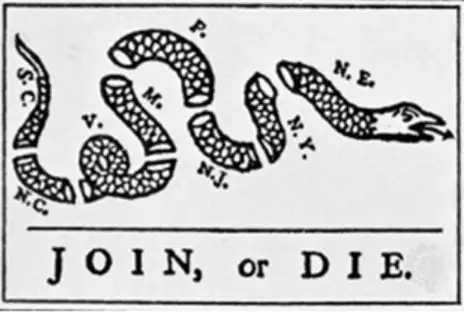
What do the pieces of the snake represent?
The British Empire after the American Revolution
The 13 Colonies if they do not band together
Countries that were once in an alliance
The states of the Confederacy
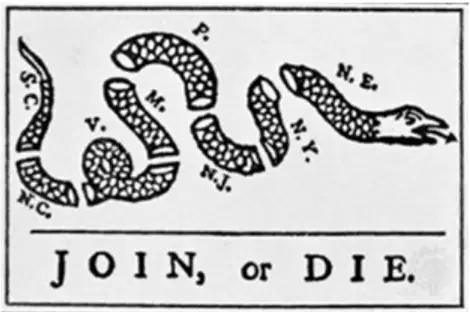
What did Benjamin Franklin mean by the words "Join, or Die"?
The colonies should unite for strength.
The colonies should remain independent.
The colonies should join the British army.
The colonies should avoid conflict.
This ended the French and Indian War, giving the British land from the Atlantic to the Mississippi River.
Treaty of Paris
Proclamation of 1763
Stamp Act
Which of the following is the connection between the French and Indian War and the Proclamation of 1763?
The French and Indian War was fought over the Proclamation of 1763
The Proclamation kept people out of the Ohio River Valley, which the war was fought over
They both are dealing with taxes
What war is the author referring to in this quote, “We are not recovered from a War undertaken solely for their (the Americans) Protection… a War undertaken for their defense only... they should contribute to the Advantages they have received…”
The French and Indian War
The Boston Massacre
The American Revolutionary War
The War of 1812
Considering the previous excerpt, which of the following statements BEST explains why the author believes that the British were justified in taxing the colonists?
A) “We are not yet recovered from a War undertaken solely for their Protection...”
B) “…they should contribute to the Preservation for the Advantages they have received...”
C) “The colonists have always paid their fair share of taxes.”
D) “The British government needs funds for domestic projects.”
This tax passed in England, was one that upset colonists the most. It made all sorts of people mad (rich and poor) because it taxed all printed paper from cards to legal documents.
Sugar Act
Townshend Act
Stamp Act
The Quartering Act ...
Taxed all printed materials
Forced colonists to provide shelter and food to British soldiers
Forced colonists to pay a “quarter” (25 cents) in taxes for paper
The Stamp Act Congress was a …
Group of Englishmen who enforced the Stamp Act in the colonies
Group of colonists who openly opposed the Stamp Act
Small group of colonists who supported the Stamp Act
Assembly of British Parliament members discussing the Stamp Act
A boycott was...
A refusal to buy certain goods
A type of letter that asks for change
Another word for mercantilism
Why does Patrick Henry feel that the Stamp Act and other British tax laws are unlawful?
Because they were approved by the British Parliament.
Because they were supported by King George.
Because they were imposed without representation.
Because they were beneficial to the colonies.
How does Patrick Henry describe King George III?
A wise leader
A tyrant
A friend of the people
A fair ruler
This tax was passed after the Stamp Act was repealed, putting a tax on everything the colonists got from England, namely lead, paint, glass, paper, and tea.
The Sugar Act
The Stamp Act
The Townshend Acts
What event is being described in this excerpt, "It was now evening, and I immediately dressed myself in the costume of an Indian, equipped with a small hatchet... I repaired to Griffin's wharf, where the ships lay that contained the tea …We then were ordered by our commander to open the hatches and take out all the chests of tea and throw them overboard, and we immediately proceeded to execute his orders, first cutting and splitting the chests with our tomahawks...”
The Boston Tea Party
The signing of the Declaration of Independence
The Battle of Bunker Hill
The First Continental Congress
Why did the colonists dump the tea into the Boston Harbor?
To celebrate a new trade agreement with Britain
To protest against taxes imposed by the British
To dispose of spoiled tea
To support the British monarchy

