
 Worksheets
Fluid dynamics
Total questions: 13
Worksheet time: 34mins
Bernoulli’s equation is valid under specific conditions. Which of the following is NOT a condition for the application of Bernoulli’s equation?
The flow must be steady.
The fluid must be compressible.
The fluid must be non-viscous (inviscid).
The flow must be along a streamline.
According to Bernoulli's Principle, what happens to the pressure of a fluid as its speed increases in a horizontal pipe?
The pressure increases.
The pressure decreases.
The pressure remains constant.
The pressure first decreases, then increases.
Why is a hydraulic system better than a pneumatic system for lifting a dump truck bed?
Hydraulic systems are less prone to leaks
Hydraulic systems are energy efficeint
Hydraulic systems can provide quick changes in movement
Hydraulic systems can handle heavy loads sustained for long periods of time
A gardener bought a larger diameter hose. What change should the gardener expect?
Change in the viscosity of the water
Decrease in temperature of the water
Decrease in the velocity of the water
Decrease in the denisty of water

Piston 2 has an area of 5 in2. Piston 1 has an area of 10 in2. If 200 lbs of force is applied to piston 1, what is the force output in piston 2?
400 lbs
200 lbs
100 lbs
50 lbs
For laminar flow in a pipe Reynold's number should be
less than 500
more than 4000
less than 2300
1

Water flows through a pipe with different sized cross-sectional areas. Which section has the slowest fluid speed?
I
II
III
IV
A student injects dye at a single point in a flow tank to observe water movement. The dye spreads and shows lines that change over time. Is the student observing streamlines, pathlines, or streaklines? Justify your answer. (2 points)
Water is flowing through a pipe of 150 mm diameter under a pressure of 24.53 N/cm² and with a mean velocity of 2.5 m/s. Find the total head of the water at a cross-section, which is 6 m above the datum line. (10 points)
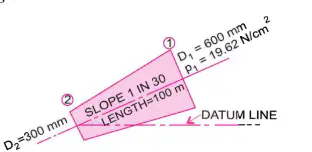
Water flows through a tapering pipe 100 m long, with a diameter of 600 mm at the upper end and 300 mm at the lower end. The flow rate is 50 L/s. The elevation at the upper end (z1) is 3.33 m, and the elevation at the lower end (z2) is 0. If the pressure at the upper end is 19.62 N/cm2, calculate the pressure at the lower end. The datum line passes through the center of the lower end. (10 points)
Water is flowing through a pipe having diameters 30 cm and 15 cm at the bottom and upper end respec tively. The intensity of pressure at the bottom end is 29.43 Nlcm2 and the pressure at the upper end is 14.715 Nlcm2 • Determine the difference in datum head if the rate of flow through pipe is 50 lit/s.
Formula:1 lit/s= 1/1000m3/s
(10 points)
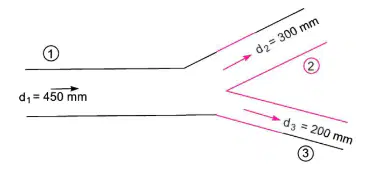
Branching Pipeline System
A 450 mm diameter pipe branches into two pipes with diameters of 300 mm and 200 mm, respectively. If the average velocity in the 450 mm diameter pipe is 3 m/s:(a) Calculate the discharge through the 450 mm diameter pipe.
(b) Determine the velocity in the 200 mm diameter pipe if the average velocity in 300mm pipe is 2.5m/s.
(10 points)

