
Font size
 Worksheets
Unit 2 Review
Total questions: 171
Worksheet time: 3hrs 45mins

An economic and political domination of a strong nation over other weaker nations.
Colony
Imperialism
Annex
Empire
Which president said “speak softly and carry a big stick; you will go far.” The U.S. Navy is the “big stick” he is referring to.
Woodrow Wilson
William H. Taft
Teddy Roosevelt
Which president said “speak softly and carry a big stick; you will go far.” The U.S. Navy is the “big stick” he is referring to.
Woodrow Wilson
William H. Taft
Teddy Roosevelt
This gave every country equal access to trade with China.
Boxer Rebellion
Open Door Policy
Modernization
Sphere of Influence
All the following were reasons for US imperialism except:
to develop closer relations with European nations
need for more natural resources
need for new markets to sell goods
fear of running out of land to settle
What event led to the start of the Spanish-American War?
sinking of the USS Maine
sinking of the USS Lusitania
attack on southern Florida by Cuba
the coronation of Liliuokalani
What role did the media(yellow journalism) play in the Spanish American War?
shaped public opinion to go to war
only covered facts of the events of the war
play no role in the war whatsoever
shaped public opinion to give the president war powers to declare war on Cuba
What is the "White Man's Burden"?
A belief in "cultural superiority"
A philosophy related to Manifest Destiny
Taft's foreign policy approach
A belief in white privilege
An economic and political domination of a strong nation over other weaker nations.
Colony
Imperialism
Annex
Empire
Which of the following was NOT a motivating factor of imperialism?
Establish naval bases around the world
Expand to new world markets
Slavery
Spread American influence & democracy
__________warned against the establishment of any additional European colonies in Latin America.
Roosevelt Corollary
Monroe Doctrine
Woodrow Wilson
William H. Taft
Which president said “speak softly and carry a big stick; you will go far.” The U.S. Navy is the “big stick” he is referring to.
Woodrow Wilson
William H. Taft
Teddy Roosevelt
___________: The system in which support is given only to the countries whose moral beliefs are similar to that of the democratic United States.
Dollar Diplomacy
Big Stick Diplomacy
Moral Diplomacy
__________used a combination of gifts and threats to convince Japan to enter into trade relations with the United States.
Commodore Matthew Perry
Lieutenant David Schwimmer
General Matt LeBlanc
What was NOT a factor in the annexation of Hawaii?
Tariffs on sugar imports
American settlers' economic interests
Queen limiting American's political power
The Hawaiian people agreeing to be annexed
This gave every country equal access to trade with China.
Boxer Rebellion
Open Door Policy
Modernization
Sphere of Influence
What was the name given to Taft's foreign policy?
Dollar Diplomacy
Big Stick
Moral Diplomacy
Taft Corollary
Which president said “speak softly and carry a big stick; you will go far.” The U.S. Navy is the “big stick” he is referring to.
Woodrow Wilson
William H. Taft
Teddy Roosevelt
___________: The system in which support is given only to the countries whose moral beliefs are similar to that of the democratic United States.
Dollar Diplomacy
Big Stick Diplomacy
Moral Diplomacy
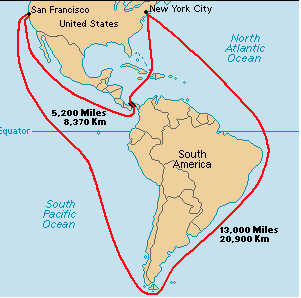
What does this map support?
The US fought the Spanish navy in the Atlantic and Pacific
The Spanish-American War led to new US territories
America became a colonial power in South America by surrounding it
The Panama Canal is critical to US trade
Why was Alaska referred to as "Seward's folly"?
Americans didn't own a territory so far north
It was considered a frozen wasteland with no resources
The U.S. had already annexed Samoa, and didn't need another territory
It was thought that two-cents an acre was too expensive

Where is this event taking place?
Maine
Cuba
Spain
Hawaii

What is depicted in this image
Jose Marti's rebellion against Spain in Cuba
Emilio Aguinaldo's war against American in the Philippines
Buffalo Soldiers capturing Puerto Rico for America
Rough Riders charging up San Juan Hill in Cuba
What was the purpose of the Open Door Policy in China?
End the Boxer Rebellion
Ensure trading rights with China
Win leaseholds in China
Establish a sphere of influence

What was a result of headlines like the one above?
World War I begin
The Spanish-American War
The US entered World War I
The Union defeated the Confederacy
Which of the following is not a territory that the US acquired through war?
Alaska
Puerto Rico
Guam
Philippines
What country does the U.S. purchase from Spain for $20 million dollars?
Japan
Philippines
China
Cuba
In his book The Influence of Sea Power upon History, Alfred T. Mahan argued that the United States should _________
avoid foreign conflicts.
sell its naval bases.
build a strong navy.
remain isolationist.
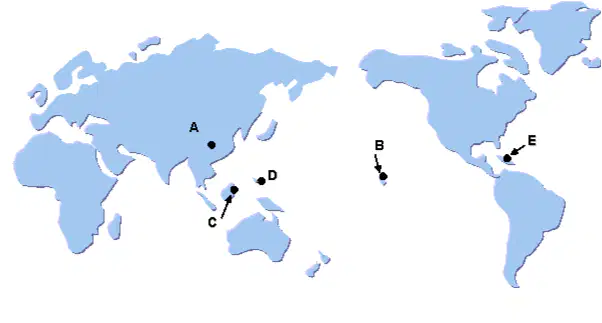
Sanford B Dole contributed to the expansion of the United States by advocating the annexation of which territory?
B
D
E
A
Imperialism is...
Taking over another nation and then leaving them to create their own government
a stronger nation that is usually industrialized and militarily strong takes control of a small nation without industry and governments unstable
when a nation decides to go to war with a small nation, usually it ends with a blockade and a victory with ease
two strong and industrialized nations try to take each other over, and end up in a long war hurting the economies of many other nations.
Which of the following BEST describes Yellow Journalism?
a type of news story that appeals to the economics of a story, making business owners interested
a type of news story that appeals to the military members, and gets them interested in other nations
a type of news story that appeals to the emotions of the listener or reader by exaggerating the facts
a type of news story that appeals to those wanting the truth without any bias on the facts
Known as the creator of the "Rough Riders"
William McKinley
Theodore Roosevelt
Alfred T Mahan
Sanford B Dole
Agreement created by United States that all countries have equal trading chances with China...
Platt Amendment
Treaty of Paris
Open Door Policy
Spanish American War
President Roosevelt hopes to build a canal to cut down military and business shipping costs/time...
Panama Canal
Cuban Canal
Guam Canal
Puerto Rico Canal
The use of financial power to put themselves into international affairs...
Open Door Policy
Monroe Doctrine
Roosevelt Corollary
Dollar Diplomacy

This cartoon is an example of:
Miitarism
Yellow Journalism
Black Journalism
Alliances
How did the US gain the rights to build the Panama Canal?
the US helped Panama achieve independence from Colombia
a treaty with Colombia whom controlled Panama
the US purchased the land from Panama for 7.2 million dollars
the US helped Colombia put down a rebellion in Panama
America's Great White Fleet was established to do which of the following?
Maintain cleanliness in America's Navy.
Display America's Naval Power to the world.
Encourage countries to declare war on America's Navy.
Conquer the world one ocean at a time.


Which United States foreign policy was most often used to carry out the actions shown on the map?
Roosevelt Corollary to the Monroe Doctrine
Wilson's Fourteen Points
Kellogg-Briand Pact
Open Door
A goal of President Theodore Roosevelt's Big Stick policy and President William Howard Taft's Dollar Diplomacy policy toward Latin America was to
Western Hemisphere nations in a military alliance
Protect American economic and political interests
Encourage foreign nations to establish colonies
Raise Latin America's standard of living
What is the policy of extending a country's power by taking over a smaller, weaker nation?
Militarism
Alliance
Imperialism
Nationalism
A policy proposed by U.S. giving all nations equal opportunities to trade in China called __________, tried to stop ____________________, an area in which one nation controls trade and investment.
Imperialism; Lay investiture
Open Door Policy; Spheres of Influence
Nationalism; Boxer Rebellion
Reparations; Treaty of Versailles
What was the goal of President Taft's Dollar Diplomacy?
Help US allies by increasing readiness of armed forces
Raise living standards of people in poverty-stricken countries
Support development of democracies in Central America
Benefit US economic interests by loaning money


What new lands did the US take over because of the Spanish American War?
Spain
Cuba
Guam
Phillipines
Puerto Rico

This foreign policy was aimed at protecting US business in Latin America.
Moral Diplomacy
Big Stick Policy
Roosevelt Corollary
Dollar Diplomacy
Open Door Policy

This foreign policy by Theodore Roosevelt was used to secure the Panama Canal. The US will negotiate, but we also have a "Great White Fleet".
Moral Diplomacy
Big Stick Policy
Roosevelt Corollary
Dollar Diplomacy
Open Door Policy
This foreign policy was supported by Woodrow Wilson. The US would only support nations with the same moral beliefs in democracy as the US.
Moral Diplomacy
Big Stick Policy
Roosevelt Corollary
Dollar Diplomacy
Open Door Policy
This foreign policy made the US a "police force" of the Western Hemisphere.
Moral Diplomacy
Big Stick Policy
Roosevelt Corollary
Dollar Diplomacy
Open Door Policy

The Spanish-American War (1898) marked a turning point in American foreign policy because the United States-
developed a plan for peaceful coexistence
emerged as a new world power with an overseas empire
pledged neutrality in future European conflicts
refused to become a colonial power

A. The United States claims the Hawaiian Islands.
B. Puerto Rico becomes a United States territory.
C. The United States fights an insurrection in the Philippine Islands.
D. The United States Senate ratifies the Panama Canal treaty.
Which is the best heading for the actions above?
Rise of American Imperialism
Causes of World War I
Enforcement of the Monroe Doctrine
Trade Expansion in East Asia

The headline in this newspaper are an example of
yellow journalism
muckraking literature
investigative reporting
government censorship
Why did the U.S. annex Hawaii during the Spanish-American war?
to move captured Spanish soldiers there
to hide weapons from the Spanish
to add more land to the U.S.
to use it as a fueling station for the Navy
Who was blamed for the sinking of the U.S.S Maine ship?
Cuba
China
Great Britain
Spain
Where did a revolution take place that drew the US into the Spanish-American War in 1898?
Cuba
America
Hawaii
Spain

This diplomatic policy helped bring US economic interests into China.
Dollar Diplomacy
Open Door Policy
Moral Diplomacy
Big Stick Diplomacy
A type of writing that sensationalized events of the Spanish American War to sell more newspapers
Yellow Journalism
Investigative Journalism
Journalism
Case study research
Which foreign policy made loans to Latin American countries?
Big Stick Policy
Platt Amendment
Dollar Diplomacy
Imperialism
Why did US senators resist joining the League of
Nations?
They were concerned they would have to
renegotiate trade deals
They feared US military leaders could be
prosecuted for war crimes.
They feared that the United States would be
drawn into costly foreign wars.
They were concerned that League members
would have to lower trade barriers.

What did the court hold to be unprotected speech
in this ruling upholding the Espionage Act during
World War I?
providing information about US troop strength
and locations to German agents
leaking schematic diagrams of a new American
tank design to the press
sending out political leaflets urging Americans
not to submit to the draft
hiding fugitives that were targeted for
deportation to Germany as spies
Why were the Espionage Act of 1917 and the
Sedition Act of 1918 used by President Woodrow
Wilson's administration during World War I?
to silence critics of the war effort
to put German Americans in camps
to remove communists from government
positions
to discourage congressional support for the war
effort

What was the outcome of the voyage of the USS Oregon in 1898?
increased US foreign aid to the developing countries in south america
increased US public support for the construction of a canal through central america
decreased US economic influence in the western hemisphere
decreased US naval presence in the caribbean sea

Which event is related to the territory shown on
the map?
The United States agreed to pay Colombia for
the rights to Panamanian holdings on the
isthmus
The United States backed a revolution in
Panama against Colombian rule
The United States sent marines into several
Central American countries
The United States received rights to build a
canal across Nicaragua

Which numbered territory did the United States gain by winning the Spanish American War?
1
2
3
4

The cartoon comments on tactics used to-
secure the southern border of California
protect shipping the lanes in the Great Lakes
create a defensive alliance with France
obtain control of the Panama Canal Zone

The cartoon depicts Woodrow Wilson calling on Congress to-
ratify the Treaty of Versailles
issue a declaration of war against Germany
authorize the use of funds to support Russian revolutionaries
enact trade sanctions against Germany

Which of the following is the best title for this list?
Issues Contributing to the Outbreak of World War I
Principal Reasons for U.S. entry into World War II
Consequences of the Twentieth-Century European Isolationism
Economic Rivalries Between Cold War Superpowers

How did these events affect the United States?
F) They increased public support for cuts in U.S. defense spending.
G) They prompted the end of Dollar Diplomacy in Latin America
H) They set a precedent of including territorial acquisitions in settlements.
J) They helped establish the United States as an imperial power similar to European nations

U.S. would collect debts for investors who worked with Latin America, acting as an “international police power.” Known as the Big Stick Policy.
Roosevelt Corollary
Open Door Policy
Boxer Rebellion
Dollar Diplomacy

After what event did the United States declare
war on Spain in 1898?
the Baltimore crisis
the Haymarket affair
the sinking of the USS Maine
the invasion of American Samoa
What was the primary reason for the establishment of the Open Door Policy?
to protect the United States trade in China
To gain control of the Panama Canal Zone
to encourage Chinese immigration to the United States
to improve relations with China
Which geographic factor played a role in the construction of the Panama Canal?
Workers faced heavy attacks by Panamanian nationalists
Heavy rains and mountainous terrain led to frequent mud slides
Cutting through the bedrock had to be done without heavy machinery
Similar elevations of the Atlantic and Pacific allowed for swift construction


I was not a "natural" Washington politician but I excelled in my role as Chief Justice of the Supreme Court and lost me re election bid to Woodrow Wilson
Rossevelt
Taft
Wilson
What was the Square Deal?
TAFT's promise to favor laborers in different trade agreements and to attack corporations
Roosevelt's promise to the American people to to be fair to all; it was comprised of controlling corporations, protecting consumers, and conservationism
Wilson's program of American conservation that promised to conserve America's wilderness
Roosevelt's agreement with foreign countries that he would prevent countries in the Eastern Hemisphere from getting involved in their affairs
Which of the following best explains what happened in the election of 1912?
It is rare for an American political party to retain control of the executive branch for three consecutive terms. The American people wanted change and voted in a new political party.
William Jennings Bryan and Woodrow Wilson both ran for president as Democrats and split the Democratic vote, allowing for a third party candidate to be elected president for the first time in American history
William Howard Taft and Theodore Roosevelt, a former Republican, split the "Republican" vote, allowing for the Democrat, Woodrow Wilson, to be elected president
Eugene V. Debs was elected president as Wilson, Taft, and Roosevelt all split the Republican vote
My foreign policy was Big Stick diplomacy
Taft
Roosevelt
Wilson
My foreign policy was the Dollar Diplomacy
Taft
Wilson
Roosevelt
I was POTUS during WW1 and my foreign policy was Moral diplomacy
Roosevelt
Taft
Wilson
I passed the Meat Inspection Act
Taft
Wilson
Roosevelt
I imposed a tariff that raised the cost of living in the USA
Taft
Roosevelt
Wilson
I passed the Clayton Anti trust to strengthen the Sherman anit trust act
Taft
Roosevelt
Wilson
I established the federal Reserve in 1913
Roosevelt
Wilson
Taft
What did the 19th Amendment guarantee?
Congress can collect taxes
Prohibition
Direct election of U.S. senators
Women's suffrage (right to vote)
Who said "speak softly and carry a big stick"?
Woodrow Wilson
Theodore Roosevelt
Eugene Debs
William H. Taft
What was NOT one of the social factors that led to governmental and corporate reform?
Dangerous working conditions
Low wages
Conspiracy theories
Long work hours
What was a characteristic of the Progressive Era?
Government reforms to better protect working class Americans
Paranoia over nuclear aggression
A downsizing of federal government
The elimination of income tax
What was the name of the book Upton Sinclair wrote that exposed the meatpacking industry's horrendous conditions?
The Desert
The Glacier
The Jungle
Meatpacking Exposed
What voting term refers to selecting a candidate from one's own political party to be the nominee in the general election?
Amendment
Primary
Secondary
Recall
What is the term that refers to a journalist that exposed political and corporate corruption in the Progressive Era?
Pundit
Segregationist
Diplomat
Muckraker
What civil rights activist thought the push for racial equality should move slowly to avoid severe backlash?
Booker T. Washington
W.E.B. Du Bois
Dr. Martin Luther King, Jr.
Robert Kennedy
Who was NOT a women's suffrage activist during the Progressive Era?
Susan B. Anthony
Alice Paul
Elizabeth Cady Stanton
Mary Todd Lincoln
Which amendment gives Congress the power to tax income?
16th
17th
18th
19th
Who was NOT one of the "Progressive Presidents"?
William H. Taft
T. Woodrow Wilson
Jimmy Carter
Theodore Roosevelt
What president was known for being a "trustbuster" because he broke up so many monopolies?
Theodore Roosevelt
William McKinley
Herbert Hoover
Adlai Stevenson
What acronym is the system for interpreting political cartoons?
OSHA
NAACP
HIPPO
FICA
Both the Sherman Antitrust Act and the Clayton Antitrust Act sough to do what?
Break up monopolies
Reform tax codes
Outlaw regulation of business by the government
Outlaw discrimination based on race
Who was NOT a candidate in the election of 1912?
William H. Taft
William Jennings Bryan
Theodore Roosevelt
Woodrow Wilson
Why did African Americans continue to face violence in the American South after the 13th, 14th, and 15th Amendments were ratified?
Lack of education in the African American community
Jim Crow laws barred African Americans from their rights
Many African Americans distrusted the government
Those amendments have nothing to do with African Americans
Jacob Riis and Jane Addams fought to improve the lives of which group?
African Americans
Immigrants
Miners and farmers
the working class and poor
According to the Declaration of Independence, who has the authority to alter or abolish the government for violating the rights of the people?
Elected senators
Wealthy industrialists
the English Monarchy
All American citizens
What was the result of third parties in the Progressive Era?
They lost elections, but their ideas were adopted
They won elections, but their ideas were ignored
They won elections, and their ideas were adopted
They lost elections, and their ideas were ignored
In what states did women have suffrage before the 19th Amendment passed in 1920?
Western states
Eastern states
Southern states
Northern states
What do reforms like initiatives, referendums, and recalls attempt to do?
give the people more power over the government
limit citizenship rights like voting
provide low interest loans to farmers
establish a system of checks and balances
Who wrote "How the Other Half Lives" about the conditions of tenement housing?
(a)
Who wrote "the Jungle" about the disgusting practices of the meat packing industry?
(a)
What is the term that describes a person who dug through American corruption to expose it to the public?
(a)
(a) is the term used to describe protecting our natural resources like forests and rivers.

• High crime rate
• Poor sanitation
In the early 1900s, these problems were most directly a result of
This speaker would most likely support which idea?

Book by Upton Sinclair which exposed the wretched and unsanitary conditions at meatpacking plants
The Jungle
How the Other Half Lives
Wisconsin idea
The Shame of Cities
Who was Susan B. Anthony?
A leader in the women's suffrage movement.
A muckraker.
The First Lady of the United States.
She founded the Hull House.
The recall allowed voters to
pass a bill
into law.
put a bill
before the legislature.
remove an
elected official. .
choose their
party's candidates.
What was the significance of the passage of the Interstate Commerce Act and the Sherman Antitrust Act?
They encouraged Big Business to grow y passing protective tariffs
They prevented poor quality goods from being shipped across state lines
They were both used to break up labor unions that interfered with free enterprise
They established the principle that Congress could regulate business in certain circumstances
Which is NOT a problem faced by most American factory workers in the late 19th century?
boring, repetitive tasks
periodic unemployment
long hours and low wages
demanding hiring requirements
What was a consequence of the rapid growth of cities in the late 1800s?
the decline of political machines in the Midwest
the migration of poor workers to the suburbs
a decrease in the gap between rich and poor
the rapid growth of tenements and high rates of crime
Which useful function was served by the political machines of the late 1800s?
they prevented corruption in local government
they helped provide a supply of cheap and skilled labor for industry
they served as role models for future city governments by acting as city managers
they assisted in the social and political assimilation of immigrants into the community
Which of the following best describes Capitalism?
A system where the government controls business
Capitalism is an economic system where the means of production are privately owned and operated for profit!
A economic system in which the people have limited rights
An economic system in which most property and resources, such as factories or farms, are publicly owned or controlled.
Neighborhood centers that arose in the late 1800s to offer education, recreation, and social activities to immigrants and poor people
Tenements
Ghetto
Settlement Houses
the YMCA
Which of the following events shows that Upton Sinclair's novel The Jungle had an important impact on the United States? pg.498
Improvements in public education
The establishments of settlement houses
Adoption of the Nineteenth Amendment
Law making meat inspection mandatory
During the Progressive Era, muckrakers published their writing mainly to
support a particular political candidate
make Americans aware of social problems
restrict immigrants to entering only a few states
help the federal government obtain more money
Which amendment gave women the right to vote?
17
18
19
20
The federal government follows the economic principle of laissez-faire when it
places restrictions on land usage
takes no action on corporate mergers
controls methods of production
determines the price of goods
Which of the following best describes the impact of the Progressive Era on American society?
It had little to no impact, with most reforms failing to pass
It led to significant social, political, and economic reforms that addressed the challenges of industrialization and urbanization
It primarily benefited the wealthy, with few changes for the working class
It resulted in a stronger emphasis on laissez-faire economics
Which of the following best describes social reforms during the Progressive Era?
Efforts to maintain traditional social structures
Reforms aimed at improving society through government intervention
A focus on expanding the rights of corporations
Ignoring social issues in favor of economic growth
What was the primary goal of the Progressive Movement?
To maintain the status quo
To promote economic growth through industrialization
To correct injustices in American life and promote reform
To support laissez-faire economics
How did muckraking journalism impact society during the Progressive Era?
It caused widespread panic and fear
It led to increased government corruption
It had no impact on society
It exposed social and political issues, leading to public awareness and reforms.
Who was known for photographing the harsh realities of life in New York City's slums?
Lewis Hine
Jacob Riis
Dorothea Lange
Ansel Adams
Who led the Progressive Movement?
Farmers from the Midwest who needed more workers.
The wealthy who wanted to help the poor.
The middle class city dwellers who were educated.
Poor immigrants who demanded help.
A major goal of the Progressive movement was to
stimulate the economy.
support government control of factory production.
encourage immigration from southern and eastern Europe.
correct the economic and social abuses of industrial society.
Jacob Riis is most important for
finding a method to mass-produce steel.
exposing the terrible conditions in the slums of New York.
developing a new process to speed up production in factories.
being the driving force behind the transcontinental railroad.
The goals of muckraking journalists were to
advertise the economic benefits of industrialization.
describe and illustrate the problems within American society.
encourage European immigration through advertising in European newspapers.
attract rural residents to move into the urban centers.
During the Progressive Era, new amendments were added to the U.S. Constitution. Which amendment number created a national income tax?
14th
15th
16th
17th
During the Progressive Era, new amendments were added to the U.S. Constitution. Which amendment number allowed citizens to directly elect senators?
14th
15th
16th
17th

Which muckraking journalist took this picture?
Lewis Hine
Woodrow Wilson
Jacob Riis
Theodore Roosevelt

Which muckraking journalist took this picture?
Lewis Hine
Woodrow Wilson
Jacob Riis
Theodore Roosevelt
In 1906, the United States Congress passed the Meat Inspection Act which allowed government officials to inspect meat sold in interstate trade. What type of reform was this law?
Grassroots
State
National
International
The NAACP was created to
promote the rights of African Americans.
organize ethnic enclaves in large urban centers.
direct immigrants to helpful services such as locating factory jobs.
promote settlement of the American Midwest away from large urban centers.

