
 Worksheets
Free-body Diagram and Momentum
Total questions: 26
Worksheet time: 42mins
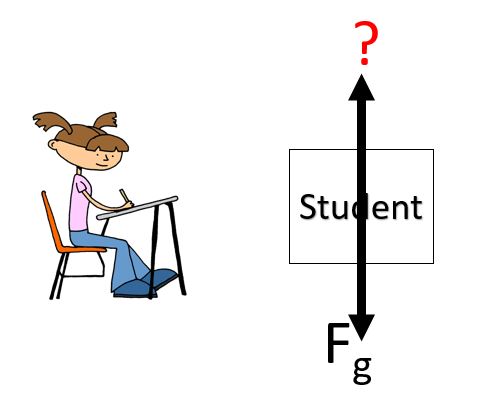
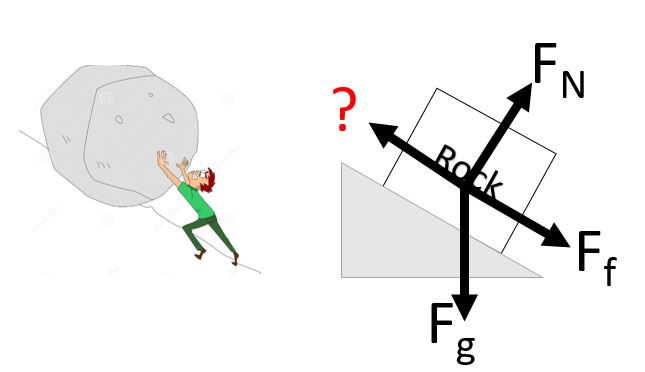

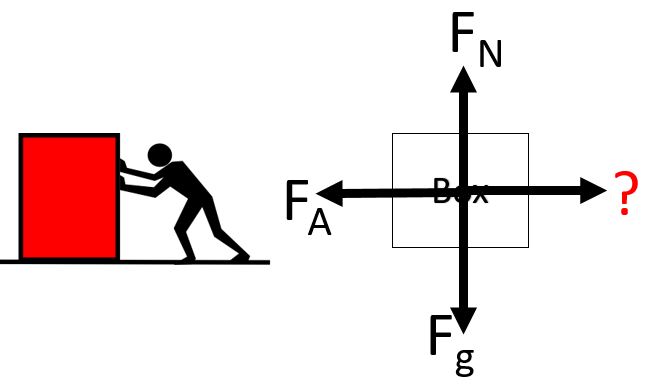

Whenever an object is moving, there is always this force opposing the motion:
inertia
momentum
friction
applied force
The force that keeps objects on top of surfaces instead of letting them sink into the surface is known as:
normal
abnormal
static
inertia
The force exerted by ropes and chains is called
tension
normal
elastic
mechanical
What symbol do we use to represent a "body" in a free-body diagram?
small dot
small figure
an outline of a human body
small triangle
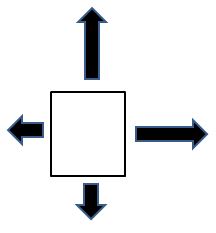
This object could be moving in which directions? (pick all that are correct):
Up
Down
Left
Right

When two forces act in the same direction, how would you calculate the net force?
Subtract the forces
Balance the forces
Add the forces
Divide the forces


What is the resultant force?
400 N, Up
400 N, Down
800 N, Up
800 N, Down

What is the resultant force?
17 N, Left
6N, Right
11N , Left
12N, Left

What is the resultant force?
40N, Left
40N, Right
0N, Balanced
75N, Right
The momentum of an object depends upon the object's ___________&_____________.
size and shape
mass and speed
mass and veloctiy
mass and energy
When the velocity of an object is doubled, its momentum
Which of the following is the formula for momentum?
p = mv
M = mv
F = ma
g = mc2
Which of the following is the unit for momentum?
kg·m/s
kg·m
kg·m/s2
Momentum has no unit.
What is the unit of impulse?
N/s
Kg.m/s
N.s
Kg.m/s and N.s
None of the above

Cart A is pulled with a 2 Newton force for 2 seconds, and Cart B is pulled with a 1 Newton force for 3 seconds. Which cart experiences the greatest impulse?
Cart B
Cart A
they are the same
A 5 N force is applied to a 3 kg ball to change its velocity from +9 m/s to +3 m/s. The impulse on the ball is ______ N s.
-2,5
45
10
-18

