
 Worksheets
Reproductive Quiz
Total questions: 39
Worksheet time: 31mins
Secreted by the cells of the testes; causes development of secondary sex characteristics in males.
testosterone
estrogen
luteinizing hormone
progesterone
Which part of the female reproductive system is the site of fertilization?
Uterus
Fallopian tube
Ovary
Cervix
It is the hormone secreted by the ovaries and responsible for the development of secondary sex characteristics in females such as the widening of hips and development of breasts.
estrogen
progesterone
testosterone
inhibin
In males, which is the correct pathway of sperms release?
Seminiferous tubules (testis)- Vas deferens - Epididymis - Urethra
Vas deferens - Seminiferous tubules (testis)- Epididymis - Urethra
Epididymis - Vas deferens - Seminiferous tubules (testis) - Urethra
Seminiferous tubules (testis)- Epididymis - Vas deferens - Urethra
The male and female reproductive systems are regulated by...
hormones
sex drive
number of chromosomes
heredity

What is the function of A & B?
A - transport gametes (eggs)
B - Produce eggs
A - produce eggs
B - transport gametes (eggs)
A - transport gametes (sperm)
B - produce sperm
A - produce sperm
B - transport gametes (sperm)
What is one difference between Meiosis and Mitosis?
Meiosis (4 different cells made)
Mitosis (2 identical cells made)
Meiosis (2 identical cells made)
Mitosis (4 different cells made)
Meiosis (offspring identical to parent)
Mitosis (offspring different from parent)
Meiosis (offspring have 46 chromosomes)
Mitosis (offspring have 23 chromosomes)
What is one difference between asexual and sexual reproduction?
Asexual (offspring different from parent)
Sexual (offspirng identical to parent)
Asexual (Slow reproduction)
Sexual (Fast reproduction)
Asexual (offspring no variation)
Sexual (offspring variation)
Asexual (more complicated)
Sexual (less complicated)
What is the main reproductive organ in females? What hormone does it secrete?
Testes: Estrogen
Testes: Testosterone
Ovaries: Estrogen
Ovaries: Testosterone
What is the main reproductive organ in males? What hormone does it secrete?
Testes: Estrogen
Testes: Testosterone
Ovaries: Estrogen
Ovaries: Testosterone
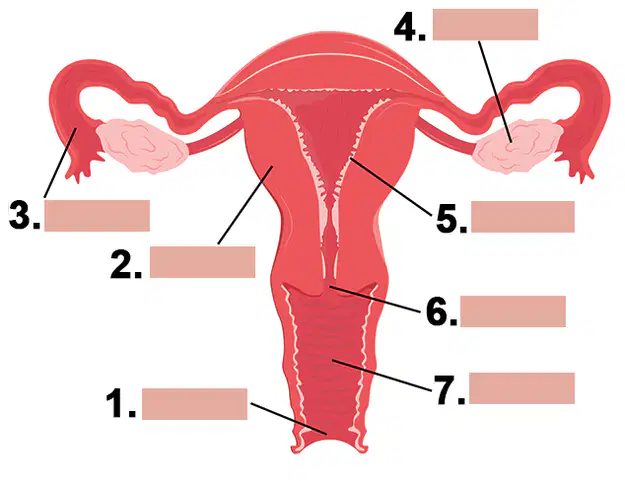
Which one is the fallopian tube?
7
4
3
6
Which one is the ovary?
7
4
3
6

Where does the following occur?
A) Meiosis?
B) Fertilization?
C) Growth & Development of Baby?
A) 5
B) 4
C) 3
A) 4
B) 5
C) 3
A) 3
B) 4
C) 5
A) 3
B) 5
C) 4

Why do each of these kittens look different?
Meiosis & Recombination/Crossing Over
Mitosis & Meiosis
Differentiation & Specialization
Fertilization & Mitosis

What is the role of LH during the menstrual cycle?
Causes ovulation and causes the ruptured follicle to develop into a corpus luteum
It stimulates the growth of the endometrium lining
Inhibits the development of another follicle by inhibiting FSH
Stimulates the development of follicles which in turn leads to estrogen secretion, which in turn inhibits FSH
What is the role of FSH during the menstrual cycle?
Causes ovulation and causes the ruptured follicle to develop into a corpus luteum
It stimulates the growth of the endometrium lining
Inhibits the development of another follicle by inhibiting FSH
Stimulates the development of follicles which in turn leads to estrogen secretion
What is the role of estrogen during the menstrual cycle?
Causes ovulation and causes the ruptured follicle to develop into a corpus luteum
It stimulates the growth of the endometrium lining, stimulating LH secretion
Stimulates the growth of the endometrium lining, but then inhibits LH & FSH
Stimulates the development of follicles which in turn leads to estrogen secretion

Where in the body is the source of FSH?
Ovary
Ovarian corpus luteum
Anterior pituitary
Pineal gland
Sexual reproduction is vital to the propagation of the Human race. Which of the following sequences represents the correct order of events in the formation of a human fetus?
Zygote → Blastocyst → Embryo → Fertilization
Fertilization → Zygote → Blastocyst → Embryo
Blastocyst → Embryo → Differentiation → Zygote
Fertilization → Growth → Differentiation → Zygote
Spermatogenesis (meiosis) is the process by which sperm develop and mature. Which of the following sequences correctly describes the anatomical path of spermatozoa from formation to ejaculation?
. testes, vas deferens, prostate, urethra
testes, urethra, prostate, vas deferens
prostate, vas deferens, testes, urethra
prostate, urethra, testes, vas deferens
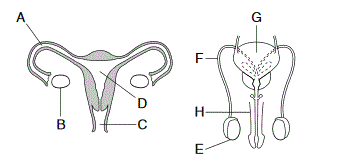
The diagram represents the reproductive systems of the human female and male. In which two structure are the gametes made
B and E
B and H
H and E
D and G
A fertilized egg undergoes several stages before it is implanted. In which of the following structure of the female reproductive system is the blastocyst (fertilized egg) implanted.
Ovary
uterus
vagina
amniotic sac
What is the role of LH during the Ovarian cycle ?
inhibits the development of another follicle by inhibiting FSH
causes ovulation and the ruptured follicle to develop into corpus luteum
stimulates the growth of endometrium
stimulates the development of follicles, which in turn leads to estrogen secretion, which in turn inhibits FSH
The two hormones that continue thicken and maintain the lining of the uterus are:
FSH and estrogen
LH and estrogen
estrogen and hCG
Progesterone and estrogen
Human somatic cells have
a haploid number of 46 chromosomes..
a diploid number of 46 chromosomes.
a haploid number of 23 chromosomes.
a diploid number of 23 chromosomes.
Ovulation is
when fertilization takes place.
when the sperm enters the egg.
when the egg is released from the ovary.
when the ovaries begin to develop egg cells.
What is the female gamete?
Ovary
Egg
Sperm
Epididymis
Where does a fertilized egg implant and develop into offspring?
Uterus
Fallopian tube
Vagina
Stomach
Sperm are created through meiosis in an area of the testes called the seminiferous tubules. Through which structure do the sperm travel to exit the testes, mix with seminal fluid, and reach the urethra?
Vas deferens
Seminiferous tubules
Scrotum
Epididymis
Which of the following describes fertilization?
Cell differentiation to form a blastula
Formation of germ layers in a deuterostome
Sperm joining an egg to form a zygote
Sperm and egg production
How can a blockage in a fallopian tube prevent pregnancy?
It prevents the ovary from releasing the egg
If prevents the egg from reaching the uterus
It prevents sperm from using flagella to move
It prevents sperm from passing through the cervix
The male gametes of the human reproductive system are called sperm cells. Where are sperm cells STORED after they are produced?
Prostate
epididymis
vas deferens
seminal vesicle
What is epididymis?
A set of coiled tubes that allow the growth and maturation of sperms.
A long tube that releases the sperms outside of the male's body.
A short tube that allows the sperms to move into the seminal vesicle.
The outer sex organ of male.
Trace the pathway of the egg cell from production to pregnancy.
Cervix > ovary > fallopian tube > uterus > vagina
Uterus > Ovary > fallopian tube > cervix > vagina
fallopian tube > Ovary > uterus > cervix > vagina
Ovary > fallopian tube > uterus > cervix > vagina
The hormone that is responsible for the male reproductive responsibilities and male secondary sex characteristics is
estrogen
FSH
LH
testosterone
The male gametes would not reach the male urethra or female reproductive system if there was a blockage in the
vas deferens
oviduct
pituitary gland
endocrine system
Sex cells have _________ the number of chromosomes as body cells.
double
a quarter
half
almost the same
The structure in males that help the testes regulate temperature is the
epididymus
vas deferens
prostate
scrotum
A zygote grows and divides through which type of cell division?
small
mitosis
meiosis
big

