
 Worksheets
Understanding Earthquakes and Faults
Total questions: 49
Worksheet time: 25mins
What is a fracture in the Earth’s crust where significant movement has taken place?
Earthquake
Fault
How are faults formed? Faults are formed______.
when volcanic activity pushes magma to the surface, causing the Earth’s crust to split and form fractures.
when stress from the movement of tectonic plates causes the Earth’s crust to bend and eventually break, creating a fracture where rocks can slide past each other.
Refer to the figure below; to explain how compressional stress produces a reverse fault?
pulling the two plates away from each other.
pushing or squeezing the two plates against each other.
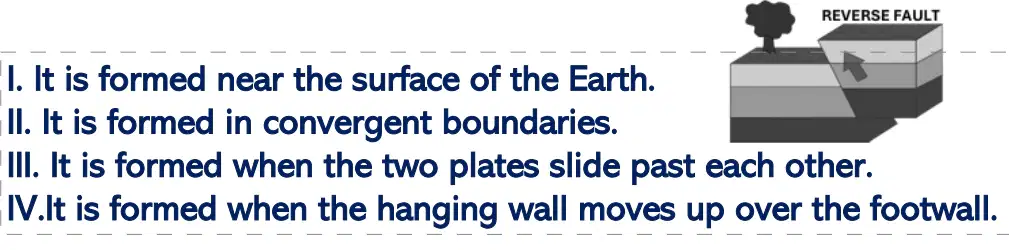
Consider the diagram below which shows the section of the Earth’s crust, and the arrow represents the movement of the tectonic plate. Which is TRUE in the formation of reverse fault?
I and II
II and III
II and IV
I and III
Refer to the illustration. Rocks deform plastically, and they tend to fold. What force squeezes rocks together that causes rocks to fold or break along faults?
Fault
Stress
What is the likely effect on rocks along a fault when they bend due to tectonic stress? The rocks will bend _______.
continuously without breaking, preventing any earthquake from occurring.
elastically, storing energy, but will eventually break and cause an earthquake when the energy is released.
In an area near a fault, scientists measure the movement of two large blocks of rock along the fault. Over many years, one block moves horizontally past the other block with little vertical movement. Which type of fault is most likely to be present in this area?


Why does a continuous movement along a fault cause an earthquake? There is a continuous movement along a fault cause an earthquake because the rocks_____.
suddenly move and kept on trembling.
are no longer moving and just stop adjusting its position.
An earthquake was detected in Nasugbo, Batangas with a magnitude of 4.1. The aftershocks are expected to be stronger than the main shock. Based on the diagram, what do you call Point A, where slip or sudden movement occur?
epicenter
focus
Which statements CORRECTLY describe the difference between the epicenter and the focus of an earthquake? The epicenter is the point ______ while the focus is ______.
where seismic waves travel fastest; the point where the earthquake is felt most strongly.
beneath the Earth’s surface where the energy is first released; the point on the Earth’s surface directly above the epicenter.
on the Earth’s surface where the earthquake starts; is the location deep beneath the surface where the energy is first released.
deep beneath the surface where the earthquake starts; the point on the Earth’s surface where the earthquake is felt most strongly.
Richter and Mercalli scales are the best-known logarithmic scales in measuring the magnitude and intensity of an earthquake. In line, which statement is correct about the difference between intensity and magnitude of an earthquake? Intensity ______while magnitude_____.
can cause earthquakes; can be caused by tsunamis.
is how strong or weak the shaking; measure the energy released.
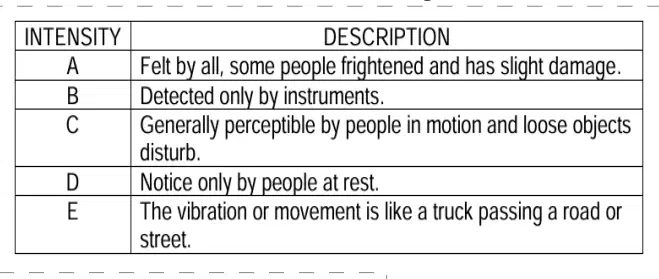
Using Roman numerals I to V, arrange the intensity scale of an earthquake from weakest to strongest.
I –B, II –D, III –E, IV –C, V –A
I – A, II – B, III – C, IV – D, V - E
Which statement BEST describes the difference between active and inactive faults? Active faults _____ while inactive faults ___ .
are areas where tectonic plates have stopped moving; are regions where movement continues to occur.
are faults that have experienced movement recently or are likely to experience movement in the future; have not moved for a long time and are unlikely to move again.
The local government is planning to build new infrastructure, including schools and hospitals, in an area that lies near both active and inactive faults. Considering the definitions of active and inactive faults, which type of fault poses a greater risk for earthquake-related damage, and why should this influence the government’s planning decisions?
Inactive Faults; because they are often overlooked and could be underestimated.
Active Faults: because they can generate earthquakes that may damage infrastructure.
What are the important items to keep in an emergency kit?
water
food
first aid kit
all of the above
Which is the MOST important reason for including water and non-perishable food in an emergency kit? Water and food are _____.
not necessary if you are evacuating to a shelter, as these items will be provided there.
important because they can help maintain energy and hydration until emergency services arrive or it is safe to leave the affected area.
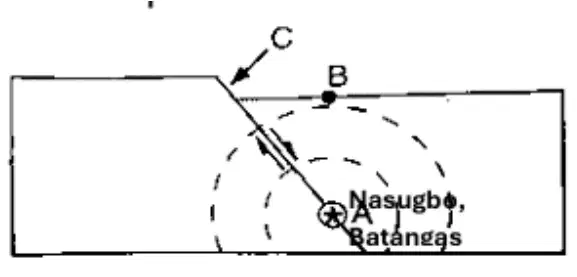
In the diagram what does letter A represent?
Focus
Epicenter
Which observations provides the BEST evidence that the outer core of the Earth is liquid?
S-waves travel faster than P-waves through the outer core, but both waves can pass through.
P-waves slow down but continue to travel through the outer core, while S-waves do not travel through it at all.
What kind of seismic wave disappears as the wave reaches the core?
P-wave
S-wave
What happens to the waves as they travel in the depth of the Earth?
P-Wave travels faster than S-Wave.
Waves travel through solids and liquids
Waves travel slowly through liquids than solids
S-Wave travels slower than P-Wave, not transmitted by liquids (or other fluids)
Which shows the correct properties of the indicated seismic waves?
Primary waves – known as P-waves, travel through solids, liquids, and gases
Secondary waves – known as S-waves, travel through solids only, and travel in a side-to side motion
Surface waves – known as L-waves, travel through earth surface, they can travel like the waves travel in the ocean, up and down
It explains how seismic waves behave as they travel through the Earth's layers.
S-waves can travel through both the solid and liquid layers of the Earth, while P-waves can only travel through solids.
P-waves can travel through both the solid mantle and the liquid outer core, but S-waves can only travel through the solid mantle and cannot pass through the liquid outer core.
How do body waves (P-waves and S-waves) help scientists understand the structure of the Earth's layers?
P-waves travel only through the Earth’s mantle, while S-waves travel only through the Earth’s core, allowing scientists to determine the composition of each layer.
P-waves travel through both solids and liquids, but S-waves can only travel through solids, providing evidence that the Earth’s outer core is liquid, as S-waves do not pass through it.
Tropical cyclone is rapidly rotating storm system characterized by the following EXCEPT _____.
Heavy rains
High –pressure center
Strong winds
Thunderstorm
Where does a typhoon usually form and develop?
mostly in ocean with warm and moist air
in area where is near the Pacific Ring of Fire
What is the correct sequence of the formation of typhoon?
I. Typhoons start off as tropical thunderstorms. II. The strong winds pull in moisture from the oceans. III. All the heat and air flow toward the eye creating the typhoon. IV. The thunderstorms convert moisture into heat. The heat causes more air to flow to the center of the storm causing evaporation
II, I, III, IV
Which statements CORRECTLY describe the wind speed and air pressure in different parts of a typhoon? The eye of the typhoon has the ___while the eye wall has the ____.
highest wind speeds and the lowest air pressure; has the lowest wind speeds and the highest air pressure.
the lowest wind speeds and the highest air pressure; has the highest wind speeds and the lowest air pressure.
Which part of the typhoon where wind speed is greatest?
eye
eyewall
From the illustration below, where can you find the lowest air pressure?
eye
tail
eyewall
rain bands
When a tropical cyclone passes over a certain place it is the ________ that has greater wind speed.
Eye
Direction
Eye wall
Rainbands
Landmasses and bodies of water are affected by typhoon. Which of these differentiates the characteristics of landmasses and bodies of water? Landmasses ________.
strengthen typhoon while bodies of water disrupt the spin of a typhoon.
disrupt the spin of a typhoon while bodies of water strengthen typhoon.
What will happen to a typhoon that strikes an island?
It loses most of its energy source.
Its circulation will breakdown.
It continues to get stronger.
It dissipates entirely because there is not enough energy to sustain it.
Which statement is INCORRECT about tracking typhoons?
It involves using a single weather instrument to predict its strength and movement.
It involves predicting the movements of typhoon within 5 to 7 days, and in 6 to 12 hours whenever there is a storm.
Based on the given coordinates, what is the most likely direction the typhoon is moving? The typhoon is moving __.
eastward (towards the east).
northward (towards the north).
Which coordinates show that a tropical cyclone is not within the PAR?
16°N 122°E
15°N 138°E
Based on the figure, the tropical cyclone is within PAR if the area is covered/bounded by the imaginary line connecting coordinates such as________ .
25°N 120°E, 25°N 135°E, 5°N 135°E, 5°N 115°E, 15°N 115°E, 21°N 120°E
20°N 120°E, 25°N 135°E, 5°N 135°E, 5°N 115°E, 15°N 115°E, 21°N 120°E
It is the agency that oversees the tracking of the movement and strength of a typhoon once it enters PAR.
National Disaster Risk Reduction and Management Council (NDRRMC)
Philippine Atmospheric, Geophysical and Astronomical Services Administration (PAGASA)
What would be the consequence of an incorrect prediction of typhoon?
People would have no time to prepare for the danger that the typhoon would bring.
There would be massive destruction of properties and lives of the people in the affected area.
Aside from keeping our family safe, what is the MOST important thing that we need to prepare?
If your house is not strong enough to withstand the storm's intensity, you should either evacuate voluntarily or follow evacuation orders from local authorities.
Prepare an "emergency kit" that includes essential items such as non-perishable food, water, medication, a first-aid kit, flashlights, batteries, and important documents.
What to do during a typhoon?
Stay inside the house.
Always keep yourself updated with the latest weather report.
Do not wade through flood waters to avoid being electrocuted and contracting disease.
If there is a need to move an evacuation center, follow these reminders.
Based on the illustration, which describe as an object made of ice, gas, and dust that orbits the Sun?
Asteroids
Comets
These are huge chunks of rock and metal (some measuring miles wide) and are believed to be left-over pieces of planets and moons are called_____.
Asteroids
Comets
A meteor is observed entering Earth's atmosphere and burning up, creating a streak of light across the sky. Based on what you know about space objects, what can you conclude about the composition of this meteor? The meteor is ________.
likely made of ice and dust.
probably made of rock or metal.
When does comet have the longest tail and largest coma? When _______.
nearest the sun
away from the sun
What happens to a comet, meteor, and asteroid as it enters the Earth’s atmosphere?
Burns up upon entering Earth's atmosphere, creating a streak of light in the sky.
It heats up due to friction with the air, causing it to glow brightly in the sky.
The meteoroid glow brightly, and a meteor appears as it passes through the Earth’s atmosphere.
When meteoroids enter Earth's atmosphere at high speed and burn up, the fireballs or “shooting stars are produced.
How have comet and asteroid impacts affected the evolution of life on Earth?
Craters will form, and extinction of species will happen.
This would result in an increase in rain resulting in landslides and mudslides.
If the asteroid hits Earth, there would be a huge amount of dust thrown up into the atmosphere.
All the above.
Which will MOST likely happen when a comet or asteroid hits the Earth?
Plants and animals grow abundantly in the crash site.
Plants and animals will be affected near or on the crash site.
When will be the next appearance if Comet Benneth known as C/1969 Y1 appeared on Earth on the 20th of March 1970 and its orbital period is 1,678 years?
3846 years
3648 years
But why do scientists study these objects? It is because they _______.
want to examine the mineral contents
want to study the origin of the Earth and other planets

