
 Worksheets
Unit 6 Review - Ecosystem Dynamics & Reproduction
Total questions: 69
Worksheet time: 1hrs 11mins

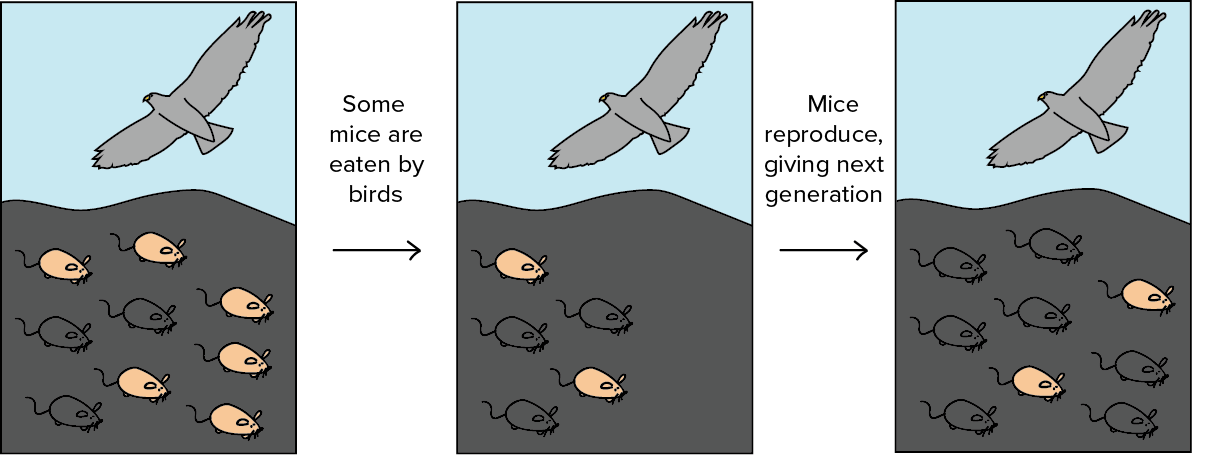
Why is the mouse population changing over time? (You can enlarge the picture by placing your cursor on it.)
The light mice can reproduce more successfully than the dark mice
The hawks eat more dark mice than light mice because the dark mice taste better
The hawks eat more light mice than dark mice because they can see the light mice more easily
The hawks eat more dark mice than light mice because they can see the dark mice more easily
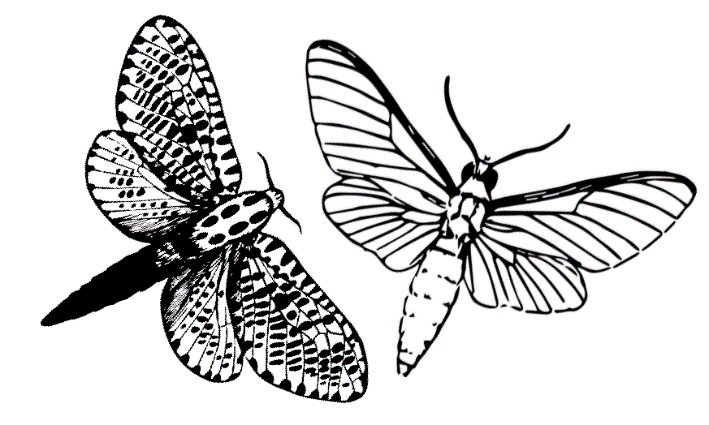
According to natural selection, light colored tree trunks would favor ___________________________.
light colored moths
dark colored moths
red colored moths
red and light colored moths
If a new trait DOES help an organism survive, what may happen to it?
It dies and its DNA is not passed on
It survives and its DNA is passed on
It changes its traits to adapt and survive
What is natural selection?
a living individual that can carry out life processes
Process by which an organism that better adapts to their environment survive and reproduce
Process by which a community better adapts to their environment to give traits to one another within their generation.
the time between when an organism is born and when they reproduce
What is the ultimate source of energy in any food chain?
the sun
producers
consumers
decomposers
Which of the following is an abiotic factor?
grass
lizard
rock
grasshopper
All the nonliving things in an environment are called the ________ factors.
abiotic
biotic
ecological
inorganic
What is an example of a biotic factor?
water
grass
soil
sunlight

If a disease strikes the snake population in the food chain shown, what will be the initial effect on the populations of hawks and rabbits?
The populations of hawks and rabbits will decrease.
The populations of hawks and rabbits will increase.
The population of hawks will increase. The population of rabbits will decrease.
The population of hawks will decrease. The population of rabbits will increase.

In the stable food chain shown here, what would you expect to happen initially if you were to suddenly double the population of rabbits?
The populations of the other three species would also increase.
The populations of the other three species would decrease.
The grass population would decrease. The snake population and hawk population would increase.
The grass population and hawk population would decrease. The snake population would increase.

What event within the food chain might lead to the graph shown below?
A disease in the population of rabbits.
A disease in the population of snakes.
A disease in the population of hawks.
It is impossible to tell which of the above occurred.
What happens when the number of producers shrinks?
The number of consumers increase.
The number of decomposers increase.
The number of consumers decrease.
The number of producers increase.
A(n) __________ includes all biotic and abiotic factors in an environment.
population
niche
abitotic
ecosystem
What is an ECOSYSTEM?
The highest number of things that can stay alive in an area.
All living things in an ecosystem.
An area, on land or in water, that contains living and non-living organisms which function together.
All non-living things in an ecosystem.
Something that limits the number of living things that can be in one ecosystem.
Identify the two BIOTIC factors from the list.
Bacteria
Rocks
Sunlight
Worms


What do the arrows BEST represent in this diagram?

What would happen if their were no producers?
Every population would grow larger
Everything would die out
The animals would make their own food

Which letters should replace the ??
aa
AA
Aa

Which letters should replace the ??
DD
dD
dd
Dd

Which letter should replace the ?
r
R
Rr
RR

Which letter should replace the ??

Which letter should replace the ??
ff
FF
Ff

Which letter should replace the ??
Nn
nn
NN

Based on the Punnett Square, what are the possible genotypes of the offspring?
Bb and bb
bb, Bb, and bb
bb only
Bb only

Based on the Punnett Square, what are the odds of an offspring having a recessive white flower?
1/4 or 25%
2/4 or 50%
3/4 or 75%
4/4 or 100%

Based on the Punnett Square, what are the odds of an offspring having a dominant purple flower?
1/4 or 1:4
2/4 or 2:4
3/4 or 3:4
4/4 or 4:4

Based on the Punnett Square, what are the genotypes of the parents?
Aa x Aa
AA x aa
Aa x AA
Aa x aa

What are the odds of the offspring showing the dominant trait?
100%
0%
50%
Combining of egg and sperm
Asexual Reproduction
Sexual Reproduction
Diverse
Uniform
Involves only one parent
Asexual Reproduction
Sexual Reproduction
Diverse
Uniform
Only one parent needed
Sexual Reproduction
Asexual Reproduction
Greater genetic diversity
Sexual Reproduction
Asexual Reproduction
Variety allows for more adaptability
Sexual Reproduction
Asexual Reproduction
Can produce more offspring faster
Sexual Reproduction
Asexual Reproduction
Offspring are identical to parent
Sexual Reproduction
Asexual Reproduction
Egg cells and sperm cells used
Sexual Reproduction
Asexual Reproduction
Offspring gets 100% of the DNA from one parent
Sexual Reproduction
Asexual Reproduction
Offspring gets 50% of its DNA from each parent
Sexual Reproduction
Asexual Reproduction
is a type of reproduction that requires only one parent. The resulting offspring are
identical to the parent.
Asexual reproduction
Sexual Reproduction
Nonsexual Reproduction
none of these answers
takes longer to reproduce offspring
sexual reproduction advantage
asexual reproduction advantage
sexual reproduction disadvantage
asexual reproduction disadvantage
Allows for diversity and evolution of a species
sexual reproduction advantage
asexual reproduction advantage
Increases genetic variation within a species
Sexual Reproduction Advantage
Asexual Reproduction Advantage
The end result of meiosis is...
4 identical cells
4 genetically different cells
2 identical cells
2 genetically different cells
Timmy fell off his skateboard and scraped his knee. Which cell process is going to be used to heal the wound?
Mitosis
Meiosis
The wound would not heal
Cell diffusion
How many chromosomes do humans have?
23
46
50
92
Main purpose is to produce sex cells
mitosis
meiosis
both
Produces identical copies of the parent
mitosis
meiosis
both

What type of cell reproduction is happening here?
Mitosis
Meiosis

What type of cell reproduction is happening here?
Mitosis
Meiosis

Organisms, like bacteria, fungi, insects and worms, that break down waste are called _____________.
carnivore
herbivores
decomposers

In an ecosystem, decomposers break down _______________.
worms and insects
wastes and dead things

An oak tree is an example of a


These worms are acting as...
producers
consumers
decomposers
omnivores
In a trophic or energy pyramid, most of the energy between trophic levels (100%, 10%, 1%, 0.1%, etc...)
is lost as ______________.
heat
cold
microplasticisty
meiosis
Which of the following is an example of natural selection?
A flood randomly kills a large portion of a population
A mutation occurs in a single individual
Individuals with advantageous traits reproduce more successfully
A population migrates to a new habitat
Which of the following is a greenhouse gas?
The Greenhouse Effect:
Traps all of the heat from the Sun
Repels sunlight away from the atmosphere
Traps some heat and releases some heat back to space
Only happens in the summer months
Human activities are __________________ the levels of the greenhouse gases in the atmosphere.
increasing
decreasing
maintaining
fluctuating

Which organism do the owl and the weasel compete for in the food web?
Hawk
Spider
Grasshopper
Shrew

In the energy pyramid below, which organism has the most amount of energy available?
Producers
Herbivores
Carnivores
Top Predator

